An AI based OCR solution helps businesses convert scanned documents, PDFs, and images into structured data, reducing manual data entry and streamlining document processing. However, choosing the best AI based OCR solution requires more than comparing text recognition capabilities. Businesses must also consider field-level accuracy, data validation, security, system integration, and human review.
In this article, DIGI-TEXX will help you understand how AI-powered optical character recognition works, explore its business applications, and evaluate the key factors for implementing a reliable document-processing solution, whether you are assessing enterprise platforms or exploring an AI based OCR solution free for basic document conversion.
What Is An AI-Based OCR Solution?
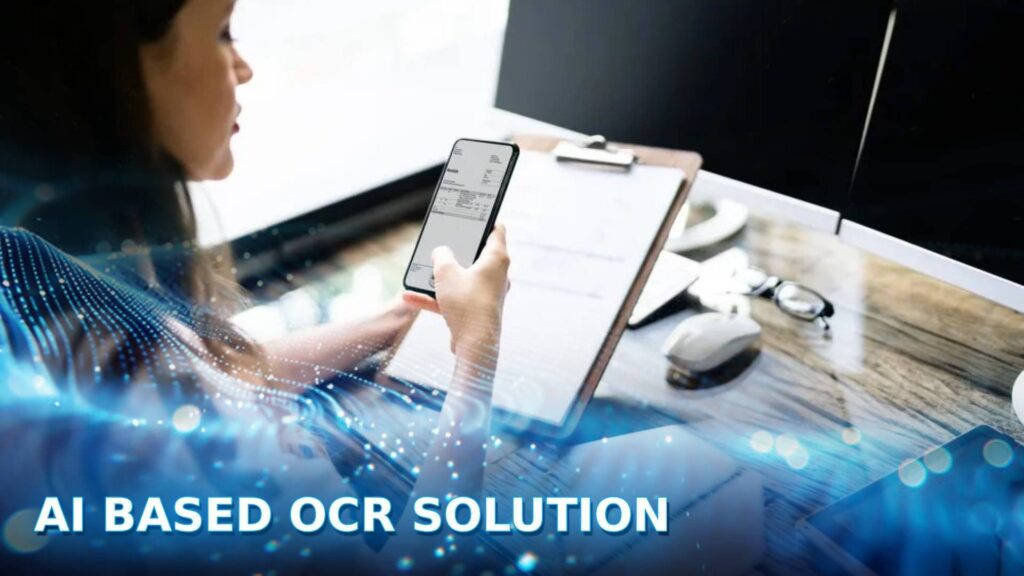
An AI based OCR solution is a document-processing technology that combines Optical Character Recognition (OCR) with machine learning, computer vision, and other AI techniques to recognize text, understand document content, and extract relevant information into structured data.
Traditional OCR primarily converts text from scanned documents or images into machine-readable content. An AI based OCR solution goes beyond character recognition by analyzing the context, position, relationships, and structure of information within a document. This enables the system to identify not only what the text says, but also what each piece of information represents.
For example, when processing an invoice, traditional OCR may recognize the text “Invoice No. 12345” as readable characters. An AI-based OCR system can go further by identifying 12345 as the invoice number, linking it to the appropriate field, and extracting other relevant information such as the invoice date, vendor name, line items, and total amount as structured data.
This capability is particularly valuable for businesses processing documents with different templates, layouts, languages, image qualities, or handwritten content. Instead of relying solely on fixed document patterns, AI-powered OCR can adapt to more complex document structures and support automated data extraction at scale.
>>> See more:
- Insurance Back Office Support Services for Insurers & Agencies
- Data Labeling Service: Benefits, Top Providers & How to Choose
- Back Office Support Services For Streamlined & Efficient Operations
How AI-Based OCR Works
An AI-powered OCR workflow generally involves several stages:
- Document capture: The system receives scanned documents, PDFs, images, or other supported files.
- Image preprocessing: The document may be enhanced through operations such as image cleanup, rotation correction, noise reduction, or resolution optimization.
- Text recognition: OCR models identify characters, words, lines, and other textual elements.
- Layout and structure analysis: AI models identify relationships between text blocks, tables, fields, headers, and other document elements.
- Data extraction: Relevant information such as invoice numbers, dates, names, addresses, totals, or policy numbers is converted into structured fields.
- Validation: Extracted information can be checked against confidence thresholds, business rules, or related data.
- Exception handling: Low-confidence or inconsistent results can be routed for human review.
- System integration: Validated data can then be transferred into business applications or downstream workflows.
Modern OCR systems can recognize both printed and handwritten text, while document-oriented AI can also identify paragraphs, lines, words, locations, and languages. This demonstrates why an AI based OCR solution should be evaluated as more than a simple text-recognition engine.
The quality of the input remains important. For example, a 2025 CDC evaluation of handwritten maternal-death review documents found that publicly available OCR tools still produced substantial errors on handwritten material, showing that handwriting remains a challenging OCR use case.
AI-Based OCR vs. Traditional OCR vs. IDP
Although these technologies overlap, they serve different purposes.
| Technology | Primary purpose | Typical capabilities |
| Traditional OCR | Convert images into machine-readable text | Character and word recognition |
| AI-based OCR | Recognize and extract information using AI | Text recognition, handwriting, layout analysis, field extraction, contextual processing |
| Intelligent Document Processing (IDP) | Automate document understanding and downstream processing | Classification, OCR, extraction, validation, workflow automation, integration |
OCR can be considered a foundational component of broader document-processing systems. An IDP workflow may use OCR to obtain text and then apply additional AI models to understand document structure, relationships, entities, and business information.
Therefore, an AI based OCR solution is often suitable when the primary requirement is intelligent text and data extraction, while a broader IDP platform may be more appropriate when the business needs end-to-end document classification, validation, workflow routing, and automation.
Key Capabilities Of AI-Based OCR Solutions
The best AI based OCR solution for a business should do more than convert scanned pages into editable text. It should be able to extract useful information from documents and deliver that information in a format that downstream systems can use.
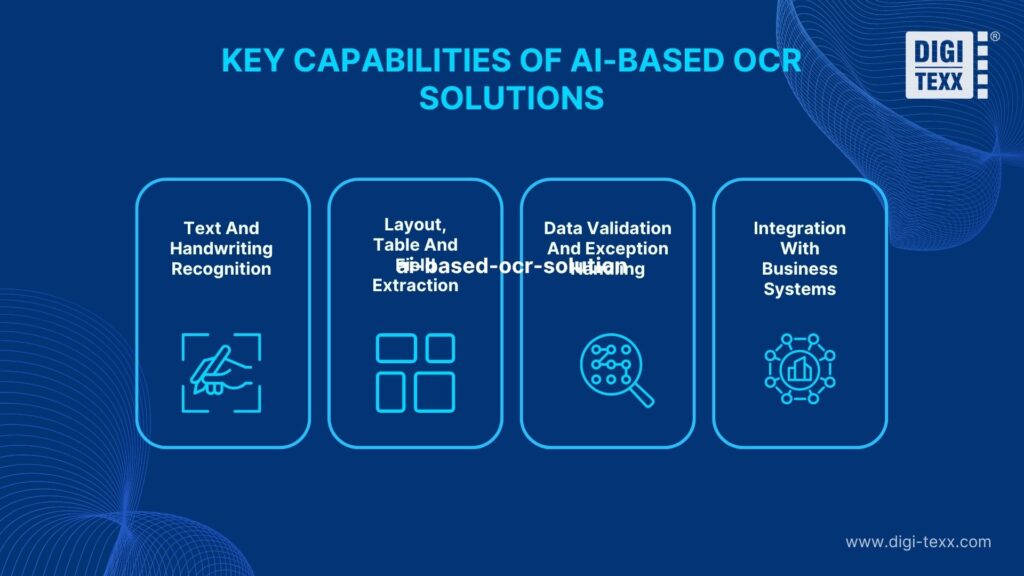
Text And Handwriting Recognition
AI OCR can recognize printed text across different document types and, depending on the model and use case, handwritten content as well.
This is important for businesses that process forms, applications, medical records, claims, signatures, or handwritten annotations. However, handwriting recognition should not be treated as universally accurate. Document quality, writing style, language, image resolution, and context can significantly affect results.
A 2025 CDC evaluation illustrates this limitation: when several OCR tools were tested on handwritten documentation, the best-performing tool still produced 30% nonsense overall in the preliminary evaluation.
This is why enterprise AI OCR workflows often benefit from confidence scoring and human review rather than assuming every extracted value is correct.
Layout, Table And Field Extraction
Recognizing individual characters is only the first step in document automation.
Business documents often contain:
- Tables and line items
- Key-value pairs
- Headers and footers
- Multiple columns
- Addresses
- Dates and monetary values
- Forms and checkboxes
- Different sections within the same document
An AI based OCR solution can analyze these elements in relation to one another. Instead of returning a block of text, the system can identify which value belongs to which field.
For example, an invoice-processing workflow may extract:
| Field | Example |
| Invoice number | INV-10245 |
| Invoice date | 10/15/2026 |
| Vendor | ABC Supplies |
| Subtotal | $4,500 |
| Tax | $450 |
| Total | $4,950 |
This structured output is much more valuable for automation because it can be passed directly into accounting or ERP workflows.
>>> Explore more:
- Ecommerce Back Office Support Services By DIGI-TEXX
- Professional E-commerce Data Entry Services by DIGI-TEXX
Data Validation And Exception Handling
OCR output should not automatically be treated as verified business data. An enterprise AI OCR solution can use confidence scores, validation rules, field-level checks, or cross-document comparisons to identify potentially incorrect results.
For example:
- An invoice total does not match the sum of line items.
- A purchase order number cannot be found in the ERP.
- A date uses an unexpected format.
- A required field is missing.
- A handwritten value has low recognition confidence.
These cases can be sent to a human reviewer instead of continuing automatically. This approach is important because OCR accuracy varies considerably depending on the document and evaluation method. A systematic review of data-processing methods found optical scanning error rates ranging from 2 to 358 errors per 10,000 fields, demonstrating why validation and quality control remain important even when OCR is used.
Integration With Business Systems
An AI based OCR solution becomes more valuable when extracted data can move directly into existing business processes.
Common integration targets include:
- ERP systems
- CRM platforms
- Document management systems
- Accounting software
- Claims management platforms
- Data warehouses
- Workflow applications
For example, an invoice can be captured, processed, validated, and transferred into an accounts payable workflow without requiring employees to manually re-enter every field.
Integration can therefore turn OCR from a standalone recognition tool into a component of a broader document automation process.
Benefits Of AI-Based OCR For Businesses
AI OCR can create operational value when it is applied to document-heavy processes with repetitive data extraction requirements.
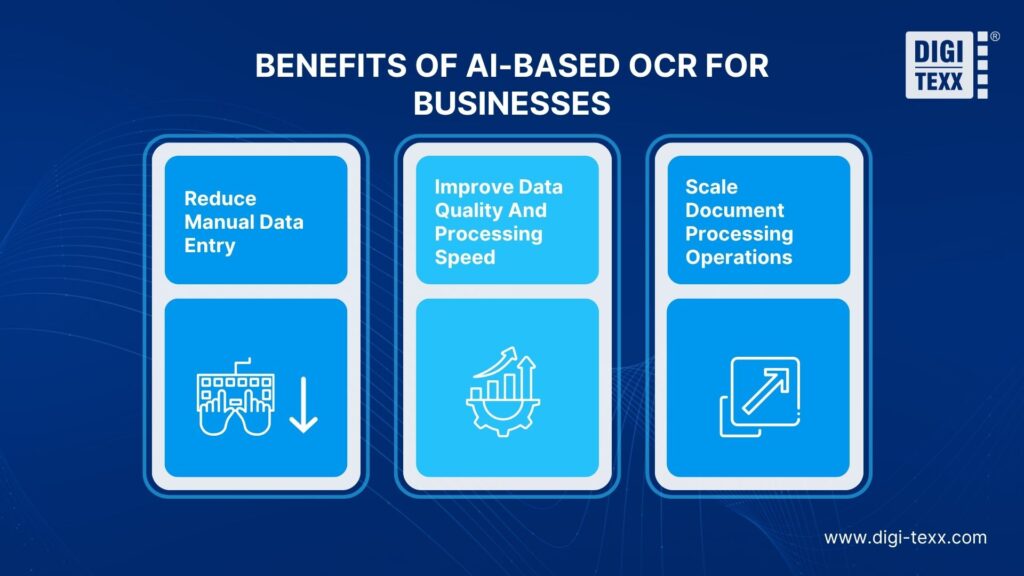
Reduce Manual Data Entry
Manual document processing requires employees to read documents, locate relevant fields, enter information, and verify the results.
Automating these repetitive steps can reduce the amount of manual data entry required and allow employees to focus on exception handling and higher-value activities.
The potential time savings can be significant in suitable workflows. In a 2025 multicenter clinical study, an OCR-based data-entry system reduced average data-entry time from 6.0 minutes to 3.4 minutes per patient, representing a mean reduction of 43.9% in the study environment. The system also achieved 96.9% overall data accuracy across 1,018 evaluated data points.
These results should be interpreted as study-specific rather than as a guaranteed performance level for every AI OCR implementation.
Improve Data Quality And Processing Speed
Manual data entry introduces opportunities for transcription errors, missing fields, inconsistent formats, and delays.
An AI based OCR solution can standardize the initial extraction process and apply validation rules before information enters downstream systems.
However, businesses should avoid treating a single “accuracy percentage” as the complete measure of OCR performance. Accuracy may refer to character recognition, field extraction, document classification, or end-to-end processing.
A better evaluation considers:
- Character or word recognition accuracy
- Field-level extraction accuracy
- Precision and recall
- Document classification accuracy
- Exception rate
- Straight-through processing rate
- Human-review rate
This gives decision-makers a more realistic understanding of the solution’s operational performance.
Scale Document Processing Operations
Manual processing becomes increasingly difficult as document volumes grow.
An AI based OCR solution can process large numbers of documents without requiring a proportional increase in manual data-entry resources. This can help organizations manage seasonal peaks, acquisitions, large document backlogs, or expanding operations.
Scalability should still be tested using the company’s actual document types. A system that performs well on clean, standardized invoices may behave differently when processing low-quality scans, handwritten forms, complex tables, or multi-document PDFs.
>>> See more:
- Document Indexing Services For Efficient Search & Data Access
- Outsourced Order Processing Services – Fast & Accurate
- Intelligent Document Processing Services: How It Works & Business Benefits
AI-Based OCR Use Cases Across Industries
AI OCR is particularly valuable in industries where employees regularly extract structured information from large volumes of documents.
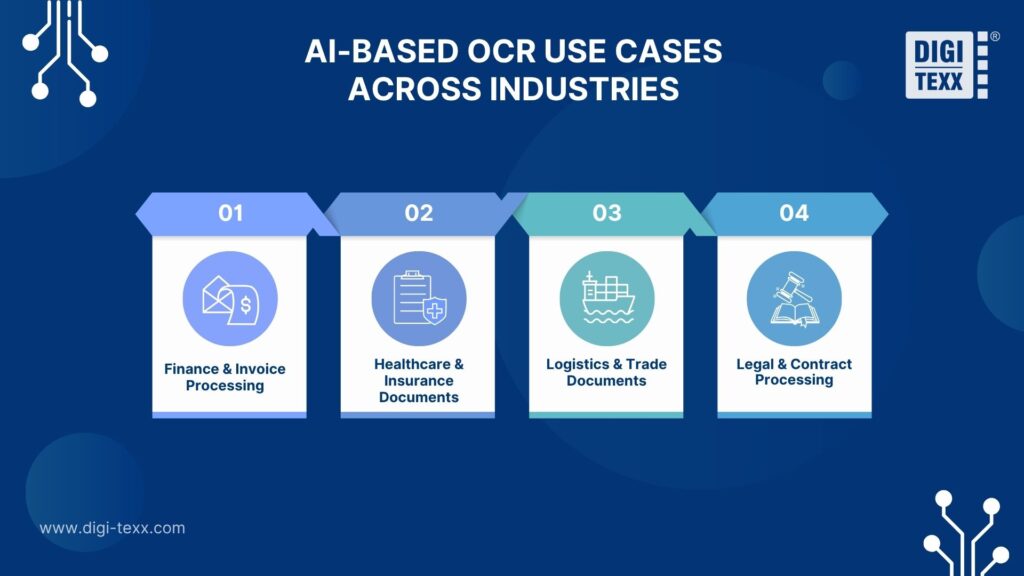
Finance And Invoice Processing
Finance teams can use AI OCR to process invoices, receipts, purchase orders, bank statements, expense records, and other financial documents.
An invoice-processing workflow may extract:
- Invoice number
- Vendor name
- Invoice date
- Purchase order number
- Tax information
- Line items
- Subtotal
- Total amount
The extracted information can then be validated against business rules or related records before entering an accounts payable workflow.
For organizations processing high invoice volumes, this can reduce repetitive data entry while improving processing consistency.
Healthcare And Insurance Documents
Healthcare organizations handle a wide range of documents, including patient records, medical forms, insurance claims, referrals, and clinical documentation.
AI OCR can help convert scanned or image-based information into structured data for subsequent processing. Healthcare documents can be particularly challenging because they may contain handwriting, abbreviations, medical terminology, tables, and sensitive information.
A recent clinical study demonstrates the potential of OCR-based workflows in healthcare data entry, while also showing why accuracy and validation need to be measured under real operating conditions.
For insurance, OCR can support the extraction of information from claim forms, accident reports, invoices, medical records, and supporting documentation.
Logistics And Trade Documents
Logistics operations depend on documents such as:
- Bills of lading
- Delivery notes
- Customs documents
- Commercial invoices
- Packing lists
- Shipping forms
An AI based OCR solution can extract shipment numbers, container information, addresses, dates, quantities, and other operational data from these documents.
Because logistics documents can vary significantly between suppliers, countries, and document formats, the ability to process variable layouts is particularly important.
Legal And Contract Processing
Legal departments manage large volumes of contracts, agreements, case files, forms, and supporting documents.
AI OCR can help convert scanned contracts and documents into searchable and structured information. Depending on the broader document-processing workflow, extracted information can include:
- Contract parties
- Effective dates
- Expiration dates
- Contract numbers
- Monetary amounts
- Specific clauses or terms
For large document collections, OCR can provide the machine-readable foundation required for subsequent search, classification, extraction, and document analysis.
How To Evaluate An AI-Based OCR Solution
Choosing the best AI based OCR solution should not be based solely on a product demo or a headline accuracy percentage. The most appropriate solution is the one that performs reliably on the organization’s actual documents and fits its operational, security, and integration requirements.
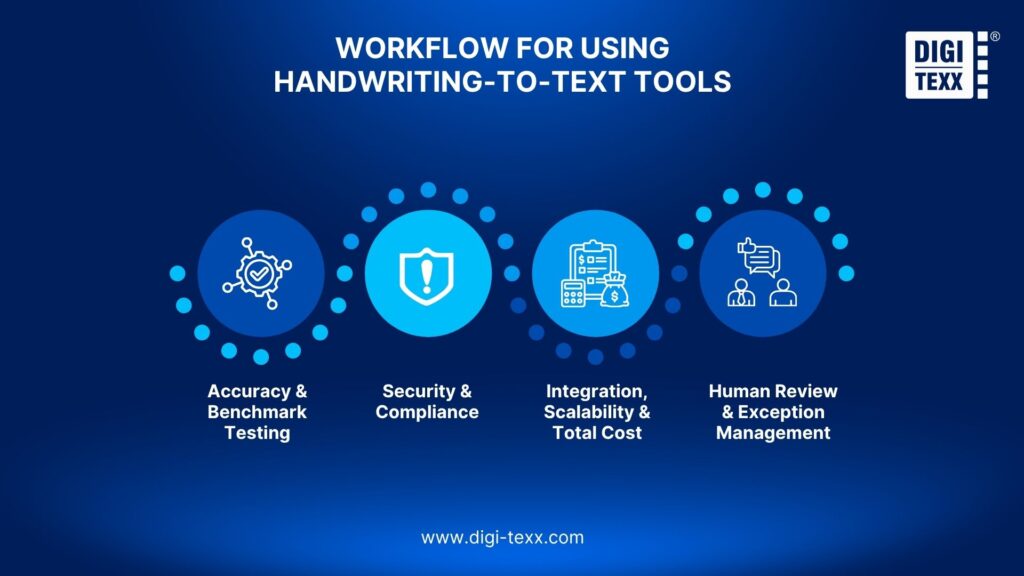
Accuracy And Benchmark Testing
Ask vendors to evaluate the system using representative business documents rather than generic samples.
A useful benchmark should include different:
- Document layouts
- Image qualities
- Languages
- Fonts
- Handwriting styles
- Table structures
- Document lengths
- Document types
Measure the results at the field level whenever possible.
For example, if an invoice contains 20 important fields, evaluate how many fields are extracted correctly rather than simply asking whether the document was “processed successfully.”
This approach matters because OCR performance can vary significantly according to document quality and processing conditions. The Library of Congress specifically notes that small fonts, unusual text styles, markings, and poor-quality originals can reduce OCR accuracy.
Security And Compliance
Document-processing systems may handle financial, healthcare, customer, employee, or legal information.
Before selecting an AI based OCR solution, evaluate:
- Data encryption
- Access controls
- Data retention policies
- Data deletion procedures
- Deployment options
- Auditability
- Compliance requirements
- Data residency requirements
Organizations should also determine whether sensitive documents are processed in a cloud environment, on-premises environment, private infrastructure, or a hybrid architecture.
Security should be evaluated alongside OCR capability rather than treated as a separate consideration after implementation.
Integration, Scalability And Total Cost
The lowest software price does not necessarily represent the lowest total cost.
Businesses should evaluate:
- API availability
- Integration effort
- Processing volume
- Infrastructure requirements
- Licensing or usage fees
- Implementation costs
- Maintenance
- Human-review costs
- Exception handling
- Support requirements
Scalability should also be tested using realistic volumes. A solution that works effectively for several hundred documents may require different infrastructure or pricing considerations at millions of pages.
Human Review And Exception Management
One of the most important considerations when choosing an AI OCR system is how it handles uncertainty.
Instead of forcing every extracted value through an automated workflow, the system should be able to identify low-confidence results and route them for review.
A practical workflow may look like:
Document → AI OCR → Field extraction → Confidence check → Validation → Human review when required → Business system
This hybrid model can provide a better balance between automation and accuracy than attempting to eliminate human involvement entirely.
The need for human review is supported by real-world OCR research. Studies have shown that OCR performance can vary substantially depending on document type, image quality, handwriting, software configuration, and validation methods.
>>> See more:
- Healthcare BPO Services For Revenue Cycle & Claims Management
- How To Prepare a Classified Balance Sheet: Template & Example
- Best Business Process Automation Solutions & Tools 2026
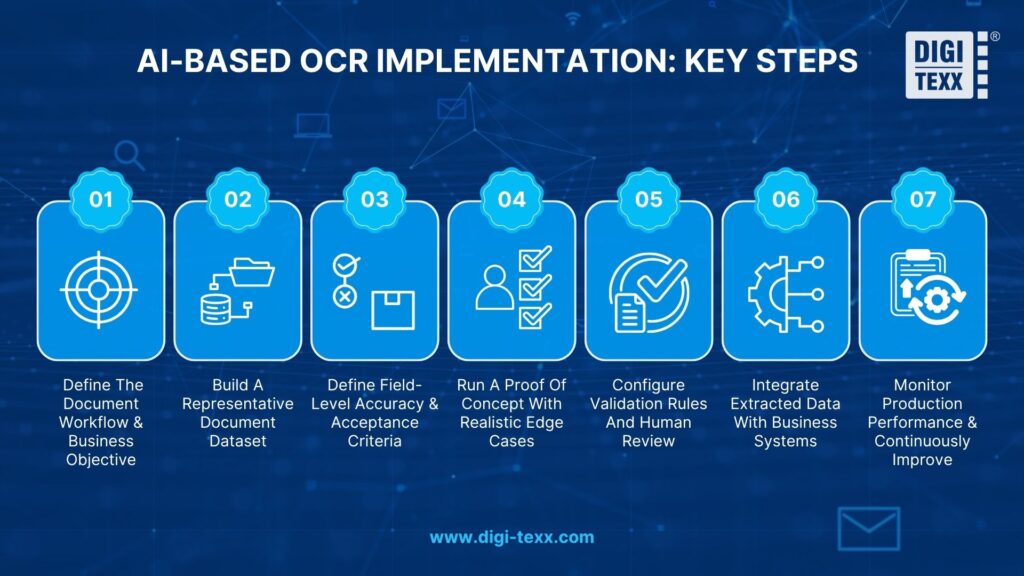
AI-Based OCR Implementation: Key Steps
Implementing an AI based OCR solution should begin with the business process rather than the technology.
1. Define The Document Workflow And Business Objective
Start by identifying where document processing creates measurable operational costs, rather than selecting an OCR technology first.
For each target workflow, assess:
- Monthly document volume and peak-period volume
- Average manual processing time per document
- Number of fields requiring manual entry
- Document types and template variations
- Percentage of documents requiring manual review
- Existing systems used for validation and storage
- Cost of data-entry errors and processing delays
For example, an invoice-processing workflow may involve document classification, vendor identification, invoice-number extraction, line-item extraction, tax validation, duplicate checking, approval, and ERP entry. An AI based OCR solution should therefore be evaluated against the entire workflow, not OCR character recognition alone.
2. Build A Representative Document Dataset
OCR performance depends heavily on the documents being processed. Testing only clean, standardized samples can produce misleading results.
A representative dataset should include variations such as:
- Different document templates and layouts
- Scanned documents and digital PDFs
- Different resolutions and image qualities
- Rotated, skewed, cropped, or partially damaged pages
- Multiple languages and character sets
- Tables, multi-column layouts, and complex forms
- Handwritten fields where applicable
- Documents containing stamps, signatures, logos, or annotations
The dataset should also contain enough samples to represent real production variability. For example, if a business receives invoices from hundreds of suppliers, testing against five standardized invoice templates is unlikely to provide a reliable estimate of production performance.
3. Define Field-Level Accuracy And Acceptance Criteria
Overall OCR accuracy can hide problems with individual fields. Businesses should therefore define accuracy at the field and workflow level.
Depending on the use case, relevant metrics may include:
- Character accuracy: How accurately individual characters are recognized
- Field-level accuracy: Whether the complete value extracted for a field is correct
- Precision and recall: How reliably the system identifies and extracts target information
- Classification accuracy: Whether documents are assigned to the correct document type
- Exception rate: Percentage of documents or fields requiring intervention
- Human-review rate: Percentage routed to manual verification
- Straight-through processing rate: Percentage completed without human intervention
- Processing time: Time required to process each document or batch
For structured document processing, field-level accuracy and straight-through processing are often more meaningful than raw OCR accuracy. A system may correctly recognize 99% of characters while still producing unacceptable results if critical fields such as invoice totals, account numbers, or policy IDs are frequently misinterpreted.
4. Run A Proof Of Concept With Realistic Edge Cases
A proof of concept should test the AI OCR solution against the representative dataset rather than a small collection of ideal documents.
The POC should evaluate at least three layers:
| Evaluation layer | What to measure |
| Recognition | Text and character recognition accuracy |
| Extraction | Accuracy of fields, tables, entities, and document classification |
| Workflow | Exceptions, human review, processing time, and downstream integration |
Testing should deliberately include difficult documents. These may include low-resolution scans, unusual layouts, handwritten content, missing fields, overlapping text, multi-page documents, and new templates.
The objective is not simply to determine whether the system can read a document. It is to determine how reliably the solution can complete the intended business process with minimal manual intervention.
5. Configure Validation Rules And Human Review
AI-based extraction should not be treated as a completely autonomous process for every document.
After extraction, businesses can apply validation rules to identify potentially incorrect or incomplete results. These rules may include:
- Required-field checks
- Date-format validation
- Mathematical checks between line items, subtotal, tax, and total
- Cross-field consistency checks
- Reference-data matching
- Duplicate-document detection
- Confidence-score thresholds
- Format and length validation
For example, if an invoice total does not match the sum of its line items and tax, the document can be automatically routed for review rather than passed directly to the accounting system.
This creates a human-in-the-loop workflow in which AI handles high-confidence documents while human specialists review exceptions. Over time, businesses can analyze recurring exceptions to determine whether additional rules, training data, document templates, or model adjustments are required.
6. Integrate Extracted Data With Business Systems
An AI based OCR solution creates greater business value when extracted information can move directly into existing workflows.
Depending on the process, integration may involve:
- ERP and accounting platforms
- CRM systems
- Document management systems
- Claims-processing platforms
- Workflow and approval systems
- Data warehouses
- Custom business applications
Integration should define not only how data enters the target system but also how validation status, confidence levels, exceptions, and audit information are transferred.
For example, an invoice should not simply be sent to an ERP after extraction. The workflow may require document classification, field validation, duplicate checking, approval, and exception resolution before the final transaction is posted.
7. Monitor Production Performance And Continuously Improve
OCR performance can change after deployment as document volumes increase and new document formats appear. Production monitoring should therefore extend beyond system availability.
Track operational metrics such as:
- Field-level extraction accuracy
- Straight-through processing rate
- Exception and rejection rates
- Human-review volume
- Average processing time
- Document classification errors
- Failed or unreadable documents
- Performance by document type or supplier
- New or previously unseen document layouts
Exception analysis is particularly important for identifying the underlying causes of processing errors. For example, if invoices from a specific supplier consistently require manual correction, the issue may be related to a newly introduced template, poor image quality, an extraction rule, or insufficient training data. Identifying the root cause allows the business to address the problem instead of repeatedly processing the same exceptions manually.
Over time, the results from human review and exception handling can be used to refine extraction rules, validation logic, document classification, or AI models. This helps the system adapt as document formats and business requirements change.
For businesses processing documents at scale, continuous optimization is more effective than treating OCR as a one-time automation project. The goal is to build an AI based OCR solution that steadily increases straight-through processing while maintaining data quality, auditability, and operational control.
AI-Based OCR Solutions For Business Document Processing
For organizations that need more than basic text recognition, an AI based OCR solution can become part of a broader document-processing workflow.
DIGI-TEXX provides DIGI-Xtract, an intelligent data extraction solution designed to process business documents using machine learning and deep learning technologies. The solution supports automated document classification, data extraction, and quality control across document types such as invoices, receipts, purchase orders, bank statements, medical records, contracts, and handwritten documents.
DIGI-Xtract can be deployed through a remote data center or at the client’s premises, depending on business and infrastructure requirements.
For organizations evaluating AI OCR, this approach is particularly relevant when document processing involves more than simply converting images into text. The combination of automated extraction and quality control can help businesses create a workflow in which documents are captured, information is extracted, exceptions are identified, and validated data can move into downstream business processes.
The right AI based OCR solution ultimately depends on the organization’s document types, extraction requirements, security needs, processing volumes, and existing technology environment. Businesses should therefore test solutions using representative documents and measurable benchmarks rather than selecting a platform based solely on advertised OCR accuracy.
DIGI-TEXX can support organizations that need AI-powered document processing, data extraction, document management, and related back-office operations. Its document-processing capabilities can be combined with human quality control where automated extraction requires additional verification.
>>> See more:
- What Is Business Process Outsourcing (BPO)? Definition & Benefits
- Invoice Reconciliation Process Steps | DIGI-TEXX
- Construction Invoice Reconciliation: Best Practices, Software & Outsourcing
FAQs About AI based OCR solution
Is AI-based OCR More Accurate Than Traditional OCR?
AI-based OCR can improve performance on complex documents, but accuracy depends on document quality, layout, language, handwriting, model configuration, and evaluation methodology. Businesses should benchmark a solution using their own representative documents rather than relying on a general accuracy claim.
Can An AI-based OCR Solution Extract Data From Invoices And PDFs?
Yes. AI OCR can extract information such as invoice numbers, dates, vendor names, totals, line items, and other fields from scanned documents and PDFs. More advanced document-processing workflows can also classify documents and validate extracted information.
Is AI OCR Free?
Free AI OCR tools and trials may be available for basic or low-volume use, but enterprise document processing typically requires additional capabilities such as API access, security controls, scalability, workflow integration, custom extraction, and human review. Businesses should compare the total cost against their processing requirements.
What Is The Difference Between AI OCR And IDP?
AI OCR primarily focuses on recognizing and extracting information from documents using AI. Intelligent Document Processing (IDP) is broader and can combine OCR with document classification, data extraction, validation, workflow automation, and integration with business systems.
Can AI OCR Work With Handwriting?
Some AI OCR systems can process handwriting, but performance varies significantly by document quality, handwriting style, language, and model. Handwritten documents should be included in the evaluation dataset before selecting a solution.
The right AI based OCR solution should do more than recognize text. It should extract business-critical information accurately, validate results, handle exceptions, and integrate with existing workflows. While a free AI OCR online tool may be sufficient for occasional PDF conversion, organizations processing large document volumes should evaluate field-level accuracy, security, scalability, human-review requirements, and total cost of ownership. Testing solutions against representative documents is essential to identifying the best OCR AI for specific business needs.
For organizations seeking support beyond basic text recognition, DIGI-TEXX provides DIGI-Xtract, which uses machine learning and deep learning for automated document classification, data extraction, and quality control across business documents. By aligning OCR capabilities with operational requirements, businesses can improve processing efficiency while maintaining data quality and control.
Reference:
- Library of Congress. (n.d.). Frequently asked questions: Chronicling America. https://guides.loc.gov/chronicling-america/frequently-asked-questions
- Library of Congress. (n.d.). Technical information: About this collection. https://www.loc.gov/collections/chronicling-america/about-this-collection/technical-information/