
Enterprise data loses value when duplicate, inconsistent, or outdated records accumulate across systems. Data quality management services help organizations maintain reliable, accurate, and trusted data for analytics, compliance, and AI initiatives. At DIGI-TEXX, our solutions combine AI automation with strict data validation and verification processes to identify, resolve, and reduce data errors and duplicate records.
Because collecting massive information is useless if it remains fragmented, organizations rely on professional DQM and data enrichment services to prevent operational bottlenecks. This proactive approach guarantees reliable, high-quality datasets that support business analytics, regulatory compliance, and AI applications.
What Are Data Quality Management Services?
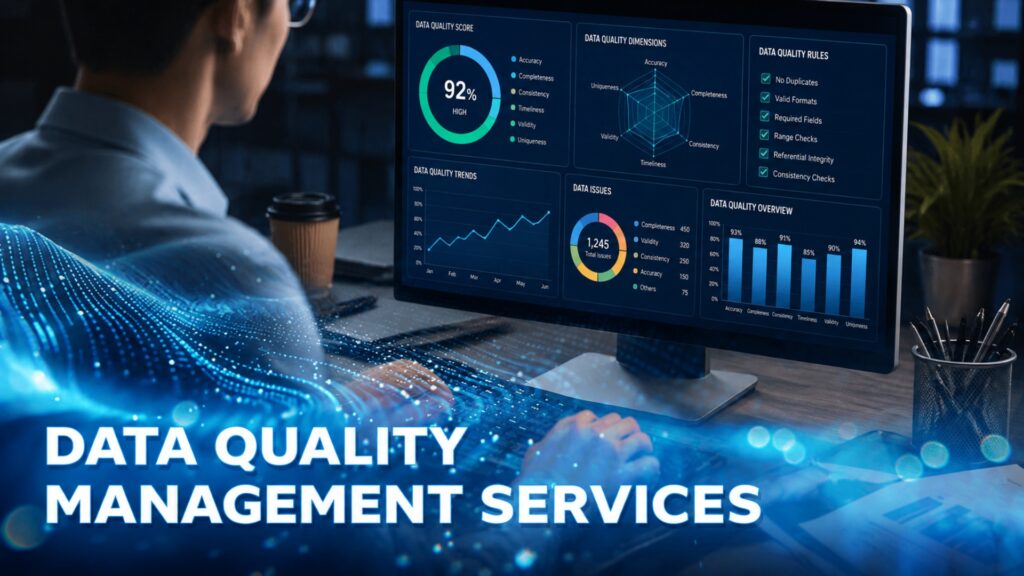
Data quality management (DQM) services combine technologies, processes, and governance practices that help organizations maintain accurate, complete, consistent, and trustworthy data throughout its lifecycle. These services combine data profiling, cleansing, validation, governance, and continuous monitoring to identify and resolve data quality issues before they affect analytics, compliance, or AI initiatives.
At its core, DQM bridges the gap between raw data collection and actionable business intelligence. Specialized engineering teams integrate data quality capabilities into existing data pipelines to validate, standardize, and monitor enterprise data. By combining AI-driven automation with governance policies, organizations can detect data quality issues earlier and improve the reliability of downstream applications.
>>> See more:
- What is Data Cleaning? Benefits, Process, and How It Works
- Online Data Processing Services: Streamline Your Data Management
- What Is Automated Data Extraction? Guide, Benefits & Tools
Why Do Businesses Need Data Quality Management Services?
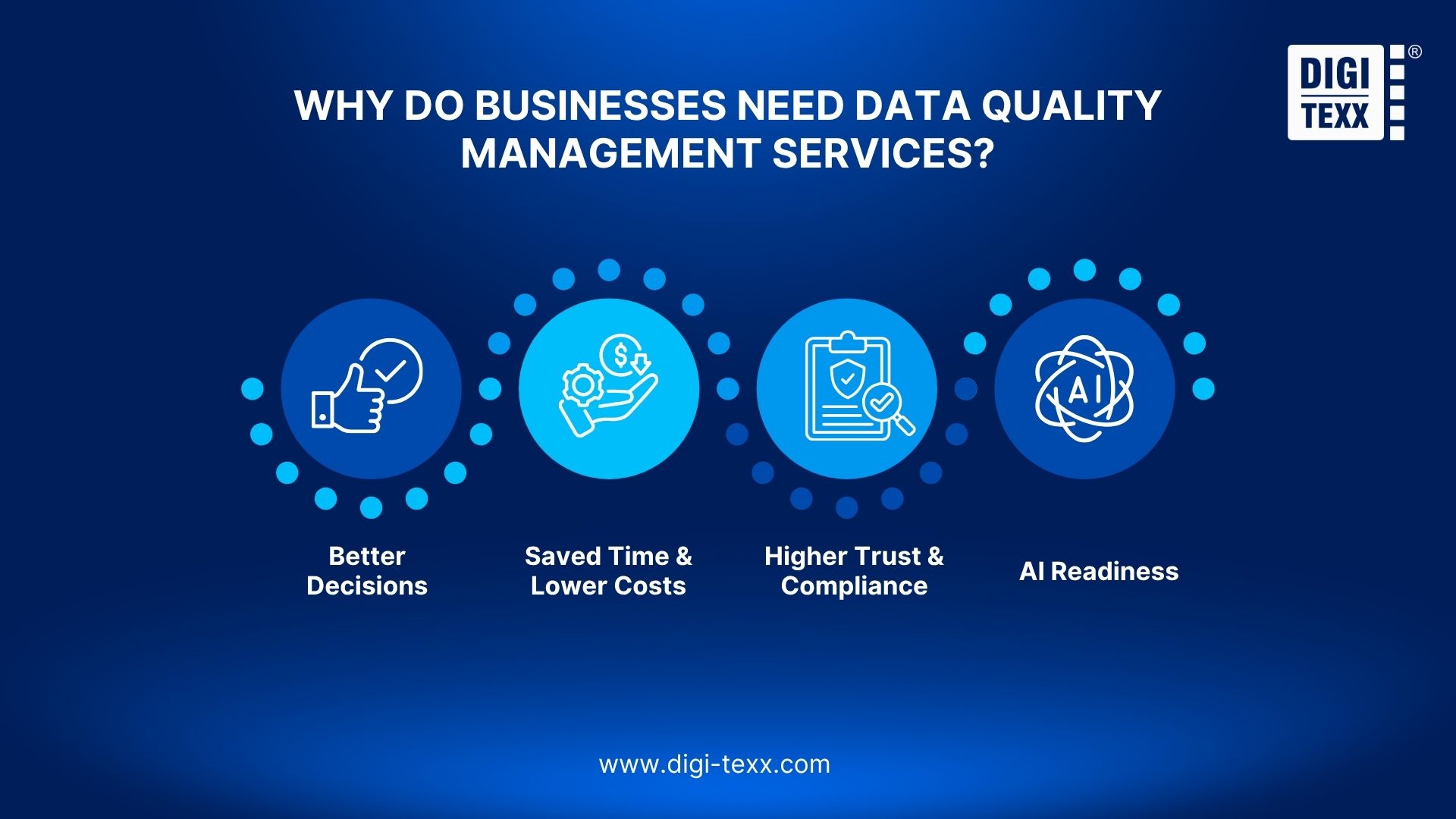
Data quality management services help organizations improve decision-making, reduce operational costs, strengthen regulatory compliance, and prepare data for AI-driven initiatives. By improving data quality at every stage of the data lifecycle, businesses can generate more reliable insights and increase the value of their enterprise data.
1. Better Decisions
Trustworthy data enables more informed, confident, and evidence-based business decisions. When executive dashboards reflect accurate and up-to-date metrics, leaders can forecast market trends without second-guessing their baseline numbers.
2. Saved Time & Lower Costs
Poor data quality drains engineering resources. Automated data cleansing drastically cuts down manual verification work. Teams spend less time correcting missing values, inconsistent formats, and invalid records.
“Poor data quality costs organizations at least $12.9 million a year on average” – Gartner Research
3. Higher Trust & Compliance
Clean digital records improve customer contact protocols and external reporting. Accurate datasets help organizations comply with privacy regulations and reduce the risk of compliance issues or reporting errors.
4. AI Readiness
Artificial intelligence models rely on accurate, complete, and representative training data. Strong DQM practices optimize AI data lakes and help reduce the risk of data-related model drift. This helps machine learning models produce more reliable and consistent predictions by improving the quality of the underlying training data.
What Are The 6 Dimensions Of Data Quality?
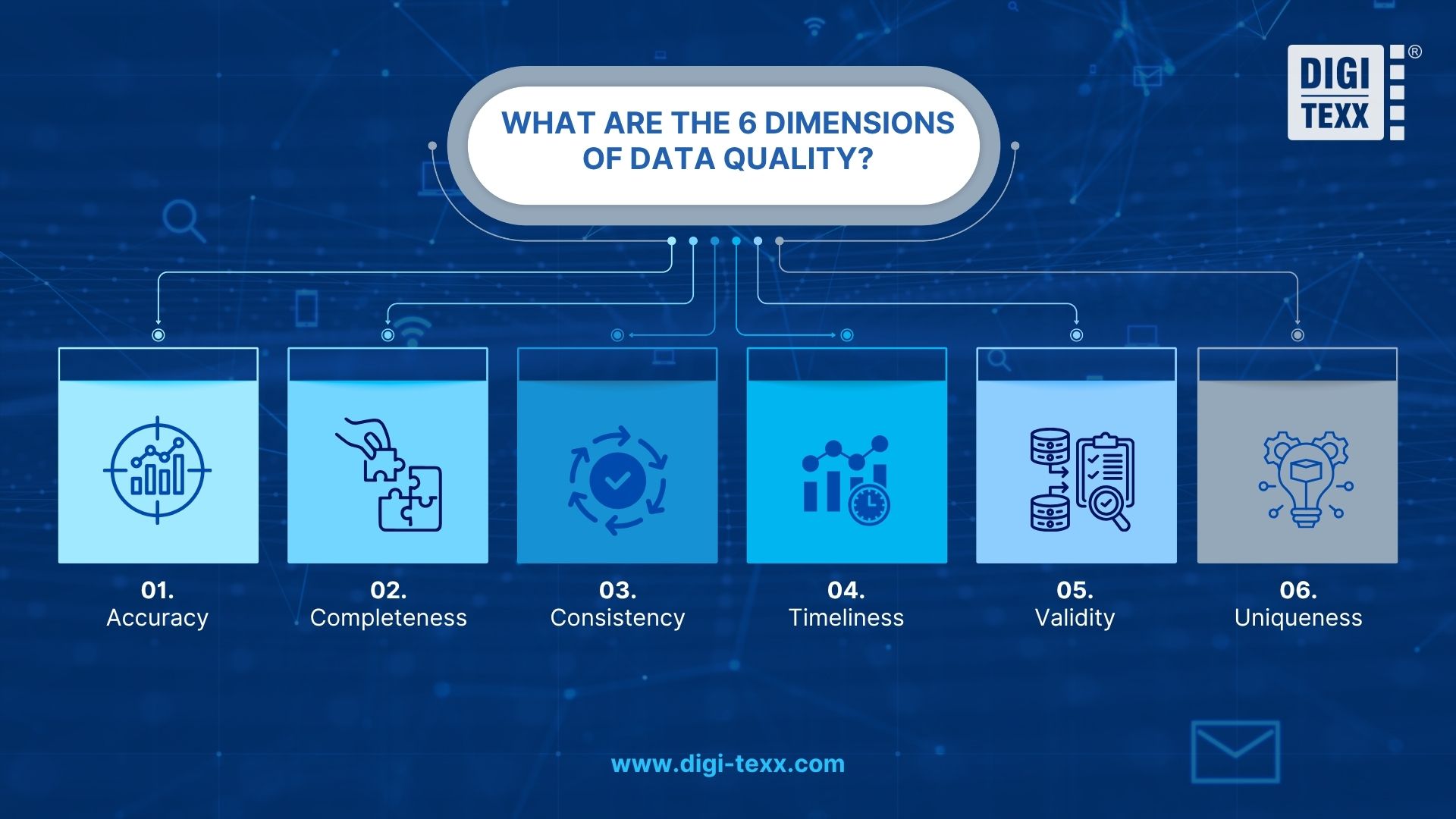
These six dimensions provide a standard framework for evaluating enterprise data quality. DQM teams use them to assess data health, identify quality issues, and define rules for ongoing monitoring and improvement.
To fix data, you must measure it. Professional services evaluate your systems using these six golden standards:
| Dimension | Definition | Error Example |
| Accuracy | Data reflects the real-world truth. | An AI schedules shifts based on outdated employee availability. |
| Completeness | No missing fields or null values. | A CRM customer profile is missing an email address. |
| Consistency | Uniform formats across all departments. | Sales logs “Main St.” while Shipping logs “Main Street”. |
| Timeliness | Data is fresh and up-to-date. | Dynamic pricing fails because it uses last month’s material costs. |
| Validity | Data follows strict format rules. | A user inputs an age of “200” or text in a number field. |
| Uniqueness | No duplicate records exist. | Sending three identical emails to one customer due to CRM clones. |
>>> See more:
- Data Cleaning: Definition, Benefits & Steps To Cleaning Data
- Top 10 Data Cleansing Companies for Businesses in 2026
- 10 Essential Data Cleaning Techniques for Better Data Quality
1. Accuracy
Data accuracy ensures that digital records accurately reflectreal-world facts and authoritative reference sources. Without accurate data, business intelligence dashboards produce false insights, leading to catastrophic financial decisions, misrouted enterprise shipments, or severe compliance violations.
Data quality management services tackle inaccuracy by cross-referencing your internal databases against trusted external APIs. For example, a DQM platform might use contact verification microservices to confirm that a customer’s physical address actually exists. This precise validation prevents downstream operational bottlenecks and builds greater confidence in automated decision-making.
2. Completeness
Data completeness guarantees that every required attribute within a dataset is fully populated without critical missing values. Professional data services prevent null records from breaking data engineering pipelines, ensuring marketing automation tools have the full context required to execute campaigns.
Incomplete profiles severely limit artificial intelligence capabilities and predictive analytics. To solve this, experts often deploy data enrichment services to append missing demographic or financial details from trusted external data sources. By filling these structural gaps, organizations maximize the utility of their existing data assets.
3. Consistency
Data consistency means identical data values and structural formats are maintained uniformly across all disparate enterprise applications. When marketing, sales, and billing platforms synchronize without data conflicts, organizations eliminate departmental silos and establish a reliable single source of truth.
Inconsistent data creates operational chaos during enterprise cloud migrations or corporate mergers. DQM tools utilize Master Data Management (MDM) solutions to standardize formatting globally. This strict governance ensures that a business client recorded as “Inc.” in the sales CRM isn’t logged as “Incorporated” in the accounting software.
4. Timeliness
Data timeliness measures whether information is processed, updated, and available exactly when business operations require it. Stale data ruins real-time analytics, causing dynamic pricing models to fail and automated supply chain algorithms to miscalculate critical inventory levels.
Modern enterprises rely on real-time data observability to maintain high data freshness. Data quality teams configure continuous monitoring pipelines that alert data stewards the moment data latency exceeds acceptable thresholds. This proactive data delivery enables agile, data-driven leadership decisions in fast-paced markets.
5. Validity
Data validity forces incoming information to conform strictly to pre-defined formats, acceptable ranges, and specific data types. By enforcing schema constraints during data ingestion, automated data quality tools can reject, flag, or quarantine invalid records before they affect downstream systems, analytics, or reporting.
Validity is your IT infrastructure’s frontline defense against human error. DQM engineers write strict validation rules, such as requiring an “@” symbol in email fields or restricting age fields to integers below 120. These automated guardrails keep unstructured, messy data from causing fatal errors during AI model training.
6. Uniqueness
Data uniqueness ensures that every real-world entity is represented by a single record across enterprise systems.. Eliminating duplicate records improves reporting accuracy, reduces operational inefficiencies, and prevents customers from receiving duplicate communications.
To maintain data uniqueness, organizations use fuzzy matching and identity resolution techniques to identify duplicate records. These machine learning tools scan millions of rows to identify and merge disconnected CRM clones seamlessly. The final result is a clean, unified 360-degree customer view that powers highly personalized user experiences.
>>> See more:
- Best Data Cleansing Outsourcing Companies for 2026
- Best Data Conversion Services in 2026 | DIGI-TEXX
Which Core Features Do DQM Services Include?
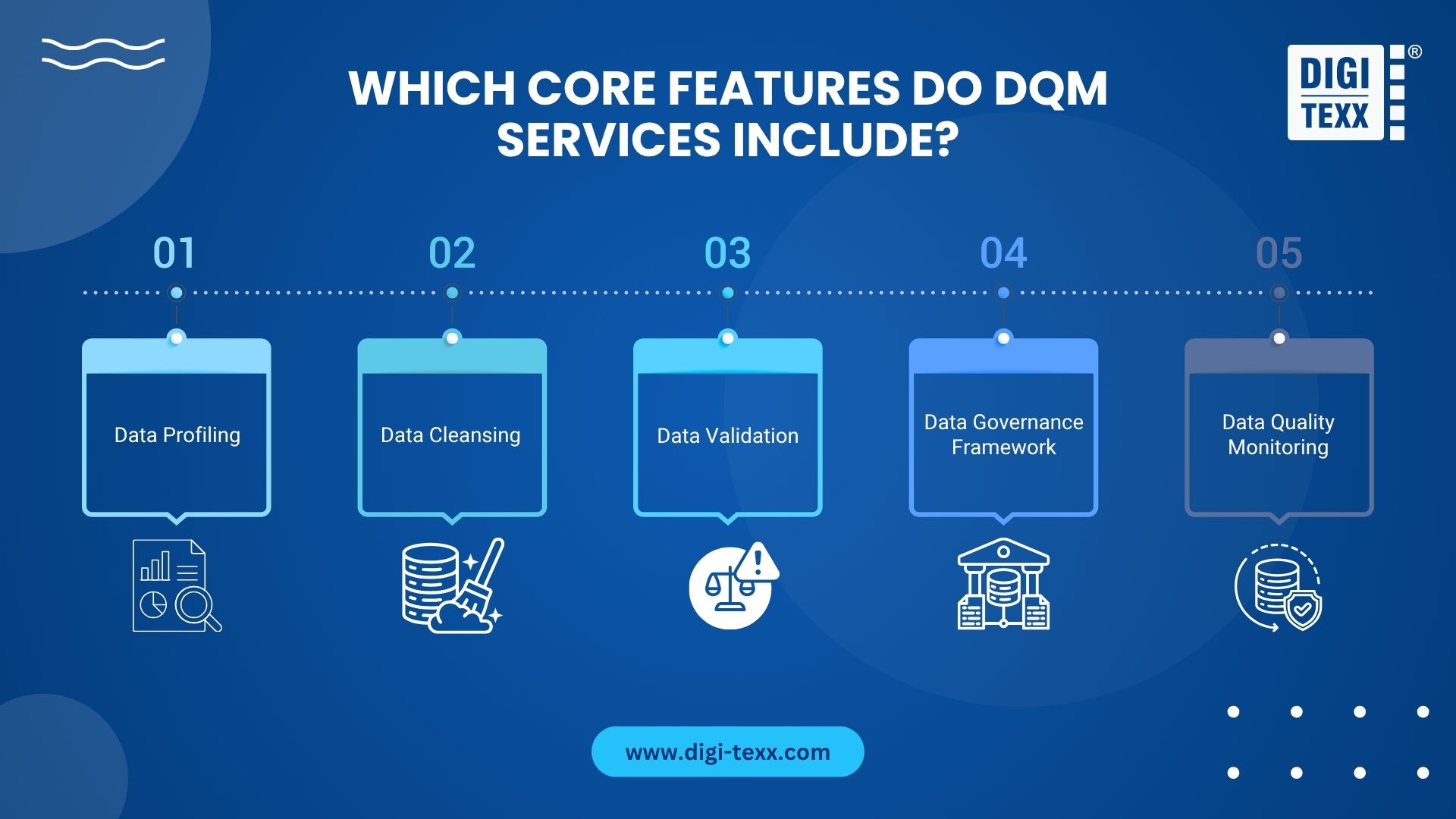
Modern data quality management services combine automation, governance, and validation capabilities to improve data quality throughout the enterprise data lifecycle. Core DQM capabilities typically include data profiling, data cleansing, validation, governance, and continuous monitoring. These integrated features prevent faulty datasets from entering storage and disrupting business intelligence.
When you partner with a top-tier provider, they will implement a suite of technical interventions to standardize your infrastructure.
1. Data Profiling
Profiling scans vast data sets to learn their structure and spot hidden statistical anomalies. It establishes a structural baseline, allowing engineers to understand the true scope of data degradation before applying fixes.
2. Data Cleansing
This process strips out duplicate records, fixes obvious typos, and fills in missing values. Automated cleansing standardizes values across different business units, turning chaotic inputs into clean, uniform intelligence. Providers may also integrate data enrichment services here to append missing external details.
3. Data Validation
Validation sets rigid architectural rules so only correct data enters the system. It checks incoming information against specific business schema constraints, rejecting or flagging entries that violate established parameters.
4. Data Governance Framework
A strong data governance framework establishes the policies, roles, and responsibilities required to maintain high-quality data across an organization. It defines ownership for critical data assets, standardizes quality requirements, and creates clear workflows for identifying, escalating, and resolving data issues. By promoting accountability and consistent governance practices, organizations can preserve data integrity while enabling secure, scalable access to data for analytics and decision-making.
5. Data Quality Monitoring
Maintaining data quality is an ongoing process rather than a one-time initiative. As new records are added, source systems evolve, and business requirements change, data quality can gradually decline without continuous oversight. Modern data quality monitoring solutions automatically track key quality metrics, detect unusual patterns or schema changes, and notify relevant teams when potential issues arise. This proactive approach helps organizations address problems before they impact reporting, analytics, or operational performance.
>>> See more:
- Top 10 Data Entry Outsourcing Companies to Hire in 2026
- 14 Data Entry Skills Hiring Managers Look For In 2026
- 20 Best Data Integration Tools: Definition, Benefits & Features
10 Best Data Quality Management Tools In 2026
Data quality management tools help organizations profile, validate, cleanse, standardize, and monitor data across their environments. The right solution depends on factors such as data volume, technical architecture, governance requirements, and whether the team prioritizes data quality, observability, or data engineering workflows.
Below are 10 data quality management tools worth evaluating in 2026, covering enterprise platforms, governance-focused solutions, developer-oriented frameworks, and data observability tools.
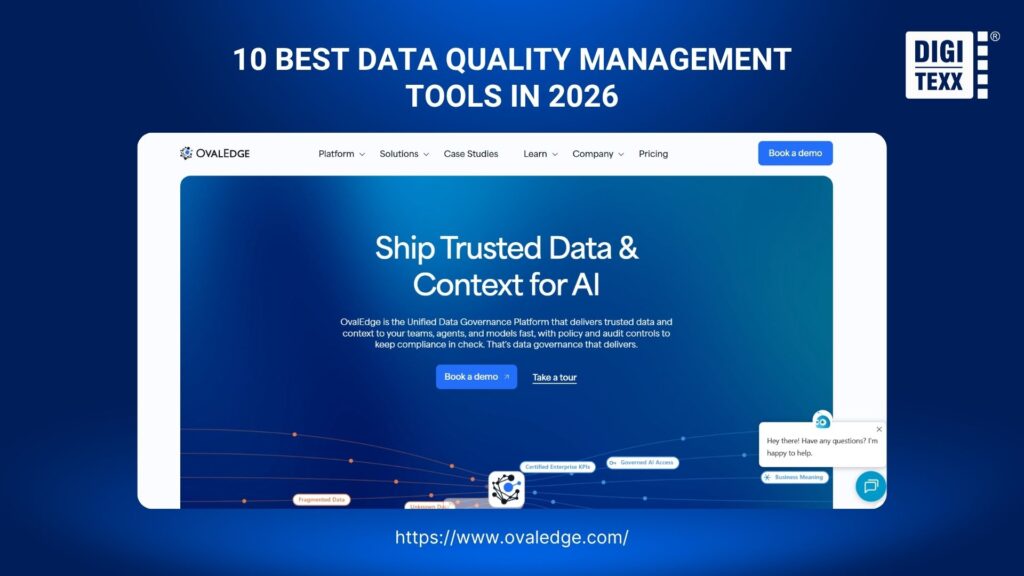
1. OvalEdge
OvalEdge is a data governance and intelligence platform that incorporates data quality, profiling, validation, lineage, and observability capabilities. Its data quality functionality is integrated with metadata management and governance, making it suitable for organizations that want to manage data quality within a broader data governance environment.
Key Features:
- Automated data profiling
- Data validation and quality checks
- Data lineage and impact analysis
- Data observability and monitoring
- Governance and policy enforcement
- Metadata management
Best For:
Large organizations that want to connect data quality with data governance, metadata, and lineage.
Pricing:
Custom pricing based on organizational requirements and deployment scope.
2. Informatica
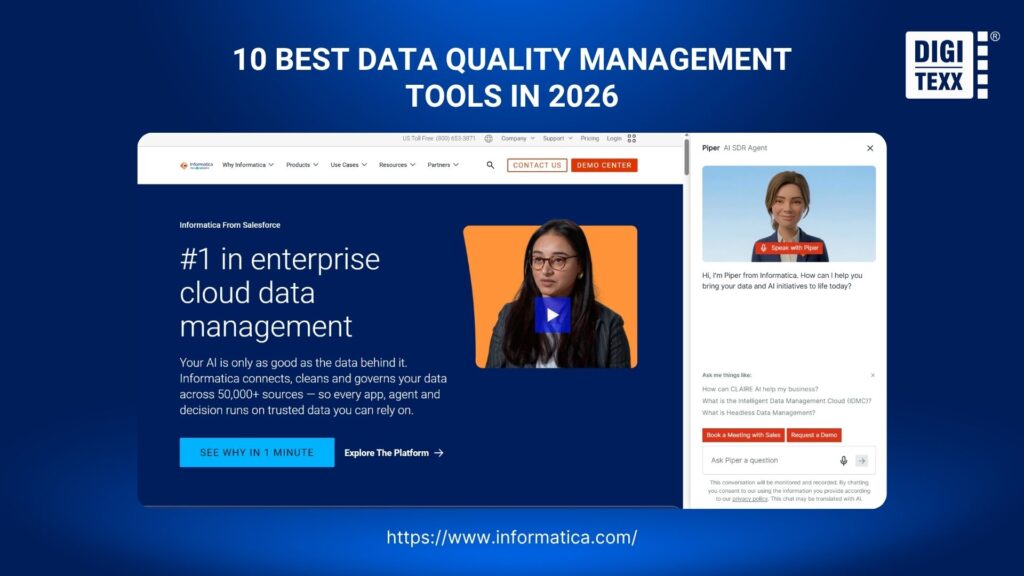
Informatica is an enterprise data quality solution within the Informatica Intelligent Data Management Cloud (IDMC). It supports profiling, cleansing, standardization, validation, matching, enrichment, and data observability across distributed data environments.
Key Features:
- Automated data profiling
- Data cleansing and standardization
- Data validation
- Duplicate detection and matching
- Address verification and enrichment
- Data quality and observability
- AI-assisted rule generation
Best For:
Large enterprises, particularly organizations with complex, distributed, or regulated data environments.
Pricing:
Consumption-based pricing using Informatica Processing Units (IPUs). Exact costs depend on usage and selected services, with pricing provided through a custom quote.
3. Qlik Talend
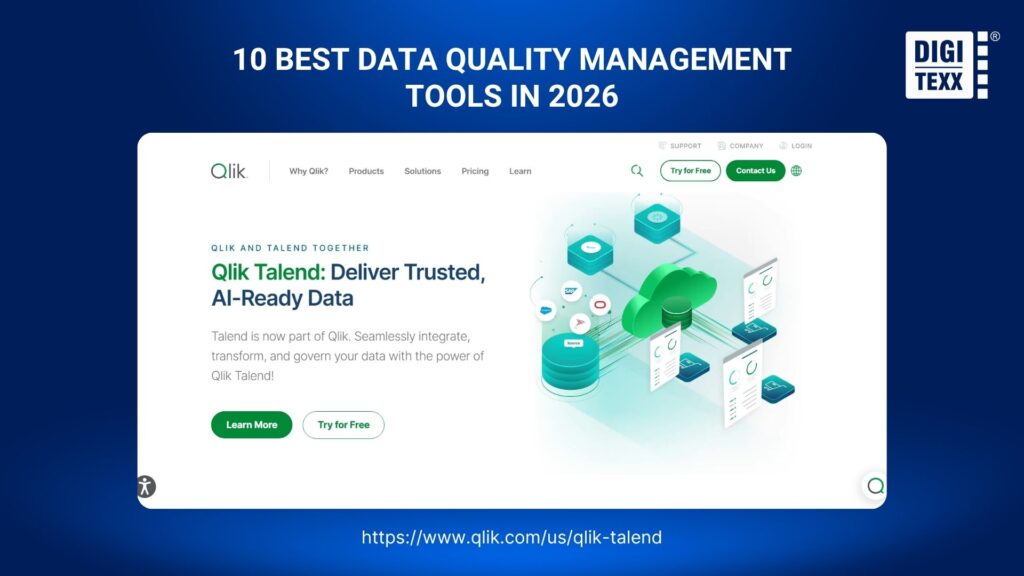
Qlik Talend provides data profiling, cleansing, validation, masking, and deduplication capabilities as part of the Qlik Talend Cloud ecosystem. It is designed to make data quality processes accessible to both technical and business users.
Key Features:
- Visual data profiling
- Data cleansing and standardization
- Duplicate detection and deduplication
- Data masking
- Data quality scoring
- Data integration capabilities
- Self-service data quality workflows
Best For: Organizations that want data engineers and business users to participate in data quality management through a more accessible interface.
Pricing: Enterprise pricing is not publicly listed and requires a custom quote.
4. Collibra
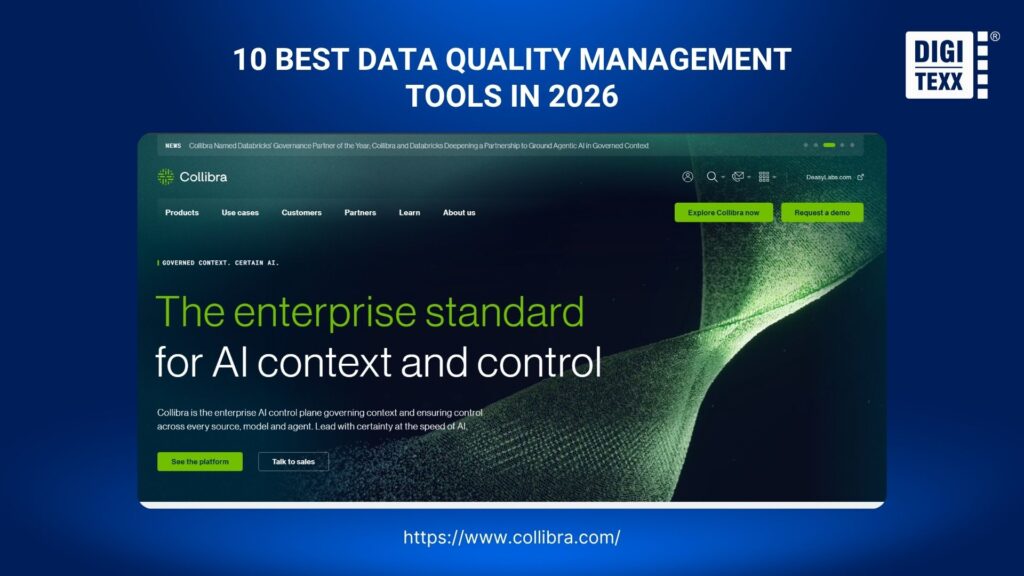
Collibra integrates data quality with data governance, cataloging, and lineage. Its approach is particularly useful for organizations that need to connect quality metrics with business context and data ownership.
Key Features:
- Automated data quality rules
- Data quality monitoring
- Adaptive thresholds
- Data catalog integration
- Data lineage and impact analysis
- Issue management and remediation workflows
- Governance integration
Best For: Governance-driven enterprises that need data quality metrics connected to data ownership, lineage, and business context.
Pricing: Custom enterprise pricing; specific costs are not publicly disclosed.
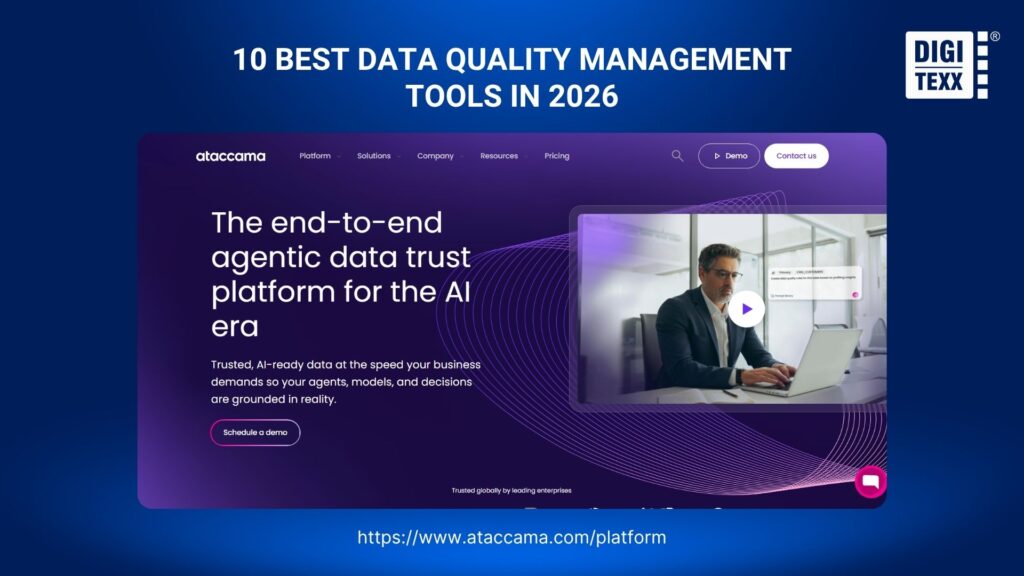
5. Ataccama ONE
Ataccama ONE is a unified data management platform combining data quality, master data management, reference data management, and governance. Its data quality capabilities use automation and AI-assisted workflows to support profiling, validation, anomaly detection, and remediation.
Key Features:
- Automated data profiling
- AI-assisted rule authoring
- Anomaly and data drift detection
- Data quality monitoring
- Master and reference data management
- Data governance
- Data quality firewall
Best For: Mid-sized and large enterprises that need data quality, MDM, and governance within a unified platform.
Pricing: Custom enterprise pricing based on modules, deployment scale, and requirements.
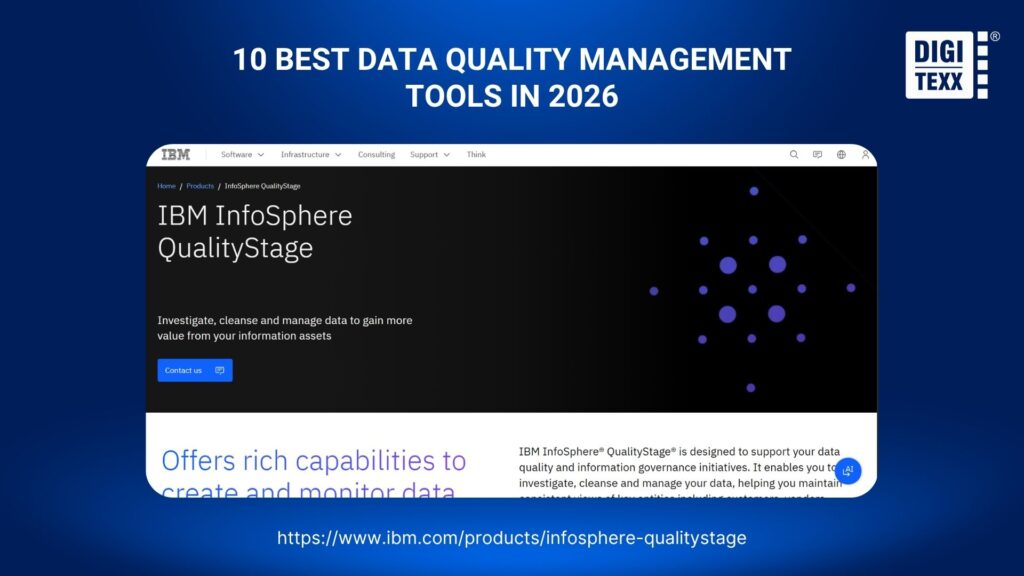
6. IBM InfoSphere QualityStage
IBM InfoSphere QualityStage is an enterprise data quality solution focused on profiling, standardization, matching, and deduplication. It is particularly relevant for organizations managing complex customer, product, or party data across legacy and modern systems.
Key Features:
- Data profiling
- Data standardization
- Record matching and deduplication
- Prebuilt data quality rules
- Probabilistic matching
- On-premises and cloud deployment options
- Integration with IBM data management technologies
Best For:
Large enterprises with complex data integration, customer data, and master data management requirements.
Pricing:
Enterprise pricing requires a custom quote from IBM. Implementation costs vary based on deployment and integration requirements.
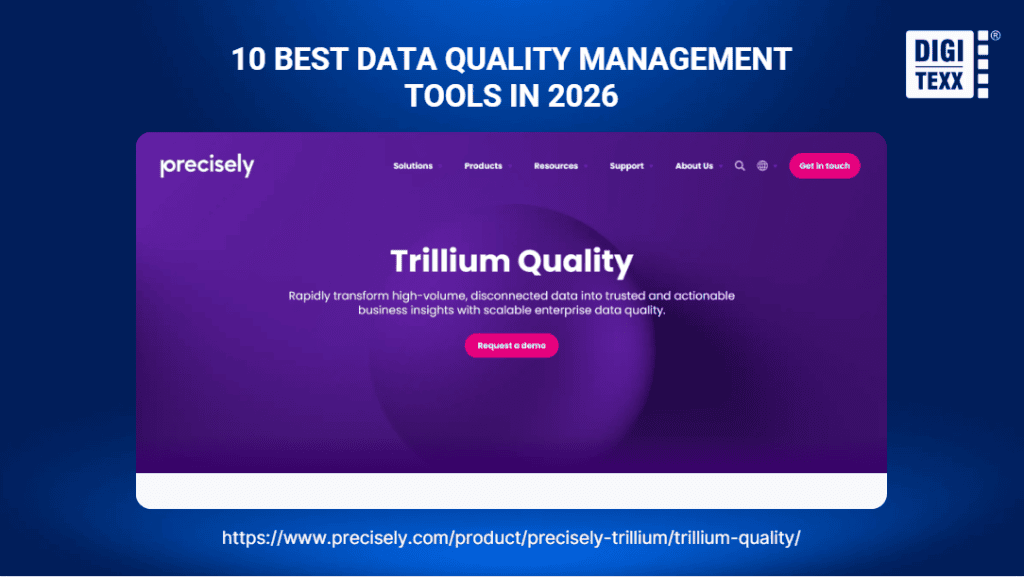
7. Precisely Trillium Quality
Precisely Trillium Quality is a data quality platform focused on data cleansing, validation, standardization, matching, and identity resolution. It is particularly relevant for organizations working with customer and location data across multiple systems.
Key Features:
- Data profiling and assessment
- Data cleansing and standardization
- Address verification
- Record matching and linking
- Identity resolution
- Open APIs
- Support for global address and postal standards
Best For:
Enterprises that need customer data validation, address quality, matching, and identity resolution across business applications.
Pricing:
Custom quote required. Pricing depends on deployment scope, data volume, and integration requirements.
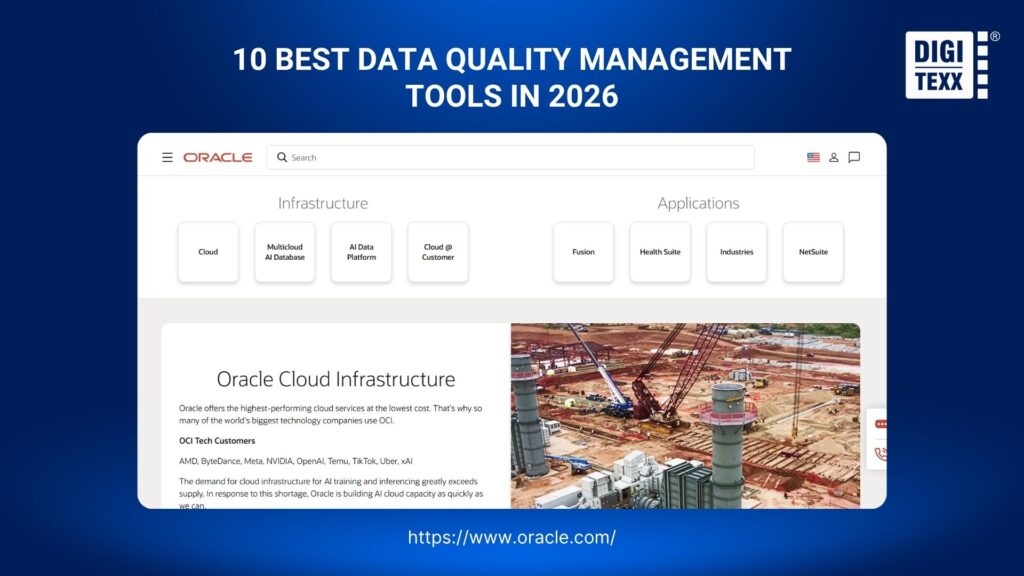
8. Oracle
Oracle is designed for organizations that need to profile, cleanse, standardize, and match enterprise data within the Oracle ecosystem. It is particularly useful for customer and product data management and can integrate with Oracle applications and infrastructure.
Key Features:
- Data profiling
- Data parsing and standardization
- Duplicate detection and matching
- Data cleansing
- Address verification integration
- Case management for data quality issues
- Oracle Cloud Infrastructure integration
Best For:
Organizations already using Oracle applications, databases, or cloud infrastructure that want integrated data quality capabilities.
Pricing:
Enterprise licensing and custom pricing apply. Exact costs require consultation with Oracle and depend on the organization’s existing licensing and deployment requirements.
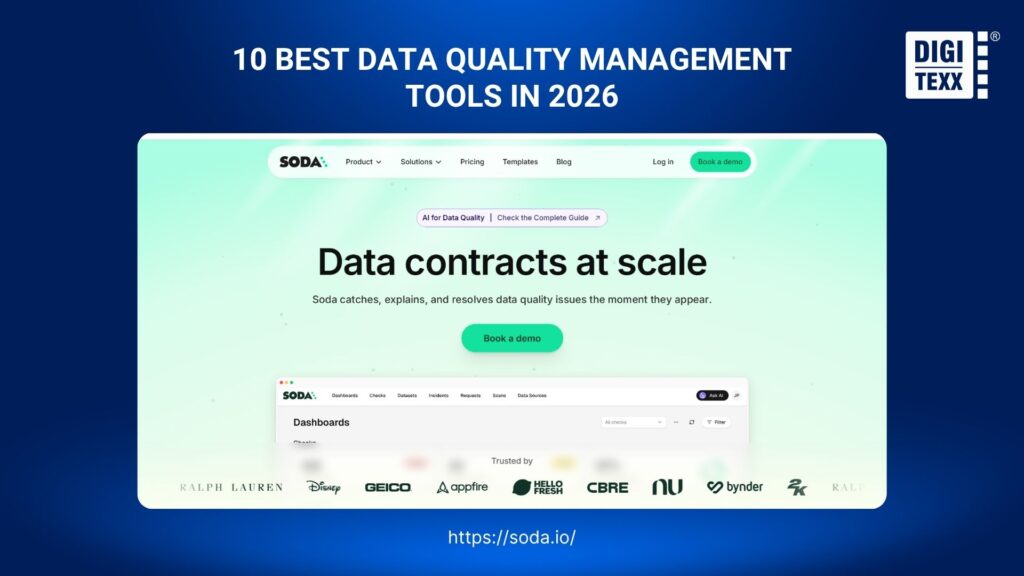
9. Soda
Soda is a developer-focused data quality platform built for modern data stacks. It combines data testing, observability, and monitoring with a checks-as-code approach, allowing data teams to define and automate quality checks within their engineering workflows.
Key Features:
- Checks-as-code
- Data quality testing
- Data observability
- Automated alerts
- SodaCL and Python support
- Integration with dbt, Airflow, Snowflake, BigQuery, and other data technologies
- Pipeline-level quality monitoring
Best For:
Data engineers and analytics engineers who want to integrate data quality checks directly into modern data pipelines and CI/CD workflows.
Pricing:
Soda offers usage-based pricing, with a free tier available. Paid costs vary according to usage and requirements.
10. DIGI-TEXX
DIGI-TEXX provides data quality management services that help organizations identify, clean, validate, standardize, and monitor enterprise data. Its approach combines data processing expertise, data validation, data cleansing, data enrichment, and quality control processes to improve the reliability of datasets used for analytics, reporting, and business operations.
Key Features:
- Data profiling and quality assessment
- Data cleansing and standardization
- Data validation and verification
- Duplicate detection and data matching
- Data enrichment services
- Data quality monitoring
- Customized data processing workflows
- Human-in-the-loop quality control
Best For:
Businesses that need managed data quality services, large-scale data processing, data cleansing, or data enrichment support without building and maintaining the entire data quality operation internally.
Pricing:
Custom pricing based on data volume, project scope, processing requirements, quality standards, and service configuration.
Key Criteria To Choose A Data Quality Management Provider
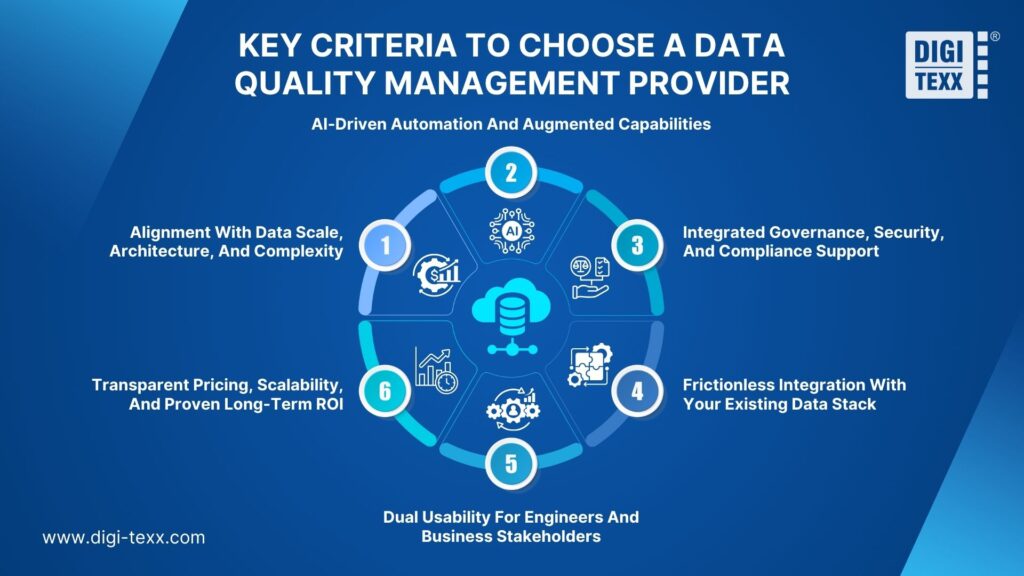
Choosing the right data quality management service is not about buying the platform with the longest feature list. It requires aligning a provider’s capabilities directly with how your enterprise data actually flows, transforms, and is governed across departments.
As enterprise data estates become increasingly distributed, your chosen tooling must support scale, automation, and cross-functional accountability without introducing operational friction. Before signing a contract, evaluate providers against these six strategic criteria:
1. Alignment With Data Scale, Architecture, And Complexity
Data quality management tools must operate within the realities of your existing infrastructure. Solutions designed for small analytics environments frequently fail when applied to enterprise-scale pipelines spanning multi-cloud or hybrid environments. Evaluating how a provider handles extreme data volume, velocity, and variety ensures your quality controls won’t cause latency as your data estate expands.
2. AI-Driven Automation And Augmented Capabilities
Manual rule creation cannot keep pace with rapidly changing schemas, new data sources, and dynamic usage patterns. Prioritize top-tier providers that deliver AI-driven “Augmented Data Quality”, including automated data profiling, machine learning anomaly detection, and self-healing pipelines. Automating these controls drastically cuts down manual engineering tasks and accelerates incident response across your modern data stack.
3. Integrated Governance, Security, And Compliance Support
Data quality and data governance are deeply interdependent. Quality validation checks must align seamlessly with data ownership, access controls, and strict audit requirements, particularly in heavily regulated industries. Choosing a provider that integrates quality metrics directly into overarching governance frameworks enhances regulatory confidence, operational transparency, and audit readiness.
4. Frictionless Integration With Your Existing Data Stack
A strong DQM service should operate naturally alongside your current data warehouses, transformation tools, orchestration frameworks, and legacy systems via robust APIs. Furthermore, providers that integrate natively with metadata and data lineage systems offer crucial contextual visibility, allowing engineering teams to pinpoint exactly where data degradation originates and which downstream assets are impacted.
5. Dual Usability For Engineers And Business Stakeholders
Widespread adoption depends on accessibility across technical and non-technical roles. While data engineers require programmatic API access and pipeline-level integration, business leaders and data stewards need clear dashboards, quality scorecards, and explicit ownership attribution. Selecting a platform that serves both audiences breaks down departmental silos and makes data health a shared organizational responsibility.
6. Transparent Pricing, Scalability, And Proven Long-Term ROI
DQM pricing structures vary widely, scaling by data volume, individual assets, validation checks, or user seats. It is essential to model how these licensing costs will grow alongside your usage. Detecting structural errors early in ingestion pipelines yields significant long-term ROI by preventing costly downstream rework, flawed AI predictions, and inaccurate business reporting.
>>> See more:
- What Is Data Integrity? Why It Matters, Types & Best Practices
- Data Quality Dimensions: 6 Core Metrics And Automation Guide
- Data Quality Framework in Practice: Templates, Tools, and Real Use Cases
How Do Experts Implement Data Quality Management Services? (The 5-Step Process)
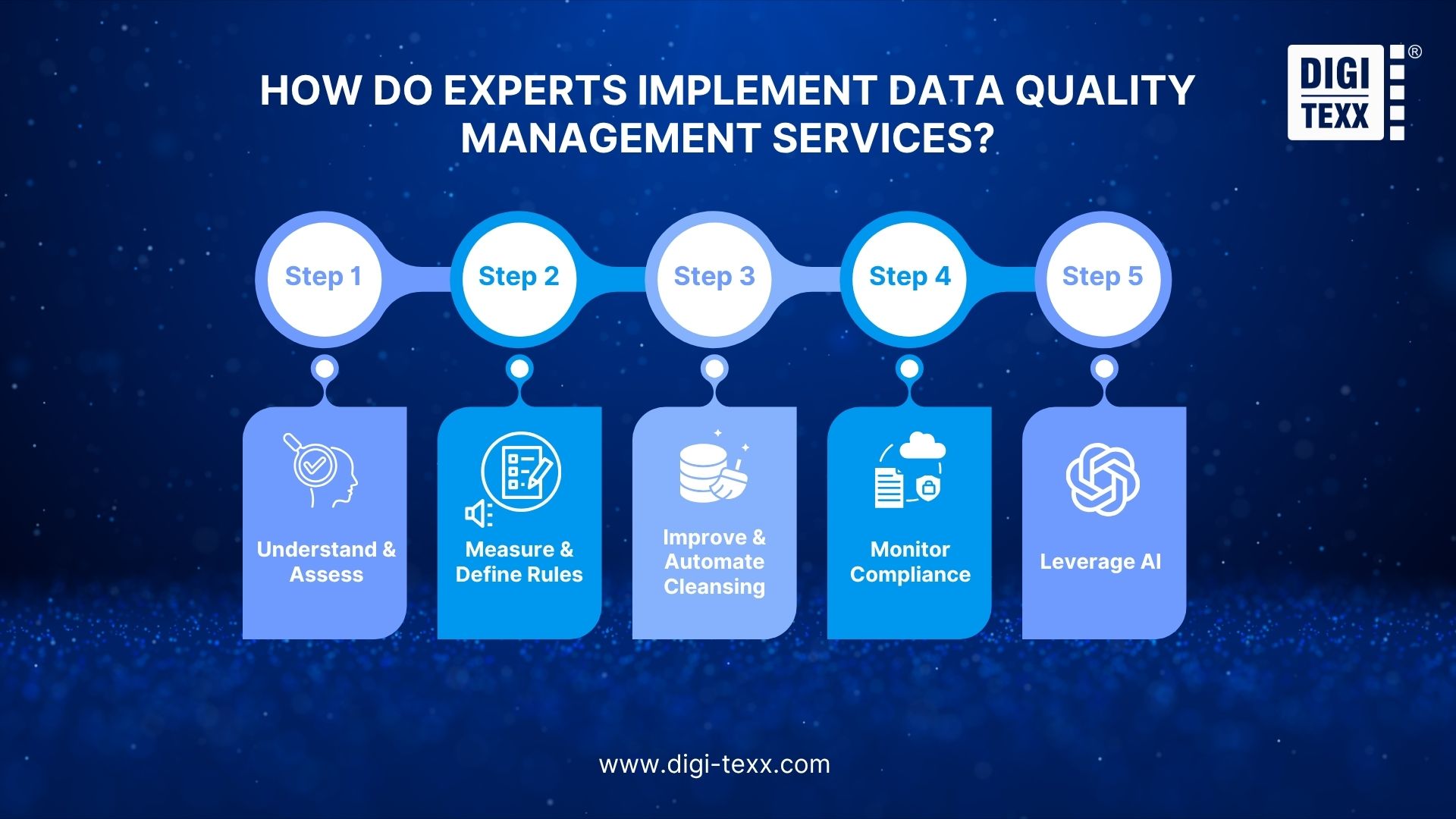
Data quality management services typically follow a structured implementation process. Teams begin by assessing existing datasets, defining quality rules, and automating data cleansing before establishing continuous monitoring and introducing AI-powered capabilities to improve data quality over time.
Transforming raw enterprise data requires executing these specific chronological steps:
1. Understand & Assess
Engineers conduct deep exploratory data profiling. They map current data lineage workflows and identify critical failure points where unstructured data actively harms business operations.
2. Measure & Define Rules
Consultants collaborate directly with business stakeholders. Together, they establish hard KPIs based on the six dimensions of data quality and hardcode these business logic rules into the system.
3. Improve & Automate Cleansing
Technical teams deploy automated scripts and fuzzy matching algorithms. This aggressively resolves existing historical errors, removes duplication, and standardizes formats across all legacy databases.
4. Monitor Compliance
Experts implement continuous data observability dashboards. These tracking tools scan live ingestion pipelines, generating instant alerts if new data violates the pre-established quality parameters.
5. Leverage AI (Augmented DQ)
Finally, modern DQM platforms leverage artificial intelligence and machine learning to enhance data quality processes. These advanced algorithms learn normal data patterns over time, proactively predicting schema drift and suggesting intelligent validation rules without human intervention.
FAQs About Data Quality Management Services
What Is Augmented Data Quality?
Augmented data quality utilizes artificial intelligence and machine learning to automate traditional data management tasks. These advanced data quality management tools proactively detect anomalies, suggest validation rules, and predict data degradation. This drastically reduces manual engineering effort while improving overall data health across complex hybrid cloud environments.
Do DQM Services Affect Self-Serve Analytics?
Yes. DQM services improve self-serve analytics by ensuring datasets are thoroughly cleansed and validated before reaching business intelligence dashboards. This empowers non-technical users to make confident decisions without relying on data analysts for manual verification.
Why Is Data Quality Critical For CRM Systems?
Customer relationship management systems rely entirely on accurate contact records. Poor data quality creates duplicate profiles, invalid email addresses, and disconnected client histories. Implementing strong data quality management services ensures seamless identity resolution, boosting marketing campaign effectiveness and improving overall customer satisfaction by maintaining a single source of truth.
What Is The Difference Between DQM, Data Governance, And MDM?
Data governance establishes the overarching corporate policies and compliance standards. Master data management (MDM) focuses specifically on creating a single, unified view of critical business entities. Data quality management services act as the operational execution layer, actively cleaning, validating, and monitoring the data to ensure it meets those strict governance standards.
How to Take Control of Data Quality Management?
Investing in data quality management services is essential for modern enterprises. Accurate, consistent datasets empower reliable analytics and AI models. Ready to transform fragmented data into high-value assets? Contact DIGI-TEXX today to assess your current data quality challenges and implement a scalable data quality management solution tailored to your business needs.
DIGI-TEXX Contact Information:
🌐 Website: https://digi-texx.com/
📞 Hotline: +84 28 3715 5325
✉️ Email: [email protected]
🏢 Address:
- Headquarters: Anna Building, QTSC, Trung My Tay Ward
- Office 1: German House, 33 Le Duan, Saigon Ward
- Office 2: DIGI-TEXX Building, 477-479 An Duong Vuong, Binh Phu Ward
- Office 3: Innovation Solution Center, ISC Hau Giang, 198 19 Thang 8 street, Vi Tan Ward
References
- Gartner. (n.d.). Data Quality – Gartner IT Glossary. Gartner. Retrieved from https://www.gartner.com/en/data-analytics/topics/data-quality
- Dataversity. (2023). What Is Data Quality? Dataversity Education. Retrieved from https://www.dataversity.net/what-is-data-quality/