
Invoice reconciliation process is a critical control point in finance operations, helping businesses verify invoice accuracy, prevent duplicate payments, and maintain cash flow transparency. In this article, DIGI-TEXX explains the invoice reconciliation process steps, examines real-world benefits and challenges in practice, and provides practical guidance for implementing an effective and scalable reconciliation process.
>>> See more:
- Top 10 Data Processing Software For Business 2026 – Best Tool Reviewed
- Top 10 Data Cleansing Companies for Businesses in 2026
- Top 10 Best Big Data Processing Tools for Business 2026
- 20 Best Data Integration Tools: Definition, Benefits & Features
What Is Invoice Reconciliation With An Example?
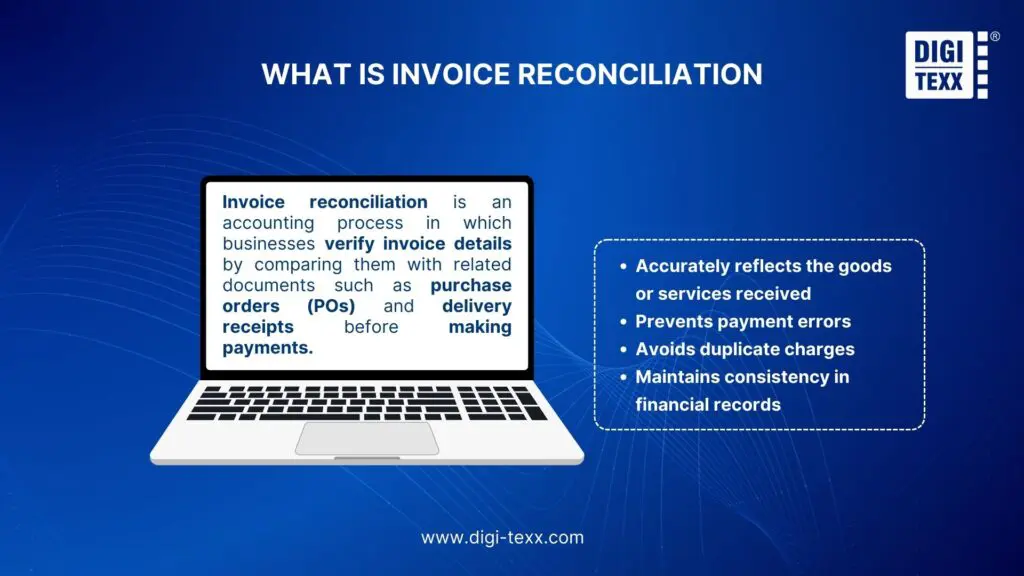
Invoice reconciliation is an accounting process in which businesses verify invoice details by comparing them with related documents such as purchase orders (POs) and delivery receipts before making payments. The goal is to ensure that each invoice accurately reflects the goods or services received, helping prevent payment errors, duplicate charges, and inconsistencies in financial records.
Example: A manufacturing company places a bulk order with a supplier and uses three-way matching to ensure that invoices reflect both the approved purchase order and the actual goods received before payment.
- Step 1 – Purchase order is issued: The company creates a purchase order for 1,000 units at $10 per unit, with a total order value of $10,000.
- Step 2 – Goods are received and recorded: Upon delivery, the receiving team confirms that 950 units are actually received and documents this quantity in the delivery receipt.
- Step 3 – Vendor invoice is submitted: The supplier sends an invoice billing 1,000 units, with a total amount of $10,000, based on the original purchase order.
- Step 4 – Three way matching is performed: During the invoice reconciliation process, the finance team matches the purchase order, delivery receipt, and invoice. A discrepancy is identified when the invoiced quantity does not align with the received quantity.
- Step 5 – Discrepancy is flagged and resolved: The invoice is placed on hold while the finance team contacts the vendor to clarify the difference. The invoice is then adjusted to reflect the actual 950 units received before approval.
- Step 6 – Payment is processed correctly: After correction, the updated invoice is approved and paid, ensuring the company pays only for goods actually received and maintains accurate financial records.
Benefits Of Regular Invoice Reconciliation
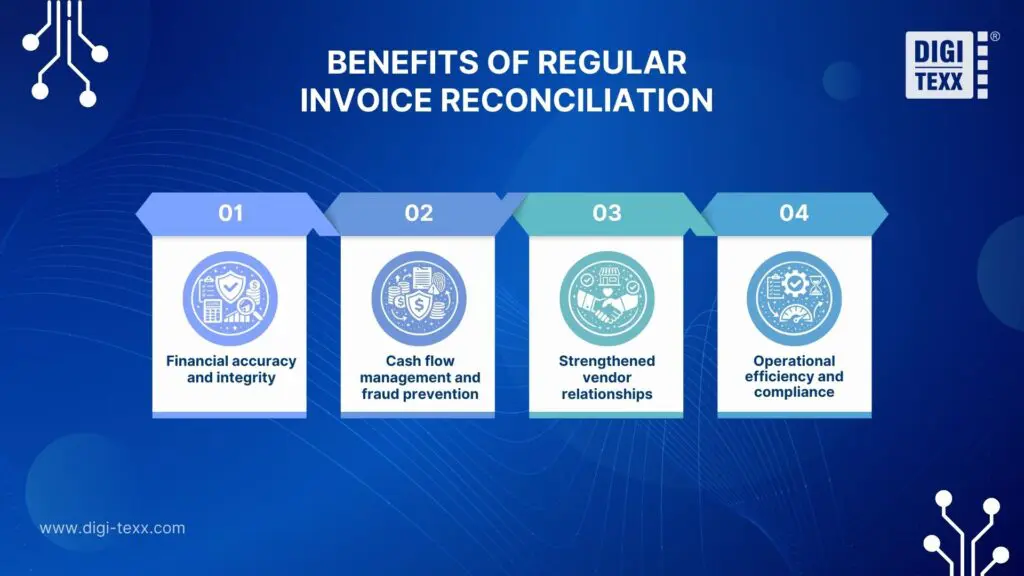
Invoice reconciliation is widely valued by finance leaders for its role in maintaining financial accuracy and operational control. When performed regularly, it delivers clear benefits that support business stability and growth.
- Financial accuracy and integrity: Regular reconciliation ensures financial records accurately reflect actual expenses. By matching invoices with purchase orders and receiving documents, businesses can prevent overpayments, duplicate payments, and pricing errors, supporting reliable reporting and audit readiness.
- Cash flow management and fraud prevention: Early detection of discrepancies helps organizations manage cash flow more effectively, schedule payments accurately, and avoid penalties. Reconciliation also reduces fraud risk by identifying unauthorized or inflated invoices before payment.
- Strengthened vendor relationships: Timely and accurate invoice reviews minimize disputes and payment delays. Resolving issues quickly improves transparency and trust, supporting long-term, collaborative vendor relationships.
- Operational efficiency and compliance: A structured reconciliation process reduces manual effort and improves workflow efficiency while supporting compliance with tax and financial regulations. Regular reconciliation also strengthens audit readiness and reduces legal and financial risk.
>>> See more:
- Outsourced Order Processing Services – Fast & Accurate
- What is Intelligent Document Processing (IDP)? How It Works
- Financial Data Quality Management: What It Is & Why It Matters
- Top Data Entry Skills You Need to Get Hired in 2025
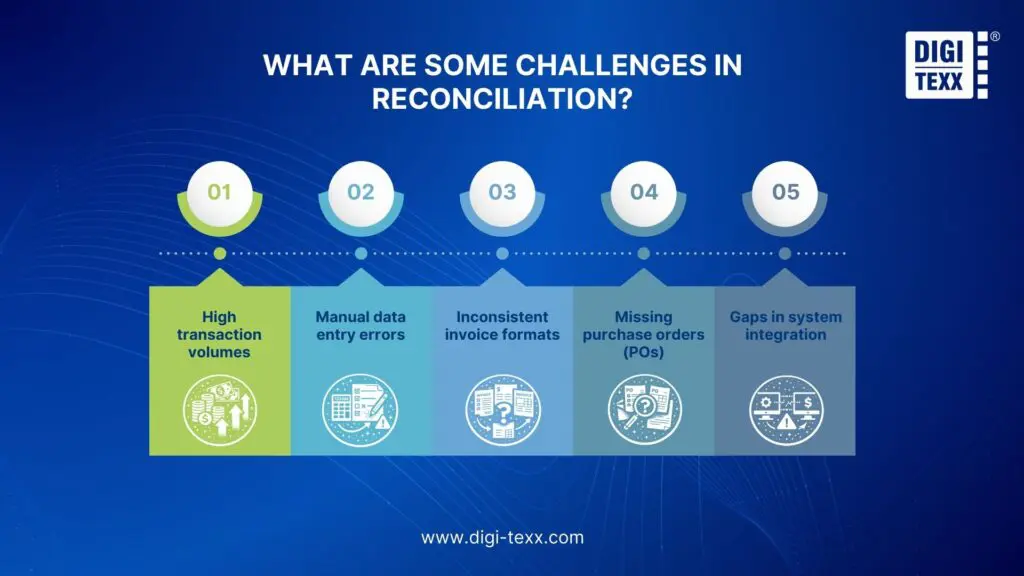
What Are Some Challenges In Reconciliation?
As transaction volumes grow, invoice reconciliation becomes more complex and difficult to manage at scale. Finance teams commonly face the following challenges:
- High transaction volumes: Large invoice volumes can overwhelm manual processes, causing backlogs and delayed payments. Applying structured review cycles, prioritization rules, and automation for repetitive matching helps maintain processing speed, especially during peak periods.
- Manual data entry errors: Small input errors can lead to incorrect payments and rework. Using OCR-based data capture, automated validation rules, and focused training significantly reduces these risks.
- Inconsistent invoice formats: Vendors submit invoices in multiple layouts, slowing reconciliation. Standardizing invoice requirements and using intelligent document processing tools helps handle format variations efficiently.
- Missing purchase orders (POs): Invoices without POs disrupt approval workflows. Enforcing PO-based procurement while defining clear exception handling for urgent cases preserves control without delaying operations.
- Gaps in system integration: Disconnected accounting, procurement, and ERP systems increase manual effort and errors. Integrating reconciliation tools directly with ERP systems enables automated data flows and faster processing.
What Is Invoice Reconciliation Process?
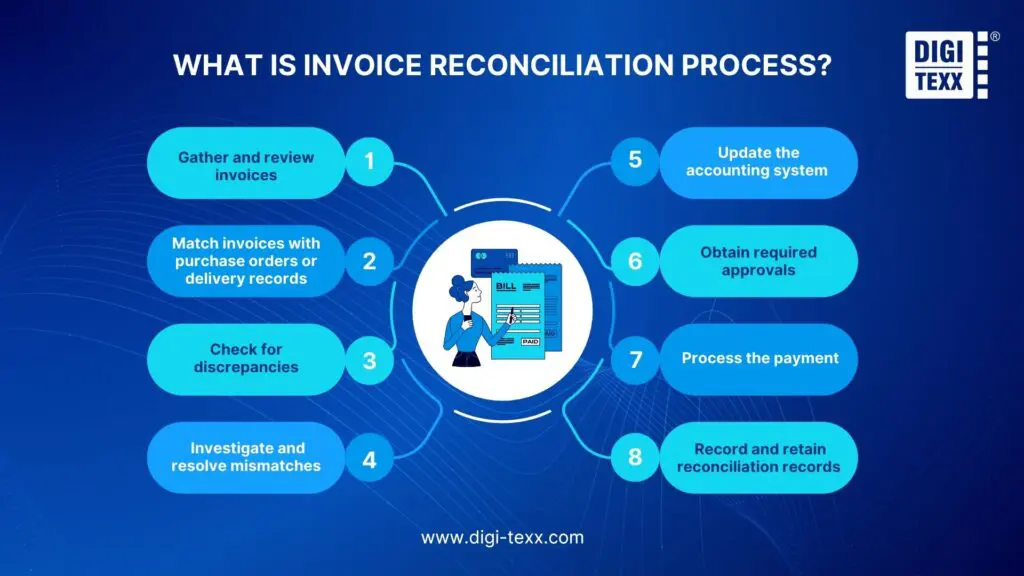
The invoice reconciliation process is a structured, multi-step workflow that finance teams follow to ensure invoices are accurate, discrepancies are resolved, and payments are processed correctly. In practice, this process typically consists of eight key steps:
Step 1: Gather and review invoices
Finance teams collect all invoices from vendors for a specific period and review basic details such as invoice numbers, vendor information, and dates to ensure completeness and accuracy from the start.
Step 2: Match invoices with purchase orders or delivery records
Invoices are then matched against purchase orders and, where applicable, delivery receipts or receiving reports to confirm that billed goods or services align with what was ordered and delivered.
Step 3: Check for discrepancies
Amounts on the invoice are compared with agreed prices and quantities. Finance teams look for mismatches such as pricing errors, quantity differences, missing credits, or unexpected additional charges.
Step 4: Investigate and resolve mismatches
When discrepancies are identified, their root causes are investigated. Internal issues like data entry errors are corrected, while vendor-related issues require clarification or invoice adjustments, with all communications documented.
Step 5: Update the accounting system
After discrepancies are resolved, the final, accurate figures are recorded in the accounting system to ensure accounts payable or receivable reflect the correct balances.
Step 6: Obtain required approvals
Reconciled invoices are reviewed and approved according to internal control policies, typically involving finance managers or authorized stakeholders.
Step 7: Process the payment
Once approved, payments are executed using the company’s standard payment methods and in line with agreed vendor terms.
Step 8: Record and retain reconciliation records
All reconciliation outcomes, supporting documents, and adjustments are stored for audit purposes, compliance requirements, and future reference.
>>> See more:
- Document Management Outsourcing: Benefits, Services & Companies
- Data Labeling Service: What It Is, Types & Benefits For AI
- Professional E-commerce Data Entry Services by DIGI-TEXX
Key Invoice Reconciliation Approaches
Invoice reconciliation acts as a financial control that helps ensure vendor invoices are accurate and valid before payment. Depending on transaction value, operational risk, and purchase complexity, businesses typically apply different reconciliation approaches to balance control and efficiency.
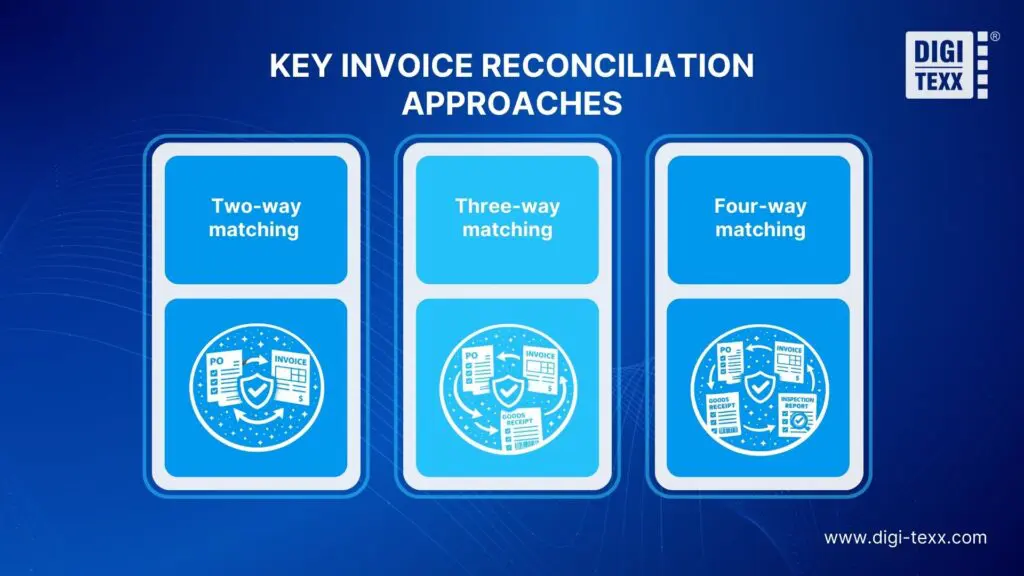
Two-way matching (Purchase Order ↔ Invoice)
Two-way matching is the simplest invoice reconciliation approach, as it focuses solely on comparing the invoice with the purchase order. This method is commonly used for service-based purchases where no physical goods are delivered, such as software subscriptions or professional services. In practice, the finance team verifies that invoice details such as item descriptions, quantities, and prices match the approved PO before payment is released. While this approach confirms alignment with agreed terms, it does not verify whether goods or services were actually received, making it less suitable for inventory-related or high-value purchases.
Three-way matching (Purchase Order ↔ Goods Receipt ↔ Invoice)
Three-way matching is the most widely used invoice reconciliation approach, especially in inventory-driven environments such as retail, wholesale, and manufacturing. In practice, the finance team compares the invoice with both the approved purchase order and the goods receipt to confirm that the items billed were ordered and actually received. Only invoices that match across all three documents are approved for payment, which significantly reduces the risk of overbilling, payment errors, and fraud. While this approach provides stronger control, it may require coordination across procurement, receiving, and finance teams if not supported by automation.
Four-way matching (Purchase Order ↔ Goods Receipt ↔ Invoice ↔ Inspection Report)
Four-way matching is the most comprehensive invoice reconciliation approach and is typically applied to high-value, high-risk, or quality-sensitive purchases. In this approach, the finance team validates the invoice against the purchase order, goods receipt, and an inspection or quality report to ensure that delivered items meet required specifications before payment approval. By adding a quality verification step, four-way matching offers the highest level of control and risk mitigation. However, it is also the most resource-intensive approach and benefits greatly from automation to avoid delays in the payment cycle.
>>> See more:
- How to Automate Documentation in 2026: Step By Step Guide
- Top 10 Best Data Entry Outsourcing Companies in USA 2026
- What are The 6 Steps of The Data Analysis Process?
- AI in Investing – How AI Technology is Shaping the Future of Investment Strategies
Types Of Reconciliation
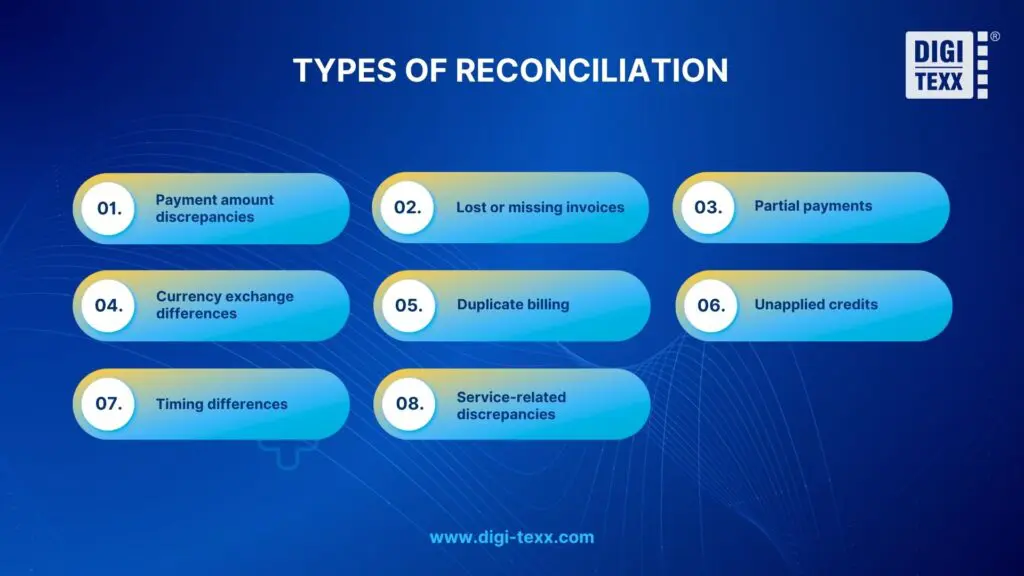
Different types of invoice reconciliation help finance teams identify where discrepancies occur and apply the right controls during the invoice reconciliation process. Common reconciliation types include:
- Payment amount discrepancies: Differences caused by discounts, adjustments, or calculation errors that affect the final payable amount.
- Lost or missing invoices: Invoices that are misplaced or not recorded, leading to incomplete or mismatched account balances.
- Partial payments: Invoices paid in multiple installments, requiring accurate tracking of outstanding balances.
- Currency exchange differences: Variances resulting from exchange rate fluctuations in international transactions.
- Duplicate billing: Cases where the same invoice or charge is recorded or paid more than once.
- Unapplied credits: Credits or credit notes issued but not reflected in the correct account.
- Timing differences: Temporary mismatches caused by differences in transaction recording dates between parties.
- Service-related discrepancies: Inconsistencies between services billed and services actually delivered.
>>> See more:
- What Is A Back Office Service? Examples, Benefits, And Cost In 2026
- Construction Invoice Reconciliation: Best Practices, Software & Outsourcing
- Best Real Estate Image Processing Services 2026: Top 15 Providers
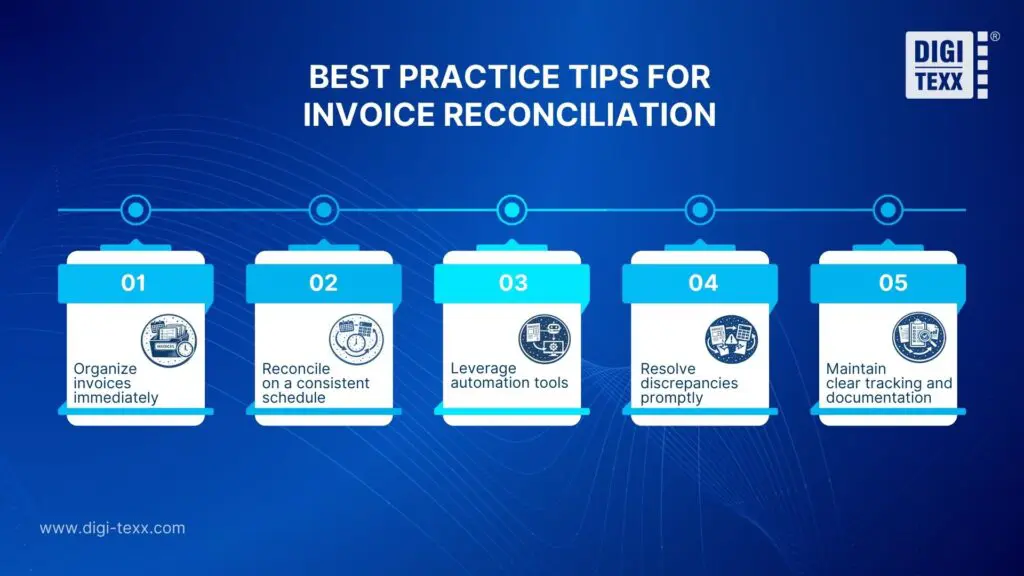
Best Practice Tips For Invoice Reconciliation
To keep invoice reconciliation accurate and efficient, businesses should follow a set of practical best practices that reduce errors and improve financial control:
- Organize invoices immediately: Capture, categorize, and store invoices immediately after issuance to avoid missing or duplicated records later in the process.
- Reconcile on a consistent schedule: Perform invoice reconciliation regularly most commonly on a monthly basis, or more frequently for high-volume transactions to detect issues early.
- Leverage automation tools: Use invoice reconciliation software to automate matching, validations, and exception handling, helping teams save time and minimize manual mistakes.
- Resolve discrepancies promptly: Investigate and address mismatches as soon as they arise to prevent payment delays, disputes, or inaccurate financial reporting.
- Maintain clear tracking and documentation: Keep an up-to-date system that clearly reflects invoice status paid, partially paid, or outstanding along with supporting documents for audit readiness.
>>> See more:
- Top 10 Outsourced AI Training Data Companies in 2026
- How To Prepare a Classified Balance Sheet: Template & Example
- What Is Business Process Outsourcing (BPO)? Definition & Benefits
Invoice Processing Solutions From DIGI-TEXX
As invoice volumes grow and data comes from multiple sources, manual invoice processing and reconciliation become increasingly difficult to control. To support finance teams in maintaining accuracy, efficiency, and compliance, DIGI-TEXX provides invoice processing solutions that combine automation technology with structured operational workflows, helping businesses streamline the invoice reconciliation process at scale.
- End-to-end invoice processing support: DIGI-TEXX supports the full invoice lifecycle, from invoice intake and data extraction to validation, reconciliation, and posting into accounting or ERP systems.
- Automated invoice data capture: DIGI-TEXX uses OCR, Machine Learning, and NLP to automatically extract invoice data from paper and electronic invoices, reducing manual effort and errors.
- Invoice validation & reconciliation enablement: DIGI-TEXX matches extracted invoice data with purchase orders, delivery receipts, or internal records to detect discrepancies early in the invoice reconciliation process.
- Exception handling with human-in-the-loop: DIGI-TEXX routes invoices with discrepancies or exceptions to experienced operations teams for accurate review and resolution.
- Scalable for high-volume operations: DIGI-TEXX designs solutions for businesses handling large invoice volumes, multiple vendors, and diverse invoice formats, with flexible scalability.
- Integration with existing systems: DIGI-TEXX integrates seamlessly with existing accounting systems, ERP platforms, and internal workflows to ensure smooth data flow.
- Compliance and audit readiness: DIGI-TEXX ensures standardized, traceable invoice processing workflows that support audit requirements and financial compliance.
- Operational efficiency and cost optimization: DIGI-TEXX combines automation and outsourcing to accelerate invoice processing cycles, reduce operating costs, and free finance teams for higher-value work.
FAQs About Invoice Reconciliation Process
Why Is Invoice Processing Important?
Invoice processing plays a critical role in ensuring invoices are reviewed, paid accurately and on time, supporting financial accuracy, cash flow visibility, compliance, and vendor relationships.
How Often Should Invoices Be Reconciled?
Invoices should be reconciled monthly. Conducting invoice reconciliation on a monthly basis helps ensure timely and efficient payment processing while enabling businesses to quickly identify and resolve discrepancies.
What Is The Automation Of Reconciliation Process?
Automation of the reconciliation process refers to using technology to automatically compare and validate financial data from multiple sources such as bank statements, payment systems, and internal ledgers in order to quickly detect discrepancies and ensure data accuracy and consistency.
>>> See more:
- Top 10 Data Entry Outsourcing Companies to Hire in 2026
- Business Process Automation Solutions: Benefits, Examples & Service Company
- Healthcare BPO Services – Cost Optimization & Improve Care 2026
- Best Insurance Claims Processing Outsourcing BPO in the US 2026
DIGI-TEXX provides key insights into structuring the invoice reconciliation process as a disciplined financial control function supported by standardized workflows and scalable automation. This approach enables businesses to improve accuracy, strengthen cash flow control, and maintain audit readiness, while giving finance teams and management clearer visibility for confident decision-making.
In practice, many organizations continue to face challenges in managing invoice reconciliation as transaction volumes grow and processes scale. Common issues include manual errors, delayed approvals, limited visibility, and pressure to maintain audit readiness.
With experience in invoice processing and reconciliation support, DIGI-TEXX works alongside businesses to help standardize reconciliation workflows, reduce operational burden, and strengthen financial control across the invoice lifecycle. If you would like to explore how to improve the accuracy, efficiency, and scalability of your invoice reconciliation process, the DIGI-TEXX team is ready to work with you to assess and optimize your invoice reconciliation process.
DIGI-TEXX Contact Information:
🌐 Website: https://digi-texx.com/
📞 Hotline: +84 28 3715 5325
✉️ Email: [email protected]
🏢 Address:
- Headquarters: Anna Building, QTSC, Trung My Tay Ward
- Office 1: German House, 33 Le Duan, Saigon Ward
- Office 2: DIGI-TEXX Building, 477-479 An Duong Vuong, Binh Phu Ward
- Office 3: Innovation Solution Center, ISC Hau Giang, 198 19 Thang 8 street, Vi Tan Ward
References:
- Committee of Sponsoring Organizations of the Treadway Commission (COSO) (.org) https://www.coso.org/
- Financial Accounting Standards Board (FASB) (.org) https://www.fasb.org/