
Purchase Orders Processing is a core function that helps businesses control spending, maintain procurement transparency, and ensure smooth operational flow. In this article, DIGI-TEXX provides a clear overview of the purchase order lifecycle, from defining what PO processing is to outlining key steps, major types, best practices, and common pitfalls.
If your goal is to improve financial oversight, reduce errors, and streamline procurement activities, understanding a structured PO process is essential to achieving greater efficiency and stronger cost control.
>>> See more:
- Top 10 Data Entry Outsourcing Companies to Hire in 2026
- Top 10 Outsourced AI Training Data Companies in 2026
- Top 10 Best Data Entry Outsourcing Companies in USA 2026
What Is Purchase Order Processing?
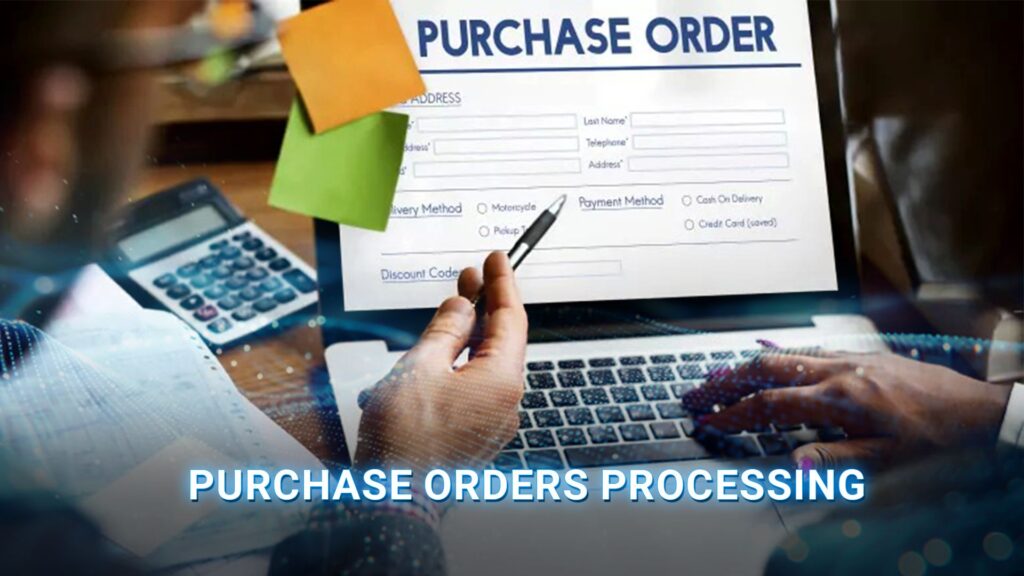
A purchase order (PO) is a formal document used by businesses to request goods or services from a supplier. It clearly outlines key details such as quantity, pricing, delivery instructions, payment terms, and required dates—helping organizations control spending and maintain accurate records.
The purchase order process refers to the structured steps a business follows to create, review, approve, issue, and track a PO—from identifying a need to receiving the goods or completing the service.
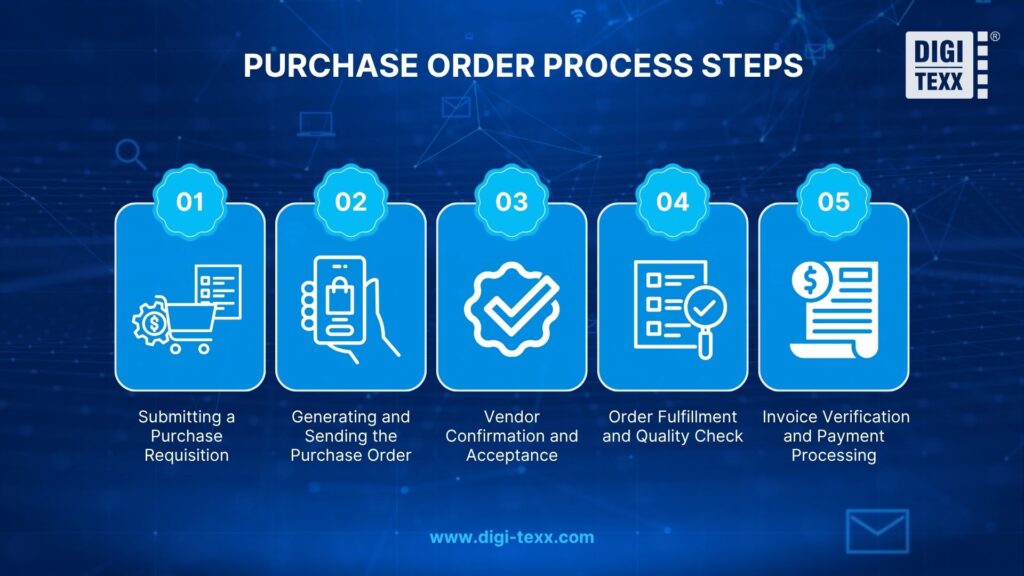
What Are The 7 Steps Of The Purchasing Process In Order?
To manage procurement efficiently, businesses need a clear and structured purchasing process where each step ensures better cost control and operational accuracy. Below are the seven key stages of the purchasing process explained in a practical, easy-to-follow way.
1. Identifying Needs
The process begins when a department identifies a requirement for goods or services. This step involves defining clear specifications, including quantity, quality standards, and delivery timelines.
Accurate need identification is critical. Poorly defined requirements often lead to incorrect orders, delays, and increased costs due to rework or returns.
2. Supplier Research And Request for Proposal (RFP)
Once the need is clearly defined, procurement teams search for suitable suppliers. This may involve issuing a Request for Proposal (RFP) or Request for Quotation (RFQ) to gather detailed information.
At this stage, businesses evaluate suppliers based on:
- Pricing and cost structure
- Product or service quality
- Delivery capability
- Reputation and reliability
Organizations with a pre-approved vendor list can significantly reduce sourcing time and minimize risk.
3. Purchase Requisition And Approval Workflow
Before making any commitment, an internal purchase requisition (PR) is submitted for approval. This step ensures that the purchase aligns with budget constraints and company policies.
A structured approval workflow helps prevent unauthorized spending and improves financial control. Companies that implement automated approval systems often reduce approval time and eliminate bottlenecks.
4. Purchase Order Creation And Issuance
After approval, the purchasing team generates a purchase order (PO) and sends it to the selected supplier. The PO serves as an official document outlining all transaction details, including pricing, delivery instructions, and payment terms.
Once accepted by the supplier, the purchase order becomes a legally binding agreement, providing clarity and protection for both parties.
>>> See more:
- Accounts Receivable Service | Invoicing, Billing & AR Management
- Ecommerce Back Office Support Services For Fast Growth
- Define Business Process Outsourcing (BPO): Meaning, Examples & Benefits 2026
5. Receiving And Inspection
When the supplier delivers the goods or completes the service, the receiving team verifies that everything matches the agreed specifications.
This step includes:
- Checking quantity and condition.
- Inspecting product quality.
- Recording delivery through a Goods Received Note (GRN)..
This is a critical control point, as most discrepancies such as damaged goods or missing items are identified here. At this stage, effective purchase orders processing plays an important role in ensuring that all received goods are accurately recorded and aligned with the original purchase order.
6. Invoice Approval And Payment
After delivery, the supplier issues an invoice. The finance team verifies the invoice through a three-way matching process, comparing:
- The purchase order
- The goods received note
- The invoice
If all documents align, the payment is approved and processed according to agreed terms. If discrepancies are found, they are resolved before payment is made.
Organizations that automate this step often achieve faster processing times and significantly lower error rates.
7. Review And Supplier Performance Evaluation
The final step involves evaluating supplier performance to improve future procurement decisions.
Key evaluation criteria include:
- Delivery timeliness
- Product or service quality
- Pricing consistency
- Responsiveness and communication
Continuous evaluation helps businesses build a reliable supplier network and maintain high procurement standards over time. In the long term, optimizing purchase orders processing across all stages enables better visibility, stronger supplier relationships, and more efficient procurement operations.
>>> See more:
- Top 10 Data Cleansing Companies for Businesses in 2026
- Top 10 Best Big Data Processing Tool for Business 2026
- Top 10 Data Processing Software For Business 2026 – Best Tool Reviewed
- Best Insurance Claims Processing Outsourcing BPO in the US 2026
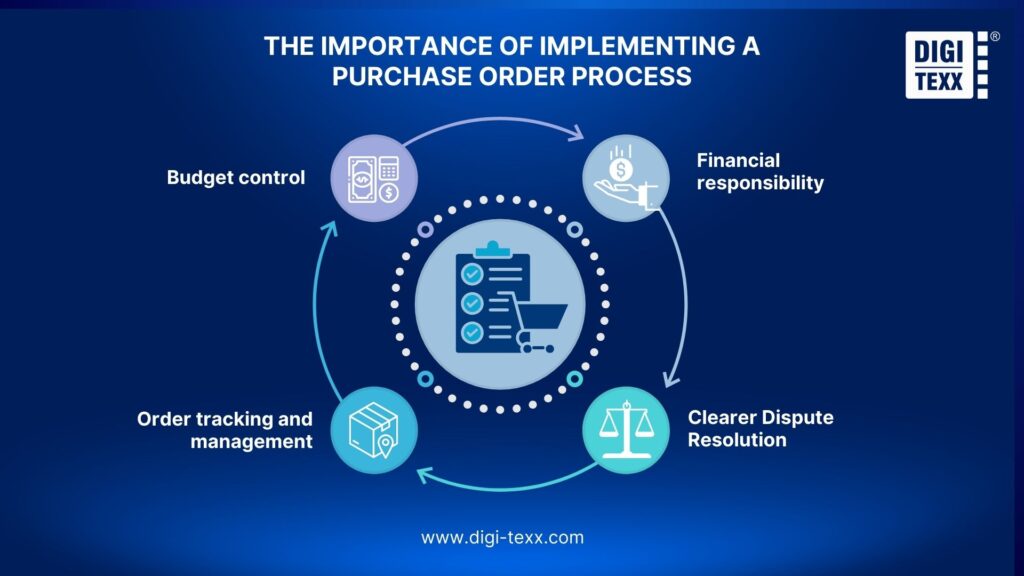
Why Is It Important To Implement A Purchase Order Process?
Implementing a clear and standardized purchase order (PO) process helps businesses maintain control over spending, improve operational efficiency, and reduce financial risks. It ensures that every purchase is properly reviewed, approved, and documented.
Budget control
A consistent PO process enables finance teams to accurately track all purchasing expenses. This improves cost forecasting, prevents overspending, and keeps budgets aligned with business plans.
Order tracking and management
With a structured workflow, companies can manage multiple orders at once while maintaining full visibility into shipping, receiving, inventory, and production activities. Each step is recorded, making it easier to monitor progress and avoid delays.
Financial responsibility
A well-managed PO process creates a clear audit trail for every transaction. This strengthens internal controls and provides reliable documentation for auditors, banks, and compliance reviews.
Clearer Dispute Resolution
A well-managed PO process creates a clear audit trail for every transaction. This strengthens internal controls and provides reliable documentation for auditors, banks, and compliance reviews.
>>> See more:
- Accounts Payable Outsourcing: How It Works, Benefits & Top Providers
- Outsourcing Advantages & Disadvantages: What Businesses Should Know?
- 5 Advantages Of Data Annotation Outsourcing Services for AI Projects
Purchase Orders Processing Example
A mid-sized US retail company processing around 5,000 POs per month faced major inefficiencies due to manual workflows, with processing time of 2–3 days per PO, an error rate of about 12%, and frequent invoice mismatches.
After implementing automation and outsourcing purchase orders processing, the company reduced processing time by 60%, lowered errors to below 3%, and significantly decreased the workload for the finance team.
Key takeaway: Optimizing purchase orders processing directly improves accuracy, speeds up procurement cycles, and enables businesses to scale more efficiently.
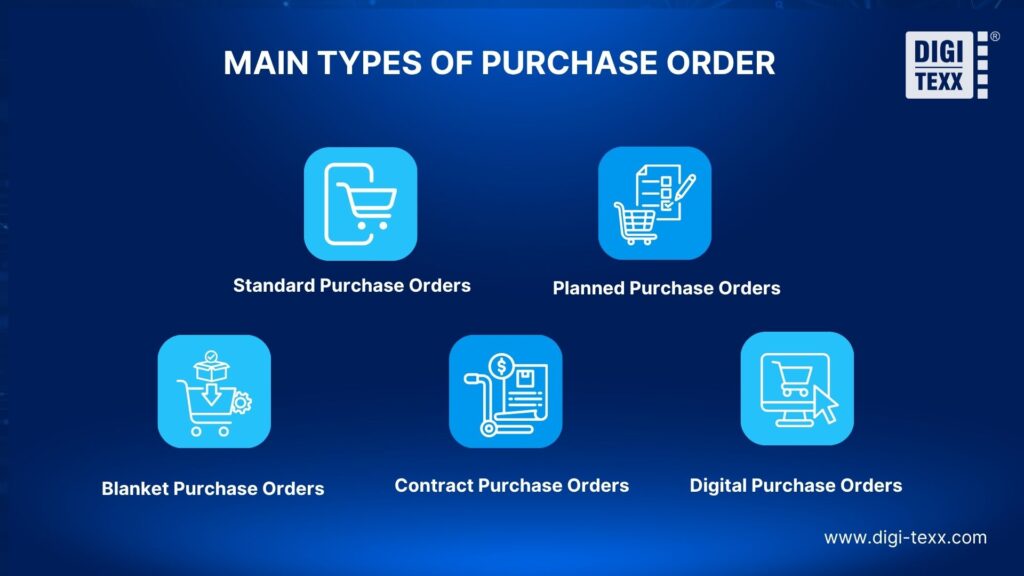
Main Types Of Purchase Order
Different types of purchase orders are designed to support various procurement scenarios, from one-time purchases to long-term supplier agreements. Understanding how each type works helps businesses choose the most efficient approach and improve overall purchase orders processing.
Standard Purchase Orders (SPO)
Standard purchase orders are the most commonly used type, typically applied to one-time purchases with clearly defined requirements.
Each SPO includes detailed information such as item descriptions, quantities, pricing, and delivery timelines, making it ideal when businesses know exactly what they need.
Since these orders are created for individual transactions, every standard PO is independent and not linked to future purchases.
Planned Purchase Orders (PPO)
Planned purchase orders are used when businesses anticipate future needs but have not finalized all details.
Instead of committing to specific delivery dates or quantities upfront, PPOs allow companies to outline general terms and release orders later when requirements become clearer.
This approach provides flexibility while still maintaining control over future procurement activities.
Blanket Purchase Orders (BPO)
Blanket purchase orders are designed for recurring purchases from the same supplier over a defined period.
They allow businesses to place multiple orders under a single agreement, eliminating the need to create a new PO each time. This significantly reduces administrative effort and improves efficiency in purchase orders processing.
BPOs often include a spending limit to help organizations control costs and stay within budget.
Contract Purchase Orders (CPO)
Contract purchase orders establish a formal agreement between buyer and supplier before specific order details are finalized.
While terms and conditions are agreed upon in advance, elements such as quantities and delivery schedules are determined later.
CPOs are commonly used in long-term partnerships, providing a strong legal framework for ongoing transactions.
Digital Purchase Orders (DPO)
Digital purchase orders leverage technology to automate and streamline the entire procurement workflow.
By using digital systems, businesses can manage creation, approval, tracking, and reporting more efficiently across all PO types. This enhances visibility, reduces manual errors, and accelerates purchase orders processing.
Transitioning to digital PO management allows organizations to optimize operations, improve accuracy, and scale procurement with greater control.
>>> See more:
- Outsourced Order Processing Services – Fast & Accurate
- Healthcare BPO Services – Cost Optimization & Improve Care 2026
- What Is Business Process Outsourcing (BPO)? Definition & Benefits
When Should You Outsource PO Processing?
PO processing is highly repetitive and data-intensive, making it an ideal candidate for outsourcing when internal resources are limited or inefficient.
Best scenarios for outsourcing include:
- High PO volume (over 1,000 orders per month).
- Manual data entry causing delays and errors.
- Frequent invoice mismatches and reconciliation issues.
- Rapid business growth requires scalable operations.
In these situations, outsourcing purchase orders processing helps businesses improve accuracy, reduce processing time, and maintain better control over procurement activities while allowing internal teams to focus on higher-value tasks.
Why Do Businesses Choose DIGI-TEXX?
With extensive experience in document and data processing, DIGI-TEXX supports global clients in optimizing purchase orders processing with accuracy, consistency, and scalability.
Core capabilities include:
- High-volume PO data processing.
- Invoice validation and reconciliation.
- Structured and standardized workflow management.
- Consistent accuracy and compliance with financial controls.
Result:
- Reduced operational workload for internal teams.
- Improved financial transparency and audit readiness.
- Scalable procurement operations to support business growth.
By leveraging DIGI-TEXX’s expertise in purchase orders processing, businesses can streamline procurement workflows while maintaining high levels of control and efficiency.

Best Practices For Managing Purchase Orders In Procurement
Managing purchase orders effectively requires clear processes, strong supplier relationships, and the right technology. The following best practices can help streamline day-to-day purchasing activities:
Establish Clear Policies and Training
Ensure that all employees involved in procurement understand purchasing policies, approval workflows, and compliance requirements. Clear guidelines reduce errors and unauthorized spending.
Build a Reliable Supplier Network
Maintain an up-to-date list of preferred suppliers who offer competitive pricing, consistent quality, and dependable service. This allows faster comparisons and more informed purchasing decisions.
Use Master Agreements for Regular Suppliers
For frequently purchased goods or services, set up master agreements that define pricing structures, escalation terms, and conditions. Keep product catalogs accurate and updated to reduce administrative work and paperwork.
Maintain Strong Supplier Relationships
Foster collaborative, long-term relationships with trusted suppliers. Open communication helps resolve issues quickly and prevents unnecessary delays or costs.
Centralize Purchasing Information and Leverage Technology
Whenever possible, centralize procurement data and make it accessible to relevant stakeholders. Invest in suitable procurement tools or automation systems to improve visibility, control, and efficiency throughout the PO process.
>>> See more:
- Construction Invoice Reconciliation: Best Practices, Software & Outsourcing
- Best Real Estate Image Processing Services 2026: Top 15 Providers
- What are the 6 Steps of the Data Analysis Process?
- How to Automate Documentation in 2026: Step By Step Guide
FAQs About Purchase Orders Processing
What are common PO mistakes?
Many companies and organizations, especially small and growing businesses, commonly make the following mistakes:
- Skipping the Purchase Requisition Stage: Bypassing the requisition step can lead to unauthorized spending and poor budget control.
- Lack of Standardization: Using inconsistent formats or manual processes creates confusion, delays, and errors.
- Poor Record-Keeping: Incomplete or disorganized documentation makes tracking expenses and audits more difficult.
- Failing to Track Order Status: Without proper monitoring, businesses risk late deliveries, missed updates, and inventory issues.
What Is The Format Of A Standard Po?
A standard purchase order typically contains the following key elements:
- Header information: Buyer and supplier names, addresses, contact details, and the issue date.
- Purchase order number: A unique reference number used for tracking and documentation.
- Order details: Clear descriptions of the products or services, including quantities, unit prices, and total costs.
- Delivery information: Shipping address, requested delivery date, and any special delivery instructions.
- Payment terms: Agreed payment conditions, such as due dates, currency, discounts, or penalties.
- Billing information: The invoice address, if different from the shipping address.
- Terms and conditions: Any contractual or legal provisions governing the transaction.
- Authorized signatures: Approval from authorized representatives of both parties.
- Attachments: Supporting documents such as specifications, drawings, or contracts.
What Are The 4 Types Of PO?
The four main types of purchase orders (POs) are Standard, Blanket, Planned, and Contract.
- Standard PO: Used for one-time purchases with clearly defined details.
- Blanket PO: Used for recurring purchases with agreed pricing over a set period.
- Planned PO: Created for future purchases, with flexible delivery dates and quantities confirmed later.
- Contract PO: Establishes general terms and conditions, with specific orders issued afterward.
How Automation Is Transforming Purchase Order Processing?
Automation is transforming purchase orders processing by improving speed, accuracy, and overall efficiency across the entire procurement workflow.
By replacing manual tasks with digital systems such as ERP, OCR, and eProcurement platforms, businesses can significantly reduce processing time, minimize human errors, and gain real-time visibility into purchasing activities.
In addition, automated purchase orders processing enables faster approvals, more accurate invoice matching, and better compliance, helping organizations scale operations while maintaining strong financial control.
Can Purchase Order Processing Be Outsourced?
Yes, purchase order processing can be outsourced—and many businesses choose this approach to improve efficiency and maintain better control.
PO processing often involves repetitive, detail-oriented tasks such as data entry, PO issuance, order tracking, and invoice reconciliation. When managed manually, these activities can consume valuable time and increase the likelihood of errors. Outsourcing helps streamline these workflows, improve accuracy, and ensure smoother day-to-day operations.
With DIGI-TEXX’s Document & Data Processing Services, businesses can rely on our experienced team to handle PO data processing, validation, and reconciliation with care and consistency. This helps maintain accurate records, support financial transparency, and reduce the workload on internal teams.
>>> See more:
- Intelligent Document Processing Services: Benefits, Use Cases & How It Works
- Business Process Automation Solutions: Benefits, Examples & Service Company
- How To Prepare a Classified Balance Sheet: Template & Example
- What Is A Back Office Service? Examples, Benefits, And Cost In 2026
DIGI-TEXX Contact Information:
🌐 Website: https://digi-texx.com/
📞 Hotline: +84 28 3715 5325
✉️ Email: [email protected]
🏢 Address:
- Headquarters: Anna Building, QTSC, Trung My Tay Ward
- Office 1: German House, 33 Le Duan, Saigon Ward
- Office 2: DIGI-TEXX Building, 477-479 An Duong Vuong, Binh Phu Ward
- Office 3: Innovation Solution Center, ISC Hau Giang, 198 19 Thang 8 street, Vi Tan Ward
References:
- Institute of Management Accountants (IMA) – (.org) https://www.imanet.org/
- Association for Supply Chain Management (ASCM) – (.org) https://www.ascm.org/