
BPO services for insurance are becoming essential as insurers face rising costs, stricter regulations, and higher customer expectations. Many companies still rely on manual processes and legacy systems that slow operations and increase risk. In this article, DIGI-TEXX breaks down the definition of insurance business process outsourcing and highlights the top 3 providers offering Best BPO services for insurance, helping insurers reduce costs, improve efficiency, ensure data security, and scale operations effectively.

>>> See more:
- Business Process Automation Solutions: Benefits, Example & Service Company
- How To Prepare a Classified Balance Sheet: Template & Example
- Top 10 Best Data Entry Outsourcing Companies in USA 2026
Defining Insurance BPO Service: What It Really Means
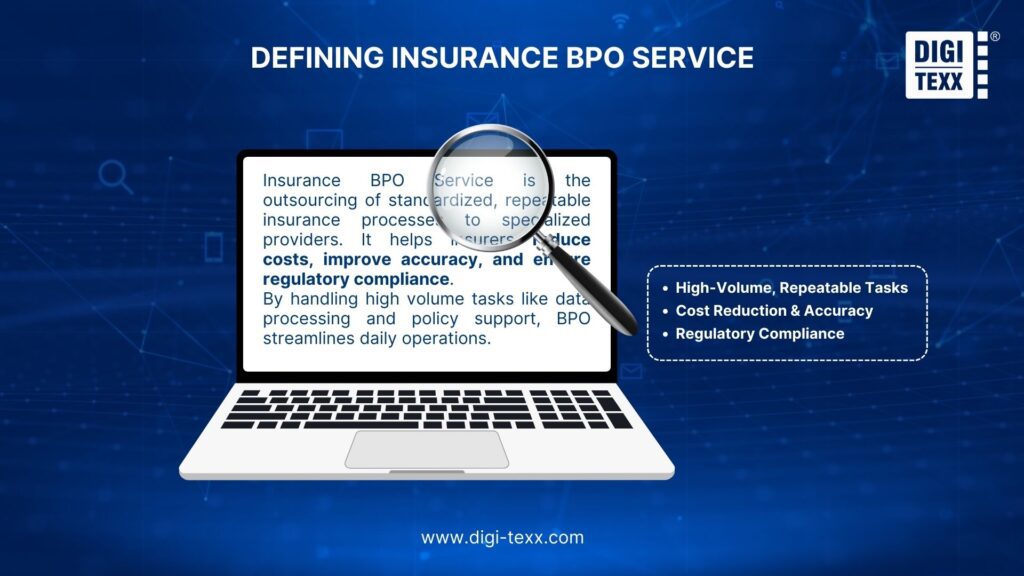
Insurance BPO Service (BPO – Business Process Outsourcing) is the practice of delegating specific, repeatable insurance operations to a specialized third party so insurers can run leaner, faster, and more compliantly.
Instead of building large in-house teams for every task, carriers use Insurance BPO Service to execute standardized processes with clear Service Level Agreements (SLAs) and measurable outcomes.
Unlike pure IT outsourcing, which focuses on system development, Insurance BPO Service involves running day-to-day operations, managing KPIs, and continuously improving performance.
By combining standardized workflows, domain expertise, automation tools like RPA and OCR, and strict governance frameworks, BPO providers free insurers from high-volume, rules-driven tasks so they can focus on core activities like product innovation, pricing strategies, distribution, and building stronger customer relationships.
How Insurance BPO Service Operates Behind The Scenes
Behind the visible outcomes, Insurance BPO Service runs on a mix of defined engagement models, technology layers, and governance practices.
Providers typically engage via lift-and-shift, co-managed, or end-to-end models depending on the insurer’s needs: they may take over a single task, co-manage a process with the insurer, or run a whole function from start to finish.
Operationally, work is orchestrated through workflow/BPM platforms and automation stacks – RPA for repetitive tasks, OCR/IDP for document capture, and APIs for integrating with core insurance systems – while chatbots and omnichannel platforms handle customer interactions.
Risk controls and compliance are embedded through role-based access, audit trails, data encryption, and regular audits or certifications. Performance is monitored continuously using KPIs, with regular reporting and continuous improvement cycles to refine processes and scale capacity during peak demand.
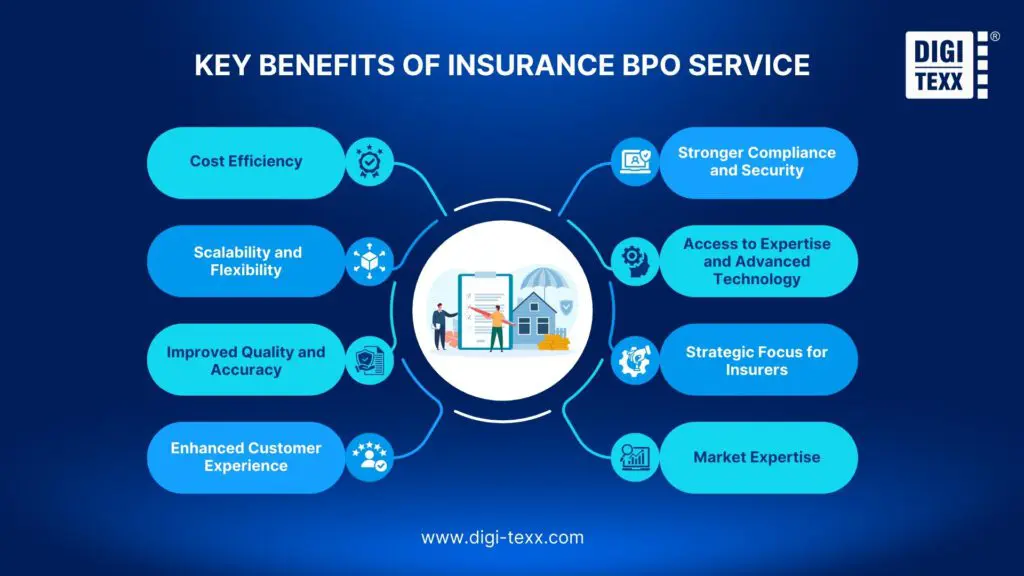
Key Benefits of Insurance BPO Service
- Cost Efficiency
One of the most immediate advantages of Insurance BPO Service is cost reduction. By outsourcing labor-intensive tasks such as claims processing or policy administration, insurers convert fixed costs into variable ones.
This eliminates the need for large in-house teams, reduces overhead for recruitment and training, and lowers cost-per-transaction. Over time, these savings improve operating margins and free capital for investment in innovation.
- Scalability and Flexibility
Insurance is a seasonal and event-driven industry. Insurance BPO Service provides the ability to quickly scale resources up or down based on demand, whether during catastrophe events, renewal seasons, or new product launches.
This flexibility ensures consistent service levels without the burden of maintaining standby staff or facing costly cycles of hiring and layoffs.
- Improved Quality and Accuracy
Specialized BPO providers bring standardized processes, trained domain experts, and automation tools like RPA, OCR, and rules engines. This combination leads to higher first-time-right rates, fewer errors, and improved data quality.
By reducing rework and inconsistencies, insurers minimize leakage, disputes, and compliance risks, while delivering more reliable outcomes to customers.
- Enhanced Customer Experience
When processes are faster and more accurate, customers benefit directly. Insurance BPO Service often includes omnichannel customer support and real-time updates, which shorten turnaround times and build trust.
Quicker claims settlements and transparent communication drive higher satisfaction and loyalty, ultimately supporting retention and revenue growth.
- Stronger Compliance and Security
Regulatory complexity is a constant challenge for insurers. BPO providers help address this by embedding compliance frameworks, maintaining certifications such as ISO 27001 or GDPR, and implementing secure data management practices.
By delegating compliance-heavy tasks to providers with robust controls, insurers reduce regulatory risk and administrative overhead.
- Access to Expertise and Advanced Technology
Recruiting niche talent and implementing advanced systems can be both challenging and expensive for insurers. Through Insurance BPO Service, companies are able to tap into a ready pool of domain experts without the delays and costs of building those capabilities internally.
In addition, BPO partners typically bring access to state-of-the-art tools such as intelligent document scanning, fraud detection models, and workflow automation platforms.
This combination allows insurers to accelerate their digital transformation journey, experiment with innovative solutions, and scale new capabilities more quickly, all while avoiding heavy upfront infrastructure and staffing investments.
- Strategic Focus for Insurers
When insurers delegate repetitive, transaction-heavy processes to Insurance BPO Service, their internal teams gain the freedom to concentrate on higher-value priorities.
Instead of being tied up with administrative workloads, staff can channel their efforts into areas such as developing innovative insurance products, refining pricing strategies, expanding distribution networks, and nurturing long-term customer relationships.
This shift of focus not only enhances organizational agility but also sharpens the insurer’s ability to compete and differentiate in an increasingly saturated market.
- Market Expertise
One of the often-overlooked advantages of Insurance BPO Service is access to deep market-specific expertise. When insurers outsource operations to providers in regions like Asia, they gain not only cost efficiency but also localized knowledge of customer behavior, cultural nuances, and regulatory environments.
This market expertise allows insurers to better tailor their offerings, avoid compliance pitfalls, and enter new markets with greater confidence. By leveraging the insights and experience of local BPO teams, companies can enhance their competitiveness and deliver services that resonate more effectively with policyholders in diverse regions.
>>> See more:
- Healthcare BPO Services – Cost Optimization & Improve Care 2026
- What Is A Back Office Service? Examples, Benefits, And Cost In 2026
- Top 10 Data Processing Software For Business 2026 – Best Tool Reviewed
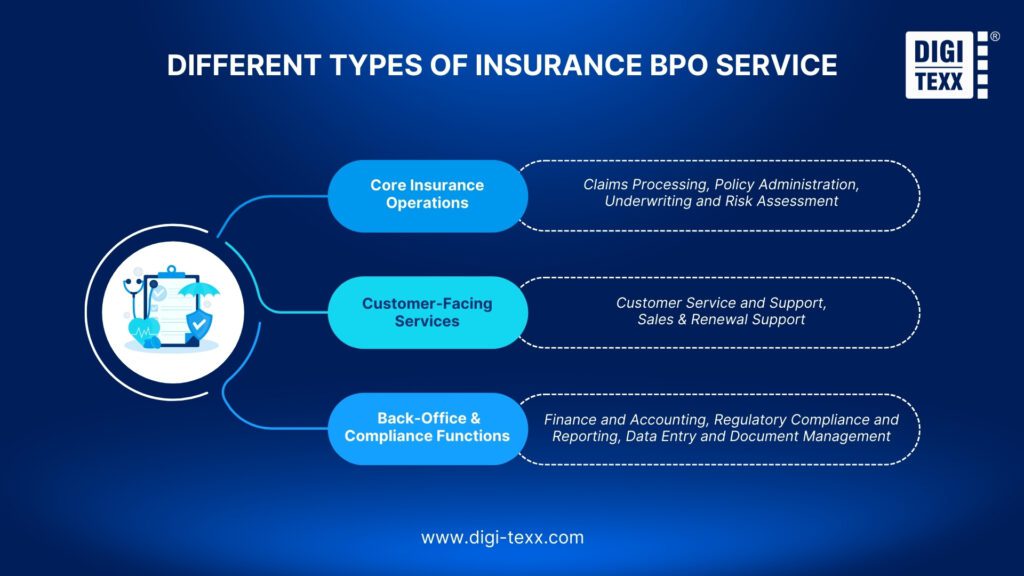
Exploring the Different Types of Insurance BPO Service
Core Insurance Operations
Claims processing is one of the most resource-intensive functions in insurance, making it a natural candidate for outsourcing. BPO providers handle the entire claims lifecycle, starting from the First Notice of Loss, document collection, verification, triage, and finally settlement.
By leveraging automation tools such as IDP and RPA, BPO partners accelerate claim intake and reduce the amount of manual intervention required. Outsourcing claims processing not only speeds up turnaround times but also improves accuracy and reduces operational costs.
Insurers benefit from standardized workflows, round-the-clock claims support, and scalable resources that can adapt to sudden claim surges. Faster claim resolution builds customer trust and enhances loyalty, while reducing leakage and dispute rates that can impact profitability.
- Policy Administration
Policy administration covers the end-to-end management of insurance policies, including issuance, endorsements, renewals, and cancellations. These are repetitive yet detail-sensitive tasks where even small errors can cause delays or customer dissatisfaction.
Insurance BPO Service helps by digitizing policy workflows, ensuring data accuracy, and providing real-time updates to both insurers and policyholders. With outsourcing, insurers can issue policies faster, handle renewals more efficiently, and minimize administrative backlogs.
Beyond efficiency, outsourcing policy administration allows insurers to scale their operations without constantly expanding their in-house teams. This flexibility is particularly valuable during seasonal peaks, such as when large volumes of renewals occur at the same time.
- Underwriting and Risk Assessment
Underwriting requires careful evaluation of risk, but much of the process involves collecting and organizing data – tasks that can be streamlined through outsourcing. Insurance BPO Service supports underwriters by gathering medical records, driving history, financial documents, and other relevant data, then preparing submission packages.
Many providers also use rule-based automation and predictive analytics to perform preliminary risk assessments.
By outsourcing, underwriters can spend less time on administrative tasks and more time on complex, high-value decision-making. This speeds up the approval process for standard applications while ensuring greater accuracy and consistency.
Ultimately, outsourcing underwriting support improves operational efficiency while helping insurers respond to customer applications more quickly.
Customer-Facing Services
Customer expectations in insurance have shifted dramatically – today, policyholders demand faster responses, 24/7 availability, and personalized communication. Insurance BPO Service enables insurers to meet these expectations through omnichannel support across phone, email, chat, and even social media.
BPO partners train their teams to manage everything from simple inquiries to complex claims updates, ensuring consistency in service quality. Key performance indicators like First Contact Resolution and Customer Satisfaction are closely tracked to maintain high service levels.
By outsourcing customer service, insurers can improve response times, lower abandonment rates, and enhance the overall policyholder experience. Stronger service delivery leads to higher retention, more referrals, and improved brand reputation in a competitive market.
- Sales & Renewal Support
Sales & Renewal Support helps insurers drive new business and protect existing revenue by streamlining pre-sales, onboarding, and renewal workflows. Typical activities include lead qualification, quote & illustration prep, proposal packaging, appointment scheduling for agents/brokers, policy reinstatement handling, and proactive renewal outreach.
BPO teams also manage data hygiene in CRM, prepare compliant disclosures, and coordinate with underwriting to shorten time-to-quote and time-to-bind. The impact shows up in higher conversion and renewal rates, reduced acquisition cost, and more predictable premium retention.
To maximize results, pair trained domain reps with automation, segment customers by risk/value, and run structured A/B testing on messages and offers – while keeping disclosures and consent tracking compliant across jurisdictions.
Back-Office & Compliance Functions
- Finance and Accounting
Finance and accounting functions are critical but often bogged down by repetitive work such as premium billing, collections, reconciliations, and commission tracking.
Insurance BPO Service takes on these tasks using structured workflows and automated platforms to ensure billing accuracy and timely collections. They also generate financial reports and maintain compliance with accounting standards.
Outsourcing finance and accounting helps insurers optimize cash flow, reduce Days Sales Outstanding, and minimize costly errors. It also alleviates the burden on internal finance teams, freeing them to focus on more strategic initiatives like forecasting and financial planning.
As insurers expand, outsourcing ensures financial operations can scale without heavy administrative overhead.
- Regulatory Compliance and Reporting
The insurance industry operates under strict regulations, making compliance both critical and complex. Insurance BPO Service assists insurers in meeting these requirements by preparing regulatory filings, maintaining audit trails, and ensuring timely statutory reporting.
Many BPO providers bring in specialized compliance expertise and certifications such as ISO 27001 or SOC 2. By outsourcing compliance-related functions, insurers reduce the risk of non-compliance penalties and avoid the heavy costs of maintaining large in-house compliance teams.
Outsourcing also provides insurers with the agility to adapt to regulatory changes across multiple markets, ensuring that compliance remains a proactive process rather than a reactive challenge.
Insurance operations rely heavily on documents – applications, claims forms, contracts, and regulatory paperwork. Traditionally, managing this information required large amounts of manual data entry, which was slow and error-prone.
Today, Insurance BPO Services leverage tools such as OCR and IDP to digitize and structure documents at scale. Outsourcing document management not only reduces manual errors but also improves data accessibility and retrieval.
Insurers can quickly search, validate, and analyze digitized records, leading to better decision-making and smoother workflows. This capability is especially critical as the industry shifts toward digital transformation, where having clean, structured, and easily retrievable data is a key competitive advantage.
>>> See more:
- Construction Invoice Reconciliation: Best Practices, Software & Outsourcing
- Top 10 Outsourced AI Training Data Companies in 2026
- Best Real Estate Image Processing Services 2026: Top 15 Providers
Why Is Insurance BPO Service Crucial?
Insurance BPO Services are becoming essential in today’s competitive insurance market. They allow insurers to streamline complex, time-consuming tasks so internal teams can focus on innovation and customer engagement.
Another key reason they are crucial is their role in accelerating digital transformation. Instead of relying on outdated manual systems, insurers can benefit from automation, analytics, and standardized workflows provided by BPO partners, leading to faster and more accurate operations.
These services also help insurers manage growing regulatory demands and talent shortages. By outsourcing to specialized providers, companies gain access to skilled professionals and built-in compliance expertise while maintaining flexibility to scale during peak periods.
Most importantly, Insurance BPO Service improves the customer experience. Faster claim settlements, 24/7 support, and greater accuracy contribute to higher satisfaction and stronger loyalty. For these reasons, BPO is no longer just a cost-saving measure but a critical driver of efficiency, resilience, and long-term growth in the insurance industry.
Top Insurance BPO Companies For 2026
DIGI-TEXX
DIGI-TEXX is a trusted offshore BPO provider with more than 20 years of experience, delivering high quality business process outsourcing solutions for global enterprises. As one of the reliable insurance outsourcing companies, DIGI-TEXX provides Best BPO services for insurance by supporting insurers with data focused, accuracy driven, and compliance oriented operations.
With a strong presence in Asia and Europe, DIGI-TEXX helps insurance companies reduce operating costs, scale teams efficiently, and maintain strict data security standards while ensuring consistent service quality.
Advantages
- Strong expertise in insurance back office operations, especially data processing and document management.
- High accuracy supported by standardized quality assurance processes.
- Cost effective service models compared to large multinational BPO providers.
- Flexible engagement models suitable for both long term partnerships and scalable projects.
- Strong focus on data security, privacy, and regulatory compliance.
Disadvantages
- Not positioned as a full scale AI platform provider like some large global BPO companies.
- Advanced AI based solutions are applied selectively depending on client needs.
Core services
- Insurance data processing and data management.
- Claims data validation and document digitization.
- Policy data entry and administrative support.
- Finance and accounting support for insurance operations.
- Secure offshore BPO services for insurance companies.

Infosys BPM
Infosys BPM is a global business process outsourcing company with over 20 years of experience, providing digital and technology-driven BPO solutions for enterprises worldwide.
Advantages
- Strong industry expertise across insurance, finance, healthcare, and banking.
- Large global workforce enabling scalable operations.
- Advanced use of AI, RPA, and automation to improve efficiency and accuracy.
Disadvantages
- Higher service costs compared to mid-sized BPO providers.
- Less flexible for small-scale or short-term projects.
Core services
- Insurance claims processing and policy administration.
- Finance and accounting operations.
- Customer support and contact center services.
- Automation and AI-driven business process solutions.
EXL Service
EXL Service is a global BPO company that supports businesses by combining data, AI, and deep industry expertise. As one of the well-known insurance outsourcing companies, EXL helps insurers simplify complex operations and improve decision-making across both life and general insurance.
Advantages:
- Strong focus on data modernization, helping insurance companies prepare clean and structured data for AI-driven insights.
- Advanced AI-powered automation that reduces manual work and improves customer experience.
- Deep domain expertise in insurance operations, especially claims and underwriting.
- Ability to integrate AI tools smoothly into existing workflows.
Disadvantages
- Heavy reliance on data readiness, which may require upfront data restructuring for some clients.
- AI-driven solutions may be more suitable for mid-to-large insurance enterprises than small firms.
Core services
- Claims management and processing.
- Underwriting support.
- Policy administration.
- Data management and analytics.
- AI-driven automation for insurance workflows.

How To Choose The Right Insurance BPO Service Provider
Choosing the right insurance BPO service provider requires a clear evaluation framework, as the decision can directly impact operational efficiency, service quality, and long-term growth. By carefully assessing BPO services for insurance, businesses can identify partners that align with their strategic goals, technical requirements, and scalability needs before committing to a long-term outsourcing relationship.
Clarify Objectives And Evaluate Expertise
Start by defining your outsourcing goals – whether you want to reduce costs, improve efficiency, or enhance customer experience. From there, look for providers with proven experience in your line of insurance and ask for case studies or client references to validate their track record.
Assess Technology, Security, And Compliance
A strong BPO partner should offer modern tools like automation, intelligent document processing, and analytics, while also ensuring seamless integration with your existing systems. At the same time, verify that they meet strict data security standards and regulatory requirements through certifications, encryption practices, and disaster recovery plans.
Review Operating Model, SLAs, And Scalability
Understand how the provider manages outsourced processes – whether they take full control or work in a co-managed model. Clear SLAs covering turnaround time, accuracy, and escalation procedures are essential. Companies should also evaluate their ability to scale quickly during seasonal peaks or unexpected surges in demand.
Consider Pricing, Transition, And Cultural Fit
Beyond cost, look for transparency in pricing models and ensure there are no hidden fees. A structured transition plan with knowledge transfer and phased onboarding will minimize disruption. Finally, cultural alignment matters: a provider that shares your values on customer service and continuous improvement will likely be a stronger long-term partner.

Reasons To Choose DIGI-TEXX As A BPO Partner For Insurance
DIGI-TEXX stands out among top insurance BPO companies by aligning closely with the key selection criteria businesses look for when outsourcing insurance operations.
Proven Insurance Back Office Expertise
Unlike providers that focus heavily on AI platforms or broad digital transformation, DIGI-TEXX specializes in insurance back office operations such as data processing, document management, and policy administration. This focused expertise ensures accuracy, consistency, and faster onboarding for insurance projects.
Strong Data Security and Regulatory Compliance
Based on the importance of security and compliance highlighted above, DIGI-TEXX delivers clear advantages with strict data protection policies, controlled access environments, and compliance-oriented workflows. This makes it a reliable choice for insurers handling sensitive customer and policy data.
Cost Effective and Scalable Operating Model
Compared to large multinational BPO providers, DIGI-TEXX offers more cost effective service models while still meeting enterprise-level quality standards. Flexible engagement options allow insurance companies to scale teams efficiently during peak periods without long-term overhead risks.
Clear SLAs and Quality Assurance Frameworks
DIGI-TEXX operates with well-defined SLAs covering accuracy, turnaround time, and escalation procedures. Multi-level quality assurance processes help maintain consistent service quality across long-term partnerships and high-volume insurance projects.
Smooth Transition and Cultural Fit
With extensive experience working with global insurance clients, DIGI-TEXX provides structured transition plans, clear communication, and collaborative working models. This reduces disruption during onboarding and supports long-term operational alignment.
Case Study: Intelligent Document Scanning Solution
A leading life insurance company in Vietnam, serving over 1.5 million customers through nearly 90 branches, was struggling with the massive volume of paperwork generated every day.
Documents from different branches had to be manually uploaded, classified, and shared, which often led to delays, errors, and limited access for teams that needed the information. These bottlenecks not only slowed down internal operations but also directly affected the speed and quality of customer service.
To overcome this, the insurer partnered with DIGI-TEXX to implement an Intelligent Document Scanning Solution. By combining smart scanning with automated data extraction and validation, the system transformed how documents were handled.
Instead of relying on manual sorting, the platform could now recognize different document types, extract key data points, check for accuracy, and route them to the correct department. Built on a modular micro-service architecture, the solution allowed workflows to be customized, monitored in real time, and easily integrated with the insurer’s existing systems.
The impact was immediate and measurable. Manual work and processing time were cut in half, while data accuracy increased significantly – from around 70% with manual handling to 97% with the automated system.
With faster document processing and reduced errors, customers experienced quicker claim settlements and smoother policy services. For the insurer, this not only meant greater efficiency but also a more resilient and scalable foundation for future digital transformation.
Insurance BPO Service As A Driver Of Efficiency And Growth
Insurance BPO Service offers insurers a practical route to simplify operations and improve performance. By outsourcing repetitive, rules-driven tasks – such as claims handling, policy administration, and document processing – companies can reduce costs, cut error rates, and shorten turnaround times without heavy capital or headcount commitments.
More than an efficiency play, BPO enables faster adoption of automation and modern workflows. Partners that bring proven technology, compliance controls, and domain expertise help insurers modernize incrementally and unlock better data for analytics, pricing, and fraud detection.
Ultimately, the value of Insurance BPO lies in its ability to free internal teams to focus on strategic priorities: product innovation, customer experience, and market growth.
Choose a partner with the right mix of industry know-how, security, and transparent SLAs, start with a focused pilot, and scale the wins – turning operational savings into sustained competitive advantage.
Frequently Asked Questions About BPO Services For Insurance
What Is BPO For Insurance?
Insurance BPO refers to outsourcing key insurance functions such as claims processing and underwriting support to a third-party provider. This helps insurance companies reduce costs, improve efficiency, and allow internal teams to focus on higher-priority tasks.
Who Are The Top BPO Companies?
DIGI-TEXX is a name worth considering. With over 20 years of experience in offshore BPO, the company is known for stable service quality, strong data security practices, and cost-effective solutions, especially in insurance and data processing. For businesses looking for a reliable outsourcing partner without the complexity of large global BPOs, DIGI-TEXX is a practical option.
>>> See more:
- Automated Insurance Claims
- What Is Business Process Outsourcing (BPO)? Definition & Examples
- Outsource Data Processing Services – Transforming Business Operations With BPO Solutions
DIGI-TEXX Contact Information:
🌐 Website: https://digi-texx.com/
📞 Hotline: +84 28 3715 5325
✉️ Email: [email protected]
🏢 Address:
- Headquarters: Anna Building, QTSC, Trung My Tay Ward
- Office 1: German House, 33 Le Duan, Saigon Ward
- Office 2: DIGI-TEXX Building, 477-479 An Duong Vuong, Binh Phu Ward
- Office 3: Innovation Solution Center, ISC Hau Giang, 198 19 Thang 8 street, Vi Tan Ward