
The data analysis process plays a critical role in helping businesses make informed decisions rather than relying on intuition or guesswork. In this guide, DIGI-TEXX walks you through the six steps of data analysis process with examples, from defining clear goals to applying insights effectively, helping organizations reduce costs, improve efficiency, and build sustainable competitive advantages in the market.
=> See more:
- What are Data Processing Services? Key Types and Benefits
- 10 Best AI Process Automation Tools Free In 2026
- AI In BPO: Benefits, Applications, Challenges & Future Trends
6 Steps Of Data Analysis
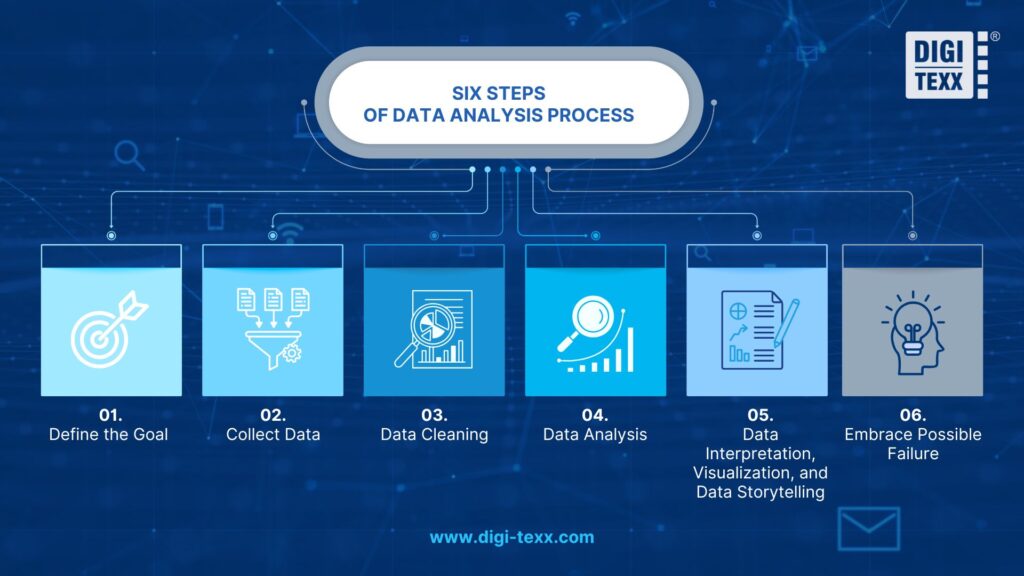
Step 1: Define The Goal – First Step In Data Analytics Process
The first and most important step in any data analytics process is to clearly define the problem you or your organization is trying to solve. This involves formulating specific, measurable questions that will guide the subsequent analysis. Without a clear goal, analytics efforts can waste resources and generate insights and information that are not relevant to the final decision.
When defining the goals for data analysis, consider the following factors:
- Specific business issues that need to be addressed
- Key metrics for a successful project
- Stakeholder needs and expectations
- What decisions will be made based on the results of the data analysis?
- Time and resources for data analysis
To illustrate a Data analysis in a research example, instead of setting a vague goal like “improve sales,” a more effective objective would be to “identify the factors that caused the 15% decline in sales in the last quarter in the southwest region and recommend three strategies for improvement.”
=> You might concern: Mastering Real-Time Data Scraping | Key to Instant Data Insights
Step 2: Collect Data
Once you have a specific goal, the next step in the steps of data analysis involves collecting data from a variety of sources. The data analysis method you will use will depend on the collection of the appropriate information. Data collection should be purposeful, focusing on collecting information that will directly support your analysis goals.
Within the steps of data analysis in research, data sources may include:
- Internal databases and customer relationship management (CRM) systems
- Customer surveys and feedback forms
- Website metrics and how users interact with the site
- Social media engagement metrics
- Market research and industry reports
- Transaction history and sales statistics
- IoT devices and sensor data
- Public data and government decrees/policies
The quality of the process will directly depend on the quality of the data collected before the analysis begins. Therefore, companies & organizations must ensure proper data governance, including documenting data sources, collection methods, and compliance with confidentiality.
=> You might concern: What is Automated Document Processing and How Does It Work?
Step 3: Data Cleaning
Data cleaning is the most important but time-consuming stage of the data analysis process. Within the steps of data analysis, this phase ensures that raw data is accurate, consistent, and ready for further processing. Raw data often contains errors, duplicates, missing data, and inconsistencies that must be resolved before analysis. Research shows that data scientists and filter scientists spend up to 80% of their time on data preparation activities before starting analysis.
At this point, people will look to automated data processing tools. Automatic data processing can help optimize these steps in the following ways:
- Eliminate duplicate values that can skew results
- Handle missing values in data by assigning values or deleting
- Standardize formats and units across different data sources
- Detect and correct unusual or outlier data points.
- Normalize data for more consistent analysis
- Validate data against given rules: business rules or logical constraints
Effective data cleaning requires both technical skills and domain knowledge in that field. Automatic data processing systems increasingly incorporate machine learning to identify data quality issues and suggest fixes. The time spent on this step will become more optimized over time.
=> See more:
- What is Data Cleaning? Benefits, Process, and How It Works
- Accounts Receivable Service | Invoicing, Billing & AR Management
- Ecommerce Back Office Support Services For Fast Growth
Step 4: Data Analysis
Once the data has been cleaned, the next stage in the steps of data analysis is where real value is created—data analysis itself. At this point, analysts apply appropriate techniques based on their business objectives and the insights they want to uncover. While there are many analytical methods available, the key lies not in how many techniques you use, but in how effectively you apply them to answer the right questions.
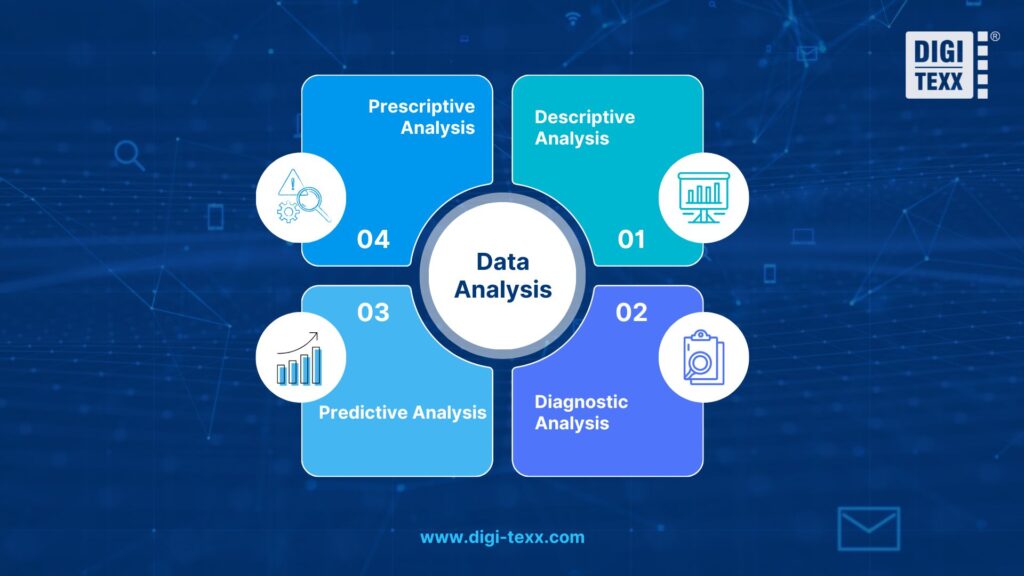
Broadly, data analysis techniques fall into four main categories:
Descriptive Analysis
Descriptive analysis focuses on understanding what has already happened. It summarizes historical data to identify patterns, trends, and overall performance. For example, a company might analyze course completion rates, user activity over a specific period, or sales performance over several years. While this type of analysis does not explain causes, it provides a solid foundation for deeper investigation.
Diagnostic Analysis
Diagnostic analysis goes a step further by explaining why something happened. As part of the steps of data analysis, it examines relationships and correlations between variables to uncover the root causes of outcomes. For instance, a business may discover that declining customer retention is linked to delivery speed, project costs, or industry-specific challenges—insights that are critical for improving decision-making.
Predictive Analysis
Predictive analysis uses historical data, statistical models, and machine learning to forecast future outcomes. Organizations commonly rely on this approach to anticipate customer behavior, market trends, or potential risks. From predicting insurance claims to identifying seasonal buying patterns in retail, predictive analytics enables data-driven planning and proactive strategies.
Prescriptive Analysis
Prescriptive analysis represents the most advanced stage of the steps of data analysis, as it recommends specific actions to achieve optimal results. By combining insights from descriptive, diagnostic, and predictive analysis, it helps organizations decide what to do next—such as optimizing operations, investing in new opportunities, or automating complex decision-making processes.
=> You might concern:
- Top 10 Big Data Processing Tools for Business 2026
- Top 10 Data Cleansing Companies for Businesses in 2026
- Outsourcing Advantages & Disadvantages: What Businesses Should Know?
Step 5: Data Interpretation, Visualization, And Data Storytelling
After analysis, the raw results must be interpreted or transformed into compelling visuals to communicate to decision-makers. Even the most sophisticated data processing and analysis will be worthless if decision-makers cannot understand the implications of the process that has been analyzed.
Steps of data analytics include:
- Create data charts, providing relevant information to decision-makers.
- Create interactive tables and charts that easily reveal new information.
- Storytelling with data and explaining the important things behind the numbers
- Link the newly analyzed findings to business goals and KPIs.
- Highlight new information that can be immediately acted upon, thereby driving decision-making.
- Create a context, a hypothetical environment that is appropriate for interpreting the results.
However, the analysis will not be 100% accurate, and it is necessary to provide limitations and confidence levels in the data you have analyzed.
Effective data-based storytelling will transform abstract numbers into a compelling story. For example, instead of simply reporting that the customer churn rate is 23%, the data-based story could explain how price changes affect customer segments. Therefore, what customer retention strategies are needed. At this point, you can rely on AI data processing models to further reference the results.
Step 6: Embrace Possible Failure
Finally, we must all acknowledge that data analysis is an iterative process, and there will be failures that you will recognize when looking at the data. This stage is one of the most critical steps of data analytics, as it focuses on evaluating outcomes and learning from both successes and mistakes. By noting challenges, tried and failed methods, and remaining limitations, analysts can refine their methods for current results, as well as for future analyses.
This step will include actions such as:
- Reviewing the performance of the analysis based on the initial goals set
- Noting limitations and assumptions that affect the results
- Taking immediate action that could change the results
- Collecting metrics on changes made to measure their impact
- Optimizing and continuously improving the data analysis process
- Creating a common knowledge repository to store lessons learned
- Creating a process to develop, test, and repeat similar analyses
Companies and organizations with a robust data analysis framework will recognize that their initial hypotheses will often be incorrect, but these ‘failures’ will generate more valuable insights in the future. Creating an acceptance mentality for further analytical experimentation will motivate more innovative approaches to solving data problems in the future.
>>> See more:
- Define Business Process Outsourcing (BPO): Meaning, Examples & Benefits 2026
- Accounts Payable Outsourcing: How It Works, Benefits & Top Providers
- Purchase Orders Processing: Steps, Types, Best Practices
Real-World Example Of The Data Analysis Process
To better understand how the steps of data analysis are applied in real business environments, let’s explore a practical example from an e-commerce company.
Scenario: Revenue Decline Despite Stable Traffic
An e-commerce business experiences a 20% drop in revenue over two consecutive quarters, even though website traffic remains stable. This signals that the issue is not traffic acquisition, but likely related to conversion, customer behavior, or pricing strategy.
Step 1: Define the Goal
The company defines a clear and measurable objective: Identify the root causes of the revenue decline and recommend actionable strategies to recover growth within the next quarter.
Key metrics are selected, including conversion rate, average order value (AOV), and customer retention rate.
Step 2: Collect Data
The team gathers data from multiple sources to ensure a comprehensive analysis:
- Website analytics (traffic, bounce rate, session duration).
- Transaction data (orders, revenue, AOV).
- Customer segmentation (new vs returning users).
- Marketing campaign performance.
- Product pricing and inventory.
Step 3: Data Cleaning
Before analysis, the dataset is prepared to ensure accuracy and consistency:
- Remove duplicate transactions.
- Handle missing or incomplete data.
- Standardize formats (dates, currency).
- Filter out bot or invalid traffic.
This step ensures the reliability of the analysis results.
Step 4: Data Analysis
Different analytical techniques are applied to uncover insights:
- Descriptive analysis shows revenue decline began after a pricing update.
- Diagnostic analysis reveals a drop in returning customers.
- Segmentation analysis identifies mid-tier customers as the most impacted group.
Step 5: Data Interpretation and Visualization
The insights are presented through dashboards and visual reports:
- Conversion funnel highlights drop-offs at checkout.
- Cohort analysis shows declining retention after pricing changes.
These visualizations help stakeholders quickly understand the problem and align on solutions.
Step 6: Take Action and Optimize
Based on the findings, the company implements targeted improvements:
- Introduce personalized promotions for returning customers.
- Optimize the checkout process to reduce friction.
- Adjust pricing strategies for sensitive customer segments.
After implementation, the company observes improvements in conversion rate, retention, and overall revenue-demonstrating the real impact of a structured data analysis process.
>>> See more;
- 5 Advantages Of Data Annotation Outsourcing Services for AI Projects
- Best Business Process Automation Solutions & Tools 2026
- Invoice Reconciliation Process: Step-By-Step Guide & Key Steps
Common Challenges In Data Analysis
On paper, the steps of data analysis look straightforward. But in reality, many businesses struggle to apply them effectively. The gap between theory and execution often comes from a few common challenges that can quietly undermine the entire process.
Poor Data Quality
Everything starts with data-and if your data is messy, the results will be too. Missing values, duplicate records, or outdated information can easily skew your analysis without you even realizing it.
That’s why teams often spend more time cleaning data than actually analyzing it. It may feel repetitive, but without this step, any insight you generate is hard to trust.
Data Scattered Across Systems
In most companies, data doesn’t live in one place. It’s spread across CRMs, analytics tools, spreadsheets, and internal systems that don’t always “talk” to each other.
This fragmentation makes it difficult to see the full picture. You might be analyzing one part of the business while missing another piece that completely changes the story.
Too Many Manual Tasks
A lot of data work is still done manually—copying files, cleaning spreadsheets, combining reports. It works at a small scale, but quickly becomes a bottleneck as data grows.
Manual processes not only slow things down but also increase the chance of errors, especially when teams are under pressure to deliver insights quickly.
Unclear Goals From The Start
Sometimes the problem isn’t the data-it’s the question. If you don’t clearly define what you’re trying to solve, it’s easy to get lost in the analysis and end up with insights that don’t really help the business.
A clear goal keeps the entire process focused and ensures the results can actually support decision-making.
Limited Skills Or Resources
Good data analysis sits at the intersection of technical skills and business understanding. Not every organization has that balance in-house.
Without the right expertise, even high-quality data can be underused, and opportunities for deeper insights may be missed.
How DIGI-TEXX Supports Data Analysis At Scale?
In many organizations, the biggest challenge in the data analysis process lies in preparing the data. Fragmented sources, inconsistent formats, and manual workflows often slow down the journey from raw data to insights.
DIGI-TEXX helps solve this by transforming unstructured and scattered data into clean, structured, and analysis-ready datasets, enabling faster and more reliable analytics.
Key Capabilities
- Data cleansing and validation to ensure accuracy.
- Document digitization to convert unstructured data.
- Automated data extraction to reduce manual work.
- Scalable data processing to handle large volumes efficiently.
Industry Expertise
DIGI-TEXX supports data-driven organizations across:
- Banking and finance.
- E-commerce and retail.
- Insurance.
- Government and public sector.
Business Impact
With high-quality input data, businesses can:
- Save time on data preparation.
- Improve analysis accuracy.
- Accelerate decision-making.
Ultimately, DIGI-TEXX strengthens the foundation of the entire data analysis process, helping organizations turn data into actionable insights more efficiently.
>>> See more:
- Top 10 Best Data Entry Outsourcing Companies in USA 2026
- Prepare A Classified Balance Sheet: Steps, Format & Example 2026
- Why Retail Outsourcing Is a Smart Strategy for Retail Businesses
FAQs About Steps Of Data Analysis
What Are The 5 Types Of Data Analysis?
There are five main types in the steps of data analytics:
- Descriptive Analytics: Summarizes historical data to clearly show past trends, patterns, and outcomes.
- Diagnostic Analytics: Digs deeper into the data to identify root causes and key factors behind past results.
- Predictive Analytics: Uses statistical models and machine learning to forecast future trends and behaviors.
- Prescriptive Analytics: Recommends specific actions or strategies based on predicted outcomes and business goals.
- Cognitive Analytics: Applies AI and automation to generate advanced, self-learning insights, often considered the most advanced stage in the steps of data analytics.
What Are The 6 Steps Of The Data Analysis Process?
Six steps of data analysis process:
- Step 1: Define the Goal
- Step 2: Collect Data
- Step 3: Data Cleaning
- Step 4: Data Analysis
- Step 5: Data Interpretation, Visualization, and Data Storytelling
- Step 6: Embrace Possible Failure
Which Step Of The Data Analysis Process Includes Collecting Data For Analysis?
The step that includes collecting data for analysis is the Collect Data step.This step comes after defining the problem and before data cleaning and processing, and it involves gathering relevant data from internal and external sources to build the foundation for the analysis.
These are the six steps of data analytics that DIGI-TEXX has outlined to give you a clear and practical understanding of how data analysis works in real business scenarios. By following this structured approach, organizations can improve data quality, enhance decision-making, and unlock greater value from their data at every stage of the analytics journey.
Although the steps of data analysis are clearly defined, many organizations continue to struggle with poor data quality, fragmented data sources, and manual workflows. These challenges slow analysis, reduce accuracy, and limit the value businesses can extract from their data.
With strong expertise in document and data processing, DIGI-TEXX streamlines data preparation and delivers analysis-ready data at scale. We work with organizations across banking, e-commerce, insurance, historical archives, and public-sector environments to transform complex, unstructured, and fragmented data into reliable inputs for analysis.
By combining industry-specific expertise with advanced data processing capabilities, DIGI-TEXX helps businesses move faster from raw data to actionable insights – supporting accurate analysis and confident, data-driven decision-making.
If you have any questions or would like expert advice on data analytics services, please feel free to contact us using the information below.
DIGI-TEXX Contact Information:
🌐 Website: https://digi-texx.com/
📞 Hotline: +84 28 3715 5325
✉️ Email: [email protected]
🏢 Address:
- Headquarters: Anna Building, QTSC, Trung My Tay Ward
- Office 1: German House, 33 Le Duan, Saigon Ward
- Office 2: DIGI-TEXX Building, 477-479 An Duong Vuong, Binh Phu Ward
- Office 3: Innovation Solution Center, ISC Hau Giang, 198 19 Thang 8 street, Vi Tan Ward
=> You might like:
- Optimize Your Insights with Survey Data Processing Services
- Outsource Data Processing Services – Transforming Business Operations With BPO Solutions
- Reliable Data Entry Service Provider for Your Business Needs
- What Is Automated Data Extraction? Guide, Benefits & Tools
- An Overview of Document Processing Company: What You Need to Know
Reference:
- National Institute of Standards and Technology. NIST big data interoperability framework. https://www.nist.gov
- Organisation for Economic Co-operation and Development. Data-driven innovation: Big data for growth and well-being. https://www.oecd.org