
For insurance companies, claims handling is often the moment that defines the customer experience. A delayed payment, inaccurate information, or complicated process can directly affect policyholder trust and brand reputation.
However, delivering fast and accurate claims resolution is becoming increasingly challenging as insurers manage growing data volumes, complex documentation, and strict compliance requirements.
This has accelerated the adoption of insurance claims business process outsourcing, enabling insurers to work with specialized providers that combine industry expertise, advanced technologies, and efficient workflows. Through outsourcing, companies can improve claims accuracy, shorten processing times, and provide a smoother experience for policyholders.
This guide from DIGI-TEXX explains the role of insurance claims BPO, how outsourced claims processing works, and how businesses can leverage outsourcing to improve operational performance.

>>> See more:
- Ecommerce Back Office Support Services By DIGI-TEXX
- Professional E-commerce Data Entry Services by DIGI-TEXX
- Insurance Back Office Support Services for Insurers & Agencies
What Is Insurance Claims Business Process Outsourcing?
Insurance claims business process outsourcing (Insurance Claims BPO) is the practice of delegating part or all of the insurance claims lifecycle to a specialized third-party service provider. Instead of relying solely on in-house teams, insurers outsource operational tasks such as First Notice of Loss (FNOL), claims intake, data entry, document verification, policy validation, customer communication, and settlement support to improve efficiency and service quality.
Modern insurance claims outsourcing extends beyond labor cost reduction. Leading BPO providers combine experienced claims professionals with technologies such as artificial intelligence (AI), optical character recognition (OCR), intelligent document processing (IDP), and workflow automation to accelerate claims processing, improve data accuracy, and maintain regulatory compliance. This allows insurers to scale operations during catastrophe events or periods of high claim volumes while delivering a faster, more consistent customer experience.
The growing adoption of outsourcing reflects a broader industry shift toward digital transformation. According to Zion Market Research, the global insurance business process outsourcing market was valued at approximately USD 7.5 billion in 2024 and is projected to reach around USD 10.9 billion by 2034, highlighting the increasing demand for specialized outsourcing partners that can improve operational agility and customer satisfaction.
Today, insurance claims business process outsourcing is no longer viewed solely as a cost-saving strategy. It has become a strategic operating model that enables insurers to optimize claims operations, improve policyholder experiences, and focus internal resources on higher-value business initiatives.
Types Of Insurance Claims Processing Supported By Outsourcing
Insurance claims processing outsourcing can support various insurance sectors by helping companies manage document processing, claim verification, data entry, and administrative workflows more efficiently.
Common types of insurance claims supported by outsourcing include:
| Insurance Claim Type | Outsourced Claims Support |
| Property Insurance Claims | FNOL processing, document review, claim data entry, damage assessment support, inventory documentation, fraud review |
| Health Insurance Claims | Eligibility verification, medical document processing, claims adjudication support, auditing, payment processing, reporting |
| Life Insurance Claims | Claim intake, document verification, policy validation, beneficiary support, claims administration |
| Motor Insurance Claims | Accident document review, claim verification, damage assessment coordination, payment support |
| Travel Insurance Claims | Claim validation, customer communication, document processing, settlement support |
| Commercial Insurance Claims | Policy data verification, claim documentation, administrative support, reporting |
| Liability Insurance Claims | Document collection, claim file management, data processing, customer support |
| Marine Cargo Insurance Claims | Shipping document verification, invoice processing, cargo claim documentation, settlement support |
By outsourcing different types of insurance claims processing, insurers can improve operational efficiency, reduce manual workloads, and provide faster service to policyholders.
>>> See more:
- Accounts Receivable Service | Invoicing, Billing & AR Management
- Accounts Payable Outsourcing: How It Works, Benefits & Top Providers
- Outsourcing Advantages & Disadvantages: What Businesses Should Know?
Benefits Of Insurance Companies Outsource Claims Processing
Many companies have traditionally handled claims processing in-house to retain control over data and workflows. However, rising claim volumes, stricter compliance requirements, and growing customer expectations have made this approach harder to sustain.
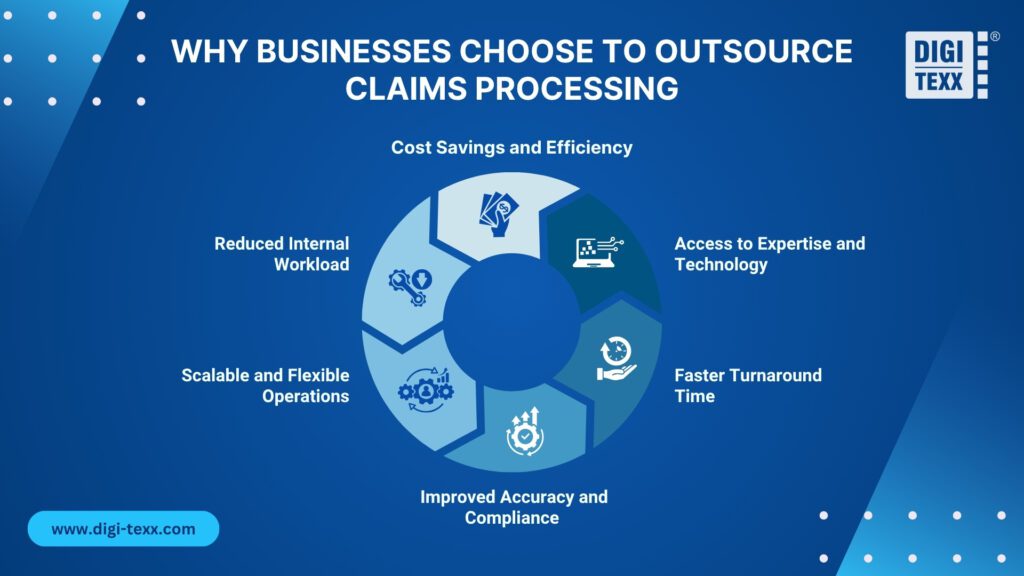
insurance claims business process outsourcing is gaining popularity among businesses looking to improve efficiency, reduce costs, and scale with ease. Here are the key reasons why it’s become a preferred solution:
1. Reduce Operational Costs
Insurance claims processing requires significant resources, including claims specialists, document reviewers, administrative staff, and technology infrastructure. For many insurers, maintaining a fully in-house operation can increase fixed costs, especially during periods when claim volumes fluctuate.
By using insurance claims business process outsourcing, companies can access trained professionals and established processing systems without investing heavily in recruitment, training, or additional infrastructure.
For example, instead of hiring temporary employees during peak claim periods, insurers can scale outsourcing resources based on actual claim volumes. This helps reduce operational expenses while maintaining processing quality.
Example: A property insurance company may experience a sudden increase in claims after a natural disaster. Instead of expanding its internal team permanently, the company can work with a BPO provider to handle additional claim intake, document processing, and verification tasks during peak periods.
2. Improve Processing Speed With Automation And Expert Teams
Fast claim resolution is becoming increasingly important as customers expect quicker responses from insurance providers.
Insurance claims business process outsourcing helps insurers improve claim turnaround times by combining experienced claims teams with automation and document processing technologies. Traditional manual processing often requires employees to review documents, enter data, and verify information step by step. This can slow down claim handling, especially when dealing with large volumes of paperwork.
Insurance claims outsourcing providers improve turnaround times by combining experienced claims teams with technologies such as:
- Optical Character Recognition (OCR)
- Intelligent Document Processing (IDP)
- Robotic Process Automation (RPA)
For example, automated document extraction can capture important claim information from forms or medical documents, reducing manual data entry time and allowing claims specialists to focus on more complex cases.
DIGI-TEXX Example: Through an automated insurance claims workflow, DIGI-TEXX helped a global insurance company reduce document processing time from 15 minutes to 5 minutes while improving claims accuracy from 98.9% to 99.95%.
3. Improve Accuracy And Reduce Processing Errors
Errors in insurance claims can lead to delayed payments, customer complaints, and compliance risks. Common challenges include:
- Incorrect data entry
- Missing documentation
- Inconsistent claim reviews
- Incorrect policy information
Insurance claims business process outsourcing can help insurers address these challenges through standardized workflows, quality control processes, and validation procedures designed to improve claims accuracy.
For example, outsourced teams can perform multiple verification steps before submitting claims for final approval, helping insurers identify missing or incorrect information earlier in the process.
Example: Healthcare insurance claims often require checking patient information, medical documents, and policy coverage. A structured review process helps reduce errors that could delay reimbursement while improving the consistency and accuracy of claims processing.
4. Access Specialized Claims Expertise
Insurance claims vary significantly depending on the coverage type, including health, property, life, and motor insurance. Building expertise across every claims category internally can require significant time and training. Insurance claims business process outsourcing allows insurers to work with specialized teams that already understand:
- Industry-specific claims procedures
- Documentation requirements
- Compliance standards
- Common claim risks
For example, a healthcare claims processing team may have experience reviewing medical documents, while property claims specialists may support damage assessment and inventory verification.
This specialized knowledge helps insurers handle different types of claims more effectively without expanding internal resources or investing heavily in additional training.
5. Scale Operations During High Claim Volumes
Insurance companies may experience sudden increases in claims due to:
- Natural disasters
- Seasonal events
- Market changes
- Business expansion
Managing these fluctuations with only internal employees can create workload pressure and increase processing delays. With insurance claims outsourcing, companies can quickly adjust processing capacity based on demand.
Example: After a major storm, property insurers may receive thousands of claims within a short period. A BPO partner can provide additional support for claim registration, document review, and customer communication to help insurers maintain service quality.
6. Allow Internal Teams To Focus On Strategic Activities
Many claims processes involve repetitive administrative tasks, such as:
- Data entry
- Document classification
- Information verification
- Status updates
Outsourcing these activities allows internal teams to spend more time on higher-value responsibilities, including:
- Complex claim decisions
- Customer relationship management
- Risk analysis
- Product improvement
This creates a better balance between operational efficiency and strategic growth.
>>> See more:
- 5 Advantages Of Data Annotation Outsourcing Services for AI Projects
- Data Labeling Service: Benefits, Top Providers & How to Choose
- Back Office Support Services For Streamlined & Efficient Operations
How Does The Claims Processing Outsourcing Workflow Work?
Outsourcing claims processing is more than just delegating tasks. It transforms a complex process into a streamlined operation that’s faster, more accurate, and easier to manage. With the right partner, businesses gain end-to-end support from claim intake to resolution.
Here is how claims processing outsourcing typically works, along with the technologies that support it:
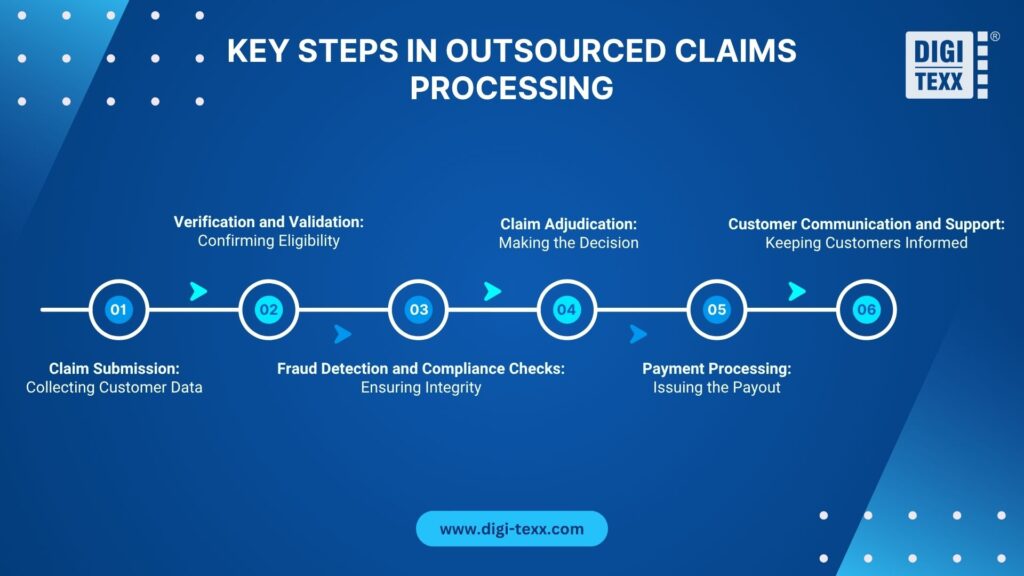
Key Steps In Outsourced Claims Processing
Claim Submission: Collecting Customer Data
The process starts when customers submit their claims through online forms, apps, customer service centers, or integrated systems. All necessary information, such as claim details, policy numbers, and documentation, is captured right from the start.
Verification and Validation: Confirming Eligibility
Claims are reviewed to ensure all required information is present and meets the basic eligibility criteria. This step helps identify missing details or mismatches early, reducing errors and processing delays.
Fraud Detection and Compliance Checks: Ensuring Integrity
Using both automated tools and expert review, each claim is checked for signs of fraud or unusual patterns. At the same time, regulatory compliance is verified to ensure every claim meets legal and policy standards.
Claim Adjudication: Making the Decision
The claim is thoroughly evaluated based on policy terms, claim history, and supporting data. A decision is made to approve, partially approve, or deny the claim, with clear documentation to support the outcome.
Payment Processing: Issuing the Payout
Once approved, the payout is processed securely and efficiently. Whether it’s a bank transfer or another method, the provider ensures that payments are completed accurately and on time.
Customer Communication and Support: Keeping Customers Informed
Customers receive timely updates about their claim status through email, messages, or direct support. Dedicated teams are available to answer questions and provide updates, improving transparency and trust.
>>> See more:
- Invoice Reconciliation Process Steps | DIGI-TEXX
- Data Validation & Verification: Differences With Clear Examples
- 15 Best Data Labeling Service Providers In 2026
Technologies Supporting Claims Processing Outsourcing
| Technology | Main Workflow Step | How It’s Used | Business Benefits |
| Artificial Intelligence | Fraud Detection and Adjudication | Analyzes data to identify fraud risks and support approval decisions | Reduces fraud, improves accuracy, accelerates claim resolution |
| Machine Learning | Verification and Compliance Checks | Learns from past data to detect anomalies and validate claim eligibility | Enhances accuracy, ensures compliance |
| Robotic Process Automation (RPA) | Data Entry and Validation | Automates repetitive tasks like data entry and document checks | Speeds up processing, reduces human error |
| Cloud-Based Platforms | All Workflow Stages | Centralizes data for real-time access and collaboration between stakeholders | Improves transparency, scales efficiently |
In-House vs. Outsourced Claims Processing
Insurance companies often evaluate whether claims processing should remain fully internal or be partially outsourced. The right approach depends on business priorities, operational complexity, and available resources.
| Criteria | In-house Claims Processing | Outsourced Claims Processing |
| Cost Structure | Requires investment in employees, infrastructure, and technology | More flexible operational costs through external resources |
| Scalability | Limited by internal workforce capacity | Easily adjusted based on claim volumes |
| Expertise | Depends on internal capabilities | Access to trained specialists |
| Technology | Requires continuous investment and maintenance | Leverages provider technologies and solutions |
| Operational Focus | Internal teams manage daily processing activities | Internal teams focus on strategic business priorities |
| Flexibility | More difficult to adapt during demand fluctuations | Faster response to changing business needs |
Rather than choosing between fully internal or fully outsourced operations, many insurers now adopt a hybrid approach that combines internal expertise with external operational support.
This model allows companies to maintain control over critical decisions while improving efficiency in document-heavy and administrative processes.
>>> See more:
- Why Retail Outsourcing Is a Smart Strategy for Retail Businesses
- Architectural Photo Editing Service in the US | Top 5 Providers
- 10 Best AI Process Automation Tools Free In 2026
Top Insurance Claims Processing Outsourcing Providers
Choosing the right insurance claims outsourcing partner can help insurers reduce administrative workload, improve claims accuracy, and scale operations without expanding internal teams. The top insurance claims processing outsourcing providers offer different capabilities, from end-to-end claims administration and healthcare BPO to medical document processing, data extraction, and claims automation.
For insurers considering business process outsourcing healthcare claims operations, the right provider depends on claims volume, document complexity, technology requirements, compliance needs, and the level of human review required. Companies evaluating health insurance claims business process outsourcing should also compare healthcare expertise, claims processing capabilities, scalability, data security, and integration requirements.
| Provider | Core Services | Best For |
| Helpware | Claims processing, medical review, adjustments, appeals, QA | Healthcare payers needing scalable claims and back-office support |
| EXL | FNOL, claims investigation, medical review, fraud, subrogation, analytics | Large insurers with complex, high-volume claims |
| Genpact | Claims processing, inspection, P&C claims, catastrophe claims, fraud detection | P&C insurers needing scalable claims management and automation |
| Sagility | Claims adjudication, adjustments, appeals, payment integrity | Health plans needing specialized healthcare claims support |
| Sutherland | Claims intake, adjudication, review, adjustments, payment integrity | Healthcare payers modernizing claims operations |
| Infosys BPM | Claims processing, FNOL, documentation, policy administration, underwriting support | Enterprise insurers outsourcing multiple insurance processes |
| Crawford & Company | Claims administration, loss adjusting, TPA, medical management, catastrophe claims | Insurers requiring global claims management and adjusting |
| ARDEM | Claims data entry, document processing, extraction, validation | Organizations handling document-heavy claims workflows |
| DIGI-TEXX | Claims processing, medical document processing, data extraction, ICD recognition | Insurers needing document digitization, extraction, and verification |
1. Helpware
Helpware provides healthcare business process outsourcing services for payers, providers, and healthcare organizations. Its healthcare operations include claims processing, medical review, member services, and other administrative workflows.
Core Services:
- Claims adjudication and processing
- Claims adjustments
- Medical review
- Claims audit and quality assurance
- Appeals and grievances
- Eligibility verification
- Healthcare data entry
Pros:
- Strong healthcare payer expertise
- Scalable delivery teams
- Supports complex healthcare workflows
- Combines technology with human processing
Best for: Healthcare payers and organizations that need scalable claims processing and broader healthcare back-office support.
2. EXL
EXL provides technology-enabled insurance operations across property and casualty, life, disability, and healthcare. Its claims capabilities cover multiple stages of the claims lifecycle, supported by analytics, automation, and industry-specific expertise. For insurers evaluating business process outsourcing healthcare claims operations, EXL offers a combination of claims expertise, digital technologies, and analytics for complex, high-volume workflows.
Core Services:
- Claims intake and first notice of loss (FNOL)
- Claims investigation and evaluation
- Medical claims review
- Fraud management
- Claims litigation support
- Subrogation and recovery
- Claims analytics
Pros:
- Extensive insurance domain expertise
- Strong analytics and AI capabilities
- Supports multiple insurance lines
- Suitable for complex claims operations
Best for: Large insurers looking for technology-enabled claims transformation and end-to-end insurance operations support.
3. Genpact
Genpact offers insurance claims management and business process services, with strong capabilities in property and casualty insurance. Its approach combines experienced claims professionals with AI, automation, digital inspection, and analytics to support more efficient outsourced claims operations. These capabilities can also support insurers implementing health insurance claims business process outsourcing where automation and scalable claims management are key requirements.
Core Services:
- Claims intake and processing
- Claims inspection and assessment
- Property and auto claims
- Catastrophe claims management
- Claims payouts
- Fraud detection
- Reinsurance recovery
Pros:
- Strong P&C insurance expertise
- AI and automation capabilities
- Experience with large-scale claims operations
- Supports Guidewire-based claims environments
Best for: P&C insurers that need scalable claims management, TPA support, or technology-enabled claims transformation.
4. Sagility
Sagility specializes in healthcare business process services for payers, providers, and healthcare organizations. Its claims operations cover claims administration, payment integrity, appeals, and other healthcare payer workflows. The provider is particularly relevant to insurers seeking business process outsourcing healthcare claims operations for routine and complex payer workflows.
Core Services:
- Claims adjudication
- Claims adjustment
- Claims appeals
- Payment integrity
- Enrollment and membership
- Pre-payment claims review
- Revenue cycle management
Pros:
- Dedicated healthcare expertise
- Strong payer operations capabilities
- Experience with complex claims workflows
- Broad healthcare BPO services
Best for: Health plans and healthcare organizations seeking specialized claims administration and payment integrity support.
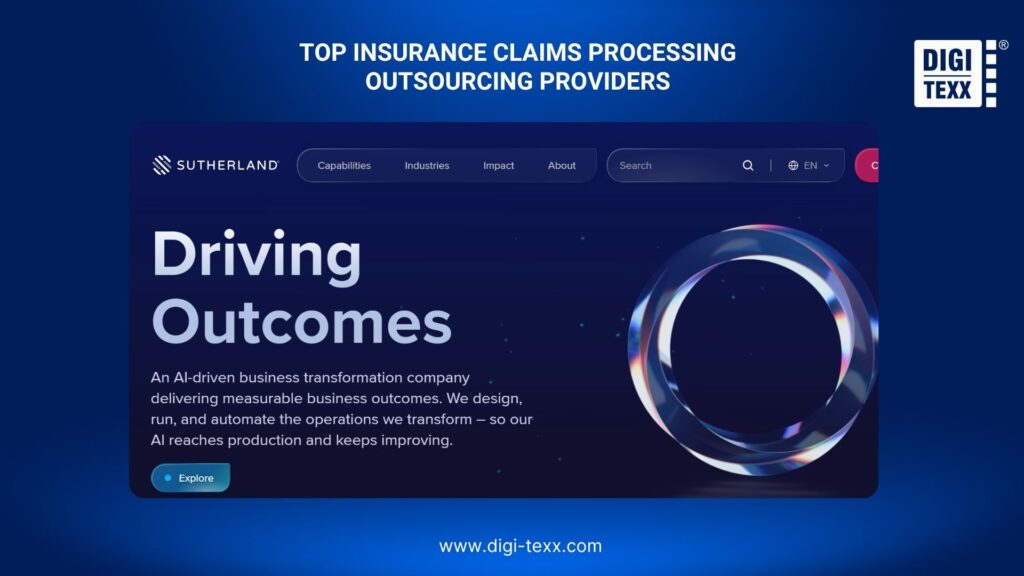
5. Sutherland
Sutherland provides healthcare claims administration and payer operations supported by automation, analytics, and managed services. Its solutions cover multiple stages of the claims lifecycle, helping healthcare organizations improve processing efficiency, accuracy, and payment integrity. Its capabilities make it a relevant option for organizations considering health insurance claims business process outsourcing to modernize payer operations.
Core Services:
- Claims intake and triage
- Claims adjudication
- Claims review and redetermination
- Claims adjustment
- Payment integrity
- Claims analytics and automation
Pros:
- Strong combination of BPO and technology
- End-to-end claims capabilities
- Focus on automation and operational efficiency
- Suitable for high-volume healthcare operations
Best for: Healthcare payers looking to modernize claims administration through AI, automation, and outsourced operations.
6. Infosys BPM
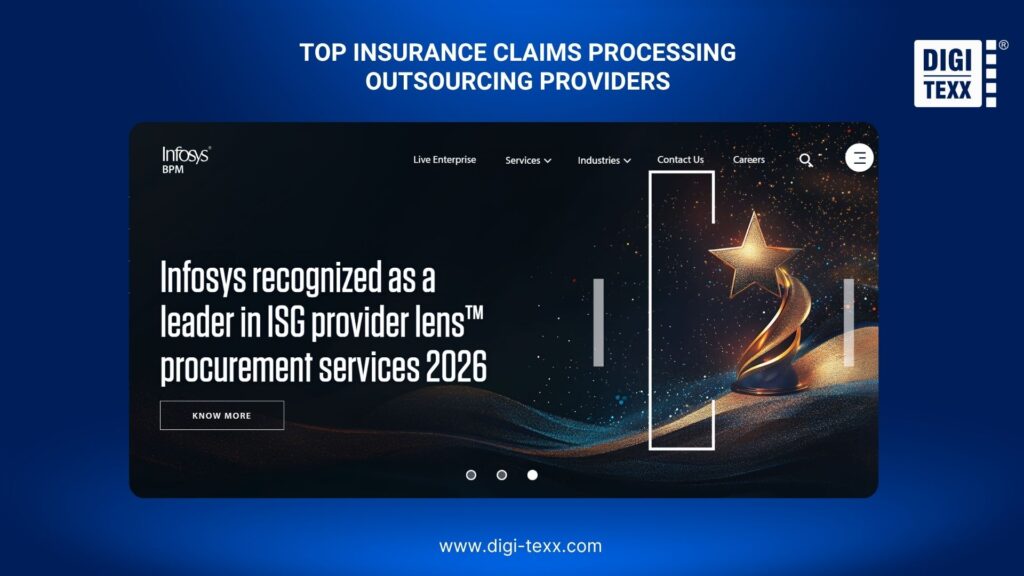
Infosys BPM provides business process management services across the insurance value chain. Its insurance operations combine process expertise with automation, analytics, and digital technologies to support claims and other back-office functions.
Core Services:
- Claims intake and FNOL
- Claims processing and management
- Exception handling
- Claims documentation
- Policy administration
- Underwriting support
- Insurance data processing
Pros:
- Broad insurance BPM capabilities
- Global delivery model
- Strong digital transformation expertise
- Supports multiple insurance processes
Best for: Enterprise insurers looking to outsource claims processing alongside policy administration and other insurance operations.
7. Crawford & Company
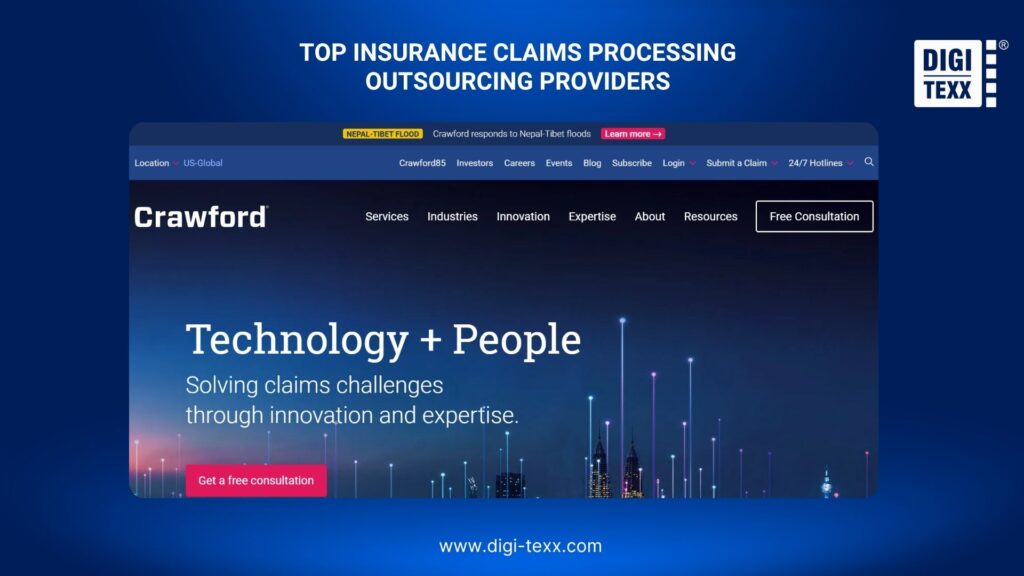
Crawford & Company is a global claims management provider specializing in claims adjusting, administration, and third-party administration. Its extensive claims network allows it to support both routine and complex claims across multiple insurance lines.
Core Services:
- Claims administration
- Loss adjusting
- Property and casualty claims
- Accident and health claims
- Medical management
- Third-party administration
- Catastrophe claims support
Pros:
- Extensive global claims infrastructure
- Strong complex claims expertise
- Broad TPA capabilities
- Large field and adjusting network
Best for: Insurers, brokers, and corporations that require global claims management, adjusting, or TPA services.
8. ARDEM
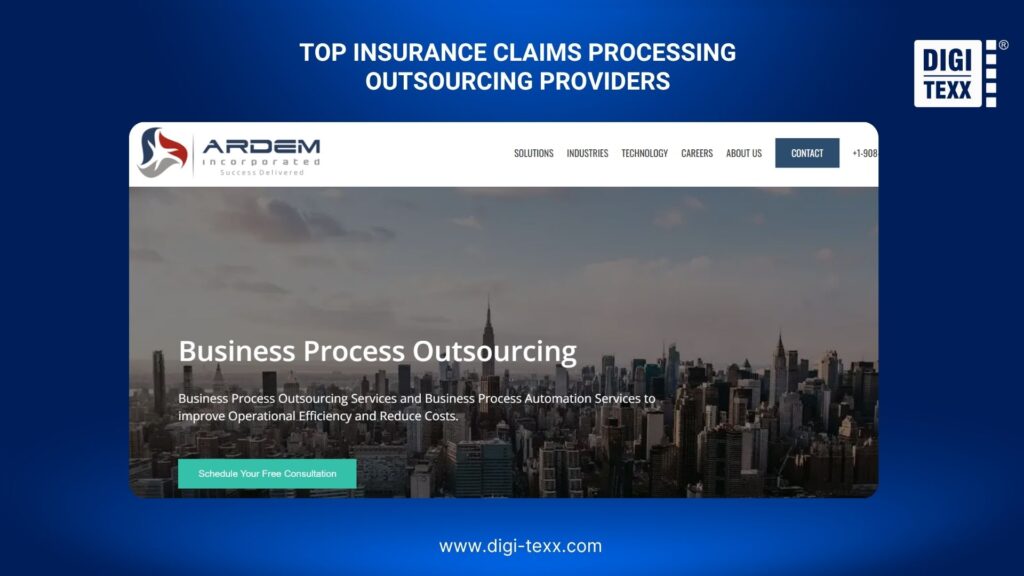
ARDEM provides insurance and healthcare BPO services with a strong focus on document-intensive processes. Its claims solutions combine data entry, document processing, extraction, validation, and quality control to reduce manual administrative work.
Core Services:
- Claims intake and data entry
- Medical claims data processing
- Document review and indexing
- Data extraction
- Claims validation
- Exception management
- Claims status processing
Pros:
- Well suited to document-heavy workflows
- Combines automation with human review
- Supports high-volume data processing
- Flexible for back-office insurance operations
Best for: Insurers and healthcare organizations handling large volumes of claims documents, medical records, and structured or unstructured data.
9. DIGI-TEXX
DIGI-TEXX provides insurance process outsourcing services focused on document processing, data extraction, verification, and intelligent automation. Its capabilities are particularly relevant to insurers handling large volumes of medical documents, scanned forms, and unstructured claims information.
For companies looking to outsource medical insurance claim processing services, DIGI-TEXX can support document-heavy claims workflows by combining AI-powered extraction with human quality control. This makes its capabilities relevant to health insurance claims business process outsourcing where accurate medical document processing and claims data extraction are important.
Core Services:
- Insurance claims processing
- Medical document processing
- Claims data extraction and verification
- Hospital discharge document processing
- ICD code recognition
- Insurance document scanning and digitization
- Claim payment letter processing
- Metadata and image data transfer
Pros:
- Strong focus on document-intensive insurance workflows
- Combines OCR, AI, and human quality control
- Supports structured and unstructured medical documents
- Suitable for high-volume data extraction and verification
- Can reduce manual document processing and data entry
Best for: Insurance companies, healthcare organizations, and financial services businesses that need outsourced medical document processing, claims data extraction, verification, and digitization.
How To Choose The Right Claims Processing Outsourcing Partner?
Choosing the right outsourcing partner is critical to the success of your claims processing strategy. The right provider should not only deliver operational efficiency but also align with your business goals, industry standards, and customer expectations.
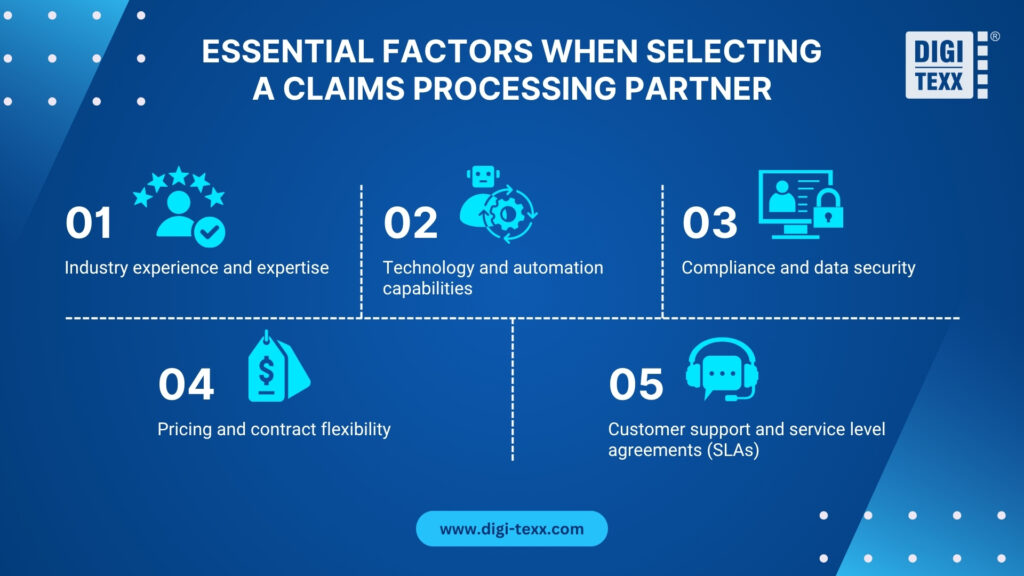
A reliable outsourcing partner should do more than handle daily claims tasks. They should understand your business requirements, follow industry regulations, protect sensitive data, and have the technology and expertise needed to support your long-term growth. Before selecting a claims processing outsourcing partner, consider the following key factors:
1. Industry Experience And Claims Expertise
Every insurance business has different requirements depending on the type of claims they handle, customer needs, and regulatory standards.
A provider with experience in insurance claims processing will better understand:
- Claims workflows and documentation requirements
- Industry regulations and compliance needs
- Common challenges in claims handling
- Quality standards for accurate processing
Working with an experienced provider helps businesses reduce onboarding time, minimize errors, and ensure smoother operations. Before making a decision, review the provider’s previous projects, industry experience, and case studies to evaluate their capabilities.
2. Technology And Automation Capabilities
Technology plays an important role in improving the speed and accuracy of claims processing.
A modern insurance claim BPO providers should have experience with solutions such as
- Artificial Intelligence (AI) for data analysis and decision support
- Optical Character Recognition (OCR) for document processing
- Robotic Process Automation (RPA) for repetitive tasks
- Cloud-based platforms for secure collaboration and data access
These technologies help reduce manual work, improve processing accuracy, and allow businesses to scale operations more easily.
3. Data Security And Compliance Standards
Insurance claims often involve sensitive information, including personal data, financial records, and medical documents. Therefore, data security should be one of the top priorities when choosing a BPO partner.
A trusted provider should have:
- Strong data protection policies
- Secure access controls
- Regular security assessments
- Compliance with relevant industry standards
Depending on the market and service scope, businesses may need to consider regulations and certifications such as HIPAA, GDPR, ISO standards, or PCI-DSS.
A strong security framework helps protect customer information and reduces risks related to data breaches.
4. Pricing Model And Contract Flexibility
Cost reduction is one of the main reasons companies choose claims processing outsourcing. However, businesses should look beyond pricing alone.
A suitable provider should offer:
- Transparent pricing models
- Flexible service packages
- Scalable solutions based on claim volume
- Clear contract terms without hidden costs
Flexible agreements allow businesses to adjust outsourcing services based on changing operational needs while maintaining cost efficiency.
5. Customer Support And Service Level Agreements (SLAs)
Effective communication is essential for a successful outsourcing partnership.
Before choosing a provider, evaluate:
- How quickly they respond to issues
- Whether they provide dedicated support teams
- How they communicate performance updates
- How they handle service problems
A clear Service Level Agreement (SLA) should define important performance indicators, including:
- Processing turnaround time
- Accuracy rate
- Quality standards
- System availability
Well-defined SLAs help both parties maintain expectations and ensure consistent service quality.
>>> See more:
- AI In BPO: Benefits, Applications, Challenges & Future Trends
- Healthcare Back-Office Support Services For Efficient Operations
- Secure Data Annotation Services: Top Companies & How to Choose
>>> See more:
- Healthcare Back-Office Support Services For Efficient Operations
- Secure Data Annotation Services: Top Companies & How to Choose
- AI In BPO: Benefits, Applications, Challenges & Future Trends
Case Studies: Success Stories Of Claims Processing Outsourcing
Insurance companies often face challenges when managing large volumes of claims documents, especially when processes still depend heavily on manual data entry and document review.
A leading international financial services group with more than 130 years of experience operating across Asia, Canada, and the United States faced similar challenges at its Vietnam branch.
As the first foreign life insurance company entering the Vietnamese market in 1999, the company had established a strong presence. However, its traditional paper-based claims process created several operational difficulties, including slow processing times, high manual workload, and risks of data errors.
The Challenge
The company’s existing claims processing workflow required employees to manually review and extract information from hospital discharge documents.
This created several challenges:
- Long claim processing times
- High dependency on manual data entry
- Increased risk of human errors
- Difficulty managing growing claim volumes
- Delayed claim payments, affecting customer satisfaction
The manual process could take up to 10 days before claims were fully processed, creating pressure on internal teams and impacting the customer experience.
DIGI-TEXX Solution
To improve efficiency, DIGI-TEXX developed an automated BPMN-based workflow designed to streamline insurance claims processing.
The solution combined advanced technologies and data processing expertise, including:
- Intelligent data extraction
- Image preprocessing
- Distortion and tilt correction
- Machine learning technology
- Automated quality control
The system was designed to automatically extract important information from hospital discharge documents and identify ICD (International Classification of Diseases) codes to support faster claims processing.
Results
Through the implementation of automated claims processing solutions, the insurance company achieved significant improvements:
- Reduced manual data entry workload by 70%
- Achieved 98% document classification accuracy
- Reduced processing time from 15 minutes to only 5 minutes per document
- Improved overall claims accuracy from 98.9% to 99.95%
This case demonstrates how insurance claims business process outsourcing, combined with automation technologies, can help insurance companies improve efficiency, reduce manual workload, and deliver faster customer service.
By partnering with a technology-driven BPO provider like DIGI-TEXX, organizations can transform traditional claims operations into a more accurate, scalable, and efficient process.
>> Read the full case study: Automated Insurance Claims
This case demonstrates how claims processing outsourcing, powered by advanced automation and expert implementation, can transform a slow, manual operation into a fast, accurate, and cost-efficient system.
By partnering with a specialized provider like DIGI-TEXX, businesses not only reduce labor and errors but also improve customer satisfaction and stay competitive. This is clear proof that outsourcing claims processing plays a key role in improving operations, boosting efficiency, and keeping customers satisfied.

>>> See more:
- Supply Chain Business Process Outsourcing (BPO) 2026
- 5 Key Indicators Of A Business Process Outsourcing Provider You Should Track
- AI-Powered Data Annotation Technologies Efficiency Accuracy Guide For AI Projects
Partner With DIGI-TEXX For Reliable Insurance Claims Processing Outsourcing
Insurance claims processing outsourcing has become an effective solution for companies looking to improve efficiency, reduce operational costs, and deliver better customer experiences. By working with an experienced BPO partner, insurers can access skilled professionals, advanced technologies, and scalable workflows without the need to expand internal resources.
Choosing the right outsourcing provider is essential to achieving long-term success. A trusted partner should not only support daily claims operations but also help businesses improve accuracy, maintain compliance, and adapt to changing business demands.
With expertise in data processing, intelligent document processing, and workflow automation, DIGI-TEXX helps insurance companies optimize complex claims processes and improve operational performance.
Whether you need support with document processing, claims data management, or end-to-end claims handling solutions, DIGI-TEXX can provide a flexible approach tailored to your business requirements.
Contact DIGI-TEXX today to explore how our insurance claims processing outsourcing solutions can help your organization build faster, more accurate, and more efficient claims operations.
>>> Explore DIGI-TEXX’s insurance outsourcing services to streamline claims processing, improve efficiency, and optimize insurance operations.
=> You might like:
- How Automation Enhances Fraud Detection | Safeguarding the Future of Insurance Claims
- Online Data Processing Services: Streamline Your Data Management
- Data Entry Outsourcing for Healthcare: Ensuring Accuracy & Compliance
For more details about our insurance claims processing outsourcing services, please contact us using the information below:
DIGI-TEXX Contact Information:
🌐 Website: https://digi-texx.com/
📞 Hotline: +84 28 3715 5325
✉️ Email: [email protected]
🏢 Address:
- Headquarters: Anna Building, QTSC, Trung My Tay Ward
- Office 1: German House, 33 Le Duan, Saigon Ward
- Office 2: DIGI-TEXX Building, 477-479 An Duong Vuong, Binh Phu Ward
- Office 3: Innovation Solution Center, ISC Hau Giang, 198 19 Thang 8 street, Vi Tan Ward
FAQs About Insurance Claims Processing Outsourcing
What Is Insurance Business Process Outsourcing In Claims?
Insurance claims business process outsourcing (Insurance Claims BPO) is the practice of outsourcing claims-related tasks, such as claim intake, data processing, document verification, and customer support, to a specialized third-party provider.
Is Insurance Claims Processing Outsourcing Secure?
Yes. Insurance claims processing outsourcing is secure when providers use strong data protection measures, access controls, quality checks, and comply with relevant security standards.
What Is The Process Of Claims Processing?
The insurance claims processing process typically includes claim submission, document verification, claim assessment, approval, payment processing, and customer communication.
Why Do Insurance Companies Outsource Claims Processing?
Insurance companies outsource claims processing to reduce costs, improve efficiency, handle high claim volumes, and access specialized expertise and technologies.
What Types Of Insurance Claims Can Be Outsourced?
Common outsourced claims include health, life, property, motor, travel, liability, and commercial insurance claims.
Conclusion
Insurance claims business process outsourcing has become a strategic solution for insurers looking to improve operational efficiency, manage increasing claim volumes, and deliver better experiences for policyholders. By partnering with a reliable BPO provider, insurance companies can access skilled professionals, advanced technologies, and flexible resources while maintaining accuracy, security, and compliance.
As claims processes continue to become more complex, outsourcing enables insurers to reduce manual workloads, accelerate claim handling, and focus internal resources on higher-value business activities.
With expertise in data processing, intelligent document processing, and workflow automation, DIGI-TEXX helps insurance organizations optimize claims operations and build more efficient, scalable, and customer-focused processes.
Reference:
- Insurance Information Institute. (n.d.). How insurance claims work. https://www.iii.org
- Insurance Research Council. (n.d.). Trends in insurance claim handling and operational efficiency. https://www.insurance-research.org