
Address validation software checks, standardizes and compares address records against postal or other reference data. DIGI-TEXX explains how to evaluate these tools for checkout forms, CRM cleanup and mailing operations, including API access, batch processing, pricing and records that need human review.
This guide compares eight address-validation or mailing platforms and two complementary tools for identity verification and place matching. It is a use-case comparison, not an independently tested ranking. The right choice depends on the countries you serve, the address detail you need to confirm and how your team handles incomplete or ambiguous results.
>>> See more:
- What Is Master Data Management (MDM)? Benefits, Process & Use Cases
- List Of 11 Free Data Cleansing Tools 2026 For Accurate Data
- Top 15 Best Big Data Tools For Analytics In 2026
What Is Address Validation Software?
Providers use “address validation” and “address verification” differently, so compare the checks a product performs rather than relying on its name. Standardization makes an address consistent; validation checks its components against rules or reference data; geocoding assigns coordinates. Autocomplete helps users enter an address, but a suggested result still needs the checks required by your workflow.
For U.S. mailing, Delivery Point Validation (DPV) checks whether a ZIP+4-coded address is represented in the USPS delivery file. DPV itself does not add missing information or correct address components. A successful result is not proof that a named person lives there, and it does not guarantee delivery. [1]
How Does Address Verification Software Work?
An address verification workflow typically follows several stages:
- Address capture: The software receives an address from an online form, CRM, e-commerce checkout, database, spreadsheet, or API.
- Parsing: It breaks the address into components such as house number, street, city, state, postal code, and country.
- Standardization: Different spellings, abbreviations, punctuation, and formatting are converted into a consistent postal format.
- Validation: The system checks whether the address structure and postal information are valid.
- Verification: The address is matched against postal or reference datasets to determine whether it represents a known or deliverable location.
- Correction: If errors are detected, the platform may suggest or return a corrected address.
- Enrichment: Some platforms append geocodes, delivery indicators, location IDs, or other attributes.
- Output: The verified address is returned to the application, database, CRM, or user interface.
For US addresses, USPS’s Delivery Point Validation (DPV) identifies whether a ZIP+4-coded address is represented in the USPS delivery file as a known address record. USPS also uses CASS certification to evaluate the quality of address-matching software.
Address Verification & Address Validation
The terms are closely related, but the distinction can matter when evaluating software.
- Address validation generally checks whether address data is structured correctly. For example, it may identify an invalid ZIP code, missing field, or incorrectly formatted street address.
- Address verification goes further by matching the submitted information against a trusted reference dataset to determine whether the address exists or can receive mail.
In practice, businesses usually benefit from a platform that combines both. A strong postal address verification software solution should be able to standardize an input, identify errors, verify the address, and return a usable result rather than simply flagging the original entry.
>>> See more:
- Top 14 Data Entry Skills To Put On Your Resume In 2026
- Top 20 Data Entry Outsourcing Companies to Hire in 2026 [List]
- Data Validation & Verification: Key Differences, Examples & Benefits
10 Address Validation and Related Tools to Compare
The tools below serve different jobs. Compare postal-validation products for address checks, mailing platforms for campaign workflows, and complementary tools only for their separate identity or matching functions. Published prices were checked on 19 October 2026; billing commitments, geographic coverage and optional services can change the final cost.
| Tool | Primary fit | Pricing / trial snapshot (USD) | Check before choosing |
| Radar | Validation within a location platform | Premium Maps from $2/1,000 calls; annual commitment; no free tier. [2] | Endpoint, countries, monthly quota |
| Twilio | Complementary authentication | Product-specific quote; not a postal-validation price. [3] | Separate postal validator required |
| Melissa | International address verification | Request quote for chosen product and volume. [4] | Local scripts, result codes, batch/API |
| Postalytics | Direct-mail address quality | Confirm checks included in mailing plan. [5] | CASS/NCOA workflow and exports |
| Smarty | U.S. / international validation | 42-day trial: 1,000 U.S. or 100 international lookups. [6] [7] | Separate product and billing allowances |
| Byteplant | API and list cleansing | 100 free checks; paid credits/subscriptions. [8] [9] | Country-based credit consumption |
| PostGrid | API and batch verification | Monthly: US/Canada $20/2,000; international $84/1,000. [10] | Overages, annual term, separate bulk fees |
| Loqate | Global capture and verification | Request quote for required scope. [11] | Country-level match precision |
| Placekey | Complementary place matching | Free 10,000/day for verified accounts. [12] [13] | Not evidence of postal deliverability |
| Lob | Verification and direct-mail workflows | US $25/1,000 or $450/50,000; international $30/500 or $550/10,000 monthly allowances; overages apply. [14] | Plan naming and total account fees |
1. Radar
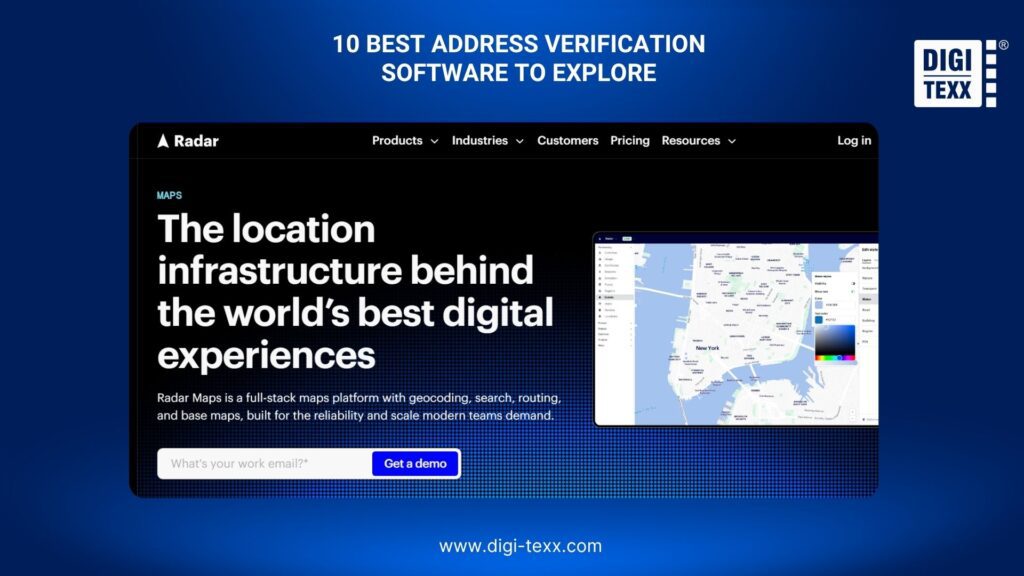
Radar is a location platform that combines address verification with autocomplete, geocoding, mapping, and other location APIs. Its address verification capabilities are designed for applications that need to validate structured addresses while also working with location data.
Key features
- Address validation and verification
- Address autocomplete
- Forward and reverse geocoding
- Location APIs and SDKs
- Developer-focused documentation
- US and international address coverage
Cost: Radar lists address validation under Premium Maps, starting at USD 2.00 per 1,000 API calls. Its current pricing page says agreements are annual and there is no free tier; a technical validation period is available. Core Maps starts at USD 0.50 per 1,000 calls, but that is a different category. [2]
Best for: Developers and businesses that need address verification alongside broader geolocation functionality.
2. Twilio User Authentication & Identity
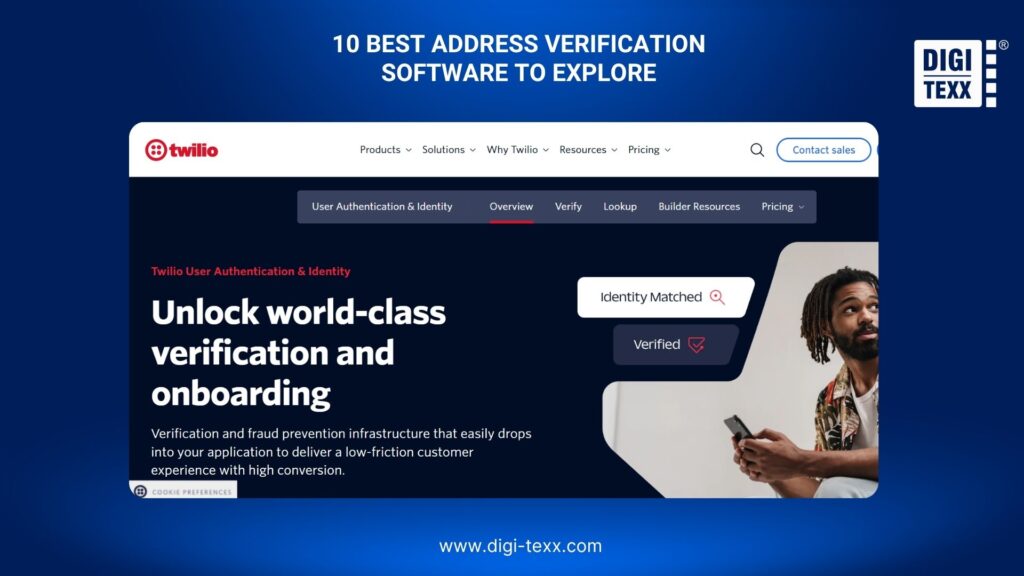
Twilio User Authentication & Identity is different from a conventional address verification software platform. Its core focus is user authentication, identity, phone verification, and fraud prevention rather than postal address validation.
Twilio belongs in an identity and authentication workflow rather than the postal-address-validation shortlist. Its authentication products can support account security, but their results should not be interpreted as confirmation of a complete mailing address. [3]
It may still appear in broader verification-tool comparisons because businesses can use Twilio’s identity and verification capabilities as part of customer onboarding and account-security workflows.
Key features
- Phone verification
- Two-factor authentication
- User authentication
- Fraud-prevention capabilities
- APIs and SDKs
Best for: Businesses that need identity and authentication workflows rather than dedicated postal address cleansing.
>>> See more:
- Enterprise Data Management: 6 Core Pillars, Benefits & Tools
- 11+ Top Data Quality Management Tools and Software for Businesses
- What is Data Extraction? Definition, How It Works & Examples | DIGI-TEXX
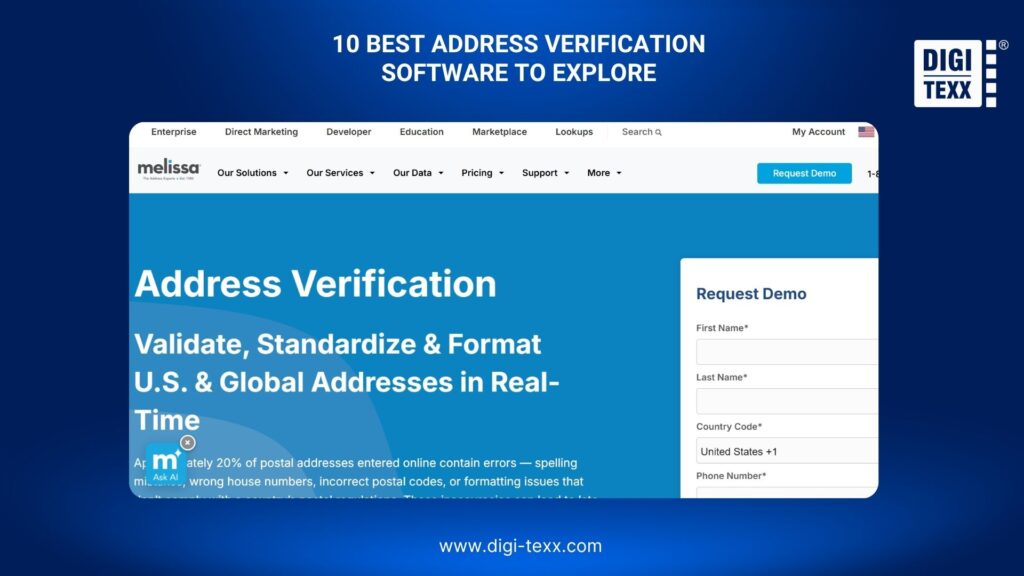
3. Melissa Global Address Verification
Melissa Global Address Verification is designed for businesses that need to verify, correct, standardize, and enrich addresses internationally. Melissa states that its solution supports more than 240 countries and territories and can return parsed address components, mailing-label formats, latitude and longitude, and other address information.
Melissa offers address verification for international address data, including parsing, standardization and correction. Its address-verification offering is relevant when a business needs consistent address components across multiple markets. [4]
Key features
- Global address verification
- Address correction and standardization
- Real-time and batch processing
- API integration
- Geocoding
- Address enrichment
- Support for different scripts and country-specific formats
Melissa also reports that its address verification solutions use a CASS-certified engine for US address processing.
Best for: Enterprises managing international customer and mailing databases.
4. Postalytics
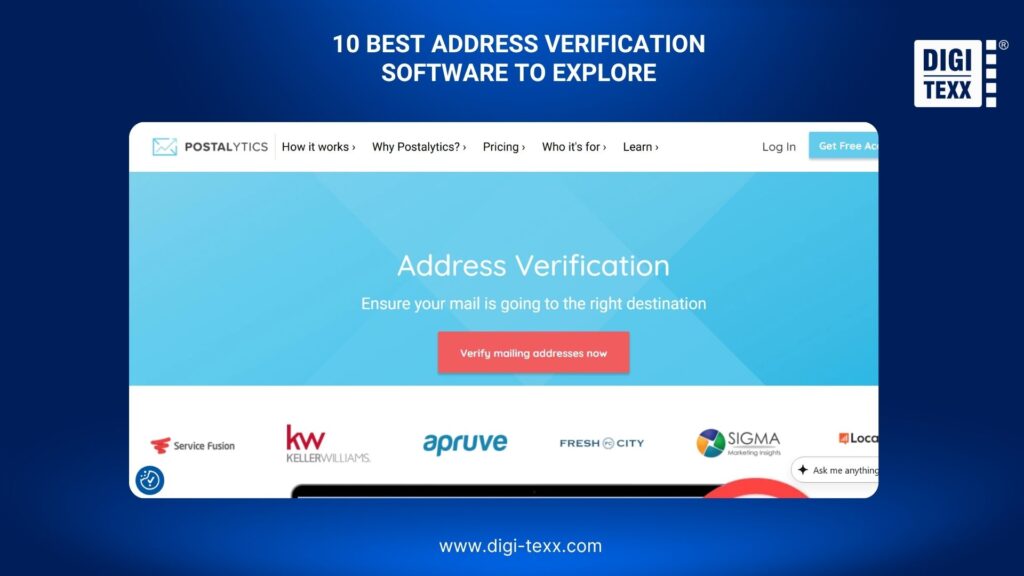
Postalytics combines postal address verification with direct-mail automation. Its address verification system checks mailing addresses against USPS data and uses CASS-certified software for address processing.
Postalytics combines contact-import checks with CASS and NCOA processing in its mailing workflow. It is worth evaluating when address quality is part of a direct-mail campaign, rather than assuming it is interchangeable with a standalone checkout-validation API. [5]
Key features
- US address verification
- CASS-certified processing
- Bulk address checking
- Mailing-list cleansing
- NCOA processing
- CRM integrations
- Direct-mail automation
Postalytics also checks addresses during campaign preparation and can mark invalid addresses before mail is sent.
Best for: Businesses that combine address validation with direct-mail campaigns.
>>> See more:
- Financial Data Quality Management: Strategies & Best Practices
- Data Integrity Definition: Meaning, Types, Examples & Best Practices 2026
- 20 Best Data Governance Tools In 2026
5. Smarty
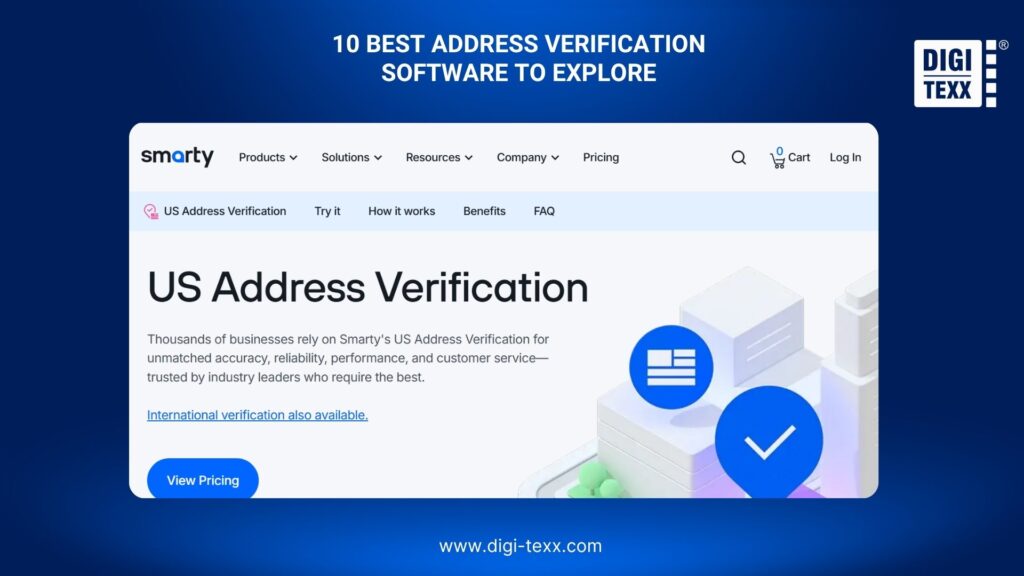
Smarty provides address verification, standardization, autocomplete, geocoding, and address enrichment. Its international address verification supports 250 countries and territories, while its US services cover more than 210 million addresses, according to the company.
Key features
- US and international address verification
- Address standardization
- Address autocomplete
- Batch validation
- API and no-code options
- Geocoding
- Address enrichment
Smarty offers a 42-day trial with 1,000 U.S. address-verification lookups; the international verification trial includes 100 lookups. These are trial allowances, not an unlimited or permanent free API. [6] [7]
Best for: E-commerce, online forms, developers, and businesses that need both real-time and batch address validation.
6. Byteplant’s Address-Validator
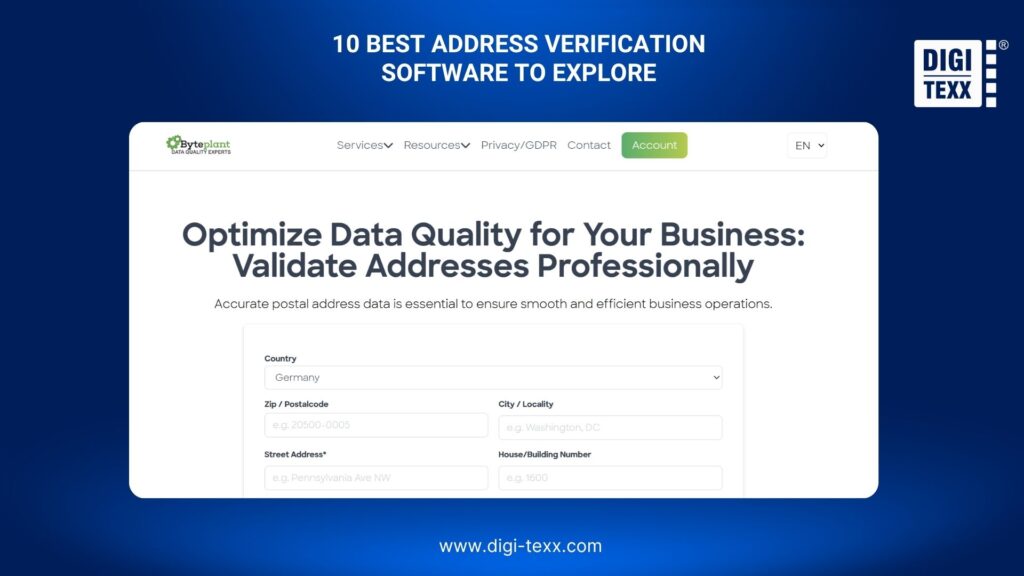
Byteplant’s Address-Validator focuses on validating, correcting, standardizing, and enriching postal addresses across more than 240 countries.
The platform supports both real-time and bulk processing, along with autocomplete, geocoding, address-list processing, and deduplication.
Key features
- Global address verification
- Address correction
- Address standardization
- Real-time API
- Bulk address cleansing
- Address autocomplete
- Geocoding
- Deduplication
- CRM and e-commerce integrations
Byteplant provides 100 free address checks and corrections without payment details. It offers one-time credits and monthly subscriptions; credit usage varies by region and optional geocoding. Its pricing page describes deletion of personal end-user information within 14 days after the data is made available to Byteplant. Confirm the applicable agreement before uploading production records. [8] [9]
Best for: Businesses looking for global address cleansing software with both API and batch-processing capabilities.
7. PostGrid Address Verification
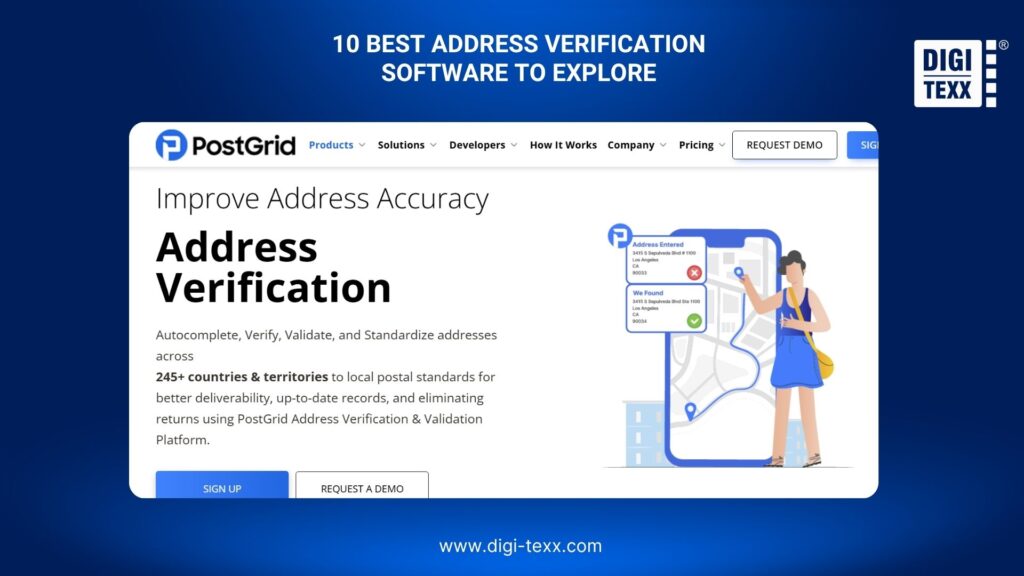
PostGrid provides address autocomplete, verification, and standardization through APIs. Its international address verification service supports more than 245 countries, while its US and Canada service supports real-time and batch verification.
Key features
- Real-time address verification
- Address autocomplete
- Address standardization
- Batch verification
- Global coverage
- API integration
PostGrid lists Standard U.S./Canada Essential at USD 20/month for 2,000 lookups, plus USD 0.02 per additional lookup. International Essential is USD 84/month for 1,000 lookups, plus USD 0.07 per additional lookup, on monthly billing. The page also displays annual-billing rates of USD 18 and USD 70 per month respectively. [10]
Best for: Growing businesses that need API-based verification and bulk processing across multiple markets.
8. Loqate
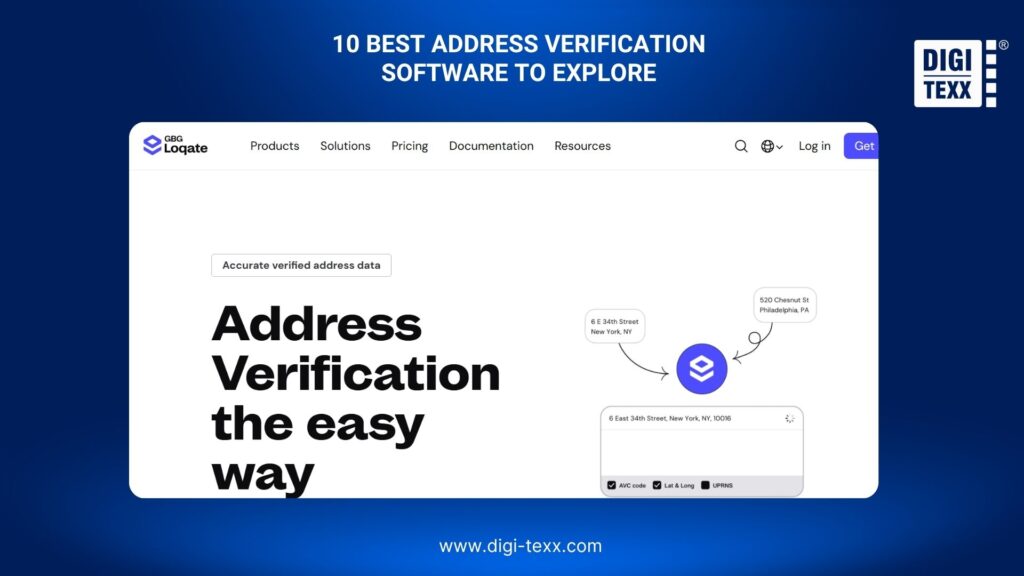
Loqate focuses on global address capture, verification, and data quality. Its platform covers more than 240 countries and territories and supports address verification, geocoding, reverse geocoding, and premise-level data.
One notable feature is AI-based address parsing. Loqate reports an average 7% improvement in match rates globally, with higher reported improvements in some developing and established markets. These figures are vendor-reported performance claims rather than independent benchmarks.
Key features
- Global address verification
- Address autocomplete
- AI-powered parsing
- Address correction and enrichment
- Geocoding
- Premise and sub-premise data
- Data cleansing
Loqate provides address verification for international address records. It is a candidate for businesses that need to assess address capture and verification together, including how a captured address is checked before it reaches downstream systems. [11]
Best for: Enterprise e-commerce and organizations managing international customer data.
>>> See more:
- 5 Best Data Parsing Software in 2026 | Features & Comparison
- 10 Types of Data Entry Services for Modern Businesses
- Automatic Data Processing (ADP): How It Works & Key Benefits
9. Placekey
Placekey is not a traditional postal address verification platform. Instead, it provides a universal identifier for physical places, making it useful for address matching, deduplication, and connecting location data across datasets.
Placekey uses a “What@Where” structure and can append a universal location ID to addresses, POIs, and latitude/longitude combinations.
Key features
- Universal location identifiers
- Address and POI matching
- Data deduplication
- Dataset interoperability
- Geospatial matching
- API access
Placekey provides identifiers for matching place records across datasets. Its Free plan lists 10,000 lookups per day; the FAQ distinguishes verified accounts from unverified accounts, which have a lower allowance. Silver is USD 3,000/year for 6 million lookups and Gold is USD 15,000/year for 30 million. [12] [13]
Best for: Data teams, geospatial applications, and organizations that need to match locations across multiple datasets.
10. Lob
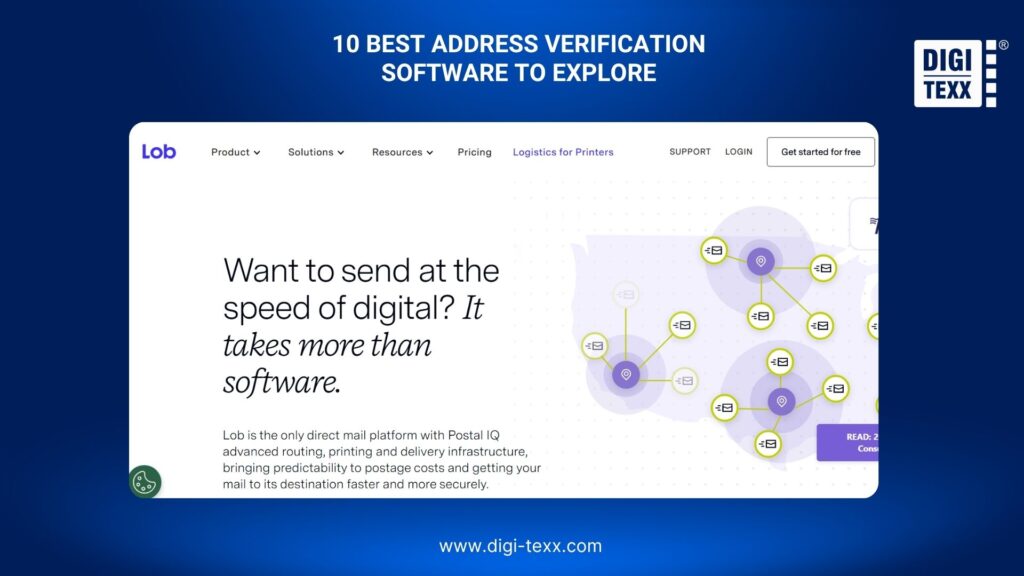
Lob combines address verification with APIs for direct-mail automation. Its address verification service supports both US and international addresses.
Lob’s public comparison lists U.S. verification at USD 25/month including 1,000 checks, then USD 0.025 per additional check in the Small Business column; Growth lists USD 450/month including 50,000, then USD 0.009 additional. International allowances are USD 30/month for 500 plus USD 0.06 additional, and USD 550/month for 10,000 plus USD 0.055 additional, respectively. [14]
Key features
- US address verification
- International address verification
- Address APIs
- Direct-mail automation
- Print and mail services
- Tracking and analytics
Best for: Developers and businesses that want address verification integrated with programmatic direct-mail workflows.
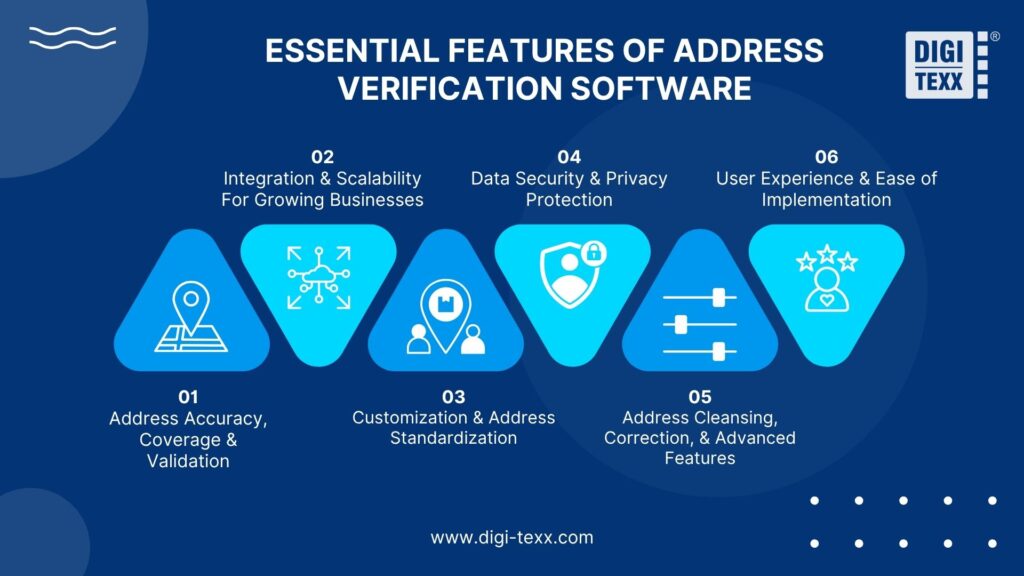
Essential Features Of Address Verification Software
Choosing an address verification platform requires more than checking whether it can identify an invalid address. Businesses should evaluate coverage, accuracy, integrations, data security, processing methods, and the ability to correct and standardize existing records.
Address Accuracy, Coverage, And Validation
Accuracy should be the first consideration when evaluating address verification software. A solution should recognize minor spelling errors, inconsistent formatting, missing components, and local address conventions without incorrectly changing valid information.
Coverage matters just as much. US-focused businesses may need USPS-based verification, while international organizations require country-specific postal formats and reference datasets.
For US mailing workflows, CASS certification is an important quality signal because USPS uses the CASS program to evaluate address-matching software. DPV can additionally determine whether an address is represented in the USPS delivery file.
For global operations, check whether the provider supports the countries, postal formats, scripts, and address levels relevant to your customers.
Integration And Scalability For Growing Businesses
Address validation should fit into the systems where addresses are already collected and used.
Look for:
- REST APIs and SDKs
- CRM integrations
- E-commerce integrations
- ERP and shipping integrations
- Webhooks
- Batch upload options
- No-code tools
- Scalable request limits
For example, Smarty supports API and batch processing, while Byteplant offers real-time and bulk validation APIs.
Scalability is especially important when moving from manual data cleanup to automated digital address verification. The platform should handle increasing transaction volumes without forcing businesses to redesign the workflow.
Customization And Address Standardization
Addresses are not formatted the same way across countries, systems, or databases. Good address standardization software should convert inconsistent records into a consistent format while preserving relevant address details.
Useful capabilities include:
- Configurable address formats
- Country-specific postal standards
- Field parsing
- Transliteration
- Custom validation rules
- Structured output
- Address enrichment
Melissa, for example, can return parsed address components and country-specific mailing-label formats.
Data Security And Privacy Protection
Address information can form part of a customer’s personal data, so security should be considered before sending records to a third-party service.
Review:
- Encryption
- Data retention policies
- Access controls
- Compliance certifications
- Data-processing agreements
- Hosting and geographic requirements
- Deletion procedures
For example, Byteplant states that API and batch data is automatically deleted within 14 days after being made available to customers.
For businesses processing addresses at scale, security requirements should be evaluated alongside accuracy rather than treated as a separate technical issue.
Address Cleansing, Correction, And Advanced Features
Basic validation only tells you whether an address passes a check. More advanced address cleansing software can identify errors, standardize records, correct incomplete information, detect duplicates, and enrich existing databases.
Useful capabilities include:
- Address correction
- Duplicate detection
- Batch cleansing
- Address autocomplete
- Geocoding
- Reverse geocoding
- Delivery-point information
- Address enrichment
This is particularly useful when a company has years of customer data stored across multiple systems. Instead of validating one new address at a time, a business can clean its existing database and then add real-time validation to prevent new errors.
User Experience And Ease of Implementation
An address verification platform should improve the user experience rather than add another obstacle.
For e-commerce, autocomplete can reduce the amount of information users need to type and help prevent invalid addresses from entering the order system. For internal teams, clear dashboards, documentation, error messages, and batch tools can reduce the learning curve.
Implementation should also be straightforward. Look for:
- Clear API documentation
- SDKs for common programming languages
- Testing environments
- Sandbox access
- Responsive support
- Easy bulk-upload workflows
The best address verification tools are not necessarily those with the longest feature list. They are the ones that fit the business’s actual data flows and can be maintained without excessive manual work.
Run a Pilot Before Selecting a Provider
Build one representative test set and run the same records through each shortlisted tool. Agree the expected outcome before testing so that a higher match count is not mistaken for higher accuracy.
- Include complete records, misspellings, missing units, duplicate households, new developments, rural addresses and local-language examples from your target markets.
- Measure correct acceptances, incorrect corrections, unresolved records and manual-review effort separately. Keep results by country and address type.
- For checkout, measure response time and user completion alongside address quality. Define a fallback for outages and rate limits.
- For batches, check input/output counts, stable customer IDs, encoding, original-address retention and import rollback.
- Compare total cost: subscription or committed spend + overages + optional enrichment + integration + manual exception handling.
Illustrative cost calculation: PostGrid’s published Standard monthly Essential allowance is 2,000 lookups. At 3,000 lookups, USD 20 + (1,000 × USD 0.02) = USD 40, before any other applicable charges. This example applies to that specific U.S./Canada plan, not its international or bulk products. [10]
>>> See more:
- Automate Document Workflow: A Complete Guide for Businesses
- Best Insurance Claims Processing Outsourcing BPO In The US 2026
What Is The Purpose Of Address Verification?
The primary purpose of address verification is to determine whether address information is accurate, complete, standardized, and usable for its intended purpose.
For businesses, this can help:
- Reduce returned shipments and mail
- Prevent incorrect delivery information
- Improve customer data quality
- Reduce manual correction
- Improve checkout experiences
- Maintain cleaner CRM records
- Support shipping and logistics workflows
- Improve direct-mail deliverability
- Identify duplicate or inconsistent records
USPS notes that correcting potential addressing issues can reduce undeliverable-as-addressed mail and improve the efficiency of mail processing and delivery.
What Are The Benefits Of Verifying An Address?
Address verification can create value across customer-facing and back-office workflows.
- Better data quality: Standardized and verified addresses give teams more reliable customer records.
- Lower operational costs: Catching invalid addresses before shipping or mailing can reduce avoidable delivery and postage expenses.
- Better e-commerce experiences: Real-time ecommerce address validation can identify problems before an order is submitted, reducing checkout friction and manual follow-up.
- Fewer manual corrections: Automated correction and standardization reduce repetitive data-entry work.
- More reliable customer communication: Accurate addresses help businesses send products, invoices, notices, and other physical communications to the intended destination.
- Cleaner databases: Batch verification and cleansing can improve the quality of legacy CRM and customer databases.
- Better downstream analytics: Standardized location data is easier to match, segment, geocode, and analyze.
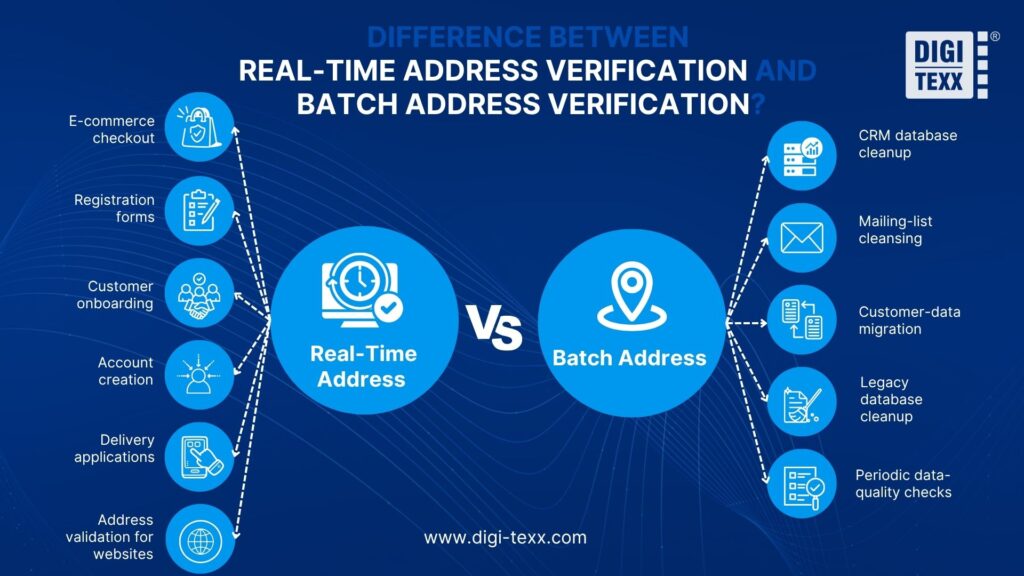
What Is The Difference Between Real-Time Address Verification And Batch Address Verification?
The main difference is when and how the address data is processed.
Real-time address verification checks an address immediately when a user enters or submits it. This makes it suitable for:
- E-commerce checkout
- Registration forms
- Customer onboarding
- Account creation
- Delivery applications
- Address validation for websites
Batch address verification processes a large collection of addresses at once. It is better suited to:
- CRM database cleanup
- Mailing-list cleansing
- Customer-data migration
- Legacy database cleanup
- Periodic data-quality checks
For example, Smarty supports both API-based and batch processing, while its bulk validation tools can process large Excel and CSV address lists.
Many organizations use both approaches. Batch processing helps clean existing records, while real-time validation can reduce new address errors at the point of entry. Neither removes the need to review unresolved records, monitor changes or refresh data.
Use real-time checks when a customer can confirm a correction immediately. Use batch checks before a CRM migration, mailing campaign or scheduled data-quality review. For both, preserve the source address and record what changed; do not automatically merge different customers just because their addresses match.
Why Choose DIGI-TEXX For Address Validation?
DIGI-TEXX’s data cleansing services include correction, validation and database standardization, with postal-address consistency checks among the stated data-correction activities. This service is relevant when address quality requires operational cleanup as well as a software check. [15]
Data Preparation and Standardization
Discuss how your address fields will be extracted, mapped and standardized before processing. Agree which source record is authoritative, how customer IDs will be preserved and which changes require approval. This is especially important when addresses arrive from several systems or document formats.
Exception Review and Quality Acceptance
Define a review queue for incomplete, conflicting and unmatched records. Agree error categories, sampling rules and acceptance criteria before a pilot. Ask for evidence from a comparable project rather than treating a general company capacity figure as an address-specific accuracy guarantee.
Integration with Your Existing Workflow
Specify the target CRM, database or commerce platform, required fields and permitted access method. Confirm the delivery format, import ownership and reconciliation process during scoping. Integration requirements should be agreed for the project rather than assumed from the word “seamless.”
Security and Operating Requirements
Discuss access permissions, secure transfer, retention, deletion and support coverage alongside the processing scope. Review the current certificate documents and their scope, and agree the service-level requirements applicable to your project. Certification should not be presented as a guarantee that every address record is correct.
Need to clean address records before a CRM migration or mailing campaign? Contact DIGI-TEXX with your target countries, monthly volume, source formats and required output. The team can discuss the data-cleansing scope, exception-review needs and pilot acceptance criteria.

FAQs About Address Verification Software
How Can I Verify An Address For Free?
You can check a U.S. postal address at no cost using official and third-party address verification tools. These services can help confirm whether an address is recognized, correct formatting errors, and standardize address details.
Free Address Verification Tools
- USPS: Use the official USPS ZIP Code Lookup to check U.S. addresses and confirm their postal information.
- Smarty: Its single-address lookup can identify common errors and standardize address details for postal use.
- Firstlogic: The Verify Address Tool helps cleanse U.S. postal addresses and align them with standard formatting.
- Google Maps: The Google Maps Address Validation Demo provides an interactive way to check and visualize address information.
How To Legally Verify Someone’s Address?
For legitimate purposes, you can verify an address by requesting recent proof of address documents, such as:
- Utility or bank statements
- Lease agreements
- Government-issued correspondence
- Notarized residency documents
For business or legal needs, you may also check authorized public records, business registries, or official postal channels where permitted by law. Always follow applicable privacy and data-protection requirements.
Is There A Free API That Can Verify Addresses?
Yes. While truly unlimited free address verification APIs are uncommon, several providers offer free tiers or limited monthly usage:
- USPS: Provides free address lookup and standardization through its official API, with usage restrictions for USPS-related shipping and mailing services.
- Google Maps: Offers a pay-as-you-go Address Validation API with a monthly free allowance.
- Smarty: Provides a limited free tier for address verification.
- Geoapify: Offers a free developer tier for geocoding and address lookup, plus a web-based tool for quick address checks.
For occasional checks, these free options may be sufficient. Businesses with higher volumes may need a paid address verification service with larger API limits.
Does The USPS Have An Address Validation Tool?
Yes. The USPS offers a free address validation tool through its ZIP Code Lookup service. It lets users check individual U.S. addresses, correct formatting issues, and identify the standardized postal format, including the ZIP+4 code.
How to Use the USPS Address Validation Tool
- Open the USPS ZIP Code Lookup page.
- Select Find by Address.
- Enter the street address, city, state, and ZIP Code.
- Click Find to retrieve the matching postal record.
- Check the result for the standardized address format and ZIP+4 code.
This tool works well for checking individual U.S. addresses. Businesses handling large customer databases may need an address validation platform with API access or batch-processing capabilities.
Is There a Free Address Validation API?
Some providers offer limited trials or free allowances, but these are not the same as an unrestricted production API. Smarty’s 42-day trials include 1,000 U.S. verification lookups or 100 international lookups; Byteplant includes 100 free checks and corrections. Confirm endpoint access, expiry, billing and permitted use before integrating. [6] [7] [8]
Can Address Validation Confirm Where a Person Lives?
No. Checking an address against reference data is different from confirming that a particular person lives there. Do not treat postal matches, coordinates or authentication results as proof of occupancy. Identity or residency checks require a separate, appropriately authorized process.
Which Address Validation Software Should I Choose?
Start with your workflow: a checkout API, a batch database cleanup or a direct-mail campaign. Then compare geographic coverage, component-level results, integration effort and total price. Use a pilot with known outcomes to select a provider; there is no single best product for every country and dataset.
Is Address Autocomplete the Same as Validation?
No. Autocomplete suggests addresses while a user types; validation checks the submitted record. A convenient suggestion can still be incomplete for delivery, particularly when an apartment or suite is missing. Check the completed address and ask the user to confirm material corrections.
Can I Validate Addresses in an Excel or CSV File?
Yes, providers with batch-upload tools can process address lists. Confirm supported file types, column mappings, volume limits and output fields. Preserve a unique record ID and reconcile all returned rows before updating your CRM; unmatched records should remain visible for review.
Does a Valid Address Guarantee Delivery?
No. A recognized address can still have missing secondary details or other delivery limitations. USPS DPV distinguishes primary and secondary address confirmation; use the returned detail rather than treating every match as equally complete. [1]
Can DIGI-TEXX Help with Address Data Cleansing?
DIGI-TEXX lists postal-address consistency checks, data validation and database standardization within its data-cleansing offering. Discuss your countries, sources, volumes and exception rules to confirm the project scope. Any required postal-validation engine or system integration should be specified separately. [15]
Accurate address data is essential for reliable deliveries, cleaner customer records, and smoother business operations. Whether you need ecommerce address validation, postal address verification software, or a solution for cleansing large databases, the right platform should match your data volume, geographic coverage, integration needs, and security requirements.
From free tools for occasional checks to scalable address verification services and APIs, businesses have options for different workflows and budgets. DIGI-TEXX can help organizations build scalable data validation and cleansing workflows that support accurate, consistent, and usable address data across business systems.
DIGI-TEXX Contact Information:
🌐 Website: https://digi-texx.com/
📞 Hotline: +84 28 3715 5325
✉️ Email: [email protected]
🏢 Address:
- Headquarters: Anna Building, QTSC, Trung My Tay Ward
- Office 1: German House, 33 Le Duan, Saigon Ward
- Office 2: DIGI-TEXX Building, 477-479 An Duong Vuong, Binh Phu Ward
- Office 3: Innovation Solution Center, ISC Hau Giang, 198 19 Thang 8 street, Vi Tan Ward
Reference:
- [1] USPS — DPV — https://postalpro.usps.com/address-quality/dpv
- [2] Radar — Pricing — https://radar.com/pricing
- [3] Twilio — User Authentication & Identity — https://www.twilio.com/en-us/user-authentication-identity
- [4] Melissa — Address Verification — https://www.melissa.com/address-verification
- [5] Postalytics — Address verification — https://www.postalytics.com/tools/address-verification/
- [6] Smarty — U.S. Address Verification — https://www.smarty.com/products/us-address-verification
- [7] Smarty — International Address Verification pricing — https://www.smarty.com/pricing/international-address-verification
- [8] Byteplant — Free trial — https://www.byteplant.com/address-validator/free-trial-registration.html
- [9] Byteplant — Pricing and retention — https://www.byteplant.com/address-validator/pricing.html
- [10] PostGrid — Address Verification Pricing — https://www.postgrid.com/pricing-address-verification/
- [11] Loqate — Address Verification — https://www.loqate.com/en-us/address-verification/
- [12] Placekey — Pricing — https://www.placekey.io/pricing
- [13] Placekey — FAQ — https://www.placekey.io/faq
- [14] Lob — Pricing — https://www.lob.com/pricing
- [15] DIGI-TEXX — Data Cleansing Services — https://digi-texx.com/data-management/data-cleansing-services/
- [16] DuckDuckGo — Sources of results — https://duckduckgo.com/duckduckgo-help-pages/results/sources
- [17] Bing — Webmaster guidelines — https://www.bing.com/webmasters/help/webmaster-guidelines-30fba23a