
Data quality software helps organizations keep data accurate, complete, consistent, and reliable across systems and workflows. The right data quality management tools can detect issues early, reduce manual checks, and ensure data is ready for analytics, reporting, and AI applications. With capabilities such as validation, profiling, anomaly detection, and remediation, data quality management software makes it easier to monitor and improve data at scale.
In this article, DIGI-TEXX will help you explore 12 data quality management solutions, compare their key features and use cases, and identify data quality analyst tools for different business needs. You will also learn how a data quality management tool can support a broader data quality program and help teams track data reliability over time.
>>> See more:
- 12 Best Scanner Apps: Free & Paid Options 2026 For Android & iPhone
- Intelligent Document Processing Services: Benefits, Use Cases & How It Works
- Enterprise Document Management System: Top 13 Solutions & Features 2026
What Is Data Quality Software?
Data quality software helps organizations assess, monitor, and improve data to ensure it remains accurate, complete, consistent, and fit for business use. These tools can automate data quality checks, identify issues in data pipelines, and support remediation before poor-quality data affects analytics, reporting, or AI applications.
Common capabilities of data quality management software include data profiling, validation, cleansing, monitoring, anomaly detection, and data quality measurement. These functions help teams understand data structures, identify missing or inconsistent values, detect outliers, and track quality issues across data assets.
By automating these activities, data quality management tools provide a more consistent way to identify and address data problems than relying solely on manual reviews or ad hoc checks. They can also help data teams monitor quality continuously as data moves through pipelines and systems.
12 Data Quality Software To Consider In 2026
The 12 tools below represent different approaches to data quality management. Some are open-source or developer-oriented, while others target enterprise data quality, observability, governance, and remediation.
| Tool | Primary focus | Best suited for | Notable capability |
| Lightup | Data quality and observability | Enterprises needing scalable monitoring | Automated metrics, anomaly detection, no-code and SQL-based checks |
| Great Expectations | Data validation and testing | Data engineers and developers | Expectations and validation workflows |
| dbt | Data transformation and testing | Analytics engineering teams | Tests integrated into transformation workflows |
| Monte Carlo | Data observability | Data teams managing complex pipelines | Automated monitoring and incident investigation |
| Anomalo | Automated data quality | Teams seeking ML-based monitoring | Anomaly detection and automated quality checks |
| Soda | Data testing and reliability | Engineering and analytics teams | SodaCL checks and data reliability workflows |
| Bigeye | Data observability | Enterprise data teams | Lineage, anomaly detection, reconciliation and quality rules |
| Acceldata | Data and AI observability | Data and AI observability | Quality policies, reconciliation, profiling and lineage |
| Ataccama | Enterprise data quality | Governance-led enterprises | DQ rules, profiling, observability and remediation |
| Datafold | Data quality engineering | Developer-focused data teams | Data diff, CI/CD testing and reconciliation |
| Informatica | Enterprise data quality and observability | Large organizations | Profiling, cleansing, validation and governance integration |
| Collibra | Data quality and governance | Data governance organizations | Quality monitoring, profiling, governance and lineage |
>>> See more:
- Best Insurance Claims Processing Outsourcing BPO in the US 2026
- Invoice Reconciliation Process: Step-By-Step Guide & Key Steps
- Optical Character Recognition Explained: What Is OCR And How It Works
1. Lightup
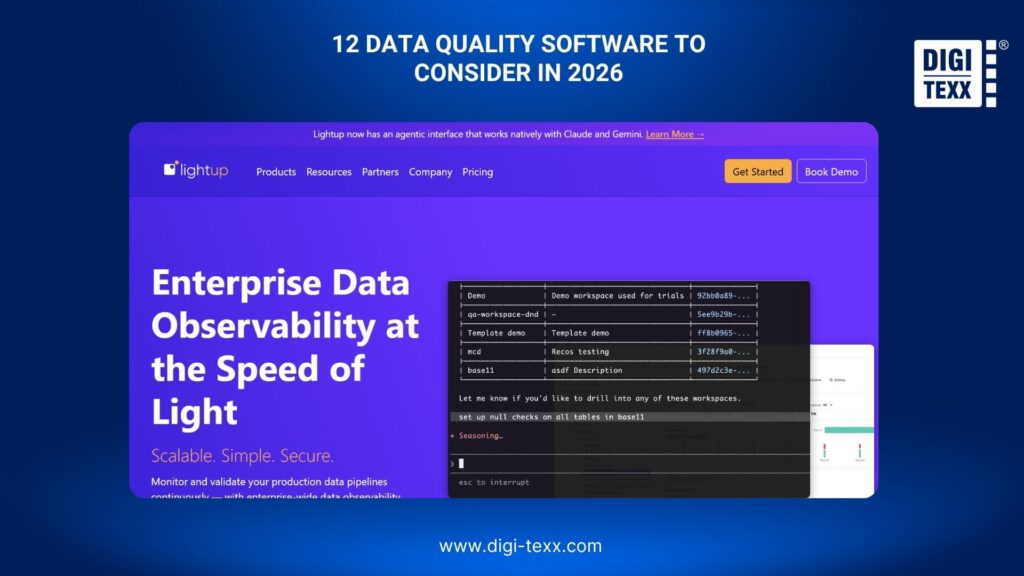
Lightup focuses on continuous data quality management and data observability, with capabilities designed to automate monitoring across cloud, hybrid, and on-premises environments.
Its approach separates metrics from monitors. A metric measures something about the data, while a monitor evaluates whether that metric remains within an expected range. Monitors can use explicit thresholds or anomaly detection.
This architecture is useful when teams need to monitor the same underlying metric against different business expectations without repeatedly recreating the measurement.
Lightup also provides automated profiling and different types of metrics, including column, table, comparison, and SQL metrics. Its documentation describes support for monitoring questions such as whether tables were updated on time, whether expected data volumes arrived, and whether values contain excessive nulls.
Strengths:
- Automated data quality monitoring
- AI-based anomaly detection
- No-code and SQL-based checks
- Data profiling
- Incident monitoring and alerting
- Support for cloud and hybrid environments
Best suited for: Enterprises that need scalable, continuous data quality monitoring without relying entirely on manually defined thresholds.
Potential limitation: Organizations looking for a lightweight testing framework embedded directly into application or transformation code may prefer a developer-first tool such as Great Expectations or dbt.
2. Great Expectations
Great Expectations, commonly referred to as GX, takes a testing-oriented approach to data quality.
Its central concept is an Expectation, which is a verifiable assertion about data. Teams can define expectations such as values being unique, fields not being null, columns conforming to a specific type, or data falling within an expected range.
This makes GX particularly useful for teams that want to treat data validation similarly to software testing. Current GX documentation covers multiple data quality scenarios, including:
- Distribution
- Freshness
- Integrity
- Missingness
- Schema
- Uniqueness
- Volume
- Unstructured data
Strengths:
- Flexible expectations-based validation
- Strong developer and data engineering orientation
- Custom SQL and multi-source expectations
- Broad range of validation scenarios
- Useful for embedding quality checks into data workflows
Best suited for: Data engineers and developers who want explicit, testable data quality rules.
Potential limitation: Teams looking primarily for a centralized enterprise governance and remediation platform may require additional capabilities beyond a testing framework.
3. dbt
Dbt approaches data quality from the transformation layer. Instead of treating quality as a separate activity after data transformation, teams can define tests alongside their data models and transformation logic. This makes dbt particularly relevant to analytics engineering teams that already manage transformation workflows as code.
The main advantage is the shift-left approach: quality checks can be introduced as part of the process that creates and changes analytical datasets.
For example, teams can validate assumptions about:
- Required fields
- Uniqueness
- Relationships between datasets
- Accepted values
- Transformation outcomes
This approach is useful when data quality problems are closely related to transformation logic.
Strengths:
- Fits naturally into analytics engineering workflows
- Version-controlled testing
- Works alongside transformation models
- Supports automated validation during data development
Best suited for: Organizations already using dbt as a core part of their analytics engineering stack.
Potential limitation: dbt testing is not a substitute for every form of enterprise data quality management. Organizations may still need dedicated observability, governance, lineage, or remediation capabilities.
4. Monte Carlo
Monte Carlo takes a data observability approach, focusing on monitoring the health and reliability of data systems rather than relying only on manually written validation rules.
This model is useful when organizations operate large numbers of pipelines, tables, dashboards, and downstream dependencies. Instead of asking only whether a particular rule passed, teams can investigate whether something unusual is happening across the data environment.
Typical observability concerns include:
- Freshness
- Volume
- Schema changes
- Distribution changes
- Pipeline failures
- Downstream impact
- Root-cause investigation
This makes Monte Carlo more relevant to organizations that have moved beyond basic data testing and need broader visibility into production data.
Strengths:
- Data observability approach
- Continuous monitoring
- Useful for complex data environments
- Focus on detecting and investigating production issues
Best suited for: Data teams managing large and interconnected analytical data platforms.
Potential limitation: Organizations that only need straightforward rule-based validation may not need the broader observability model.
5. Anomalo
Anomalo focuses on automated data quality monitoring, with machine learning used to identify abnormal patterns in data.
Its platform combines anomaly detection, validation, data observability, lineage, and investigation workflows. Anomalo states that its monitoring can identify missing and anomalous data through unsupervised machine learning and supports both API and no-code configuration.
This approach can be useful when teams cannot realistically anticipate every possible data problem and write a rule for each one.
For example, a dataset may technically satisfy its existing validation rules while still exhibiting an unexpected distribution change. Automated anomaly detection can help identify these patterns.
Strengths:
- Automated anomaly detection
- Deep table-level monitoring
- Data validation
- Root-cause analysis
- No-code and API-based workflows
Best suited for: Organizations that want machine-learning-based monitoring alongside conventional data quality checks.
Potential limitation: Teams with highly deterministic requirements may still need explicit business rules and validation tests.
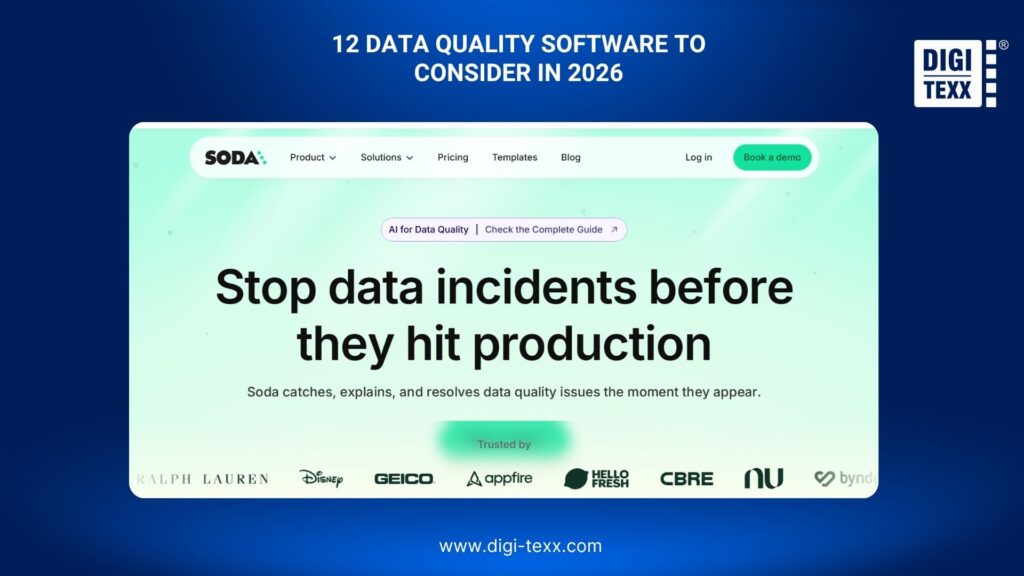
6. Soda
Soda provides a data quality platform built around checks and data reliability workflows. Its SodaCL language is YAML-based and designed to make data quality checks human-readable.
SodaCL supports checks for common problems such as:
- Missing values
- Invalid values
- Duplicate records
- Freshness
- Row counts
- Schema changes
- Cross-dataset relationships
- Reference integrity
For example, a team can define a check to verify that a dataset is not empty or that a timestamp is less than a defined age. Soda also supports reference checks to verify relationships between datasets.
Strengths:
- Human-readable quality checks
- YAML-based configuration
- Broad set of built-in metrics
- Supports developer and data team workflows
- Useful for validation and monitoring
Best suited for: Engineering and analytics teams that want explicit, configurable data quality checks without building every test from scratch.
Potential limitation: Enterprises seeking broader governance, catalog, lineage, and remediation capabilities may need a larger platform.
>>> See more:
- Accounts Payable Outsourcing: Pros, Cons, Costs And Top Providers
- Business Process Automation Solutions: Top Tools, Benefits & Use Cases
- AI In Investing: What Every Investor Needs To Know
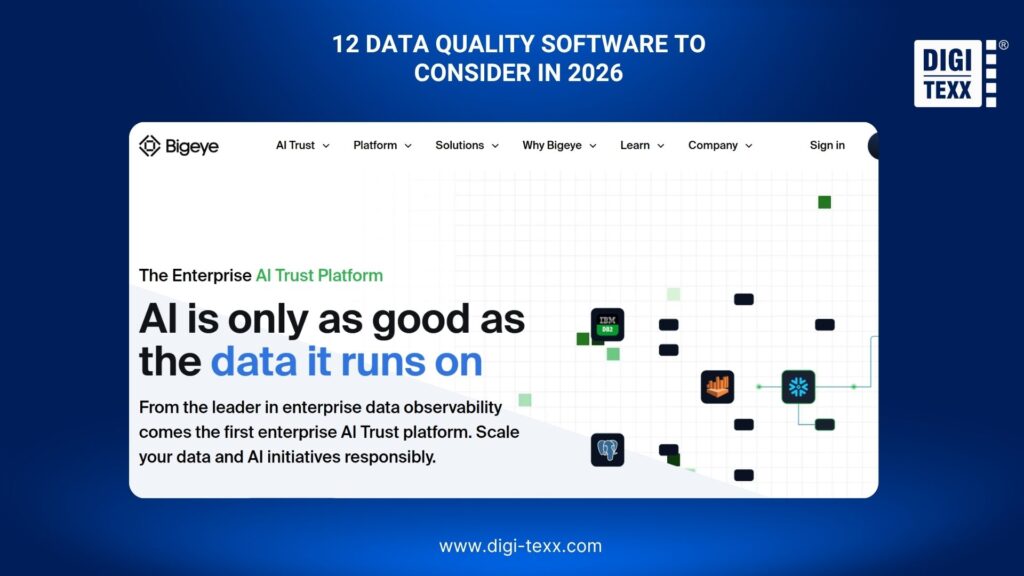
7. Bigeye
Bigeye is an enterprise data observability platform that combines data lineage, anomaly detection, data quality rules, reconciliation, and incident management.
Its observability model is designed to reduce dependence on manually written rules by continuously examining metadata, profiling information, lineage, and data behavior.
This distinction is important for large environments. Traditional validation can be highly effective when teams know exactly what they need to test. However, manually maintaining thousands of rules can become difficult as datasets and pipelines change.
Bigeye is therefore more closely aligned with organizations looking for broad production monitoring rather than only a standalone validation framework.
Strengths:
- Data observability
- Data lineage
- Anomaly detection
- Data reconciliation
- Quality rules
- Incident management
Best suited for: Enterprise data teams that need visibility across complex production data pipelines.
Potential limitation: It may provide more functionality than smaller teams need if their requirements are limited to basic data testing.
8. Acceldata
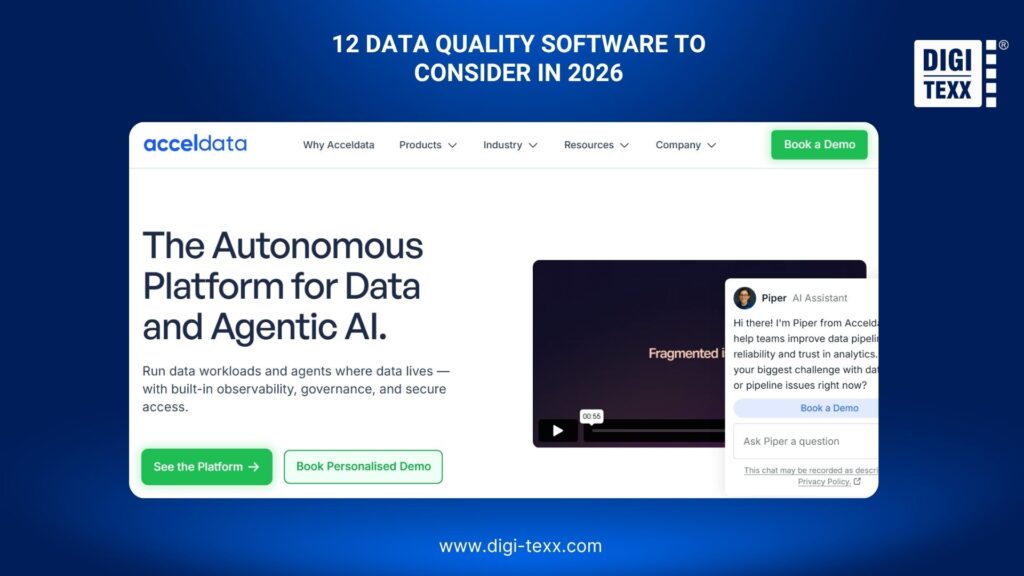
Acceldata Data Observability Cloud provides a centralized approach to data reliability across pipelines and data assets.
Its current documentation describes capabilities for quality checks, data and schema drift, cadence monitoring, reconciliation, pipeline observability, and alerts.
The platform also supports data profiling, lineage, anomaly detection, and data reliability policies.
This makes Acceldata relevant when data quality is only one part of a broader data operations problem.
For example, an organization may need to determine whether a reporting issue originated from:
- A source-system change
- A pipeline failure
- A schema change
- A transformation problem
- An unexpected data distribution
- A reconciliation mismatch
A broader observability platform can connect these signals instead of treating each problem separately.
Strengths:
- Data quality policies
- Data reconciliation
- Data profiling
- Anomaly detection
- Pipeline monitoring
- Data lineage
Best suited for: Large data environments where reliability depends on understanding both data and pipelines.
Potential limitation: Smaller organizations may find a focused data testing tool more appropriate for straightforward requirements.
9. Ataccama
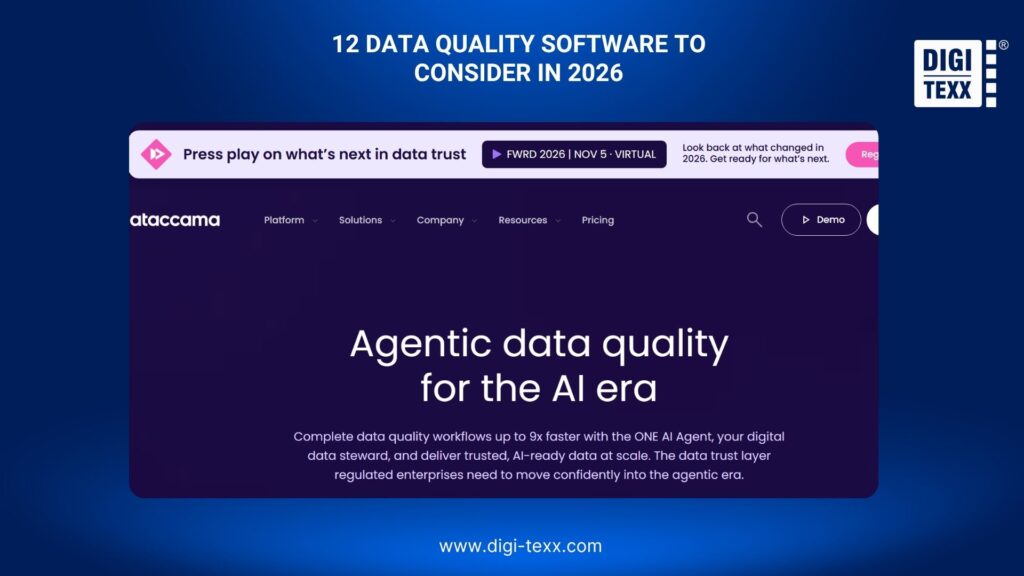
Ataccama ONE takes an enterprise data quality approach that combines data quality, data catalog, observability, lineage, and remediation capabilities.
Its current documentation describes data quality evaluation based on configurable rules and dimensions such as accuracy, completeness, validity, uniqueness, and timeliness. The platform can also monitor schema changes, anomalies, and data sources.
Ataccama also supports continuous monitoring and can connect data quality findings with pipeline health. Its documentation describes a unified workflow for detecting quality problems, investigating root causes, tracking resolution, and measuring quality over time.
This broader architecture is relevant to organizations where data quality is part of a formal data quality program, rather than an isolated engineering task.
Strengths:
- Enterprise data quality management
- Data catalog and glossary integration
- Data observability
- Data lineage
- Data remediation
- Rule management
- Hybrid and multi-environment support
Best suited for: Large organizations with mature data governance and quality requirements.
Potential limitation: Its broad platform scope can introduce more implementation and governance complexity than a focused testing tool.
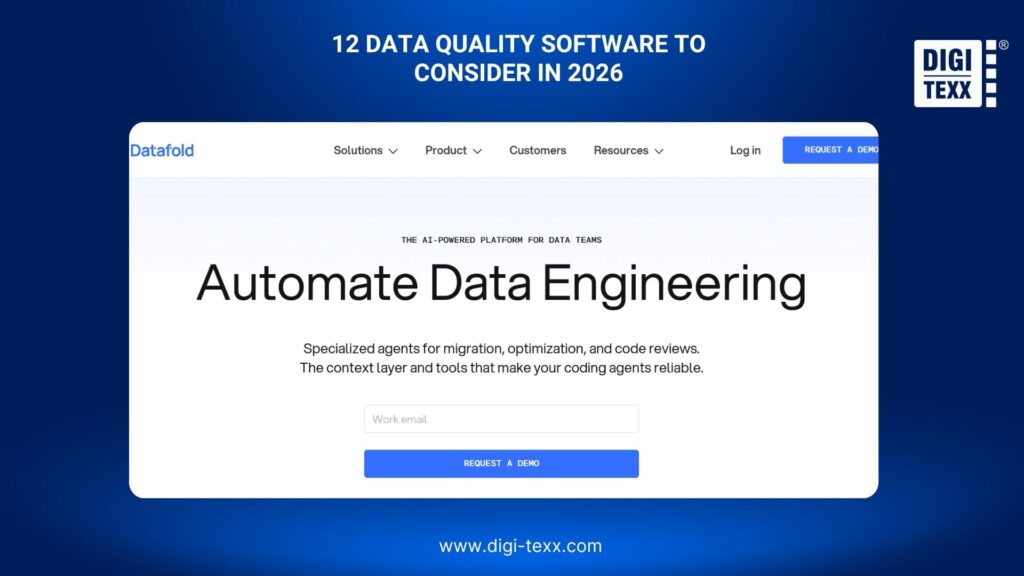
10. Datafold
Datafold approaches data quality from the perspective of data engineering workflows. One of its distinguishing capabilities is data diff, which compares data before and after a change at the value level. This helps teams identify unexpected changes that may not be visible through conventional schema tests or row-count checks.
Datafold also provides reconciliation, data monitoring, data tests, and schema change alerts. Its monitoring capabilities include metrics such as freshness, row count, and cardinality.
This makes it particularly relevant to teams that want to identify quality problems earlier in development rather than discovering them after deployment.
Strengths:
- Data diff
- CI/CD testing
- Data reconciliation
- Data monitoring
- Schema change detection
- Developer-oriented workflows
Best suited for: Data engineering teams that want to integrate data quality into software development and CI/CD practices.
Potential limitation: Organizations seeking centralized governance and enterprise-wide data stewardship may require additional platforms.
>>> See more:
- How AI-Powered Document Automation Transforms Business Operations?
- How Handwriting Recognition Technology Improves Note-Taking
- What Is Document Control Process? Steps, Benefits & Requirements
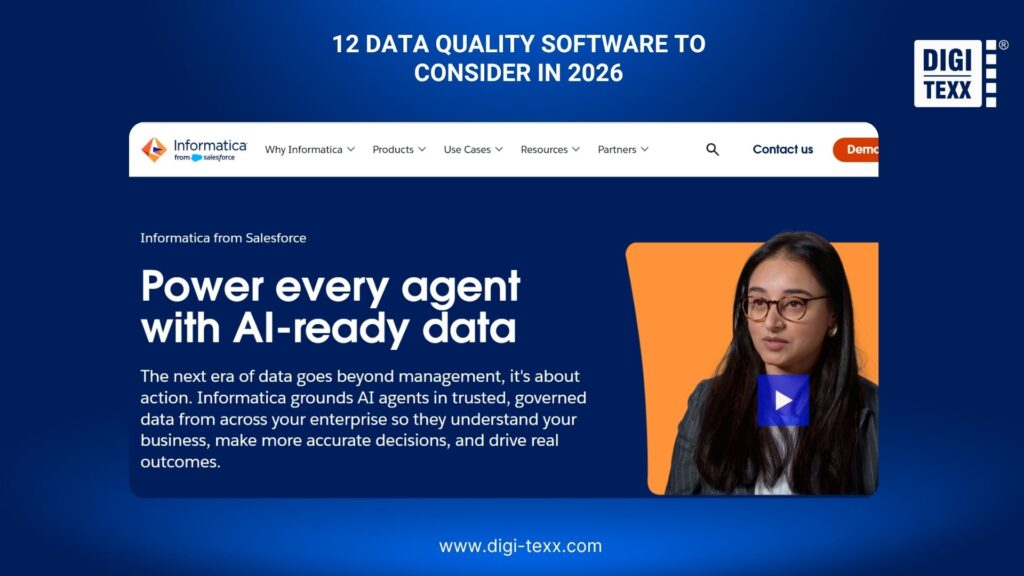
11. Informatica
Informatica provides a broad enterprise approach to data quality and observability through its data management ecosystem.
Its current Data Quality and Observability offering includes continuous profiling, data quality validation, cleansing, standardization, anomaly detection, and observability across data and pipelines.
The platform is designed for organizations that need data quality as part of a wider data management architecture rather than as a standalone testing layer.
Informatica is also included in Gartner’s research on Augmented Data Quality Solutions. Gartner’s 2025 Magic Quadrant evaluated 12 vendors in this market, including Informatica, Ataccama, Anomalo, Collibra, and others.
Strengths:
- Enterprise-scale data quality
- Profiling and cleansing
- Validation and standardization
- Data observability
- Integration with broader data management capabilities
- AI-assisted data quality workflows
Best suited for: Large enterprises with complex data management, governance, and integration requirements.
Potential limitation: A comprehensive enterprise platform may involve greater implementation scope than a focused data quality testing tool.
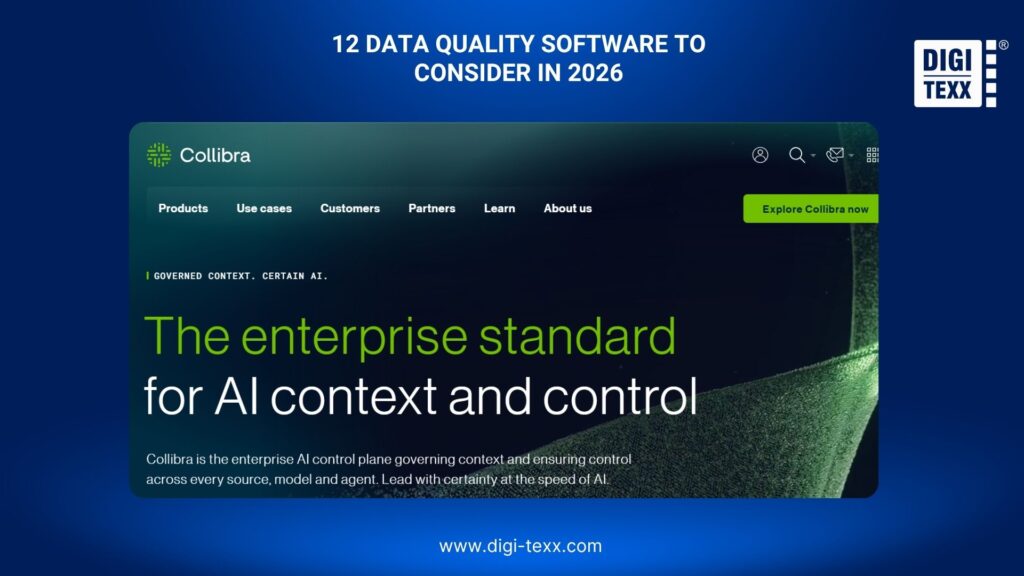
12. Collibra
Collibra Data Quality & Observability combines data profiling, monitoring, anomaly detection, and governance-related capabilities.
Its current platform supports automated and custom monitors, profiling, SQL-based monitoring, alerts, and connections between data quality signals and data products, policies, and AI models.
Collibra’s architecture also supports data quality jobs that can run immediate or scheduled checks and create data profiles.
This makes Collibra particularly relevant to organizations where data quality management tools need to operate within a wider data governance framework.
Strengths:
- Data quality monitoring
- Profiling
- Data observability
- Governance integration
- Lineage and context
- Automated and custom monitoring
Best suited for: Enterprises with established data governance and cataloging requirements.
Potential limitation: Teams that only need lightweight data testing may not require the broader governance platform.
Why Use Data Quality Management Software?
Data quality software helps organizations monitor, identify, and resolve data issues before they affect business decisions and operations. As data volumes grow across multiple systems, relying on manual checks can make it difficult to maintain accurate, complete, and consistent information.
Key benefits of using data quality management tools include:
- Detect data issues earlier: Automated monitoring can identify missing, duplicate, inconsistent, or inaccurate data before these issues spread across business processes.
- Reduce manual effort: Data quality management software automates repetitive validation and monitoring tasks, allowing teams to focus on higher-value data management activities.
- Improve decision-making: Reliable data gives analysts and business teams greater confidence in reports, dashboards, and other data-driven decisions.
- Maintain consistent data standards: Data quality management solutions can apply predefined rules and quality metrics across different datasets and systems.
- Support continuous improvement: A data quality program can track recurring issues, measure improvements, and help teams address the root causes of poor data quality.
For data teams, data quality analyst tools also provide a more structured way to monitor quality metrics and investigate issues. This makes a data quality management tool useful not only for fixing existing errors but also for maintaining data quality over time.
Benefits Of Using Data Quality Software
Using data quality software helps organizations maintain reliable data across systems, reduce repetitive quality checks, and respond to data issues before they affect business operations. The right data quality management tools can also support broader data governance efforts by standardizing quality rules and monitoring performance over time.
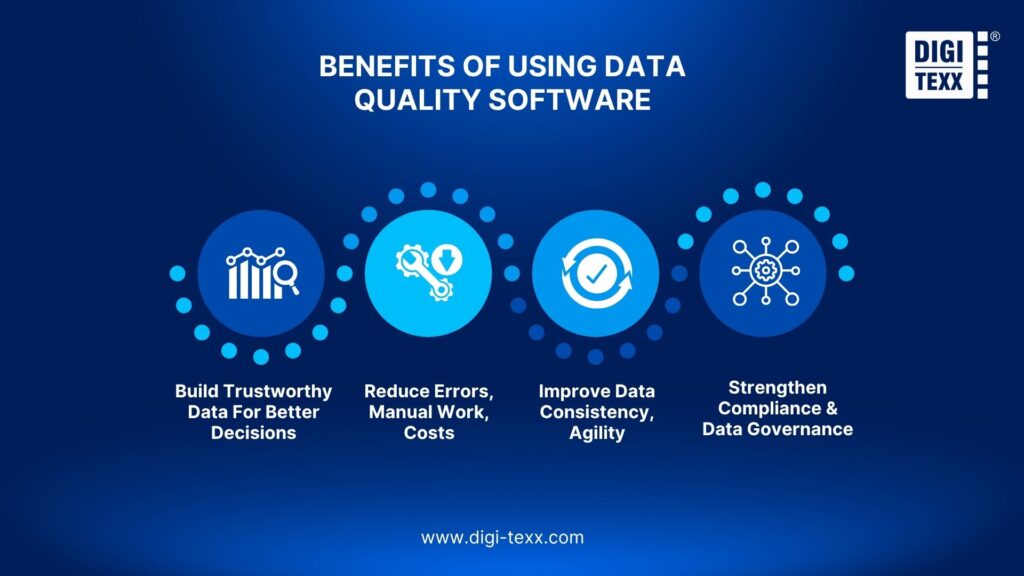
Build Trustworthy Data For Better Decisions
Reliable decisions depend on reliable data. Data quality management software helps identify inaccurate, incomplete, outdated, or inconsistent records so teams can work with information they can trust. By continuously monitoring quality issues, organizations can reduce the risk of basing reports, forecasts, or business decisions on flawed data.
Reduce Errors, Manual Work, And Costs
Manual data checks can be time-consuming, especially when teams manage large datasets across multiple sources. A data quality management tool can automate validation, profiling, monitoring, and issue detection, reducing repetitive work and helping teams address errors earlier. This can lower the operational cost associated with correcting poor-quality data later.
Improve Data Consistency And Agility
When data is inconsistent across systems, teams may work from conflicting information and spend additional time reconciling records. Data quality management solutions help apply consistent quality rules across datasets, making information more standardized and easier to use. With more reliable data available when needed, teams can respond to changing business requirements more quickly.
Strengthen Compliance And Data Governance
Poor-quality data can create problems for reporting, auditing, privacy, and regulatory requirements. Data quality analyst tools help teams monitor data against defined quality rules and identify issues that require attention. When integrated into a broader data quality program, these capabilities can support consistent data standards, clearer accountability, and stronger data governance.
Key Metrics For Measuring Data Quality
Data quality metrics provide a measurable way to determine whether data meets business requirements and where improvements are needed. A combination of quality dimensions and operational metrics can help teams monitor data continuously rather than relying only on periodic manual reviews.
Accuracy: How Often Is Your Data Correct?
Accuracy measures whether data correctly represents the real-world information it is intended to describe. For example, customer contact details should match verified customer information, while product records should contain the correct IDs, prices, and specifications. Tracking accuracy helps teams identify unreliable data that could affect analysis and decision-making.
Completeness: How Much Required Data Is Missing?
Completeness measures whether the required fields and records are present. A high number of empty or missing values can limit the usefulness of a dataset and affect downstream processes. Teams can monitor missing-value rates to identify datasets or fields that require data collection, validation, or cleansing.
Timeliness: Is Data Available When Needed?
Timeliness measures whether data is available and up to date when users or systems need it. Delayed data can reduce the value of reports, analytics, and operational workflows even when the information itself is accurate. Monitoring data freshness and delivery against defined time requirements helps teams identify delays before they disrupt business processes.
Consistency: Does Data Match Across Systems?
Consistency measures whether the same data remains aligned across databases, applications, and other sources. For example, a customer’s name, address, or account status should not conflict between a CRM and billing system. Tracking consistency helps organizations detect discrepancies and maintain a reliable view of business information.
Transformation Error Rate: How Often Does Data Change Incorrectly?
The data transformation error rate measures how frequently errors occur when data is converted, migrated, cleaned, or otherwise transformed between systems. A rising error rate can indicate problems with transformation rules, mapping logic, or data pipelines. Monitoring this metric helps teams detect issues early and prevent incorrect data from reaching downstream applications.
>>> See more:
- Prepare A Classified Balance Sheet: Steps, Format & Example 2026
- 15+ Best Document Scanning Software: Features, Pricing & Reviews 2026
- The Role of OCR in Healthcare: Digitizing Patient Records
FAQs About Data Quality Software
What Is The Best Data Quality Tool?
There is no single best data quality tool for every organization. The right choice depends on your data environment, technical requirements, and quality goals.For example:
- Informatica: A practical option for large enterprises that need data quality alongside profiling, cleansing, and governance.
- Ataccama: A good fit when data quality needs to work closely with lineage, cataloging, and remediation.
- Anomalo: A suitable choice for teams that want automated data quality monitoring and anomaly detection with minimal reliance on predefined rules.
- Great Expectations: A practical option for data engineering teams that need explicit, customizable validation tests within their workflows.
What Are The 5 Pillars Of Data Quality?
The five commonly used pillars of data quality are accuracy, completeness, consistency, timeliness, and validity. Together, these dimensions help a data quality program determine whether data is correct, sufficiently complete, aligned across systems, available when needed, and compliant with defined business rules.
What Are The Top 10 Data Governance Tools?
Ten data governance tools worth considering are:
- Ataccama: Combines data quality with data governance, lineage, cataloging, and remediation.
- Informatica: Supports enterprise data quality, profiling, cleansing, governance, and observability.
- Collibra: Connects data quality with governance, lineage, profiling, and data management.
- Bigeye: Provides data observability, lineage, quality monitoring, reconciliation, and incident management.
- Acceldata: Supports governance initiatives through observability, lineage, quality checks, reconciliation, and anomaly detection.
- Monte Carlo: Helps monitor data reliability through observability, lineage, anomaly detection, and downstream impact analysis.
- Anomalo: Uses automated anomaly detection and monitoring to identify potential data quality issues.
- Lightup: Supports continuous data quality monitoring, automated metrics, anomaly detection, and quality checks.
- Soda: Enables data quality checks for completeness, freshness, duplicates, schema changes, and data relationships.
- Great Expectations: Provides customizable data validation tests for data engineering and quality workflows.
Choosing the right data quality software depends on your data environment, business requirements, technical resources, and quality goals. The right solution can help organizations automate quality checks, detect issues earlier, and maintain reliable data across systems and workflows.
A well-structured approach to data quality goes beyond choosing a tool. By combining the right data quality management software with clear quality metrics and a consistent data quality program, organizations can improve data reliability, reduce manual data processing, and support more accurate analytics, reporting, and AI initiatives. DIGI-TEXX will help you improve data accuracy, consistency, and processing efficiency through scalable data processing and data quality services, enabling your teams to work with more reliable data while reducing the operational effort required to manage it.
DIGI-TEXX Contact Information:
🌐 Website: https://digi-texx.com/
📞 Hotline: +84 28 3715 5325
✉️ Email: [email protected]
🏢 Address:
- Headquarters: Anna Building, QTSC, Trung My Tay Ward
- Office 1: German House, 33 Le Duan, Saigon Ward
- Office 2: DIGI-TEXX Building, 477-479 An Duong Vuong, Binh Phu Ward
- Office 3: Innovation Solution Center, ISC Hau Giang, 198 19 Thang 8 street, Vi Tan Ward
Reference:
- Lighterness, A., Adcock, M., Scanlon, L. A., & Price, G. (2024). Data quality–driven improvement in health care: Systematic literature review. Journal of Medical Internet Research, 26, e57615. https://doi.org/10.2196/57615
- NIST. (2024). NIST research data framework (RDaF), version 2.0 (NIST Special Publication 1500-18r2). National Institute of Standards and Technology. https://doi.org/10.6028/NIST.SP.1500-18r2