
Today’s enterprise businesses are dealing with enormous volumes of data. With these volumes growing ever larger, it is increasingly challenging to keep everything under tight control, safeguard the data, and make it operational.
That is where data governance tools step in – they enable data quality, enforce compliance with the rules, manage access rights, and produce more discerning business insights. In this article, DIGI-TEXX will introduce 20 of the best data governance tools you can consider.
>>> See more
- What Is Data Governance? Key Elements & Benefits
- Construction Invoice Reconciliation: Best Practices, Software & Outsourcing
- Top 10 Outsourced AI Training Data Companies in 2026
What are Data Governance Tools?
Data governance tools are software solutions that help organizations systematically manage, protect, and maximize the value of their data assets. At their core, these platforms provide a structured framework for ensuring that data across an enterprise is accurate, consistent, accessible to authorized users, and compliant with both internal policies and external regulations.
As modern businesses generate data at unprecedented volumes – spanning cloud platforms, on-premises systems, SaaS applications, and third-party sources – unmanaged information quickly becomes a liability rather than an asset. Data governance tools solve this by acting as a centralized control layer: they catalog what data exists, define who owns it, enforce quality standards, track how it moves through the organization, and monitor compliance in real time.
Unlike simple data management utilities, today’s governance tools are comprehensive platforms that bridge the gap between technical data teams and business stakeholders. They support policy creation and enforcement, automate metadata management, enable self-service data discovery, and increasingly leverage artificial intelligence to accelerate governance workflows.

Top 20 Best Data Governance Tools In 2026
Below, we provide you with 10 of the best data governance tools that enable companies to govern and manage their data better.
1. Collibra
Collibra is end-to-end data governance software, one that is intended to assist companies in controlling vast and complicated data environments. It offers features for data discovery, cataloging, governance, quality management, and regulatory compliance.
Key Features:
- Comprehensive data intelligence from start to finish
- Automated processes that streamline efficiency
- Extensive integration network for seamless connectivity
- Transparent data lineage with precise impact assessment
- Compliance-ready reporting with detailed audit tracking
Pros:
- Comprehensive end-to-end governance capabilities
- Strong enterprise-grade features suitable for large, complex organizations
- Extensive integration ecosystem with major data platforms and tools
- Robust policy modeling and compliance support for regulatory frameworks
- Well-established platform with mature features and strong vendor support
Cros:
- High cost and complex pricing structure
- Steep learning curve requiring significant training and expertise
- User interface can be challenging to navigate for non-technical users
- Data quality and observability require separate offerings
Primarily used by: Enterprise organizations, financial institutions, healthcare systems, telecommunications, manufacturing corporations.
2. Axon (Informatica)
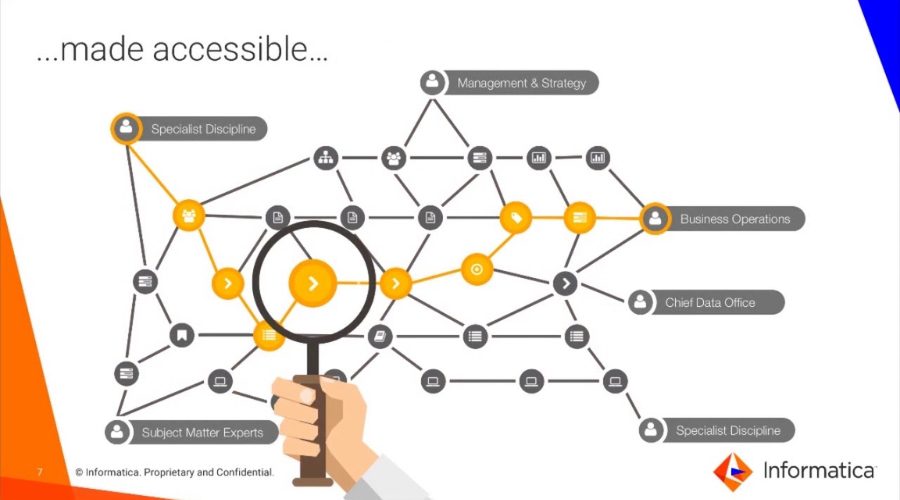
Informatica Axon Data Governance is among the top data governance tools that offers organizations a unified platform for ensuring compliance, transparency, and accountability by creating governance policies, documentation, and enforcement. Focusing on closing the gap between business and IT, the platform guarantees proper coordination between IT experts and business owners regarding governance projects.
Key Features:
- Development and oversight of governance policies
- Clearly established responsibilities for data stewardship and ownership
- Built-in capabilities to ensure data quality
- Self-service availability via an integrated data marketplace
- Automation to streamline and simplify governance activities
Pros:
- Seamless integration with the broader Informatica ecosystem
- Strong focus on bridging business and IT teams for collaborative governance
- Comprehensive policy management and enforcement capabilities
- Built-in data marketplace for self-service data access
- Enterprise-grade features with proven track record in large organizations
Cons:
- Can be expensive, especially for organizations not already in the Informatica ecosystem
- Complex setup and configuration requiring specialized expertise
- User interface primarily designed for technical users, less intuitive for business users
- Lineage often limited to table-level, with refresh delays
Primarily used by: Large enterprises, banking and financial services, insurance, pharmaceutical, government agencies and multinational corporations.
3. Alation
The Alation Data Governance solution automates governance procedures by integrating collaboration, metadata management, and stewardship in one solution. Based on Alation’s data catalog, this data governance software makes it easy for organizations to discover, govern, and share data effectively with full visibility and control.
Key Features:
- Seamless connection with the data catalog
- Automated enforcement of policies and stewardship functions
- Regulatory reporting supported by complete audit logs
- Collaboration tools including comments, tags, and resource sharing
- Secure data usage enabled through role-based access control (RBAC)
Pros:
- User-friendly interface with strong focus on data discovery and collaboration
- AI-powered (ALLIE AI) metadata recommendations and enrichment
- Quick onboarding and relatively fast time-to-value
- Strong community features promoting data culture and collaboration
- Good balance of governance and usability features
Cons:
- Advanced profiling and rule creation features are less mature
- Can require extensive training for full feature adoption
- Less comprehensive for complex regulatory compliance needs
Primarily used by: Financial Services, Healthcare, Technology, and Retail.
4. Apache Atlas
Apache Atlas is open-source data governance software for managing and governing data with extensive use in Hadoop-focused big data stores. It supports automated discovery and cataloging of metadata through strong integrations with technologies like Apache Hive, HBase, and Spark.
Key Features:
- Data classification using tagging
- Complete support for REST API
- Metadata management with a graph model
- Policy management in conjunction with Apache Ranger
Pros:
- Open-source with no licensing costs
- Strong integration with Hadoop ecosystem (Hive, HBase, Spark)
- Active community support and regular updates
- Flexible and customizable to specific organizational needs
- Graph-based metadata model for complex relationships
Cros:
- Primarily designed for Hadoop environments, limited cloud-native support
- Requires significant technical expertise to deploy and maintain
- User interface is less intuitive compared to commercial tools
- Limited out-of-box compliance automation features
- Manual policy configuration required for regulatory compliance
Primarily used by: Big data organizations, apache hadoop users, tech companies, research institutions.
5. Ataccama One
Ataccama ONE is a contemporary self-service solution that integrates data quality, cataloging, and governance into one place. Unlike most other data governance tools, its architecture is built on enabling users by integrating self-service management, quality validation, and governance processes together.
This makes Ataccama ONE a flexible solution for businesses requiring ease of use coupled with robust controls. In contrast to Axon’s emphasis on compliance and data quality, Ataccama ONE is unique in that it combines data governance with easy self-service capabilities that empower data teams to have greater authority over their data assets.
Key Features:
- Independent data management with self-service capabilities
- Built-in functionality to maintain and improve data quality
- Governance workflows streamlined through automatioPros
- Strong self-service capabilities empowering business users
- Comprehensive data quality features built into the platform
- AI-powered automation for data profiling and cleansing
- User-friendly interface with good balance of power and simplicity
- Responsive customer support and training resources
- Cros
- Relatively newer player compared to established competitors
- AI governance capabilities still maturing
- May require additional tools for complete enterprise governance
- Integration with some legacy systems can be challenging
- Higher learning curve for advanced customization
- Primarily used by: Finance and banking, insurance, retail, manufacturing, mid-market organizations.
Pros
- Strong self-service capabilities empowering business users
- Comprehensive data quality features built into the platform
- AI-powered automation for data profiling and cleansing
- User-friendly interface with good balance of power and simplicity
- Responsive customer support and training resources
Cros
- Relatively newer player compared to established competitors
- AI governance capabilities still maturing
- May require additional tools for complete enterprise governance
- Integration with some legacy systems can be challenging
- Higher learning curve for advanced customization
Primarily used by: Finance and banking, insurance, retail, manufacturing, mid-market organizations.
>>> See more:
- What Is Business Process Outsourcing (BPO)? Definition & Benefits
- Business Process Automation Solutions: Benefits, Example & Service Company
6. Talend Data Fabric
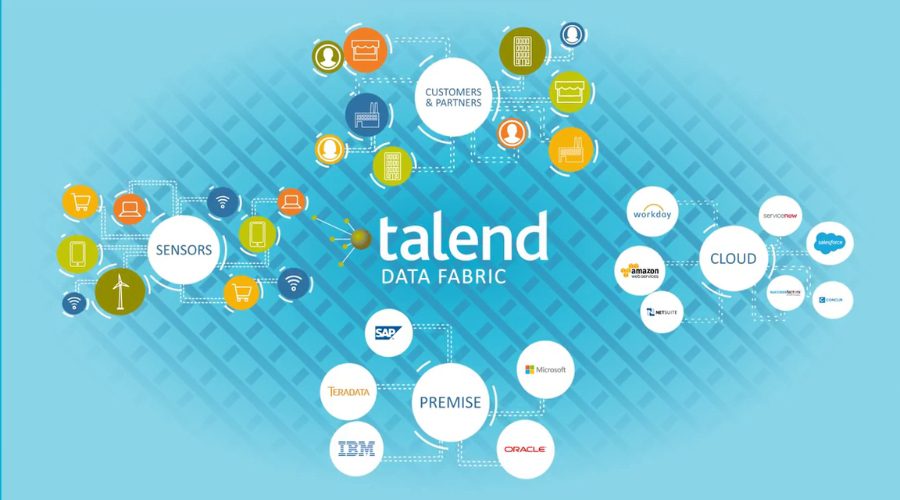
Talend Data Fabric is a complete, end-to-end platform that brings data integration, integrity, and governance capabilities under one solution. As a data governance software, it natively integrates governance functions with integration and quality components, enabling organizations to deal with data across multiple environments without sacrificing reliability and compliance.
Based on its robust focus on data integration, Talend Data Fabric is a reliable alternative for governance, supporting other strong platforms such as Domo, which provide full-scale data management.
Key Features:
- Robust capabilities for data integration
- Embedded tools ensuring data accuracy and consistency
- Governance support across multiple platforms
Pros:
- Strong data integration capabilities combined with governance
- Comprehensive platform covering integration, quality, and governance
- Support for hybrid and multi-cloud environments
- Pre-built connectors for various data sources and platforms
- Cost-effective for organizations already using Talend
Cros:
- Governance features can be overshadowed by integration focus
- May be overly complex for organizations only needing governance
- Requires technical expertise to maximize platform capabilities
- Learning curve for non-technical users
- Some advanced features require additional modules
Primarily used by: Data integration-heavy enterprises, ETL teams, Multi-cloud organizations, Telecommunications, Retail, End-to-end data management solutions.
7. Atlan
Atlan offers a team data workspace aimed at making discovery, governance, and collaboration easier within and between organizations. One of the new data governance tools, Atlan empowers data teams to make data-driven decisions by automating governance rules, metadata management, and workflow automation.
Prioritizing collaboration and usability, Atlan allows teams to govern and understand data assets in an easy and transparent way while still staying in control.
Key Features:
- End-to-end automated management of metadata across datasets
- Continuously updated and dynamic business glossary
- Adaptable workflows tailored to organizational needs
- Visual representation of data asset lineage
Pros:
- Modern, intuitive user interface promoting high user adoption
- Cloud-native architecture with excellent scalability
- Strong collaboration and metadata management features
- AI-powered automation for governance tasks
- Recognized as Visionary in Gartner Magic Quadrant 2025
Cros:
- Newer platform with less extensive track record than legacy tools
- May lack some advanced features of more established competitors
- Limited on-premise deployment options
- Smaller partner ecosystem compared to larger vendors
- Some enterprise features still evolving
Primarily used by: Fast-growing tech companies, data-driven startups, modern cloud-native enterprises, analytics teams, collaboration-focused organizations.
8. IBM
IBM Cloud Pak for Data is an integrated cloud platform that has governance, data quality, privacy, integration, MDM, analytics, and AI governance as one solution. As a top-rated data governance software, data fabric architecture is utilized to provide AI-powered discovery, profiling, and cataloging via IBM Knowledge Catalog. The catalog also has metadata enrichment, data policy, and activities to improve data quality.
The platform packages up a number of tools with a governance emphasis, including IBM Manta Data Lineage for data tracing and mapping, IBM Data Product Hub for marketplace-access to governed data, and IBM Match 360, which merges data sets through high-level matching. They are all tightly coupled with IBM Knowledge Catalog and deployable on-prem or as a managed cloud service.
Key Features:
- Advanced sensitive data discovery with dynamic policy enforcement and access controls
- IBM Knowledge Catalog Relationship Explorer, leveraging knowledge graphs to expose relationships between data assets and governance artifacts
- Generative AI-powered metadata enrichment, including glossary terms and classifications to data catalogs
Pros:
- Comprehensive all-in-one platform for data, AI, and governance
- Strong enterprise-grade security and compliance features
- Deep integration across IBM ecosystem
- Advanced AI-powered metadata enrichment and discovery
- Suitable for highly regulated industries with strict requirements
Cons:
- Complex and expensive, designed for large enterprises
- Steep learning curve requiring specialized IBM expertise
- Implementation can be resource-intensive and time-consuming
- User interface and workflows less modern than newer platforms
- May be too heavyweight for organizations with simpler needs
Primarily used by: Financial institutions, healthcare organizations, government agencies, pharmaceutical companies, regulated industries.
9. OneTrust
OneTrust Data Governance is a part of the overall OneTrust Suite and brings the company’s security, compliance, and privacy expertise to data management. Placed alongside new data governance tools, it provides a centralized platform for data classification, discovery, and governance in addition to solving privacy and protection needs.
This makes it a better solution for organizations with both governance as well as regulatory compliance combined.
Key Features:
- Centralized and unified catalog for all data assets
- Built-in capabilities for managing data quality
- Governance procedures streamlined through automation
- Privacy protection and management tools included
- Complete traceability of data origins from end to end
Pros
- Exceptional privacy and compliance capabilities
- Centralized platform for data governance, privacy, and security
- Strong support for GDPR, CCPA, and other privacy regulations
- Automated privacy management and consent tracking
- Comprehensive risk management features
Cons
- Primarily focused on privacy, less comprehensive for general governance
- Can be expensive with complex pricing structure
- Limited data quality and observability features
- Requires integration with other tools for complete data lifecycle management
- May be overkill for organizations without heavy compliance needs
Primarily used by: Privacy-conscious enterprises, GDPR/CCPA compliance companies, healthcare and pharmaceutical, financial services, e-commerce, regulated industries.
>>> See more:
- How To Prepare a Classified Balance Sheet: Template & Example
- Intelligent Document Processing Services: How It Works & Business Benefits
10. Cloudera
Cloudera offers a hybrid data platform equipped with powerful data governance tools to ensure consistent control across on-premises and cloud environments. Built on its Shared Data Experience (SDX) framework, Cloudera integrates metadata management, lineage tracking, and policy enforcement into a single data fabric.
By leveraging Apache Atlas for cataloging and lineage, along with Apache Ranger for access control, Cloudera helps organizations classify data, enforce policies, and maintain full visibility throughout the data lifecycle.
Key Features:
- Unified governance powered by a Shared Data Experience (SDX)
- Integration with Apache Atlas for metadata management and lineage tracking
- Role-based access and policy enforcement through Apache Ranger
- Centralized system for data classification and tagging
- End-to-end audit logs with compliance-focused reporting
Pros:
- Strong hybrid cloud support for on-premises and cloud environments
- Proven platform with Apache Atlas and Apache Ranger integration
- Excellent for organizations with existing Hadoop infrastructure
- Comprehensive metadata management and lineage capabilities
- Enterprise-grade security and access controls
Cons:
- Can be complex to deploy and manage
- Requires significant infrastructure and technical expertise
- Pricing can be high for full-featured deployment
- Legacy platform that may lag behind modern cloud-native solutions
Primarily used by: Hybrid cloud enterprises, data analytics teams, tech companies, research institutions, large-scale distributed data environments.
11. BigID
BigID is a specialized data security and privacy platform designed to help organizations discover, classify, and protect sensitive data across their entire infrastructure. It excels in identifying personally identifiable information (PII), protected health information (PHI), and payment card information (PCI) through advanced machine learning algorithms.
Key Features:
- Automated PII/PHI/PCI identification and classification
- Built-in data privacy controls including masking, anonymization, and encryption
- Multi-cloud and hybrid environment support with extensive connectors
- Real-time risk detection and automated compliance monitoring
- Native integration with security tools for comprehensive data protection
Pros
- Exceptional capabilities for privacy and security use cases
- Advanced machine learning for accurate data discovery
- Strong compliance support for GDPR, CCPA, HIPAA regulations
- Comprehensive data mapping across complex environments
Cros
- Limited capabilities for general data governance beyond security
- Can be expensive for smaller organizations
- Steeper learning curve compared to general-purpose tools
- Less focus on business-oriented data cataloging features
Primarily used by: Financial services firms, healthcare organizations, insurance companies, retail enterprises with payment processing, tech companies, regulated industries.
12. Monte Carlo
Monte Carlo is a data governance tool that focuses on data reliability and quality monitoring. It helps organizations prevent data downtime by automatically detecting, resolving, and preventing data quality issues before they impact business operations.
Key Features:
- Automated data quality monitoring and anomaly detection
- Real-time alerts for data freshness, volume, and schema changes
- End-to-end data lineage tracking across pipelines
- Root cause analysis for data incidents
- Integration with major data warehouses and BI tools
Pros
- Proactive approach to data quality management
- Reduces time spent on data firefighting
- Machine learning-powered anomaly detection
- Strong support for modern data stack
Cons
- Focused primarily on data observability rather than full governance
- Requires integration with existing governance tools
- Can generate alert fatigue if not properly configured
- Premium pricing may not suit smaller teams
Primarily used by: Data engineering teams, analytics-focused organizations, saaS companies, e-commerce platforms, media and entertainment, real-time data pipeline organizations.
13. OvalEdge
OvalEdge is a comprehensive data governance and cataloging platform designed for mid-market to enterprise organizations beginning their governance journey. It provides an intuitive interface for cataloging datasets, creating business glossaries, and enforcing data access policies.
Key Features:
- User-friendly data catalog with self-service discovery
- Automated metadata harvesting and classification
- Visual data lineage with impact analysis
- Role-based access control and policy enforcement
- Built-in compliance tracking and audit reporting
- Business glossary with AI-powered term suggestions
Pros
- Intuitive interface designed for business users
- Quick deployment and time-to-value
- Comprehensive feature set at competitive pricing
- Strong customer support and training resources
Cons
- May struggle with performance at extreme enterprise scale
- Limited advanced AI capabilities compared to top-tier platforms
- Some integration capabilities require custom development
- Less suitable for highly complex governance requirements
Primarily used by: Mid-market enterprises, financial institutions, healthcare providers, manufacturing companies, retail organizations, businesses seeking rapid implementation.
>>> See more:
- 15 Best Data Labeling Service Providers In 2026
- Invoice Reconciliation Process Steps | DIGI-TEXX
14. Salesforce Security and Privacy
Salesforce Security and Privacy provides comprehensive data governance capabilities within the Salesforce ecosystem, combining CRM data management with enterprise-grade security and privacy controls through Data Cloud and Shield.
Key Features:
- Centralized data governance across Salesforce products
- Field-level encryption and platform shield capabilities
- Consent and privacy management aligned with global regulations
- Event monitoring and audit trail capabilities
- Data retention policies and automated lifecycle management
- Fine-grained permission controls and data masking
Pros
- Seamless integration with Salesforce ecosystem
- Built-in compliance with GDPR, CCPA, and other regulations
- Strong security features including encryption at rest and in transit
- No-code configuration for most governance tasks
Cons
- Primarily focused on Salesforce data
- Additional costs for Shield and advanced features
- Complex permission model can be challenging to manage
- Limited governance for non-Salesforce data sources
Primarily used by: Salesforce-centric enterprises, B2B and B2C companies, financial services, healthcare organizations, customer-facing businesses, salesforce ecosystem-heavy organizations.
15. Secoda
Secoda is a modern data discovery and documentation platform that centralizes data knowledge, making it accessible to both technical and non-technical users. It emphasizes collaboration and self-service data access.
Key Features:
- AI-powered data discovery and search
- Automated metadata management and synchronization
- Collaborative documentation with commenting and annotations
- Integration with popular data warehouses and BI tools
- Data lineage tracking and impact analysis
- Team workspace for knowledge sharing
Pros
- Modern, intuitive user interface
- Strong focus on data democratization
- Quick setup and onboarding
- Good balance of features for growing teams
Cons
- Limited enterprise-grade governance features
- Fewer compliance and security capabilities than full-suite tools
- May require supplementary tools for complete governance
- Smaller integration ecosystem than established players
Primarily used by: Growing tech companies, data-driven startups, analytics teams, data science departments, marketing and product teams, data democratization-focused organizations.
16. SAS Viya
SAS Viya is an AI-powered analytics and data management platform that combines advanced analytics capabilities with comprehensive data governance features, designed for organizations with sophisticated data science and governance needs.
Key Features:
- Integrated analytics and governance in a unified platform
- AI-powered data quality profiling and validation
- Automated metadata management and lineage tracking
- Advanced data preparation and transformation capabilities
- Enterprise-grade security and access controls
- Comprehensive audit trails and compliance reporting
Pros
- Powerful combination of analytics and governance
- Strong data quality and profiling capabilities
- Robust performance for large-scale data processing
- Extensive industry-specific solutions
Cons
- Steep learning curve for new users
- Higher cost compared to lighter-weight alternatives
- Requires significant infrastructure and resources
- May be over-featured for basic governance needs
Primarily used by: Enterprise analytics organizations, financial services, healthcare and pharmaceutical, government agencies, manufacturing and retail, advanced data science organizations.
>>> See more:
- Outsourced Order Processing Services – Fast & Accurate
- Top 10 Data Cleansing Companies for Businesses
17. Syniti Knowledge Platform
Syniti Knowledge Platform is a comprehensive data management solution that specializes in data quality, migration, and governance. It offers pre-built solutions for industry-specific data challenges.
Key Features:
- Advanced data discovery and profiling capabilities
- Data quality management with automated cleansing
- Master Data Management (MDM) integration
- Data migration and transformation tools
- Industry-specific templates and accelerators
- Comprehensive data governance workflows
Pros:
- Strong focus on data quality and accuracy
- Excellent for data migration projects
- Industry-specific expertise and solutions
- Comprehensive data management capabilities
Cons:
- Can be complex to implement
- Higher cost for full-featured deployment
- Requires specialized expertise for optimal use
- May include features beyond basic governance needs
Primarily used by: Enterprises undergoing data migration, financial institutions, healthcare organizations, manufacturing and supply chain, retail, industry-specific governance requirements.
18. Egeria
Egeria is an open-source project under the Linux Foundation that focuses on metadata exchange and governance interoperability. It’s designed to enable metadata synchronization across diverse data management tools and platforms.
Key Features:
- Open metadata standards and APIs
- Automated metadata synchronization across systems
- Support for governance zones and classifications
- Context-aware metadata search
- Extensible architecture for custom integrations
- Community-driven development and support
Pros
- Free and open-source with no licensing costs
- Flexible and customizable to specific needs
- Strong focus on interoperability
- Active community and regular updates
Cros
- Requires significant technical expertise to implement
- Limited out-of-box security features
- Needs custom development for production deployment
- Smaller user community than commercial alternatives
Primarily used by: Heterogeneous tool ecosystem organizations, linux foundation members, tech companies, research institutions, open-source-first enterprises, vendor-agnostic organizations.
19. Open Source Alternatives
Open source alternatives are software programs with publicly available source code that users can study, modify, and distribute, serving as free, community-driven replacements for proprietary applications. These include Apache Atlas, DataHub, OpenMetadata, Amundsen, and others.
Key Features:
- Cost-effective metadata management and cataloging
- Community-driven development and support
- Flexible customization and extension capabilities
- Basic data lineage tracking
- Open APIs for integration
- Active development communities
Pros
- Zero licensing costs
- Full source code access for customization
- No vendor lock-in
- Strong community support
Cons
- Requires dedicated technical resources
- Limited enterprise support options
- Gaps in compliance and security features
- Manual configuration and maintenance required
- Slower feature development than commercial tools
Primarily used by: Startups, budget-conscious organizations, open-source technology-first companies, research institutions, cost-saving focused, technical capability organizations.
20. Twilio Segment
Twilio Segment is a customer data platform (CDP) that specializes in collecting, unifying, and routing customer data across various systems. While not a traditional data governance tool, it provides essential governance capabilities for customer data.
Key Features:
- Customer data unification across touchpoints
- Real-time data collection and routing
- Privacy controls and consent management
- Data quality validation and transformation
- Customer journey tracking and analytics
Pros
- Excellent for customer data management
- Real-time data processing capabilities
- Extensive integration ecosystem
- Strong privacy and consent features
Cros
- Limited to customer data use cases
- Higher costs for large data volumes
- Not suitable for general enterprise data governance
- Requires integration with other tools for complete governance
Primarily used by: E-commerce companies, SaaS platforms, digital marketing teams, customer experience organizations, retail and hospitality, customer data and attribution organizations.
>>> See more:
- What are the 6 steps of the data analysis process?
- How to Automate Documentation in 2026: Step By Step Guide
Benefits Of Using Data Governance Tools
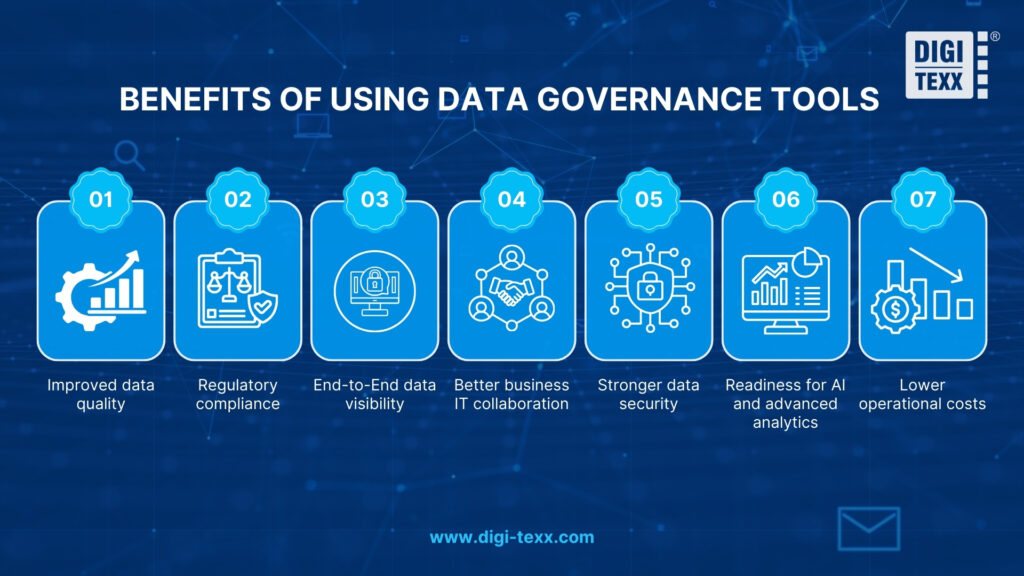
Investing in a data governance platform goes far beyond regulatory checkboxes , when implemented well, these tools deliver tangible business value across the entire organization:
- Improved data quality: Tools continuously profile and cleanse data across sources, catching errors and inconsistencies before they impact downstream decisions.
- Regulatory compliance: Automated audit trails, retention policies, and compliance reports dramatically reduce the manual effort needed to meet GDPR, CCPA, HIPAA, and other regulations.
- End-to-End data visibility: Data lineage tracking lets organizations trace exactly where any data asset came from, how it was transformed, and who accessed it – invaluable during audits and investigations.
- Better business IT collaboration: Shared data catalogs and business glossaries give both technical and non-technical teams a single source of truth, reducing dependency on IT for data access.
- Stronger data security: Role-based access controls and automated access reviews ensure sensitive data stays in the right hands while reducing the IT security burden.
- Readiness for AI and advanced analytics: Governance tools provide the lineage, quality assurance, and metadata enrichment that AI models need to produce reliable, unbiased outcomes.
- Lower operational costs: Reducing duplicate datasets, manual data fixes, and compliance firefighting frees teams to focus on higher-value work.
How To Choose Right A Data Governance Tools For Businesses
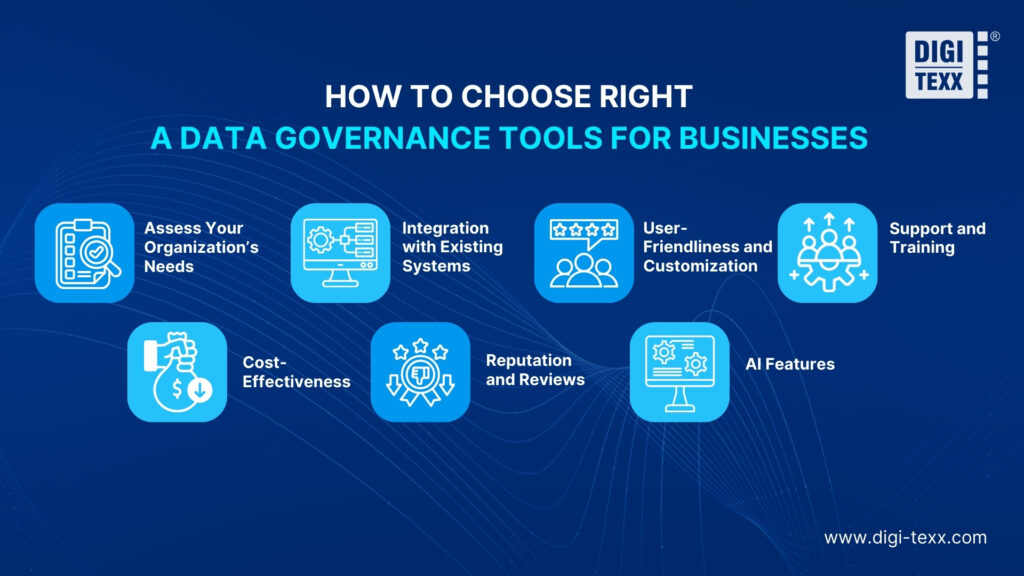
The right choice depends on your specific needs and how well the tool integrates into your current workflows. Here are 7 key factors to consider when evaluating your options.
1. Assess Your Organization’s Needs
While it may seem obvious, it’s crucial to recognize that every business has unique requirements. A growing company may only need basic data cataloging and accuracy checks, while a large enterprise might need advanced compliance features, automation, and scalability. Aligning the tool’s capabilities with your organization’s objectives is the first step toward finding the right fit.
2. Integration with Existing Systems
Just as a team needs to work together smoothly, your governance tool should easily integrate with your current systems, such as databases, data warehouses, and applications. The easier the integration, the quicker you can start utilizing the tool’s benefits.
3. User-Friendliness and Customization
A tool is only valuable if it’s easy for your team to use. If the tool is too complex or lacks an intuitive interface, or if it doesn’t allow customization to meet your organization’s specific data needs, adoption will be difficult. Focus on tools that offer a simple, clear interface and can be tailored to different roles across your company, not just technical users.
4. Support and Training
Expect a learning curve, but ensure that your team isn’t left without guidance. Good documentation and accessible tutorials can significantly reduce frustration, and reliable support can keep your team focused on their work rather than troubleshooting issues.
5. Cost-Effectiveness
While more features often mean a higher price, the most expensive tools aren’t always the best for your needs. What’s important is whether the tool offers the right functionality at a reasonable cost, without charging for unnecessary extras that won’t be used.
6. Reputation and Reviews
Leverage the experiences of others to gain insight into how a tool performs in real-world scenarios. Reviews, peer recommendations, and case studies can help you gauge how well a tool actually works, beyond what’s promised in the sales pitch. A solid reputation is often a sign of a worthwhile investment.
7. AI Features
Many data governance tools now incorporate AI to automate tasks like data classification, error detection, and compliance monitoring. While AI isn’t a complete solution, it can streamline processes, reduce manual effort, and make data management more proactive. In fact, 84% of business leaders believe AI can enhance data accessibility.
>>> See more:
- Outsourced data annotation services: List of best companies to work for
- Best Insurance Claims Processing Outsourcing BPO in the US 2026
FAQs About Data Governance Tools
What Are The 4 Areas Of Data Governance?
The four main pillars of data governance include:
- Data Quality: Ensuring the accuracy and reliability of data across the organization.
- Data Stewardship: Managing and overseeing data assets to maintain accountability and proper usage.
- Data Protection & Compliance: Securing data and ensuring adherence to relevant regulations and legal requirements.
- Data Management: Covering the full data lifecycle, from creation to disposal, including availability and usability.
These four pillars work together to form a comprehensive data governance framework, enabling organizations to treat data as a valuable and well-managed asset.
Is Informatica A Data Governance Tool?
Yes, through its Intelligent Data Management Cloud (IDMC), including the Axon Data Governance module and Enterprise Data Catalog Informatica covers policy management, metadata cataloging, data lineage, data quality, and MDM. It is best suited to large enterprises already within the Informatica ecosystem that have dedicated governance teams to manage its complexity and cost.
What Is The Purpose Of A Data Governance Tool?
A data governance tool helps organizations ensure their data is accurate, secure, compliant, and consistently understood across the business. It does this by establishing and enforcing data policies, cataloging all data assets, tracking lineage from source to destination, managing access controls, and generating the audit trails that regulators and internal stakeholders require.
Can smaller or mid-sized organizations also benefit from governance tools, or are they only for large companies?
Smaller organizations can absolutely benefit from data governance. By implementing lightweight solutions focused on information classification, access management, and user consent processes, companies can achieve significant results in building trust, ensuring regulatory compliance, and strengthening the reliability of business decisions. As your data volume and usage patterns expand, you can progressively incorporate advanced capabilities such as privacy protection, data lifecycle management, and audit tracking without requiring substantial upfront investment.
Choosing the right data governance tools is essential for organizations that want to unlock the full value of their data while ensuring compliance, accuracy, and security. From metadata management to data quality monitoring and policy enforcement, these solutions empower businesses to maintain transparency and build trust in their data assets.
By implementing the right governance strategy and technology, companies can turn raw data into actionable insights that drive long-term growth.
If your organization is looking for a trusted partner in data management and governance, DIGI-TEXX can help. With years of experience in digital transformation services, DIGI-TEXX provides tailored solutions that streamline data processes, enhance governance, and ensure compliance with global standards. Partnering with DIGI-TEXX means gaining the expertise and tools you need to manage data effectively and sustainably.
If you have any questions or would like expert advice on data analytics services, please feel free to contact us using the information below.
DIGI-TEXX Contact Information:
🌐 Website: https://digi-texx.com/
📞 Hotline: +84 28 3715 5325
✉️ Email: [email protected]
🏢 Address:
- Headquarters: Anna Building, QTSC, Trung My Tay Ward
- Office 1: German House, 33 Le Duan, Saigon Ward
- Office 2: DIGI-TEXX Building, 477-479 An Duong Vuong, Binh Phu Ward
- Office 3: Innovation Solution Center, ISC Hau Giang, 198 19 Thang 8 street, Vi Tan Ward