
Content moderation tools range from developer-focused APIs and cloud AI services to enterprise Trust & Safety platforms and managed human-in-the-loop solutions. This guide compares 11 leading content moderation tools based on their moderation capabilities, strengths, limitations, and best use cases.
DIGI-TEXX also provides scalable content moderation services combining technology and human expertise for businesses with diverse content safety needs.

>>> See more:
- E-commerce Content Moderation: Essential Guide for Platform Owners & E-commerce Businesses
- AI vs Human Content Moderation Solutions: Which Approach Works Best For E-commerce In 2026?
What Are Content Moderation Tools?
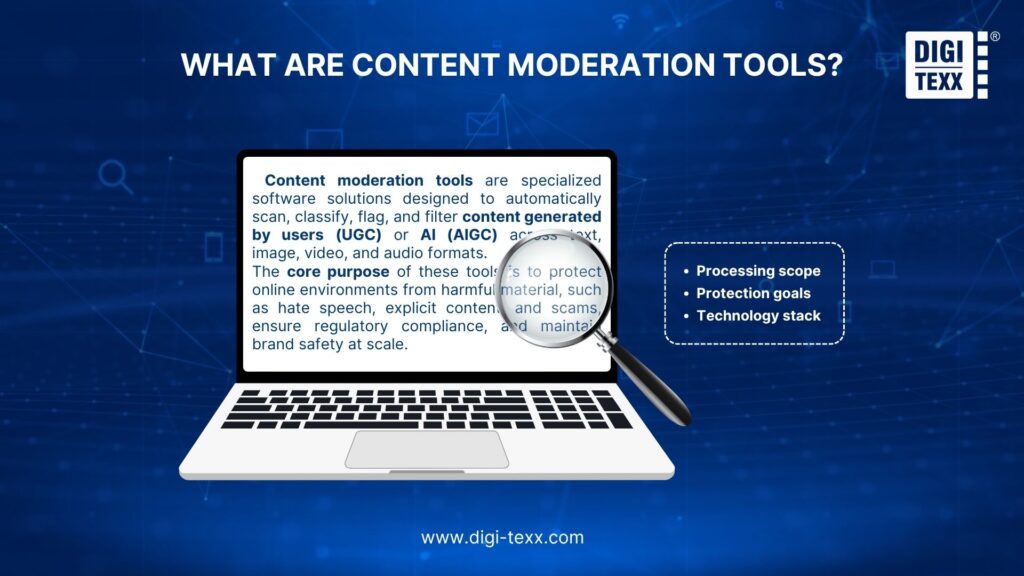
Content moderation tools are specialized software solutions designed to automatically scan, classify, flag, and filter content generated by users (UGC) or AI (AIGC) across text, image, video, and audio formats.
The core purpose of these tools is to protect online environments from harmful material, such as hate speech, explicit content, and scams, ensure regulatory compliance, and maintain brand safety at scale.
To operate effectively, modern platforms combine Artificial Intelligence (AI), Machine Learning (ML), automated classifiers, keyword blacklists, and human-in-the-loop workflows.
- Processing scope: Scan and manage diverse UGC and AIGC across four primary formats: Text, image, video, and audio.
- Protection goals: Promptly detect and prevent obscene content, hate speech, explicit imagery, scams, and misinformation.
- Technology stack: Combine automated AI/ML classifiers with human moderation teams through human-in-the-loop workflows to optimize detection accuracy.
4 Types Of Content Moderation Models
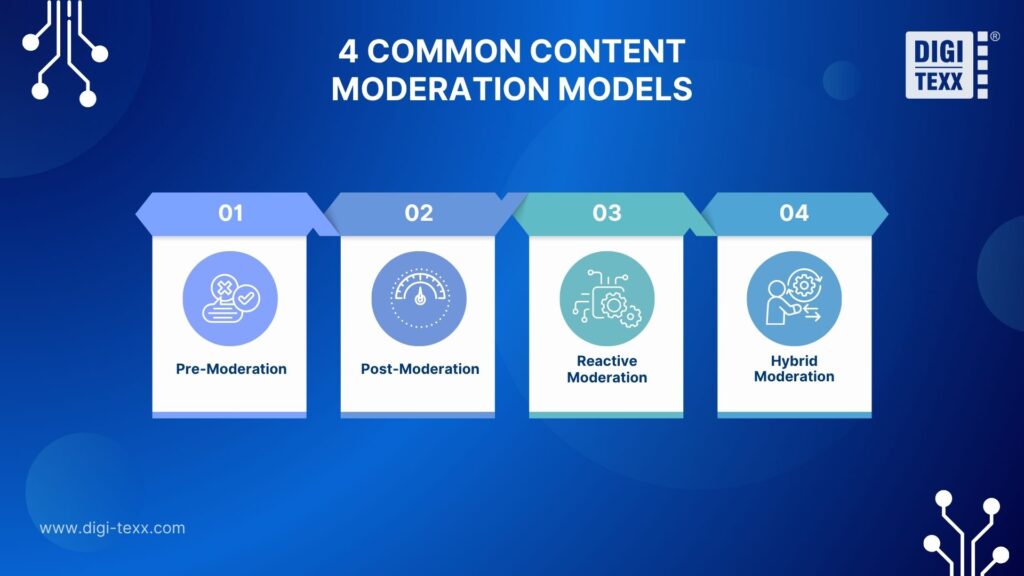
Businesses can select or combine four common moderation models depending on their product, content risk, user experience requirements, and tolerance for exposure to harmful content.
| Moderation Model | When It Happens | How It Works | Key Advantage | Main Limitation | Best For |
| Pre-Moderation | Before publication | Content is reviewed before becoming publicly visible | Strong control over harmful content | Higher latency and moderation workload | High-risk or sensitive platforms |
| Post-Moderation | After publication | Content is published first, then reviewed by AI or human moderators | Fast publishing and better user experience | Violating content may be visible temporarily | High-volume UGC platforms and social networks |
| Reactive Moderation | After a report or flag | Users, communities, or systems flag potentially harmful content for review | Cost-efficient and scalable | Relies on reporting and user participation | Online communities and large social platforms |
| Hybrid Moderation | Throughout the moderation workflow | AI handles routine cases while human moderators review complex or uncertain content | Balances speed, accuracy, and scalability | Requires more complex workflows and oversight | Enterprise platforms, gaming, and large UGC environments |
1. Pre-Moderation
- How it works: Content is held in a moderation queue and reviewed before it becomes publicly visible.
- Common use cases: Children’s social platforms, financial forums, advertisements, and e-commerce listings.
- Pros and cons: Provides strong control over published content, but introduces latency and can negatively affect real-time user experiences.
2. Post-Moderation
- How it works: Content is published immediately, then reviewed asynchronously by automated systems or human moderators.
- Common use cases: In-app chat, live comments, social networks, and high-volume UGC platforms.
- Pros and cons: Enables a fast publishing experience, but violating content may remain visible temporarily before detection and enforcement.
3. Reactive Moderation
- How it works: Relies on users or community members to flag, report, or vote on potentially harmful content.
- Common use cases: Open community forums, social platforms, and very large UGC environments.
- Pros and cons: Cost-efficient and highly scalable, but effectiveness depends on user participation and the reliability of community reporting.
4. Hybrid Moderation
- How it works: Automated systems handle routine, high-confidence cases, while complex or uncertain cases are escalated to Human-in-the-Loop (HITL) reviewers.
- Common use cases: Enterprise platforms, large-scale online communities, gaming platforms, and modern digital applications.
- Pros and cons: Provides a practical balance between speed, accuracy, scalability, and operational cost by combining automated detection with human judgment.
Why Do Businesses Need Content Moderation Tools?
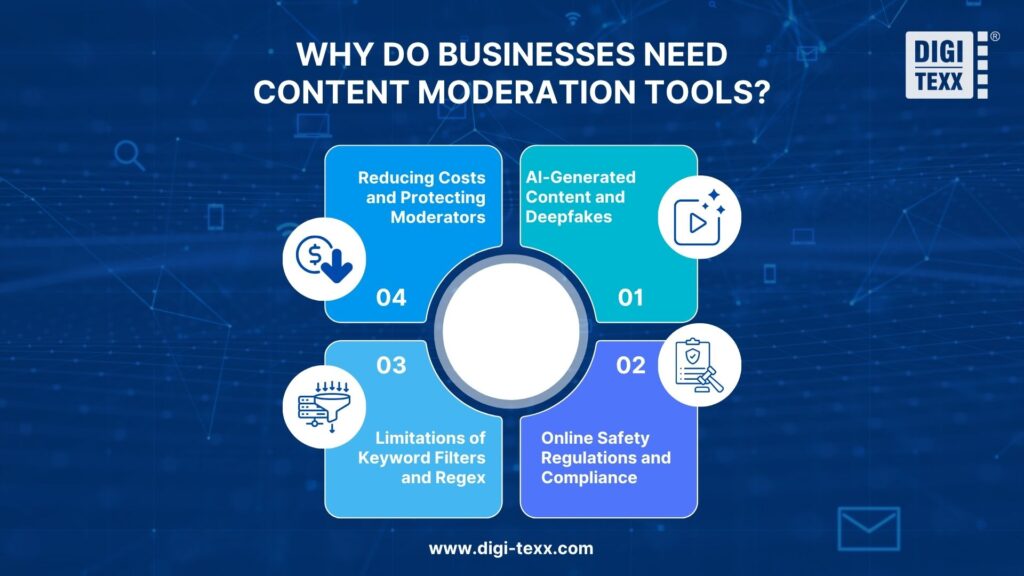
As content volumes, online abuse, and regulatory requirements grow, businesses need scalable ways to detect harmful content and enforce safety policies. Content moderation tools automate detection and triage while allowing human moderators to handle complex or high-risk cases.
- AI-Generated Content and Deepfakes
Generative AI makes synthetic text, images, audio, and video easier to produce at scale. Deepfakes, voice clones, impersonation, and AI-generated spam create additional risks that require multimodal detection and specialized synthetic-media analysis.
- Online Safety Regulations and Compliance
Regulations such as the EU Digital Services Act (DSA) and UK Online Safety Act (OSA) increase requirements for content reporting, risk management, enforcement, transparency, and user appeals. Moderation tools help automate these workflows and maintain audit trails.
- Limitations of Keyword Filters and Regex
Keyword blocklists and Regular Expressions (Regex) are useful for deterministic rules but struggle with context and evasion. Users can bypass filters through leetspeak, misspellings, Unicode variations, emojis, or hidden characters, while text-based rules cannot moderate visual or audio content.
- Reducing Costs and Protecting Moderators
Automation allows platforms to process large content volumes without proportionally increasing moderation headcount. Human-in-the-Loop (HITL) workflows can route edge cases to reviewers while automated systems handle routine decisions and help shield moderators from unnecessary exposure to graphic content.
>>> See more:
- How to Moderate User-Generated Content: Complete Guide 2026
- Best Social Media Moderation Services Guide (2026)
- Data Labeling Service: What It Is, Types & Benefits For AI
11 Best Content Moderation Tools In 2026
The best content moderation tools depend on the content formats you need to moderate, your platform’s risk profile, and how much automation or human oversight your workflow requires. The table below highlights the primary strengths and best-fit use cases of the 11 platforms covered in this guide.
| Tool | Primary Strength | Content Coverage | Best For | Reference Price |
| Hive Moderation | Multimodal AI moderation and synthetic media detection | Text, image, video, audio | Large platforms with diverse content types | Custom pricing / Contact sales |
| Microsoft Azure AI Content Safety | Configurable AI safety filters and severity-based classification | Text, image, multimodal | AI applications and Microsoft/Azure environments | Pay-as-you-go; varies by API usage |
| Amazon Rekognition | Image and video moderation at cloud scale | Image, video | AWS-based applications and visual UGC | Pay-as-you-go; varies by image/video volume |
| OpenAI Moderation API | Simple API-based text and image safety classification | Text, image | AI applications and developer workflows | Free to use through the Moderation API, subject to applicable limits |
| Alice (formerly ActiveFence) | Trust & Safety intelligence and complex threat detection | UGC, platform and AI safety use cases | Enterprise Trust & Safety programs | Custom enterprise pricing |
| Modulate ToxMod | Real-time voice moderation | Voice/audio | Gaming and live voice communities | Custom pricing / Contact sales |
| Sift | Real-time community and UGC moderation | Text, image, video, usernames | Gaming and large online communities | Custom pricing / Contact sales |
| Sightengine | Developer-focused multimodal moderation APIs | Text, image, video, audio | API-driven moderation workflows | Usage-based pricing; plans vary by volume |
| WebPurify | AI + human moderation services | Text, image, video, GenAI | Businesses needing managed hybrid moderation | Custom pricing / Contact sales |
| Checkstep | AI moderation, policy management, and compliance workflows | UGC and multimodal content | Platforms with complex policy and regulatory requirements | Custom pricing / Contact sales |
| DeepCleer | Granular, real-time multimodal risk detection | Text, image, audio, video, live streams | Global platforms and high-volume content workflows | Custom enterprise pricing |
Cloud Infrastructure & AI APIs
These platforms are particularly suitable for development teams that want to integrate automated moderation directly into their applications through APIs, cloud services, or AI infrastructure.
1. Hive Moderation
Hive Moderation is a multimodal AI moderation platform designed to analyze text, images, video, and audio at scale. Its broader detection stack also covers AI-generated content and deepfakes, making it particularly relevant for social platforms, marketplaces, gaming communities, and other services handling large volumes of UGC.
Key moderation capabilities:
- Text moderation: Detects categories such as profanity, hate, bullying, and other policy violations. Hive can also combine deep-learning classification with pattern matching for profanity and PII detection, giving teams both semantic and deterministic controls.
- Image and video moderation: Classifies visual content across categories such as sexual content, violence, weapons, and drugs. Video can be analyzed through sampled frames, with moderation results returned alongside timestamps.
- OCR moderation: Extracts text embedded inside images and sends it through text moderation models. This is particularly useful for detecting harmful text in memes, screenshots, profile images, and other visual UGC that keyword filters alone would miss.
- Audio and speech moderation: Hive can transcribe speech, identify the spoken language, and classify undesirable speech. Moderation results can include timestamps and sentence-level classifications, which is useful for live chat, streams, and voice-based communities.
- AI-generated content detection: Separate APIs are available for detecting AI-generated text, images, video, and audio. Visual detection can also identify deepfakes and provide confidence scores for classifications.
What makes Hive stand out:
- Broad multimodal coverage: Text, image, video, audio, OCR, and synthetic-media detection can be incorporated into a broader moderation stack.
- Confidence-based decisioning: Teams receive model scores rather than a simple binary “safe/unsafe” result, enabling customized thresholding and escalation policies.
- Flexible moderation architecture: Businesses can combine automated classifications with their own rules, workflows, and human review rather than handing enforcement decisions entirely to the model.
- Useful for synthetic-media risks: AI-generated content and deepfake detection make Hive particularly relevant for platforms where content authenticity is part of the Trust & Safety strategy.
Limitations to consider:
- Threshold tuning is still required: A confidence score does not automatically equal a moderation decision. Platforms need to calibrate thresholds against their own content distribution, risk tolerance, and policy requirements. Hive itself recommends analyzing thresholds against real-world data.
- Real-time video requires architecture planning: Longer videos may need frame sampling or segmentation to control latency and processing requirements.
- AI detection should not be treated as definitive proof: Synthetic-media classifiers provide predictions and confidence scores, so high-risk enforcement decisions may still require additional signals or human review.
Best for: Large social platforms, marketplaces, gaming communities, and UGC-heavy applications that need multimodal moderation alongside AI-generated content or deepfake detection.
Pricing: Custom pricing. Hive Moderation does not present a single public fixed price for its full moderation platform. Costs can vary based on the APIs and detection capabilities required, content volume, and deployment needs. Businesses should contact Hive for a tailored quote.

2. Microsoft Azure AI Content Safety
Microsoft Azure AI Content Safety is a cloud-based AI content moderation and safety service within Microsoft Azure. It analyzes text and images for potentially harmful content and provides configurable severity scores, blocklists, and safety filters. The service is particularly relevant for developers building generative AI applications, copilots, agents, and other workloads that require content safety controls within the Azure ecosystem.
Key Moderation Capabilities:
- Text and image moderation: Detects four core harm categories: hate, sexual, violence, and self-harm. Teams can apply these capabilities to user prompts, generated responses, uploaded images, and other content requiring automated safety screening.
- Severity-based classification: Instead of returning only a binary safe/unsafe decision, the service assigns severity levels to detected harmful content. Developers can use these scores to establish different enforcement thresholds based on their application’s risk tolerance.
- Custom blocklists: Organizations can supplement AI-based classification with custom blocklists containing specific words or phrases that violate their policies. This is useful when businesses need deterministic controls for brand-specific or domain-specific risks.
- Prompt Shields: Azure AI Content Safety includes Prompt Shields for detecting certain prompt injection and jailbreak attacks. This is particularly relevant to applications where users can directly interact with LLMs or AI agents.
- Groundedness detection: For supported generative AI workflows, groundedness detection can help identify when an AI-generated response is not sufficiently supported by the provided source or context. This addresses a different risk from traditional harmful-content moderation.
- Custom Categories: Organizations can create custom safety categories for specific content risks and use additional classifiers where the standard harm taxonomy does not fully match their content policy.
- Content filtering for generative AI: The service can be incorporated into AI application pipelines to screen both user inputs and model outputs, helping developers establish safety controls before content reaches the end user.
What makes Microsoft Azure AI Content Safety stand out:
- Strong fit for Azure-native applications: Its biggest advantage is integration with the broader Microsoft Azure and Microsoft Foundry ecosystem, reducing the need to introduce a separate moderation vendor into an existing Microsoft-based architecture.
- Designed for generative AI safety: Features such as Prompt Shields, groundedness detection, and configurable content filters make it more than a conventional UGC moderation API. It is particularly relevant to applications built around LLMs, copilots, and AI agents.
- Configurable enforcement: Severity levels and configurable thresholds allow developers to build different moderation policies instead of applying the same binary decision to every application.
- Combination of AI classification and deterministic controls: Teams can combine machine-learning-based harm detection with custom blocklists, providing greater control over organization-specific policy requirements.
- Enterprise-oriented deployment: Azure’s broader security, identity, monitoring, and governance capabilities can make the service attractive to organizations that already operate their applications and data infrastructure within Microsoft Azure.
Limitations to Consider:
- Best suited to Azure-centric environments: Organizations already invested in Azure can benefit from its ecosystem integration, while teams running primarily on AWS, Google Cloud, or independent infrastructure may have less incentive to adopt a cloud-specific safety service.
- Not a complete Trust & Safety operation: Azure AI Content Safety provides detection and safety controls, but businesses still need to define content policies, enforcement actions, escalation workflows, human review, and appeals processes.
- Standard harm categories do not cover every policy need: Hate, sexual, violence, and self-harm detection provide a useful foundation, but specialized platforms may require additional classifiers for risks such as scams, fraud, spam, impersonation, or highly specific community-policy violations.
- Threshold calibration is still necessary: Severity scores should be evaluated against the application’s actual content and risk tolerance. A threshold that works for a casual community may be inappropriate for a children’s platform, financial service, or high-risk AI application.
Best For: Developers and enterprise teams building generative AI applications, copilots, AI agents, and Azure-native products that need configurable content safety, prompt protection, and automated moderation within the Microsoft ecosystem.
Pricing: Pay-as-you-go pricing. Azure AI Content Safety is priced based on API usage rather than a fixed software license. Costs can vary according to the type and volume of content processed, so businesses should estimate expected API calls and content volume when calculating moderation costs.

>>> See more:
- AI Image Processing Tools: Top 10 for Automation In 2026
- How To Automate Documentation: 6 Steps To Improve Workflow Efficiency
- Digitization Of Historical Documents: Importance & Process
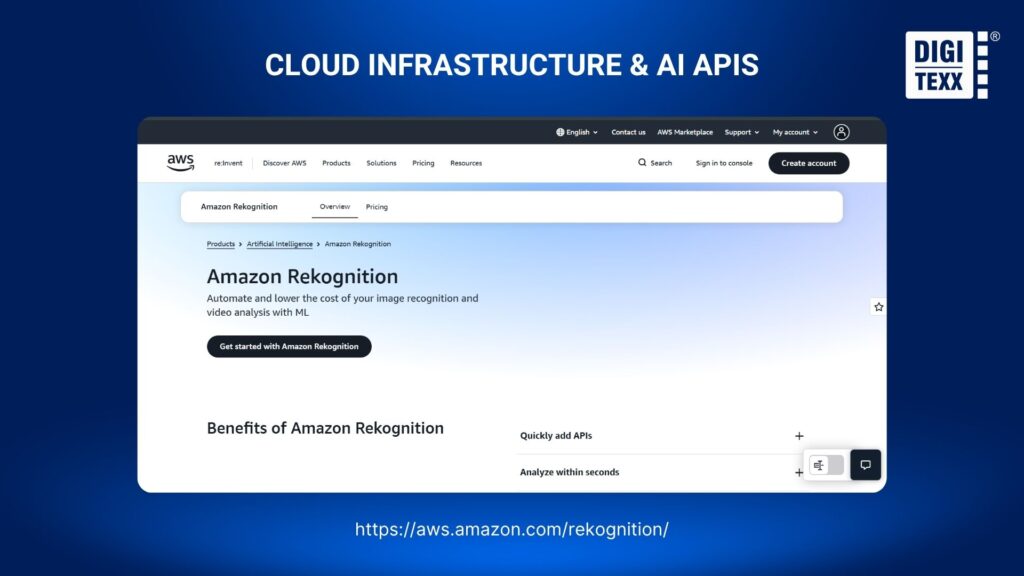
3. Amazon Rekognition
Amazon Rekognition Content Moderation is an AWS-managed machine learning service for detecting inappropriate, unwanted, or offensive content in images and videos. Its main advantage is strong integration with the AWS ecosystem, making it a practical option for businesses already storing and processing UGC through services such as Amazon S3.
Key Moderation Capabilities:
- Image moderation: Detects a broad range of visual risks, including explicit and suggestive content, nudity, violence, drugs, tobacco, alcohol, hate symbols, gambling, and disturbing content. Businesses can use these classifications to build their own content-policy enforcement logic.
- Video moderation: Analyzes stored videos asynchronously and identifies potentially unsafe content throughout the video. Results include moderation labels, confidence scores, and timestamps, allowing moderators to jump directly to relevant sections instead of reviewing an entire video manually.
- Hierarchical moderation taxonomy: Moderation labels are organized across three taxonomy levels (L1–L3). This enables teams to enforce policies at different levels of granularity, for example, applying a broad rule to explicit content or a more specific rule to a particular subcategory. AWS recommends using L1/L2 categories for general moderation and L3 for more targeted concepts.
- Confidence-based filtering: Each detected moderation label includes a confidence score. Teams can use the “MinConfidence” parameter and their own policy thresholds to determine which predictions should trigger blocking, review, or other enforcement actions.
- Timestamp and segment detection: For video, moderation results can be returned by individual timestamps or aggregated into time segments. This is particularly useful for long-form video moderation and human review workflows.
- Human-in-the-Loop review: Amazon Rekognition integrates with Amazon Augmented AI (A2I) to route selected predictions to human reviewers. Businesses can configure review conditions based on confidence thresholds or sampling rates, creating a practical automated moderation-to-human-review workflow.
What makes Amazon Rekognition stand out:
- Strong AWS ecosystem integration: For businesses already using Amazon S3, Amazon SNS, IAM, and other AWS services, Rekognition can fit naturally into an existing content-processing pipeline without introducing a separate moderation infrastructure.
- Particularly strong for visual UGC: Unlike general-purpose moderation platforms that cover multiple content formats, Rekognition is especially well suited to workflows centered on image and video moderation. This makes it relevant to marketplaces, social platforms, media services, and applications with substantial visual UGC.
- Granular policy control: The combination of hierarchical labels, confidence scores, and customizable moderation rules gives Trust & Safety teams more flexibility than a simple safe/unsafe classifier. Different thresholds can be applied depending on the application’s audience, geography, or risk tolerance.
- Efficient video review: Timestamped detections allow organizations to identify potentially harmful portions of a video without manually watching the entire asset. This can reduce the amount of content that needs to reach human reviewers.
- Scalable managed service: AWS positions Rekognition Content Moderation for processing from small volumes through millions of images and videos, with usage-based pricing and no upfront license commitment.
Limitations to Consider:
- Primarily focused on image and video: Rekognition Content Moderation is not a general-purpose multimodal moderation platform covering text, audio, and conversational content in the same way as some specialized Trust & Safety vendors. Businesses with broader moderation requirements may need additional AWS services or third-party tools.
- Video moderation is asynchronous: The stored-video workflow uses asynchronous analysis rather than instant synchronous decisions. This makes it more suitable for post-moderation, batch processing, and review workflows than use cases requiring immediate blocking during a live video stream.
- Detection does not equal policy enforcement: Rekognition returns moderation labels and confidence scores, but businesses remain responsible for defining content policies, thresholds, enforcement actions, escalation rules, and appeals workflows.
- Human review may still be necessary: Confidence scores represent model confidence rather than a guaranteed correct decision. Ambiguous or high-risk cases can require HITL review, especially where false positives or false negatives carry significant business or safety consequences.
- AWS dependency matters: Organizations operating outside the AWS ecosystem may face additional architectural considerations compared with vendor-neutral moderation APIs.
Best For: AWS-native businesses, marketplaces, social platforms, media services, and other UGC-heavy applications that primarily need scalable image and video moderation, granular visual-content classification, and integration with AWS-based processing and human-review workflows.
Pricing: Usage-based pricing. Amazon Rekognition Content Moderation follows AWS’s pay-as-you-go model, with costs depending on the amount and type of image or video processed. Video analysis can have different pricing considerations from image moderation, so businesses should calculate costs based on their expected media-processing volume.
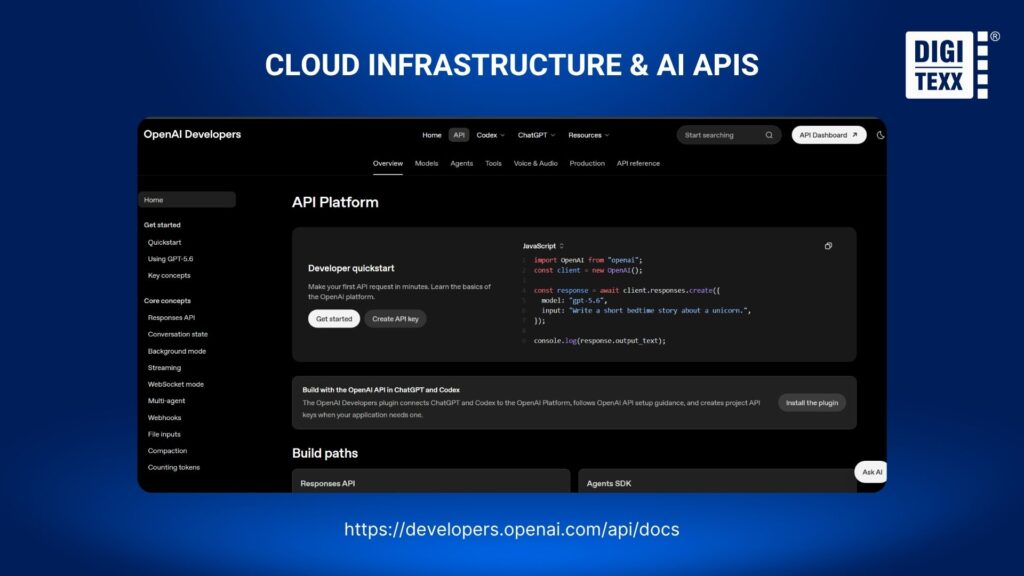
4. OpenAI Moderation API
OpenAI Moderation API is a developer-focused moderation service for identifying potentially harmful text and image content. Its current omni-moderation-latest model supports multimodal inputs and returns category-level classifications and scores that developers can integrate into their own Trust & Safety workflows, content policies, and enforcement logic.
Key Moderation Capabilities:
- Text moderation: Classifies potentially harmful text across categories such as harassment, hate, sexual content, violence, self-harm, and illicit activities. The API returns both boolean category flags and category-level scores that developers can use for downstream decisioning.
- Image moderation: The omni-moderation-latest model accepts images either independently or alongside text. Multimodal classification currently covers categories including sexual content, violence, and self-harm, while other moderation categories remain text-only.
- Multimodal content analysis: Developers can submit text and image inputs together, allowing moderation systems to evaluate harmful combinations across modalities rather than treating each input completely independently. This is useful for image captions, memes, visual UGC, and AI application inputs.
- Category scores and calibrated outputs: The API provides category scores alongside moderation flags. OpenAI designed the newer model’s scores to better represent the likelihood that content belongs to a relevant harm category, giving developers a basis for application-specific thresholding.
- Multilingual moderation: OpenAI reports improvements across a broad range of languages with omni-moderation-latest, including Vietnamese, Chinese, Indonesian, Spanish, French, German, and Portuguese. This makes the API more suitable for multilingual applications than earlier moderation models.
- API-first integration: Developers can submit content directly to the “/v1/moderations” endpoint and use the returned classification results within their own application logic. This makes it suitable for pre-moderation, post-moderation, input filtering, and output safety checks.
What makes OpenAI Moderation API stand out:
- Low barrier to implementation: The API provides a ready-made moderation classifier, allowing development teams to add automated safety checks without building and maintaining their own classification models.
- Strong fit for AI-native products: Its combination of text moderation, image understanding, and multilingual classification makes it particularly useful for LLM applications, AI assistants, generative AI platforms, and AI-powered communication products.
- Multimodal moderation in a single API: Developers can evaluate text and images through the same moderation interface, simplifying moderation architecture for applications that handle multiple input types.
- Useful for both input and output safety: The API can be incorporated into workflows that screen user prompts before model processing or evaluate generated content before it is displayed. This makes it relevant to AI applications where both user input and model output require safety controls.
- Free moderation model access: OpenAI states that its moderation models are free to use through the Moderation API, although developers remain subject to applicable API usage and rate limits.
Limitations to Consider:
- Limited modality coverage: The current omni-moderation-latest model accepts text and images, but does not directly support audio or video inputs. Platforms requiring voice, livestream, or video moderation need additional processing or specialized moderation solutions.
- Image coverage is not identical to text coverage: Although the model is multimodal, not every harm category is currently supported for image inputs. For example, OpenAI’s documentation identifies certain categories as text-only, so businesses should verify category coverage against their specific moderation policy.
- Detection does not equal enforcement: The API returns moderation signals, but developers remain responsible for defining policy thresholds, enforcement actions, escalation paths, appeals, and human review. A flagged result should not automatically be treated as a final policy decision in every use case.
- Threshold calibration remains important: Category scores are model outputs rather than guaranteed judgments. Platforms with different risk tolerances may need different thresholds and should evaluate false positives and false negatives against representative production data.
- Not a complete Trust & Safety platform: The API focuses on content classification rather than providing the full operational layer of a large-scale moderation program, such as moderator queues, case management, user reporting, policy governance, appeals management, or comprehensive enforcement operations.
Best for: AI-native applications, LLM-powered products, generative AI platforms, and developer teams that need an accessible API for text and image moderation, particularly when moderation needs to be integrated directly into AI input/output safety workflows.
Pricing: Free to use. OpenAI states that its moderation models are available through the Moderation API at no additional model usage cost. However, developers are still subject to applicable API limits, rate limits, and the technical costs associated with processing content through their broader application architecture.
>>> See more:
- Intelligent Document Recognition (IDR): Definition, Example, Benefits
- Best Insurance Claims Processing Outsourcing BPO in the US 2026
- Construction Invoice Reconciliation: Process, Best Practices & Software 2026
Gaming & Community Chat Safeguards
These platforms focus more heavily on the challenges of real-time communities, gaming, voice chat, behavioral signals, and large-scale UGC environments.
5. Alice (formerly ActiveFence)
Alice, formerly known as ActiveFence, is an enterprise Trust & Safety, AI safety, and security company. Its ActiveFence solution continues to focus on UGC safety, helping large platforms detect, investigate, and respond to harmful content and emerging online threats.
In 2026, Alice expanded its positioning to cover the broader AI lifecycle, including GenAI safety, runtime guardrails, and adversarial intelligence.
Key Moderation Capabilities:
- UGC moderation: Alice provides a Trust & Safety layer for detecting and responding to harmful content across large-scale online platforms. Its coverage is designed for social platforms, marketplaces, gaming environments, and other services handling substantial volumes of UGC.
- Adversarial intelligence: Alice combines moderation technology with intelligence gathered from the wider internet to identify emerging threats, harmful narratives, abuse patterns, and threat actors before they become widespread platform problems.
- Multilingual and multimodal safety: Alice states that its UGC protection covers 117+ languages and multiple abuse areas, supporting moderation across culturally nuanced content and large-scale user interactions.
- Automated content detection: Its SaaS capabilities use in-house large language models and proprietary intelligence to help moderation teams validate, flag, and respond to harmful content in real time.
- Threat investigation: Beyond automated classification, Alice provides deep-web investigations that help organizations identify threat actors, understand malicious networks, investigate emerging tactics, and strengthen their broader Trust & Safety defenses.
- AI safety and runtime protection: Following the rebrand, Alice has expanded into GenAI safety and security, including runtime guardrails designed to detect and mitigate harmful inputs and outputs from AI applications and agents.
What makes Alice stand out:
- Threat intelligence beyond the platform: Unlike moderation tools focused primarily on classifying content submitted to an API, Alice combines content moderation with adversarial intelligence. This allows organizations to investigate how harmful campaigns, scams, abuse patterns, or threat actors develop outside their own platform.
- Strong enterprise Trust & Safety positioning: Alice is designed for organizations dealing with complex abuse at significant scale rather than simply providing a basic profanity or image classifier. The company states that its technology protects 3B+ users and analyzes 750M+ daily signals.
- Proactive rather than purely reactive moderation: Its intelligence model is designed to identify emerging threats and malicious behavior before they become widespread. This is particularly valuable for Trust & Safety teams managing coordinated abuse, fraud, disinformation, or rapidly evolving attack patterns.
- Expanded AI safety capabilities: The 2026 rebrand reflects Alice’s move beyond traditional UGC moderation toward AI security, AI safety, and AI governance, giving enterprises a broader safety stack across AI development and deployment.
Limitations to Consider:
- Enterprise-oriented solution: Alice is positioned primarily toward large platforms, enterprises, and organizations with sophisticated Trust & Safety requirements. It may be excessive for small communities that only need a straightforward moderation API.
- Broader than a conventional moderation API: Its value comes from combining moderation, threat intelligence, investigations, and AI safety. Organizations looking only for basic text or image classification may find a simpler API-first solution easier to deploy.
- More operational complexity: Because Alice addresses broader Trust & Safety and threat-management workflows, organizations may need dedicated policy, moderation, security, and investigation teams to fully leverage its capabilities.
- UGC and AI safety are now both part of the offering: Buyers should distinguish between ActiveFence UGC Protection and Alice’s newer AI safety products when evaluating capabilities. The company’s current positioning spans the AI lifecycle rather than focusing exclusively on conventional content moderation.
Best for: Large social platforms, gaming communities, marketplaces, and enterprise UGC platforms facing complex online abuse, coordinated threats, multilingual moderation, and emerging Trust & Safety risks. Alice is also increasingly relevant to GenAI companies and enterprises that need to extend content moderation into broader AI safety and runtime protection.
Pricing: Custom enterprise pricing. Alice does not provide a standardized public price for its broader Trust & Safety and AI safety solutions. Pricing is likely to depend on the scope of moderation, threat intelligence, AI safety capabilities, content volume, and enterprise requirements. Businesses should contact Alice for a customized quote.

6. Modulate ToxMod
Modulate ToxMod is a voice-native, real-time moderation platform built primarily for gaming and social platforms. Rather than relying solely on speech-to-text transcripts or keyword matching, ToxMod analyzes the original audio together with tone, context, speech patterns, and interaction dynamics to identify harmful behavior as conversations unfold.
Key Moderation Capabilities:
- Real-time voice moderation: ToxMod continuously monitors live voice conversations and produces moderation signals with low latency. This enables platforms to identify harmful behavior during gameplay or live conversations instead of relying exclusively on user reports submitted after an incident.
- Voice-native analysis: The system analyzes more than the words being spoken. Its underlying Velma Ensemble Listening Model evaluates signals such as tone, intensity, emotion, escalation patterns, interruptions, and interaction dynamics, helping distinguish harmful behavior from ordinary conversation or playful banter.
- Contextual toxicity detection: ToxMod can detect harassment, hate, threats, grooming, abusive behavior, and other forms of toxicity while considering the surrounding conversational context. This reduces reliance on isolated keywords that can produce misleading moderation decisions.
- Behavior and escalation signals: The system can identify conflict escalation, repeated toxic behavior, coordinated behavior, contextual misuse, and other behavioral patterns rather than evaluating each utterance as an isolated event.
- Triage and escalation workflow: ToxMod uses a triage → analysis → escalation workflow. Voice data is first screened for potentially problematic conversations, deeper analysis is then applied to relevant cases, and high-risk events can be surfaced to moderators with supporting context.
- Human-in-the-Loop review: Moderators can receive audio clips, timestamps, and behavioral context for escalated events. This gives reviewers evidence surrounding an incident rather than requiring them to manually monitor every voice channel.
- SDK and integration options: ToxMod provides client-side and server-side SDKs for ingesting voice data from gaming and voice-chat infrastructure. It also supports APIs and webhooks for connecting moderation signals to existing Trust & Safety systems and workflows.
What makes Modulate ToxMod stand out:
- Voice-native rather than transcript-first: ToxMod’s core differentiation is that it analyzes the audio signal itself, not simply a transcript. This allows the system to incorporate vocal characteristics and conversational dynamics that text-based moderation can miss.
- Context over isolated keywords: ToxMod is designed to distinguish playful trash talk from genuine toxicity by considering factors such as tone, emotion, conversation context, and escalation. This is particularly important in multiplayer games where aggressive language is not automatically a policy violation.
- Proactive moderation: Instead of waiting for users to submit reports, ToxMod can identify harmful behavior as it occurs and escalate relevant incidents to moderators. This allows Trust & Safety teams to detect unreported abuse that reactive reporting systems may never surface.
- Designed around moderator workflows: The product does not simply generate a toxicity score. It can provide reviewable evidence and contextual signals that help human moderators investigate incidents and determine appropriate enforcement.
- Purpose-built for adversarial voice environments: ToxMod is specifically designed for multiplayer games, social audio, and UGC-driven voice communities, where conversations move rapidly, and toxicity can emerge through interactions between multiple users.
Limitations to Consider:
- Highly specialized for voice: ToxMod’s major strength is also its primary limitation. It is designed around voice moderation, so platforms needing comprehensive text, image, video, and multimodal UGC moderation will generally require additional moderation technologies.
- Voice moderation is technically demanding: Processing live audio at scale requires careful consideration of latency, audio ingestion, infrastructure, privacy, and processing costs. ToxMod provides SDKs and integrations, but implementation still depends on the platform’s existing voice architecture.
- Contextual detection is not perfect: Tone, sarcasm, humor, and interpersonal dynamics are inherently ambiguous. High-risk or borderline cases should therefore remain subject to HITL review and policy-based escalation, rather than treating automated signals as definitive enforcement decisions.
- Language coverage should be evaluated: ToxMod currently advertises support for 18 languages in its product offering. Multilingual platforms should verify language coverage and detection performance against their actual user base before deployment.
- Requires integration with enforcement workflows: ToxMod can surface moderation events and connect with existing Trust & Safety systems, but organizations still need to define community guidelines, enforcement policies, moderator procedures, appeals, and account-level actions.
Best For: Multiplayer gaming platforms, social audio applications, and voice-enabled UGC communities where moderation needs to understand not only what users say, but also how they say it and how conversations evolve. It is especially valuable for platforms dealing with voice toxicity, harassment, grooming, threats, and other real-time conversational risks.
Pricing: Custom pricing. ToxMod does not publish a standard public price for its enterprise voice moderation solution. Costs can depend on factors such as voice-chat volume, moderation requirements, integration scope, and the scale of the gaming or social platform. Prospective customers should contact Modulate for pricing.

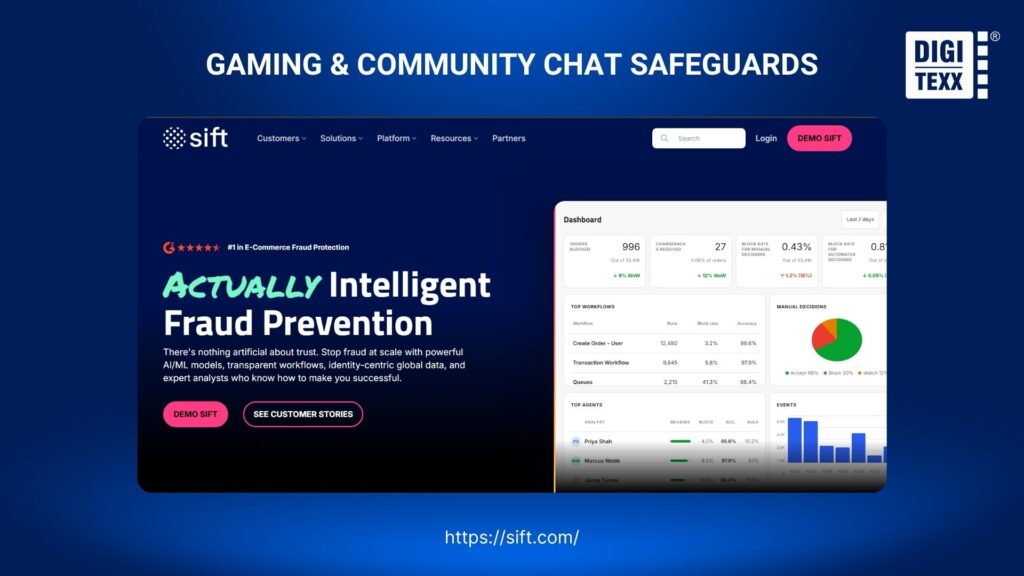
7. Sift Content Integrity (Formerly Two Hat Community Sift)
Sift Content Integrity is an AI-powered solution for detecting and preventing content abuse, spam, scams, and malicious user behavior. It combines content analysis with behavioral signals, user context, and Sift’s broader risk intelligence to identify abusive activity beyond the content itself. This makes it particularly relevant to large communities, marketplaces, social platforms, and digital services.
Key Moderation Capabilities:
- Content and text analysis: Analyze user-generated content and identify patterns associated with spam, scams, abuse, and other forms of content-related risk. Sift can also analyze duplicate or similar messages and use text clustering to uncover coordinated activity.
- Behavioral analysis: Evaluate how users create and distribute content, including timing, activity velocity, interaction patterns, and relationships between users. This adds behavioral context that traditional content-only classifiers cannot provide.
- User and content risk assessment: Sift can connect content signals with user-level and behavioral information, helping Trust & Safety teams investigate whether suspicious content is part of a broader abuse pattern rather than an isolated violation.
- Spam and scam detection: Content Integrity is specifically positioned to identify spam, scams, and fraudulent content, making it useful for marketplaces, communities, creator platforms, and other environments where malicious content can damage user trust.
- Custom models and workflows: Businesses can use custom modeling for specific use cases and configure workflows to accept or block users and content or route risky activity to review queues.
- Case management and review: Sift provides tools for investigating and managing risk cases, allowing teams to combine automated decisioning with analyst-driven review when additional context is required.
What makes Sift Content Integrity stand out:
- Content + behavior intelligence: Its biggest differentiator is that moderation does not stop at what was posted. Sift also considers who posted it, how they behaved, how quickly they acted, and how they interact with other users.
- Strong abuse and scam focus: Compared with tools primarily focused on detecting categories such as hate speech, sexual content, or violence, Sift is particularly valuable for identifying spam, scams, fraudulent content, and coordinated abuse.
- Global risk intelligence: Sift’s platform is backed by a large Global Data Network, providing additional behavioral and identity signals from its broader network of digital services. Sift currently states that its network processes more than 1 trillion events annually.
- Detection of coordinated behavior: Text clustering, duplicate-content analysis, user relationships, and behavioral patterns can help surface coordinated campaigns that may be difficult to detect through individual content classification alone.
- Flexible enforcement workflows: Teams can configure workflows to accept, block, or send risky users and content to review queues, allowing automated detection to fit into existing Trust & Safety operations.
Limitations to Consider:
- Not a general-purpose multimodal moderation API: Sift Content Integrity is primarily positioned around content abuse, spam, scams, and behavioral risk. Businesses looking for comprehensive moderation of NSFW imagery, video, audio toxicity, or multimodal safety categories may need complementary specialized moderation tools.
- Strongest value comes from behavioral context: Because Sift’s differentiation depends heavily on user, behavioral, and network signals, businesses should provide sufficient event and user-context data to maximize detection quality. Sift itself emphasizes the importance of high-quality data for its machine-learning models.
- Requires policy and workflow configuration: Sift provides risk signals and configurable decisioning, but businesses still need to define content policies, risk thresholds, enforcement actions, escalation paths, and review procedures appropriate to their platform.
- Potential integration complexity: Organizations need to integrate Sift with their existing product and Trust & Safety stack. Sift provides REST APIs, JavaScript snippets, and mobile SDKs, but implementation requirements depend on the platform architecture and the signals available.
Best For: Large marketplaces, social platforms, online communities, creator platforms, and digital services that need to detect spam, scams, content abuse, and coordinated malicious behavior by combining content signals with user and behavioral intelligence. It is particularly valuable when identifying “who is behind the content and how they behave” is as important as analyzing the content itself.
Pricing: Custom pricing. Sift does not offer a simple public fixed price for Content Integrity. Pricing can depend on event volume, product requirements, risk signals, and the broader Sift services used by the business. Organizations should request a quote based on their expected traffic and moderation use case.
>>> See more:
- Top Business Process Documentation Tools You Should Consider
- Medical Claims Processing Outsourcing Services For Faster Reimbursements
- Prepare A Classified Balance Sheet: Steps, Format & Example 2026
Visual Content Specialists
This group combines visual moderation, multimodal APIs, managed human review, and policy/compliance capabilities. They are useful when businesses need more than a basic image classifier.
8. Sightengine
Sightengine is a developer-focused Content Moderation API platform built for analyzing and filtering images, videos, live streams, text, and audio. Its strongest positioning is broad multimodal coverage with granular detection models, making it useful for platforms that need to moderate different types of UGC through a single API layer.
Key Moderation Capabilities:
- Image moderation: Sightengine offers a broad set of visual moderation models covering nudity and adult content, violence, gore, weapons, hate and offensive content, self-harm, drugs, alcohol, tobacco, gambling, and other restricted or sensitive categories. Its visual moderation stack currently provides more than 100 moderation classes across multiple models.
- Video and live-stream moderation: Platforms can analyze uploaded videos and live streams for harmful visual content. For stored video, Sightengine supports both synchronous processing for short videos and asynchronous processing for longer media, making the architecture suitable for different latency requirements.
- Text moderation: Sightengine supports both ML-based text classification and rule-based pattern matching. The ML approach focuses on semantic and contextual meaning, while rule-based moderation is useful for low-latency detection and customized allowlists or disallowlists.
- OCR and visual text moderation: The platform can extract text embedded in images and videos and evaluate it for profanity, PII, sexual or toxic content, URLs, and other unwanted text. This is particularly useful for moderating memes, screenshots, product images, and other visual UGC where harmful text is not available as a conventional text field.
- QR code and URL moderation: Sightengine can detect QR codes and analyze the URLs they contain. Its URL moderation capabilities can also identify potentially unsafe or unwanted links appearing directly in text, images, and videos.
- Audio moderation: Sightengine can transcribe audio and detect profanity and unwanted speech, extending its moderation coverage beyond conventional visual and text content.
- AI-generated and manipulated media detection: Separate models can detect AI-generated images and videos, deepfake imagery, AI-generated speech, and AI-generated music. Its deepfake model specifically focuses on photographic images or videos where faces have been swapped or manipulated.
What makes Sightengine stand out:
- Broad multimodal coverage: Sightengine brings image, video, live-stream, text, OCR, QR, and audio moderation into one API ecosystem, reducing the need to maintain separate vendors for every content format.
- Granular moderation models: Instead of returning only a generic “safe” or “unsafe” classification, teams can select specific models and moderation categories relevant to their policies. This enables more precise policy thresholds and enforcement logic.
- Strong visual moderation capabilities: Its particularly broad image/video taxonomy makes Sightengine a practical choice for platforms where visual UGC represents a significant portion of moderation volume.
- Combines ML and deterministic controls: The combination of deep-learning text classification with rule-based pattern matching and custom lists allows teams to balance contextual understanding with predictable, low-latency controls.
- Custom moderation workflows: Businesses can define their own rules and determine whether content should be accepted or rejected based on selected detection models. This makes the API easier to adapt to platform-specific community guidelines.
- Developer-friendly integration: Sightengine is designed as an API-first solution, with documentation and SDKs for common development environments. Its API can return moderation results directly without requiring content to pass through a manual moderation queue.
Limitations to Consider:
- Detection still requires policy configuration: Sightengine provides detection signals and configurable workflows, but organizations must determine which categories matter, what severity thresholds apply, and which enforcement action should follow.
- Multimodal does not mean every model applies to every format: Different detection capabilities are available for different media types. Teams should verify the specific format, model, language, and detection category coverage required for their use case before implementation.
- Long-form video requires asynchronous processing: Short videos can be processed synchronously, but longer videos generally require an asynchronous workflow and callbacks, which may not be suitable when an immediate moderation decision is required.
- AI-generated media detection should be treated as a signal: AI and deepfake detection models produce predictions rather than definitive proof of manipulation. High-risk enforcement decisions may benefit from additional signals, investigation, or Human-in-the-Loop (HITL) review.
- No human review by default: Sightengine emphasizes automated processing, so organizations that require managed human moderation or human-in-the-loop review services will need to build or integrate that layer separately.
Best For: Developers, marketplaces, social platforms, and UGC-heavy applications that need flexible API-based multimodal content moderation, particularly those with substantial image and video workloads. Sightengine is especially suitable when a team wants granular visual moderation, OCR/QR analysis, text filtering, and synthetic-media detection within a single moderation stack.
Pricing: Usage-based pricing with different plans. Sightengine uses a usage-based pricing model, with costs depending primarily on the amount of content processed and the moderation APIs or models required. This can make it more accessible for smaller development teams while allowing costs to scale with moderation volume.

9. WebPurify
WebPurify is a managed content moderation provider that combines AI-powered moderation with human review rather than relying exclusively on automated classification. Its services cover text, images, video, live-streaming, and Generative AI (GenAI) moderation, making it particularly relevant to businesses that want to outsource part or all of their Trust & Safety operations.
Key Moderation Capabilities:
- Text moderation: WebPurify can detect profanity, hate speech, bigotry, sexual advances, and offensive intent. Its custom text moderation can also combine profanity filtering with AI-based analysis of phraseology and context, helping reduce the limitations of simple keyword matching.
- Image moderation: Its AI moderation can screen images for categories including nudity, partial nudity, drugs, weapons, gore, hate symbols, alcohol, gambling, offensive gestures, and embedded text. Businesses can also define custom moderation criteria for specific communities or brand requirements.
- Video and live-stream moderation: WebPurify supports both AI-based video moderation and human review for uploaded videos and live streams. Its AI can detect multiple visual safety categories, while human reviewers can assess more nuanced or context-dependent violations.
- AI-powered moderation: WebPurify’s Automated Intelligent Moderation (AIM) provides automated screening for high-volume content. This enables businesses to identify obvious violations quickly before escalating more ambiguous cases to human moderators.
- Human moderation: WebPurify provides 24/7 human moderation through trained, in-house moderators rather than crowdsourced reviewers. Human teams can enforce standard or custom moderation criteria according to a client’s community guidelines and risk requirements.
- Hybrid moderation: AI can perform the initial classification, while edge cases and context-sensitive content are routed to human reviewers. For example, businesses can configure different thresholds for automatic acceptance, rejection, and human escalation.
- GenAI moderation: WebPurify supports moderation workflows for AI-generated content, including synthetic-image detection, model-output review, AI training data, and risk mitigation. Its approach combines automated detection with human judgment for cases where AI-generated content requires contextual assessment.
- API-based integration: WebPurify provides APIs for integrating AI and human moderation into existing websites, applications, and content workflows. The platform can return moderation results through API-based workflows and callbacks, allowing businesses to connect moderation with their own CMS or Trust & Safety infrastructure.
What makes WebPurify stand out:
- AI + human moderation under one provider: WebPurify’s primary differentiator is its ability to combine automated detection and managed human review. Businesses can use AI for high-volume, straightforward cases while reserving human review for ambiguous or high-risk content.
- Managed moderation rather than software only: Unlike an API-only vendor, WebPurify can provide the human moderation workforce, moderation criteria, workflows, and operational support needed to run moderation at scale. This is valuable for companies that do not want to build an internal moderation operation.
- Customizable moderation criteria: Businesses can define what constitutes unacceptable content for their specific product, brand, or community. WebPurify can customize criteria, coverage, turnaround time, and the balance between AI and human review.
- Strong fit for nuanced content: Human review provides an important layer for cases where automated models can struggle with context, intent, sarcasm, artistic content, or borderline violations. This is particularly useful for platforms where a false positive can be as damaging as a missed violation.
- Scalable moderation operations: WebPurify combines automated processing with dedicated moderation teams and states that its services can scale across large volumes of images and video. This allows businesses to expand moderation capacity without building an equivalent internal workforce.
Limitations to Consider:
- Not purely self-service: Businesses looking for a developer-only moderation API with fully self-managed workflows may find WebPurify less suitable than API-first platforms such as Sightengine. WebPurify’s major value proposition includes its managed human moderation services.
- Human moderation adds operational cost: Human review provides additional contextual judgment, but it generally costs more than relying solely on automated classification. Teams should determine which content requires human review and use threshold-based escalation to control moderation costs.
- Turnaround varies by workflow: AI moderation can provide real-time results for supported use cases, while human review operates on different response times depending on content type, volume, and service configuration. Businesses with strict real-time enforcement requirements should evaluate latency for their specific workflow.
- Custom policies require setup: Although WebPurify supports custom moderation criteria, businesses still need to define community guidelines, policy taxonomies, escalation rules, and enforcement thresholds before deployment.
- Human review remains necessary for complex edge cases: WebPurify itself emphasizes that AI is not sufficient for every moderation decision, particularly where context, intent, or nuanced interpretation is important. Therefore, hybrid moderation should be viewed as a complement to automation rather than a fully autonomous solution.
Best For:
Businesses that need managed content moderation combining AI automation with trained human reviewers, particularly social platforms, marketplaces, UGC applications, dating platforms, live-streaming services, and GenAI companies.
WebPurify is especially suitable when a business wants to outsource moderation operations instead of building and managing an entire Trust & Safety team and moderation workflow internally.
Pricing: Custom pricing. WebPurify’s pricing depends on the moderation services selected, including automated moderation, human moderation, content types, volume, and turnaround requirements. Because the platform combines AI with managed human review, businesses should request a customized quote based on their desired moderation workflow.

10. Checkstep
Checkstep is an AI-powered Trust & Safety and content moderation platform that combines multimodal content detection, configurable policy enforcement, automated moderation, human review, and regulatory compliance workflows.
Key moderation capabilities:
- Multimodal content detection: Analyze text, images, video, and audio using AI models selected according to the platform’s content and policy requirements. Checkstep supports multiple moderation models rather than limiting customers to a single detection approach.
- Policy management: Its configurable policy engine lets Trust & Safety teams define what is and is not allowed, create policy-specific rules, and select appropriate models for different use cases, regions, or harm categories.
- Automated moderation and decisioning: Teams can configure confidence thresholds so high-confidence violations can be automatically actioned, while uncertain cases are routed for further review. This supports a more controlled automation-to-human escalation workflow.
- Human-in-the-loop moderation: Customizable moderation queues allow reviewers to prioritize cases based on severity, content type, policy, or urgency. This is particularly useful for edge cases where automated classification alone may not provide sufficient context.
- Community reporting: Checkstep can incorporate user reports into moderation workflows, giving platforms another signal for surfacing potentially harmful content that automated systems may miss.
- DSA transparency workflows: Its compliance tooling supports Transparency Reports, Statements of Reasons, notices, and appeals, helping platforms operationalize key EU Digital Services Act requirements around content moderation transparency.
- Moderation analytics: Teams can monitor operational metrics such as policy violations, moderation performance, moderator handling time, and community flagging activity through the platform’s analytics capabilities.
- API and webhook integration: Checkstep can operate as an API-first moderation layer. Platforms send content for analysis and receive moderation decisions through webhooks, allowing enforcement actions to remain connected to their existing product infrastructure.
What makes Checkstep stand out:
- Policy-first moderation: Checkstep goes beyond simply returning AI classification labels. Its policy engine connects detection results to the specific rules and enforcement standards a platform wants to apply.
- Strong compliance layer: Its built-in DSA transparency, Statement of Reasons, notices, and appeals workflows make it particularly relevant for platforms that need moderation operations and regulatory processes to work together.
- Model flexibility: Checkstep provides access to multiple AI models and allows teams to choose or switch models based on their content type, policy requirements, and detection needs, reducing dependence on a single model provider.
- Balanced automation and human review: The platform is designed to automate routine cases while escalating edge cases and sensitive content to human moderators, supporting a practical Human-in-the-Loop operating model.
- Operational visibility: Moderation decisions, reports, appeals, and performance metrics can be managed within connected workflows rather than being handled through isolated detection APIs.
Limitations to consider:
- More operationally oriented than a simple moderation API: Checkstep’s broader policy, workflow, human-review, and compliance capabilities are most valuable to organizations with established Trust & Safety operations. Smaller teams looking only for basic text or image classification may find a simpler API more appropriate.
- Policy configuration requires expertise: The platform provides significant control over policies and thresholds, but teams still need to define appropriate harm taxonomies, confidence thresholds, escalation rules, and enforcement actions for their own risk profile.
- Compliance requirements remain the platform’s responsibility: Checkstep can automate and support DSA-related workflows, but using the platform does not by itself make an organization legally compliant. Businesses still need appropriate governance, policies, records, and legal oversight.
Best for: Online platforms, marketplaces, review sites, and UGC-heavy businesses that need more than automated content detection, particularly organizations looking for policy management, Human-in-the-Loop moderation, community reporting, and DSA-focused transparency and appeals workflows.
Pricing: Custom pricing. Checkstep does not present a universal public price for its AI moderation and Trust & Safety platform. Costs can vary according to content volume, moderation models, policy-management requirements, human review, and compliance workflows. Businesses should contact Checkstep for a tailored quote.

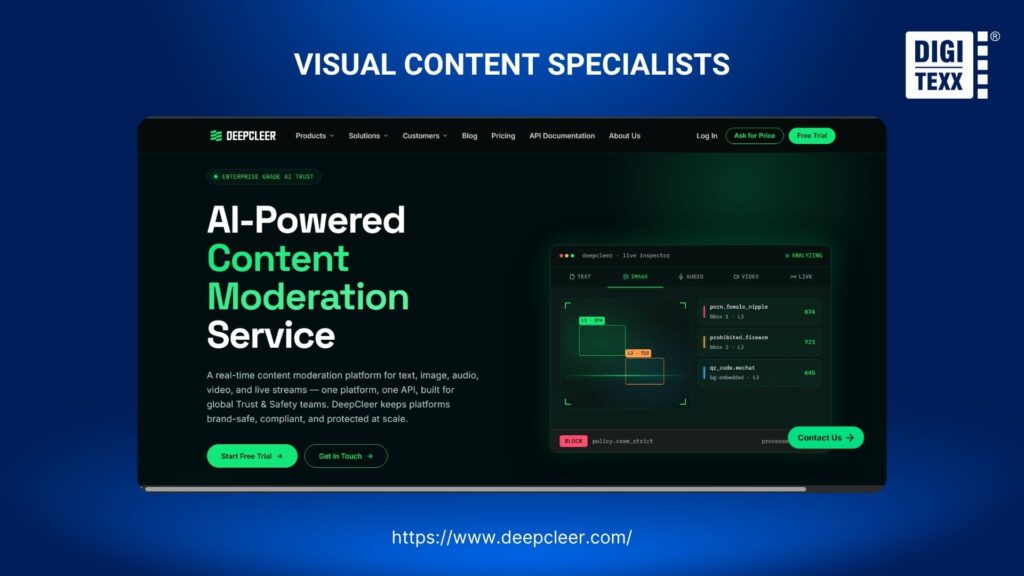
11. DeepCleer
DeepCleer is an enterprise-oriented multimodal content moderation platform that analyzes text, images, audio, video, and live streams. Its strongest differentiator is the depth of its content taxonomy, allowing Trust & Safety teams to distinguish specific risk subcategories rather than relying only on broad labels.
Key moderation capabilities:
- Multimodal moderation: Supports text, image, audio, video, and audio/video streaming moderation, making it suitable for platforms where harmful content appears across multiple formats.
- Granular visual classification: DeepCleer’s visual moderation uses a three-tier label taxonomy covering 8 top-level risk categories, 164 subcategories, and 976 detection labels. This allows policies to operate at different levels of specificity.
- Text moderation: Detects sensitive, abusive, violent, advertising, and other potentially harmful text. The platform also supports custom sensitive-word dictionaries and semantic analysis for more targeted policy enforcement.
- Image moderation: Detects risks including sexual content, violence, weapons, drugs, gambling, hate symbols, minors, spam, and prohibited advertising. It also supports detection of QR codes, barcodes, and other embedded machine-readable content.
- AI-generated content moderation: Dedicated visual detectors can identify certain AI-generated content, including AI-generated nudity and anatomical anomalies. This is particularly relevant to platforms dealing with AIGC-related safety risks.
- Audio moderation: Supports multilingual audio risk detection across scenarios such as audio files, group chats, broadcasts, and live streams. Its detection categories include abusive speech, prohibited content, spam advertising, and other unwanted audio.
- Video and live-stream moderation: Analyzes multiple signals within video, including visual frames, audio, subtitles, text, and on-screen comments, enabling broader risk detection than visual-only frame analysis.
- Custom policy controls: Teams can configure custom sensitive vocabularies, confidence thresholds, and policy rules to determine whether content should be allowed, blocked, or routed for review.
- Minor protection: Supports age-related classification and child-safety detection, including CSAM-related detection capabilities and workflows designed for platforms serving younger users.
What makes DeepCleer stand out:
- Highly granular moderation taxonomy: The three-tier labeling structure allows Trust & Safety teams to move from a broad risk category to a specific detector. This is useful when a platform needs different enforcement actions for closely related types of content.
- Strong multimodal coverage: DeepCleer can coordinate moderation across text, images, audio, video, and live streams, rather than requiring separate tools for each media type.
- Video context beyond individual frames: Its video moderation can evaluate visual, audio, subtitle, text, and other signals appearing within the video, which is valuable for detecting violations that cannot be identified from images alone.
- Jurisdiction-aware controls: Its visual moderation documentation describes configurable policies for different regions, including North America, the EU, the Middle East, and Southeast Asia, which can help multinational platforms adapt moderation policies by market.
- Broad industry coverage: DeepCleer positions its solutions for social media, gaming, communities, live streaming, e-commerce, dating, and Generative AI applications.
Limitations to consider:
- Granularity can increase policy complexity: A highly detailed taxonomy provides greater control, but Trust & Safety teams still need to map labels to their own policy taxonomy, confidence thresholds, and enforcement actions.
- AI classifications still require validation: Detection results should be evaluated against the platform’s own content distribution. High-risk or ambiguous cases may still require Human-in-the-Loop review rather than fully automated enforcement.
- Live-stream moderation requires architecture planning: Real-time audio and video moderation involves latency, sampling, processing volume, and escalation considerations. The appropriate configuration depends on the platform’s real-time enforcement requirements and content volume.
- Broader enterprise capabilities may be unnecessary for smaller teams: Organizations looking only for a basic text or image moderation API may prefer a narrower developer-focused solution rather than a broader multimodal Trust & Safety platform.
Best for: Global social platforms, gaming communities, live-streaming services, online communities, and GenAI applications that need granular multimodal moderation, multilingual coverage, and configurable policy enforcement across different content types and markets.
Pricing: Custom enterprise pricing. DeepCleer does not provide a standardized public price for its multimodal moderation platform. Pricing can depend on content volume, supported modalities, detection categories, real-time moderation requirements, and deployment needs. Businesses should contact DeepCleer to discuss their specific requirements.
>>> See more:
- Top 11 Free AI Business Document Analysis Tools 2026
- Best Administrative Support Outsourcing Services In 2026
- 15 Best Invoice Processing Software Compared In 2026
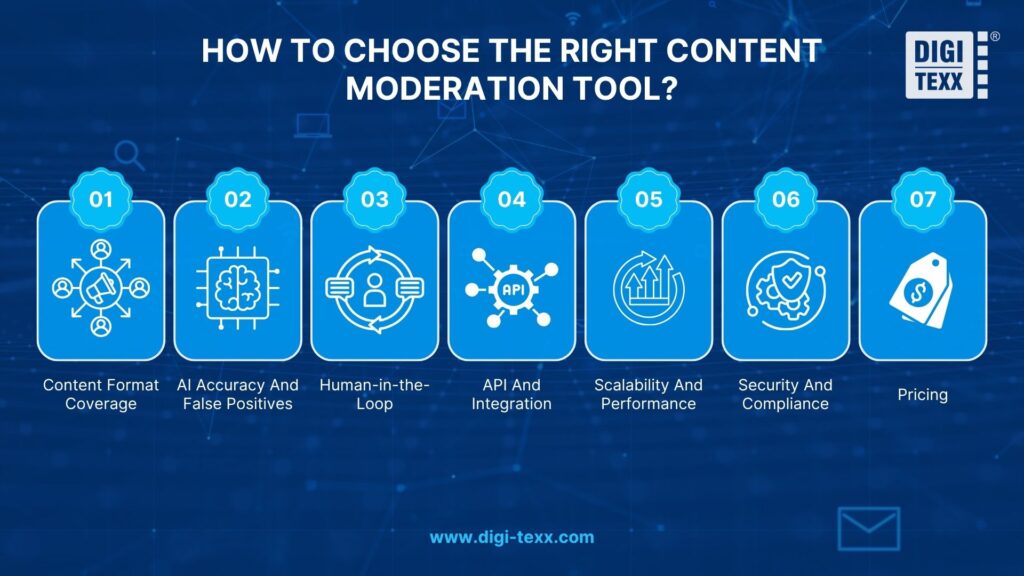
How To Choose The Right Content Moderation Tool?
The right content moderation tool should match your content types, risk level, technical stack, and budget. Before choosing a provider, evaluate these key factors:
1. Content Format Coverage
Start by identifying every type of content your platform needs to moderate. A tool that works well for text may not provide the same level of coverage for images, video, or audio.
Look for support for:
- Text: Hate speech, harassment, threats, spam, scams, and abusive language
- Images: Nudity, violence, weapons, graphic content, and unsafe imagery
- Video: Visual content, scenes, audio tracks, and real-time video
- Audio: Toxic speech, threats, harassment, and other harmful language
- Live streams: Real-time detection and intervention
- OCR: Text embedded in images, screenshots, and scanned documents
- AI-generated content: Synthetic text, images, video, and audio
- User-generated content (UGC): Comments, posts, profiles, reviews, and uploads
Best practice: Choose a multimodal content moderation tool if your platform handles multiple content formats. This can simplify your moderation workflow and reduce the need to integrate separate systems for each media type.
2. AI Accuracy And False Positives
Do not evaluate a moderation tool based only on its overall accuracy. Performance can vary significantly between moderation categories.
For example, detecting clearly defined content such as explicit nudity may be easier than identifying context-dependent categories such as harassment, hate speech, or bullying.
Evaluate:
- Precision and recall
- Performance by moderation category
- Confidence scores
- False-positive and false-negative rates
- Context-aware detection
- Multilingual capabilities
- Evasion and adversarial-content detection
- Customizable confidence thresholds
Best practice: Test shortlisted tools using your own content dataset. Measure both what the system correctly detects and how often it incorrectly flags legitimate content.
3. Human-in-the-Loop
AI moderation works best when automated decisions are combined with human review for ambiguous or high-risk cases.
A strong human-in-the-loop (HITL) workflow should support:
- Automatic escalation of low-confidence cases
- Custom moderation queues
- Reviewer dashboards
- Appeals and re-review workflows
- Reviewer assignment and prioritization
- Moderation quality assurance
- Audit trails and decision history
A practical workflow is:
- High-confidence violation → Automated action
- Low-confidence or ambiguous case → Human review
- Appeal → Re-review
Best practice: Automate high-confidence decisions while routing uncertain or sensitive cases to trained reviewers. This can improve efficiency without relying entirely on automated decisions.
4. API And Integration
Your moderation tool should fit naturally into your existing product architecture.
Before integrating a provider, check for:
- REST APIs or other integration methods
- SDKs for your programming languages
- Webhooks
- Real-time and asynchronous processing
- Batch moderation
- Custom rules and thresholds
- Clear API documentation
- Authentication and access controls
- Rate limits and usage limits
- Error handling and retry mechanisms
- Sandbox or testing environments
For applications such as live chat, social platforms, or marketplaces, API latency and reliability can be just as important as detection quality.
Best practice: Prioritize low latency, high throughput, reliable webhooks, and strong documentation for real-time applications.
5. Scalability And Performance
A moderation system that works for 10,000 pieces of content per day may not perform the same way at 10 million.
Evaluate:
- Processing latency
- Throughput
- Concurrency limits
- Real-time versus batch processing
- Large-file and large-media handling
- Queue management
- Reliability and uptime
- Regional availability
- Performance during traffic spikes
Different workloads may require different priorities:
- Real-time moderation: Prioritize low latency and fast responses
- Batch moderation: Prioritize throughput and cost efficiency
- Live-stream moderation: Prioritize continuous processing and low latency
- Large-scale video moderation: Prioritize media processing capacity and efficient resource usage
Best practice: Test the platform using your expected traffic volume, file sizes, media types, and peak workloads before committing to a provider.
6. Security And Compliance
Content moderation often involves sensitive user-generated content, so security and data handling should be evaluated before deployment.
Check for:
- Encryption in transit and at rest
- Access controls
- Data retention policies
- Data deletion procedures
- Data residency options
- Audit logging
- GDPR compliance
- DSA requirements where applicable
- CCPA/CPRA requirements where applicable
- SOC 2 or ISO 27001 certifications where relevant
- Policies governing sensitive content and user data
- Whether submitted content may be used for model training
Best practice: Confirm exactly how the provider stores, processes, retains, and deletes your content before sending production data to the platform.
7. Pricing
Do not compare moderation providers based solely on their advertised API price.
Your actual moderation cost may include:
- Cost per API request
- Cost per image
- Cost per video or minute of video
- Cost per audio minute
- Cost per token for text processing
- Volume-based pricing
- Minimum commitments
- Human review fees
- Storage costs
- Data-transfer fees
- Enterprise support fees
- Custom model or implementation costs
It is also useful to calculate your effective moderation cost per 1,000 pieces of content based on your actual content mix.
Best practice: Compare the total cost of ownership (TCO) using your expected monthly volume and manual review requirements rather than comparing headline API prices alone.
The right solution depends on your platform’s specific requirements.
| Platform Need | Recommended Approach |
| Small platform with limited UGC | API-based moderation tool |
| Large UGC platform | Scalable multimodal moderation |
| Social or messaging platform | Low-latency text and image moderation |
| Video platform | Video, audio, frame, and OCR moderation |
| Live-streaming platform | Real-time multimodal moderation |
| High-risk content | AI moderation + human-in-the-loop |
| Global platform | Multilingual and context-aware moderation |
| Highly regulated platform | Strong security, compliance, and audit controls |
| Custom community guidelines | Configurable rules and thresholds |
| High-volume platform | High-throughput infrastructure with volume pricing |
>>> See more:
- Invoice Reconciliation Process: Step-By-Step Guide & Key Steps
- 25 Document Management Software & Platforms 2026
- What Is Purchase Orders Processing? A Complete Guide To Workflow & Steps
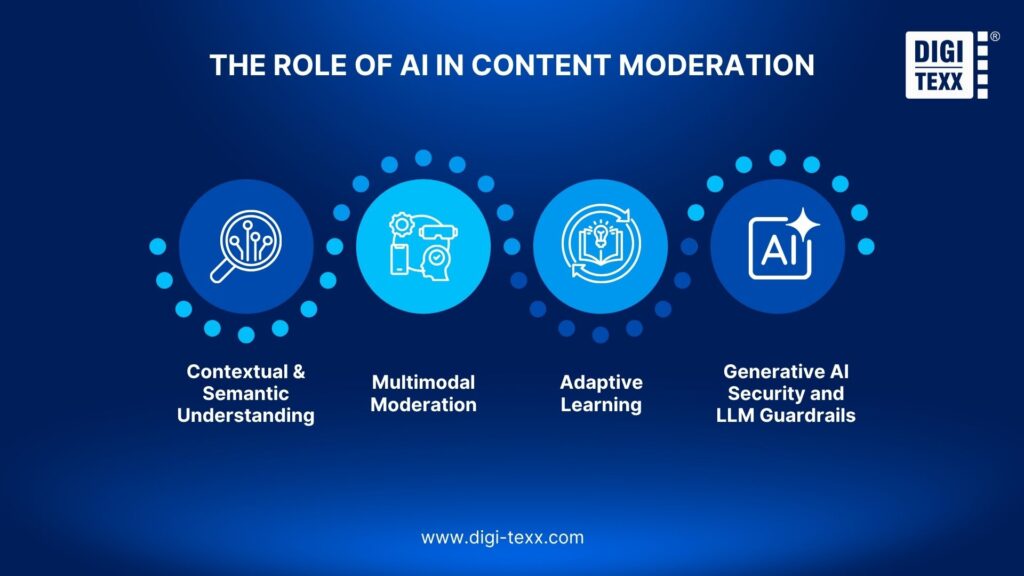
The Role Of AI In Content Moderation
Artificial intelligence (AI) plays a central role in modern content moderation by overcoming many limitations of traditional manual and rule-based systems.
Rather than scanning individual keywords in isolation, AI-powered moderation can analyze semantic meaning, contextual signals, and behavioral patterns.
Contextual & Semantic Understanding
- Identify nuanced language such as sarcasm, slang, intentional misspellings, and coded language.
- Distinguish between genuine threats and non-threatening expressions used in gaming, forums, or other online communities.
Multimodal Moderation
- Analyze relationships between text and accompanying images, such as a seemingly harmless image paired with hateful or inflammatory text.
- Analyze audio, video, and other visual signals simultaneously in live-streaming environments.
Adaptive Learning
- Improve detection based on feedback and decisions from human moderators.
- Adapt to emerging abuse patterns, new forms of harmful content, and evolving scam techniques.
Generative AI Security and LLM Guardrails
- Integrate safeguards such as Prompt Shields to help defend AI applications against prompt injection and jailbreak attempts.
- Detect and mitigate harmful or unsafe outputs generated by AI systems.
- Apply LLM guardrails to enforce safety policies around prompts, model outputs, and user interactions.
FAQs About Content Moderation Tools
Can AI Replace Human Content Moderators?
Not completely. AI can automate high-volume, repetitive moderation tasks, but human moderators remain important for contextual decisions, edge cases, appeals, and policy interpretation. The most effective approach is typically Human-in-the-Loop (HITL), where AI handles routine cases and escalates uncertain or high-risk content to human reviewers.
What Is the Difference Between Pre-Moderation and Post-Moderation?
Pre-moderation reviews content before publication, providing stronger control but potentially increasing latency. Post-moderation allows content to go live first and reviews it afterward, providing a faster user experience but allowing violating content to remain visible temporarily.
Do Content Moderation Tools Support the EU DSA?
Yes. Many tools can support DSA-related workflows, including illegal-content detection, reporting, enforcement, human review, audit trails, and transparency processes. However, using a moderation tool alone does not guarantee DSA compliance. Platforms must implement appropriate policies, processes, and governance based on their specific obligations.
Are There Free Content Moderation Tools?
Yes. Some providers offer free tiers, limited usage, or developer access for content moderation APIs. Availability and limits vary by provider. Free options can work for small projects and testing, while high-volume platforms typically need paid plans with greater throughput, features, and support.
How Do I Handle Video Moderation At Scale?
Video moderation at scale requires analyzing both visual and audio content efficiently. Instead of processing every frame, you can sample key frames and use scene detection to identify important changes throughout the video. Audio can be analyzed simultaneously to detect potentially harmful or prohibited content. Platforms such as Mixpeek can help automate this workflow with configurable sampling rates and parallel processing, making large-scale video moderation faster, more efficient, and easier to manage.
How accurate are AI content moderation tools?
AI content moderation tools can achieve high accuracy for clearly defined categories such as explicit nudity, graphic violence, and spam. However, accuracy is generally lower for context-dependent categories like hate speech, harassment, or bullying, where meaning and intent can be difficult for AI to interpret. Custom-trained models designed for a specific type of content can often deliver better results than general-purpose moderation APIs. For sensitive or ambiguous cases, combining AI moderation with human review can further improve overall accuracy.
The best content moderation tools depend on your content types, risk level, scalability needs, and moderation workflow. From multimodal AI platforms to specialized voice and managed moderation solutions, each tool serves different requirements. Evaluate accuracy, integrations, human review, security, compliance, and pricing before choosing the right solution for your platform.
DIGI-TEXX Contact Information:
🌐 Website: https://digi-texx.com/
📞 Hotline: +84 28 3715 5325
✉️ Email: [email protected]
🏢 Address:
- Headquarters: Anna Building, QTSC, Trung My Tay Ward
- Office 1: German House, 33 Le Duan, Saigon Ward
- Office 2: DIGI-TEXX Building, 477-479 An Duong Vuong, Binh Phu Ward
- Office 3: Innovation Solution Center, ISC Hau Giang, 198 19 Thang 8 street, Vi Tan Ward
References
- Huang, T. (2025). Content moderation by LLM: From accuracy to legitimacy. Artificial Intelligence Review, 58, 320. https://doi.org/10.1007/s10462-025-11328-1
- Davidson, T. (2026). Multimodal large language models can make context-sensitive hate speech evaluations aligned with human judgement. Nature Human Behaviour, 10, 514–530. https://doi.org/10.1038/s41562-025-02360-w
- Amazon Web Services. (2026). Moderating content with Amazon Rekognition. AWS Documentation. https://docs.aws.amazon.com/rekognition/latest/dg/moderation.html