
AI in BPO helps businesses automate repetitive tasks, process data faster, and improve the efficiency of outsourcing operations.
From customer support to document processing, artificial intelligence allows BPO providers to deliver faster and more accurate services.
In this article, DIGI-TEXX will help you explore the key benefits, applications, challenges, and future trends of AI in BPO, helping businesses better understand how AI driven outsourcing solutions support operational efficiency and long-term growth.
>>> See more:
- 15 Best Data Labeling Service Providers In 2026
- Secure Data Annotation Services: Top Companies & How to Choose
- Document Management Outsourcing: Benefits, Services & Companies
Key Benefits Of AI In BPO For Businesses And Clients
Below are some of the key benefits that AI brings to both BPO providers and their clients.
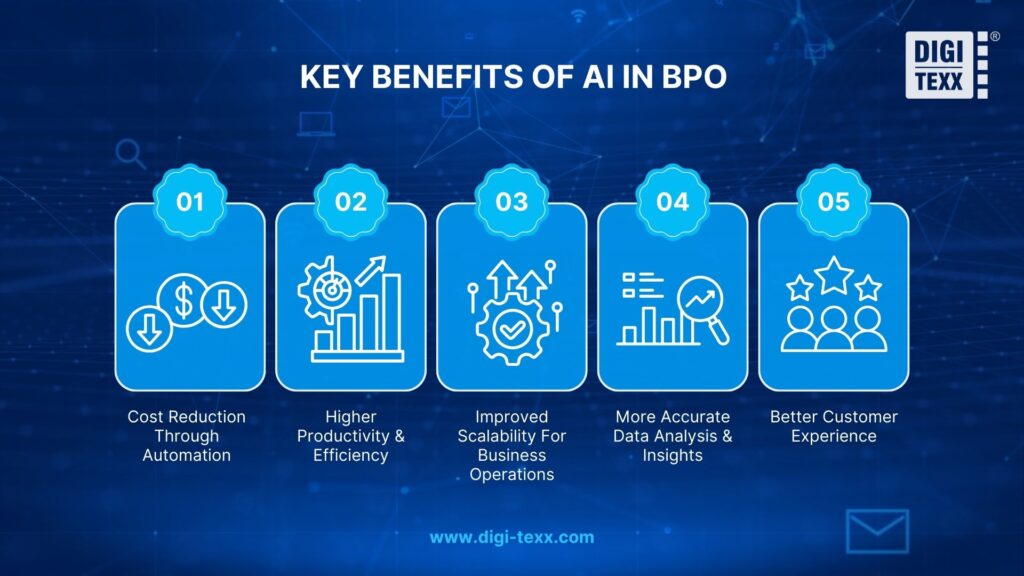
Cost Reduction Through Automation
One of the main advantages of AI in BPO is the ability to automate repetitive tasks such as data entry, document processing, and basic customer inquiries. Automation reduces the need for manual work, helping businesses lower operational costs while maintaining consistent service quality.
Higher Productivity And Efficiency
AI-powered systems can process large volumes of data much faster than manual processes. This helps BPO providers handle tasks such as data processing, document classification, and customer interactions more efficiently while reducing the risk of human errors.
Improved Scalability For Business Operations
With AI technologies, outsourcing providers can scale services more easily based on client demand. Businesses can increase or reduce workloads without needing to significantly expand internal teams, making operations more flexible and adaptable.
More Accurate Data Analysis And Insights
AI tools can analyze large datasets and identify patterns that would be difficult to detect manually. These insights help businesses understand customer behavior, monitor performance, and make more informed strategic decisions.
Better Customer Experience
AI-powered chatbots and virtual assistants allow businesses to respond quickly to common customer questions and service requests. By combining automation with human support teams, companies can provide faster response times and more personalized customer interactions.
>>> See more:
- Data Validation & Verification: Differences With Clear Examples
- Healthcare Back-Office Support Services For Efficient Operations
- Professional E-commerce Data Entry Services by DIGI-TEXX
Challenges Of Implementing AI In BPO
While AI in BPO brings many operational benefits, implementing these technologies also comes with several challenges that businesses and outsourcing providers need to manage carefully. From technical investments to workforce concerns, successful AI adoption requires a balanced strategy that combines technology with human expertise.
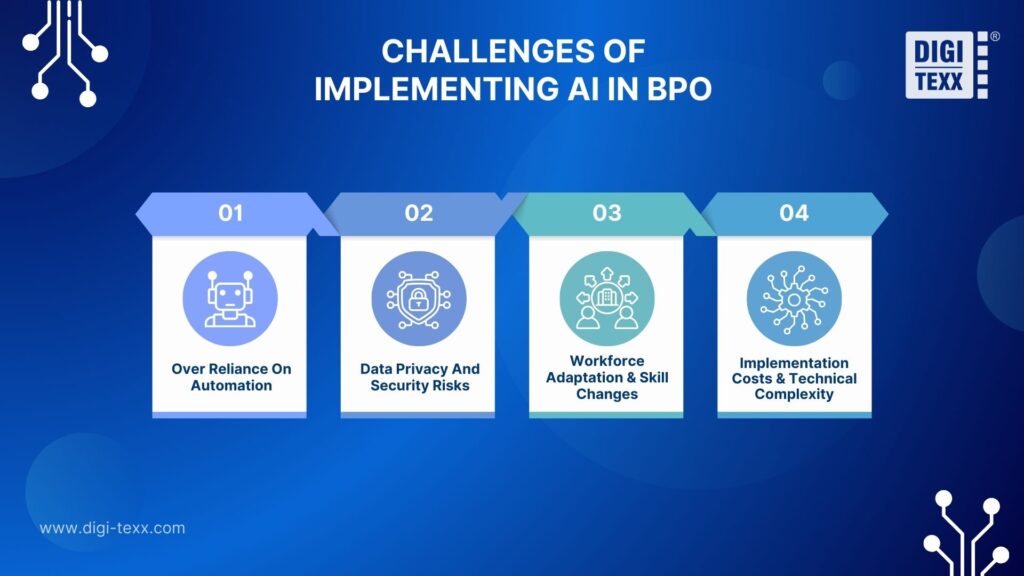
Over Reliance On Automation
One challenge of AI in BPO is the risk of relying too heavily on automation. While AI systems can handle repetitive tasks efficiently, excessive automation may reduce the human interaction that customers expect. Businesses often need to balance AI tools with human agents to ensure complex or emotionally sensitive situations are handled effectively.
Data Privacy And Security Risks
BPO providers frequently manage large volumes of sensitive customer information. When integrating AI in BPO systems, companies must ensure strong data protection practices to prevent security breaches. Clear privacy policies, secure infrastructure, and compliance with regulations are essential to maintain trust with clients.
Workforce Adaptation And Skill Changes
The adoption of AI technologies can create concerns among employees about job stability. Instead of replacing workers entirely, many companies focus on reskilling and training programs so employees can work alongside AI systems and take on more complex roles.
Implementation Costs And Technical Complexity
Although AI can generate long-term savings, the initial investment in infrastructure, system integration, and employee training can be significant. Businesses often implement AI in BPO gradually through phased deployment or cloud-based solutions to manage these costs more effectively.
>>> See more:
- Data Labeling Service: Benefits, Top Providers & How to Choose
- Invoice Reconciliation Process Steps | DIGI-TEXX
- Document Indexing Services For Efficient Search & Data Access
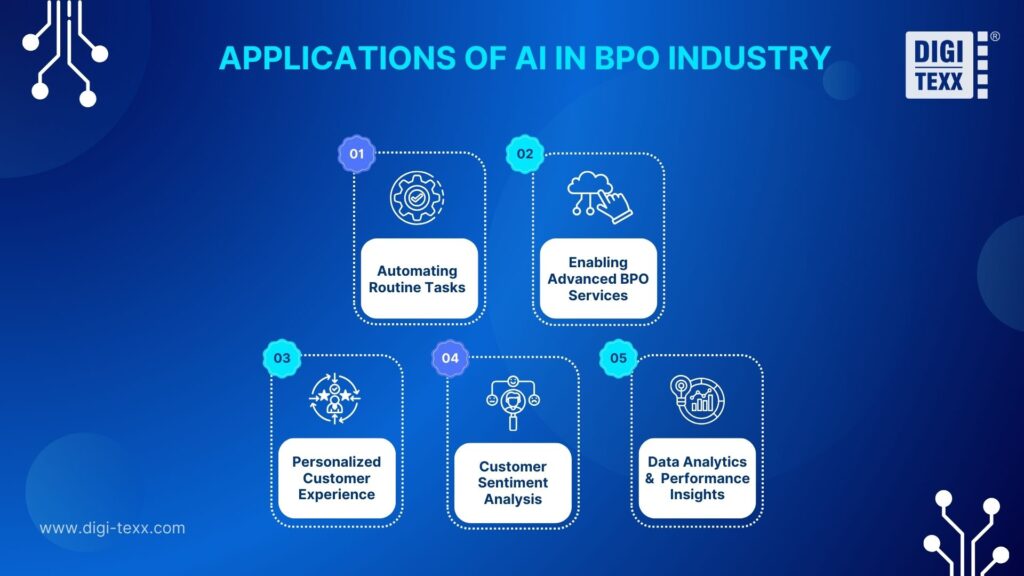
Applications Of AI In BPO Industry
Artificial intelligence is transforming how outsourcing providers manage large volumes of data and customer interactions. AI in BPO allows companies to automate repetitive processes, improve service quality, and generate deeper insights from business data. By integrating AI technologies into daily operations, BPO providers can handle tasks faster while delivering more consistent and scalable services.
Automating Routine Tasks
One of the most common applications of AI in BPO is the automation of repetitive and rule-based tasks. Many outsourcing operations involve processing large amounts of structured data such as data entry, document handling, or transaction processing. AI-powered automation tools and robotic process automation help reduce manual workloads, minimize human errors, and allow employees to focus on tasks that require analysis or decision making.
Enabling Advanced BPO Services
AI technologies such as machine learning and natural language processing allow outsourcing providers to offer more advanced services. These systems can analyze large volumes of customer interactions and operational data to identify patterns and trends. With these insights, businesses can better understand customer needs and improve service strategies.
Personalized Customer Experience
AI in BPO also helps companies deliver more personalized customer experiences. Virtual assistants and AI-powered support tools can analyze customer history, previous interactions, and behavior patterns. Based on this information, businesses can provide more relevant recommendations and faster support for customer requests.
Customer Sentiment Analysis
AI systems can analyze conversations between customers and support agents to detect emotional signals such as tone of voice, pauses, and interaction patterns. This helps companies understand how customers feel during service interactions and allows agents to respond more effectively to improve satisfaction.
Data Analytics And Performance Insights
Another important application of AI in BPO is advanced analytics. AI tools can analyze operational data such as response times, resolution rates, and customer feedback. These insights help businesses monitor performance, identify service improvements, and make better strategic decisions for long-term growth.
Some AI Examples In BPO Industry
Below are some common examples of how AI is applied in BPO operations.
- Invoice Processing Automation: AI can automatically extract and verify information from invoices and transfer the data into accounting or ERP systems. This reduces manual data entry and speeds up financial processing.
- Customer Support Chatbots: AI powered chatbots can handle common customer questions and provide instant responses. This helps reduce waiting times while allowing human agents to focus on more complex issues.
- Data Annotation For AI Training: Many BPO companies provide data annotation services to label images, text, audio, or video. These labeled datasets are used to train AI models and improve their accuracy.
- Fraud Detection: AI systems can analyze financial transactions and detect unusual patterns that may indicate fraud. This helps businesses identify risks earlier and strengthen financial security.
- Intelligent Document Processing: AI can extract key information from documents such as forms, contracts, or reports. This makes document management faster and more efficient for back office operations.
>>> See more:
- What Is A Back Office Service? Examples, Benefits, And Cost In 2026
- Intelligent Document Processing Services: How It Works & Business Benefits
- Outsourced Order Processing Services – Fast & Accurate
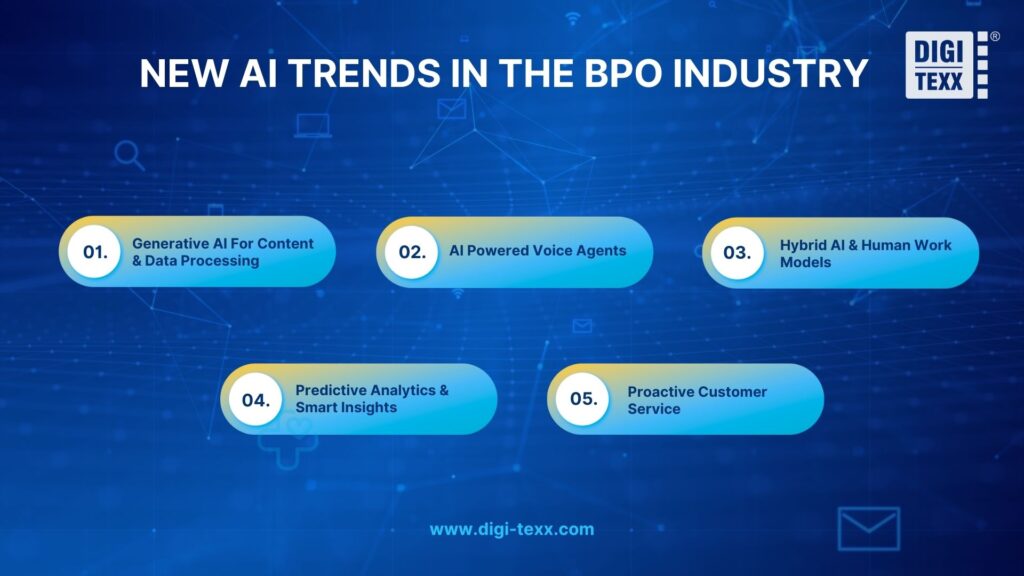
New AI Trends In The BPO Industry
As the adoption of AI in BPO continues to grow, outsourcing providers are using new technologies to automate processes, improve efficiency, and deliver better services.
Generative AI For Content And Data Processing
Generative AI can create humans like text, images, and code. In the BPO industry, it is used for tasks such as data annotation, content generation, and document processing. This helps companies handle large volumes of data more efficiently and improve the quality of AI training datasets.
AI Powered Voice Agents
AI voice agents are becoming more advanced and can support multilingual conversations in real time. These systems can handle customer inquiries, manage high call volumes, and assist support teams by resolving common requests automatically.
Hybrid AI And Human Work Models
Many BPO companies now combine AI tools with human expertise. AI handles repetitive tasks such as data processing or basic customer inquiries, while human agents focus on complex situations that require problem solving and empathy.
Predictive Analytics And Smart Insights
AI is also used to analyze large datasets and identify patterns in customer behavior. Predictive analytics helps companies forecast service demand, understand customer needs, and make better operational decisions.
Proactive Customer Service
With AI driven insights, businesses can move from reactive to proactive customer service. By analyzing past interactions and customer data, AI systems can identify potential issues early and help companies address them before they affect customer satisfaction.
Is AI Taking Over BPO?
The answer is no. The growing adoption of AI in BPO, along with machine learning technologies, does not mean that human workers will be replaced. Instead, AI is expected to enhance existing roles and support employees by automating repetitive tasks and improving operational efficiency.
While AI can handle routine processes and reduce the need for manual work in certain areas, it does not lead to large-scale job losses. In many cases, the adoption of AI actually creates new types of jobs that require different skills and expertise.
As AI becomes more widely used in BPO operations, companies will need professionals with skills in areas such as programming, data analytics, and AI system management. At the same time, roles that rely on human creativity and empathy, such as user interface design and customer experience design, will continue to be important.
Because of this shift, the BPO industry is also placing greater emphasis on training and upskilling. Many outsourcing companies are investing in programs that help employees develop new capabilities so they can work effectively in an AI-driven environment.
>>> See more:
- Back Office Support Services For Streamlined & Efficient Operations
- Insurance Back Office Support Services for Insurers & Agencies
- Ecommerce Back Office Support Services By DIGI-TEXX
FAQs About AI In BPO
How Is AI Used In BPO?
AI is used in BPO to automate repetitive and data-intensive tasks. It helps handle processes such as data entry, invoice processing, and document management more quickly and accurately.
How Is AI Used In Call Centers?
AI is used in call centers to improve service efficiency and response speed. It helps automate tasks such as call routing, answering common customer inquiries, and analyzing customer interactions. As a result, AI helps standardize service quality, reduce transfer times, and support faster issue resolution for customers.
What Is The Role Of AI In The BPO Industry?
AI in BPO plays a key role in automating repetitive processes and improving operational efficiency. It helps reduce human errors in tasks such as data processing and document handling while enabling BPO providers to manage larger workloads more accurately.
>>> See more:
- Top 10 Data Processing Software For Business 2026 – Best Tool Reviewed
- Best Real Estate Image Processing Services 2026: Top 15 Providers
- Top 10 Best Data Entry Outsourcing Companies in USA 2026
- Top 10 Outsourced AI Training Data Companies in 2026
- Define Business Process Outsourcing (BPO) & Clear Examples
- Construction Invoice Reconciliation: Best Practices, Software & Outsourcing
AI in BPO helps businesses automate processes, improve efficiency, and manage large volumes of data more effectively. By combining AI technologies with human expertise, DIGI-TEXX provides reliable outsourcing services that help businesses streamline operations, reduce manual workloads, and improve data accuracy. With scalable solutions and experienced teams, DIGI-TEXX supports clients in optimizing processes, enhancing service quality, and achieving sustainable business growth.
DIGI-TEXX Contact Information:
🌐 Website: https://digi-texx.com/
📞 Hotline: +84 28 3715 5325
✉️ Email: [email protected]
🏢 Address:
- Headquarters: Anna Building, QTSC, Trung My Tay Ward
- Office 1: German House, 33 Le Duan, Saigon Ward
- Office 2: DIGI-TEXX Building, 477-479 An Duong Vuong, Binh Phu Ward
- Office 3: Innovation Solution Center, ISC Hau Giang, 198 19 Thang 8 street, Vi Tan Ward
Reference:
- St. Thomas University. (2025). How businesses use AI and automation to improve management efficiency. https://www.stu.edu/news/how-businesses-use-ai-and-automation-to-improve-management-efficiency/
- University of Cincinnati. (2024). Business benefits of artificial intelligence. https://www.online.uc.edu/blog/business-benefits-artificial-intelligence-ai.html