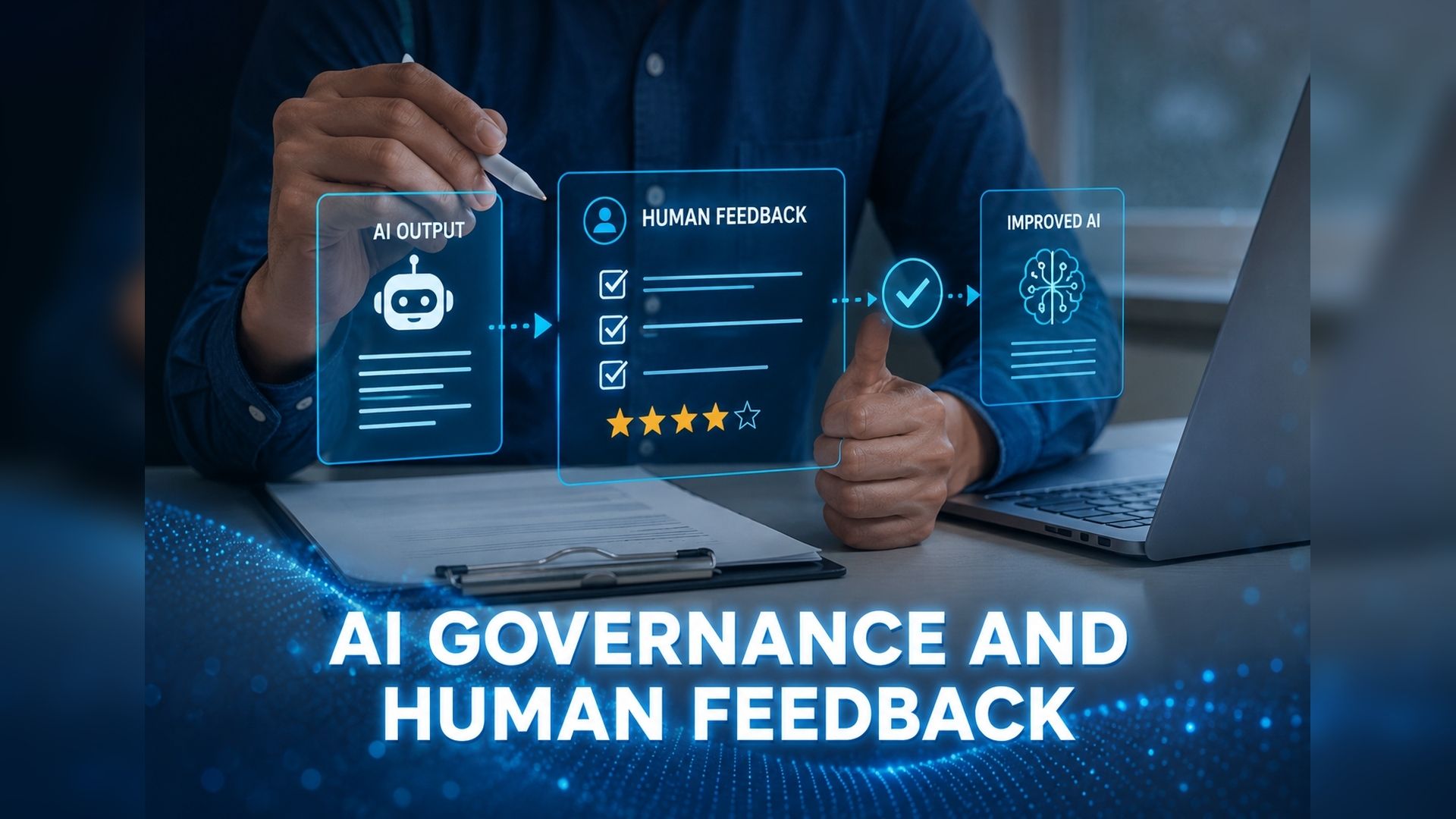

Effective AI governance depends on more than written policies. In AI governance and human feedback, the evaluations, corrections, and overrides people provide reveal whether risk controls actually work once a system is live. They shape decisions across the AI lifecycle, from choosing the right human oversight model to strengthening the data governance foundations that most AI risks trace back to.
In this article, DIGI-TEXX explains how human feedback works in AI governance, how to build a feedback loop that leads to action, and the risks to manage along the way.
What Is Human Feedback In AI Governance?
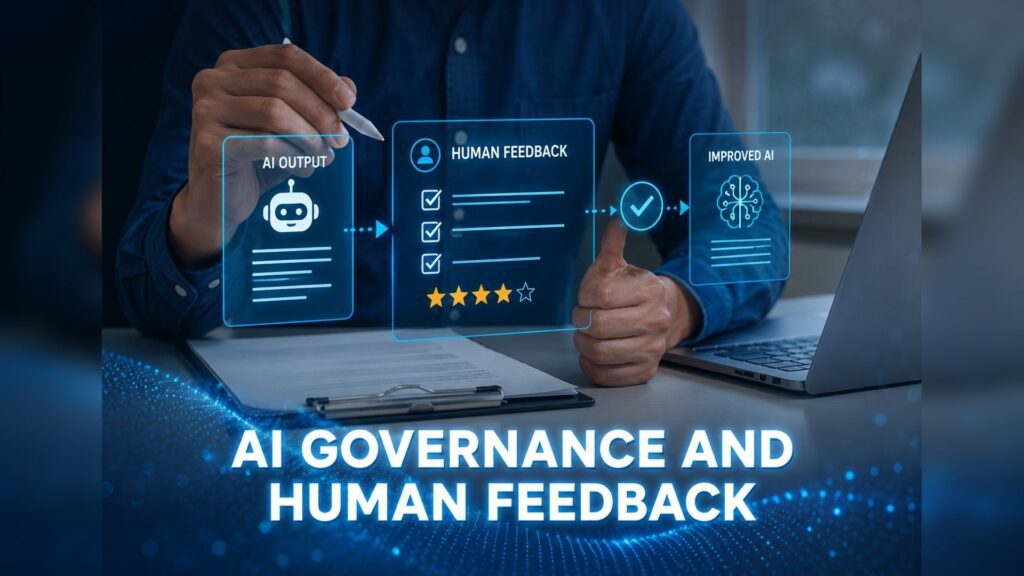
Human feedback in AI governance is the evaluation, judgment, correction, and observations people provide about an AI system. It helps organizations compare AI behavior with governance requirements, risk controls, and human expectations, then identify where intervention or improvement is needed.
Feedback can include expert reviews, output corrections, human overrides, user reports, incident findings, and stakeholder observations. It can come from users, subject-matter experts, reviewers, operators, or other affected stakeholders.
Human feedback therefore acts as a bridge between AI governance policies and real-world AI behavior, providing evidence of whether requirements for fairness, safety, reliability, transparency, and accountability are being met.
Human Feedback vs. Human Oversight vs. Human-in-the-Loop
| Concept | Meaning | Purpose |
| Human feedback | Human evaluation, correction, or observations about AI | Identify issues and improve AI behavior or controls |
| Human oversight | Processes that allow people to monitor, assess, and control AI | Maintain human control and accountability |
| Human-in-the-Loop (HITL) | Humans directly review, approve, modify, or reject AI outputs | Prevent or correct errors before execution |
These concepts are related but not interchangeable. Human feedback provides information, human oversight provides control, and HITL is one way to apply that control. Collecting feedback alone is not enough; effective governance requires reviewers to have appropriate expertise, context, authority, and a defined process for acting on their findings.
Human feedback should also be continuous across the AI lifecycle, informing design, evaluation, deployment, monitoring, incident response, and system improvement rather than being limited to model development.
>>> See more:
- How to Moderate User-Generated Content: Complete Guide 2026
- 20 Best Data Governance Tools You Need In 2026
- Why Secure Data Processing Solutions Are Critical for Modern Businesses
Types Of Human Feedback In AI Governance
Human feedback in AI governance can come from different sources and serve different governance purposes. Treating all feedback as the same signal can make it difficult to identify which issues require operational changes, risk escalation, or broader governance action. A useful feedback system therefore distinguishes between several types of human input.
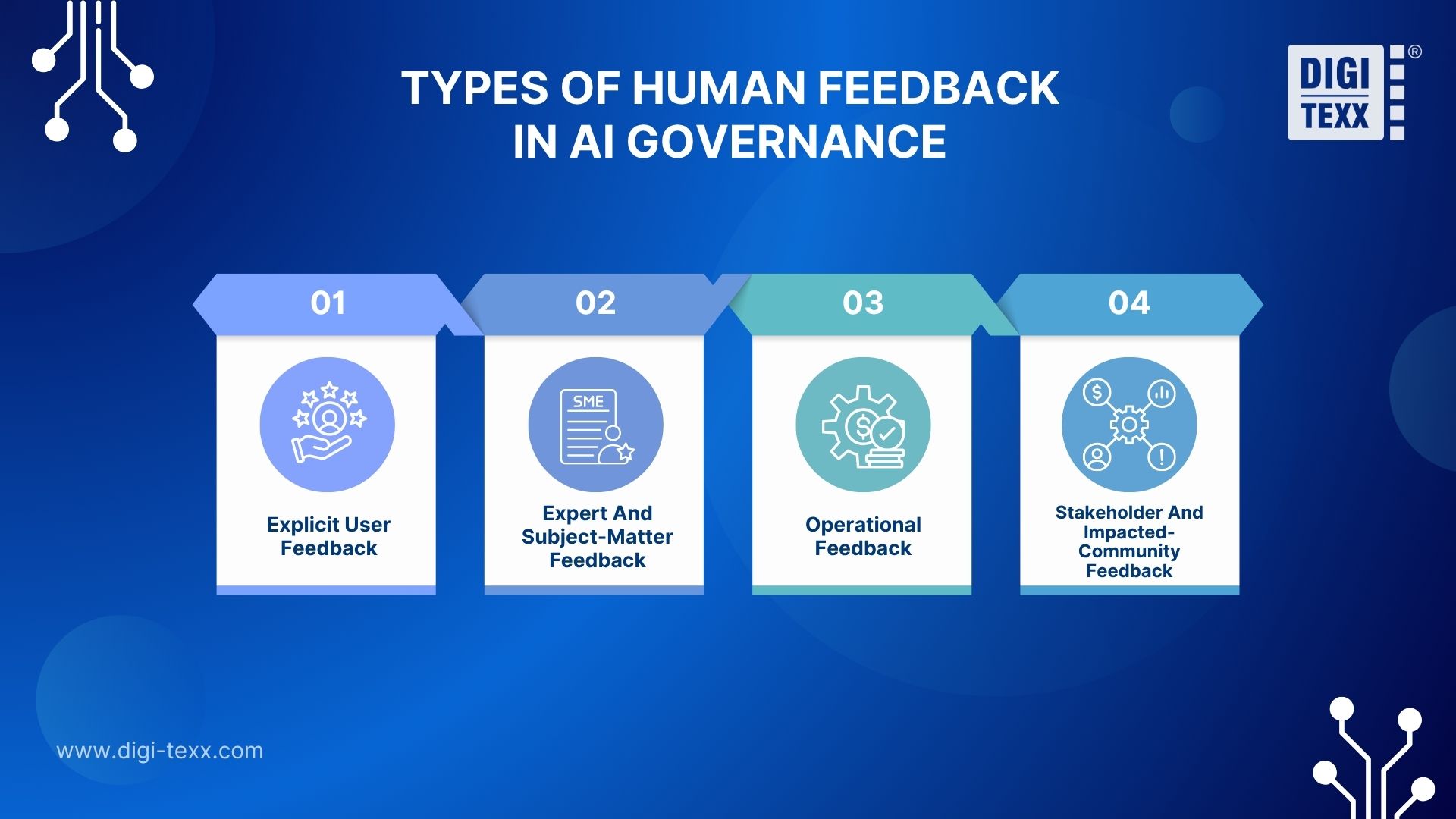
Explicit User Feedback
Explicit feedback is information users intentionally provide about an AI system’s output or behavior. Common examples include ratings, corrections, written comments, error reports, complaints, and appeals. These signals can reveal whether users consider outputs accurate, useful, safe, or appropriate in the context where the system is being used.
For governance purposes, explicit feedback is more valuable when it includes sufficient context, such as the original input, AI output, reason for the complaint, and potential impact. NIST recommends establishing feedback processes that allow end users and impacted communities to report problems and appeal system outcomes, with this information incorporated into AI system evaluation.
Expert And Subject-Matter Feedback
Subject-matter experts (SMEs), domain specialists, and trained reviewers can provide more detailed assessments than general users. Their feedback may evaluate factual accuracy, regulatory compliance, safety, fairness, interpretability, or whether an AI system is suitable for a particular professional context.
This type of feedback is particularly important for high-impact applications where users may not have enough technical or domain knowledge to identify subtle failures. Organizations can use expert adjudication to distinguish isolated errors from recurring or systemic issues.
Operational Feedback
Operational feedback comes from people who monitor or use AI systems as part of an organization’s workflow. It can include manual overrides, rejected recommendations, escalation events, incident reports, repeated corrections, or observations from operators.
These signals are especially useful for governance because they show how humans interact with AI under real operating conditions. A high override rate, for example, may indicate that an AI system is unreliable for a particular task or that its operating boundaries need to be reconsidered.
Stakeholder And Impacted-Community Feedback
Feedback can also come from people affected by an AI system, even when they are not direct users. Employees, customers, affected individuals, community representatives, and other stakeholders may identify unintended impacts that internal technical teams overlook.
NIST specifically emphasizes engagement with relevant AI actors and the integration of feedback about positive, negative, and unanticipated impacts into AI risk management.
Why Does Human Feedback Matter in AI Governance?
Human feedback gives AI governance a practical way to evaluate whether policies, risk controls, and AI systems work as intended in real-world use. It complements automated metrics by capturing contextual, ethical, and operational issues that technical evaluation alone may overlook.
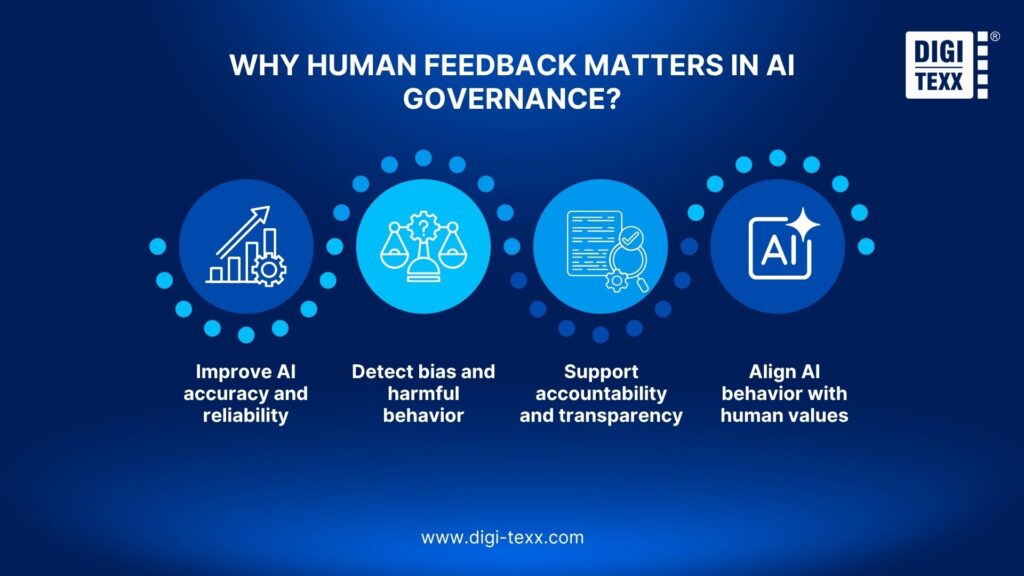
- Improve AI accuracy and reliability: Human reviewers can identify incorrect, incomplete, misleading, or contextually inappropriate outputs, helping organizations detect recurring errors and improve models, prompts, guardrails, and workflows.
- Detect bias and harmful behavior: Feedback from users, experts, and affected stakeholders can reveal discriminatory outcomes, unsafe recommendations, or failures affecting specific groups that may be missed by aggregate performance metrics.
- Support accountability and transparency: Structured feedback creates evidence of what went wrong, who reviewed it, what action was taken, and whether the issue was resolved. This strengthens traceability and makes human oversight more accountable.
- Align AI behavior with human values: Human evaluation helps determine whether AI behavior reflects expectations around fairness, safety, reliability, and responsible use, particularly in ambiguous or high-impact situations where automated metrics may be insufficient.
The goal is not to place a human in every AI decision. Instead, effective governance uses human feedback where human judgment adds the most value and ensures that important findings can lead to meaningful intervention and system improvement.
“Only 28% of organizations said their CEO takes direct responsibility for AI governance oversight, and just 17% said their board does.” – McKinsey & Company, The State of AI (2025)
How Does Human Feedback Work Across The AI Lifecycle?
Human feedback is not limited to model training. In effective AI governance, it can support decision-making and risk control across the entire AI lifecycle, from development and deployment to ongoing monitoring and post-deployment improvement. Each stage uses human input differently, depending on the level of risk and the type of intervention required.
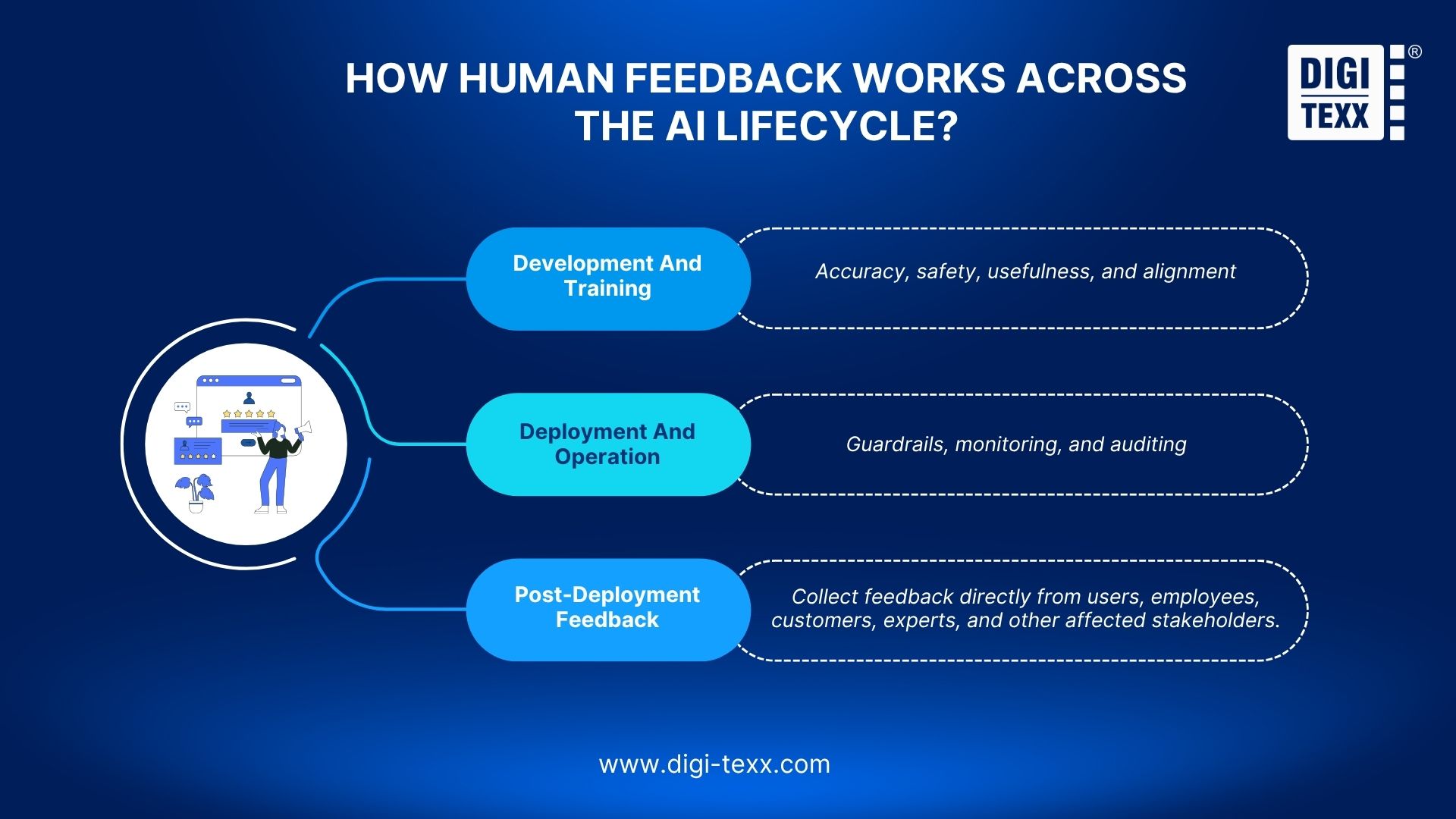
Development And Training
During development, human feedback helps organizations evaluate whether an AI system produces outputs that meet defined goals for accuracy, safety, usefulness, and alignment. Human evaluation can be used to compare outputs, identify failure patterns, and refine evaluation criteria before the system is deployed. At this stage, feedback often overlaps with dataset preparation, where AI-assisted annotation combined with human review helps ensure that training data is consistent and reliable.
For generative AI, Reinforcement Learning from Human Feedback (RLHF) is one example of using human judgments during model development. People evaluate or rank model outputs, and those judgments are used to optimize the model toward preferred behaviors. This depends heavily on the quality of the underlying AI training data and on the consistency of the reviewers providing the judgments. However, RLHF is a model-development technique, not a complete AI governance process.
Deployment And Operation
Once an AI system is deployed, human feedback shifts from model improvement to operational oversight and risk control. Human reviewers may assess high-risk recommendations, approve or reject actions, or intervene when predefined conditions indicate that automated decisions require additional scrutiny.
Organizations can also combine human review with guardrails, monitoring, and auditing. For example, low-confidence outputs or sensitive cases can be automatically escalated to human experts, while reviewers examine system logs to identify bias, hallucinations, unexpected behavior, or other emerging risks.
The key principle is that human involvement must be meaningful. Reviewers need sufficient context, expertise, and authority to override or challenge AI outputs. Otherwise, human review can become little more than a procedural approval step.
Post-Deployment Feedback
After deployment, organizations can collect feedback directly from users, employees, customers, experts, and other affected stakeholders. This may include error reports, complaints, incident reports, corrections, or feedback about unexpected AI behavior.
This feedback provides evidence of how the system performs in real-world conditions and can reveal issues that were not identified during testing. Organizations can then use validated feedback to trigger corrective actions, update safeguards, adjust workflows, improve evaluation criteria, or re-label and expand training datasets. Many teams treat this as a continuous data labeling cycle rather than a one-time preparation step. In this way, feedback creates a continuous governance loop rather than a one-time review.
>>> See more:
- AI vs Human Content Moderation Solutions: Which Approach Works Best For E-commerce In 2026?
- Outsourced Content Moderation Services: The Key to Safer Digital Communities
Human Oversight Models In AI Governance
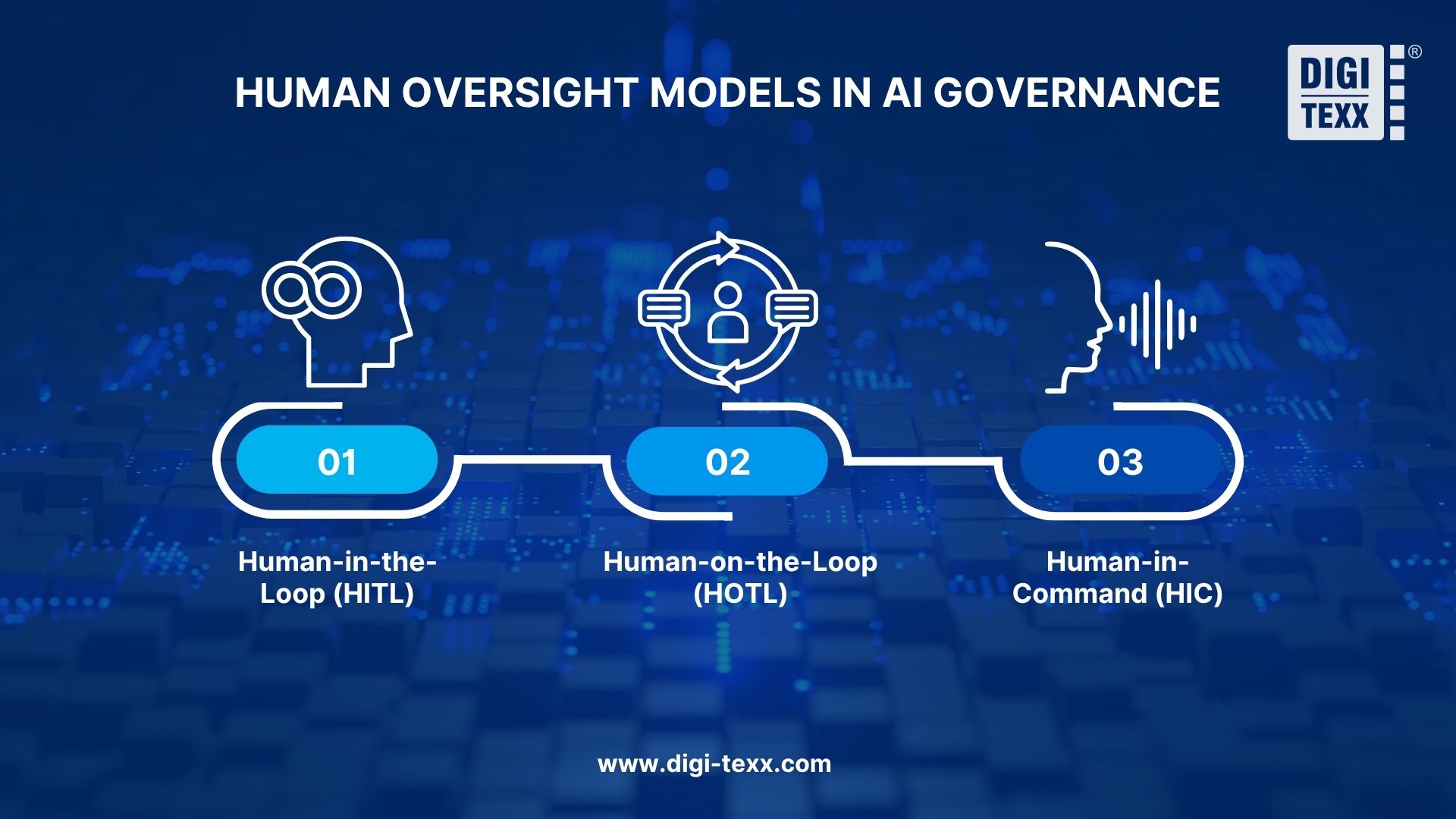
Human oversight defines how people retain control over AI systems based on their risk, autonomy, and potential impact. Three common models are Human-in-the-Loop (HITL), Human-on-the-Loop (HOTL), and Human-in-Command (HIC).
| Model | How it works | Primary governance role |
| HITL | Humans review, approve, modify, reject, or escalate AI outputs before action. | Direct control over high-risk decisions |
| HOTL | AI operates autonomously while humans monitor performance and intervene when predefined thresholds or risks are triggered. | Ongoing monitoring and intervention |
| HIC | Humans retain authority over whether, where, when, and why an AI system is deployed. | Strategic governance and accountability |
These models can work together within the same AI governance structure: HIC defines the system’s boundaries, HOTL monitors its operation, and HITL handles decisions requiring direct human judgment.
>>> See more:
- Business Process Automation Solutions: Top Tools, Benefits & Use Cases
- AI Data Processing Company: Transforming Data into Intelligent Business Insights
How To Build An Effective Human Feedback Loop?
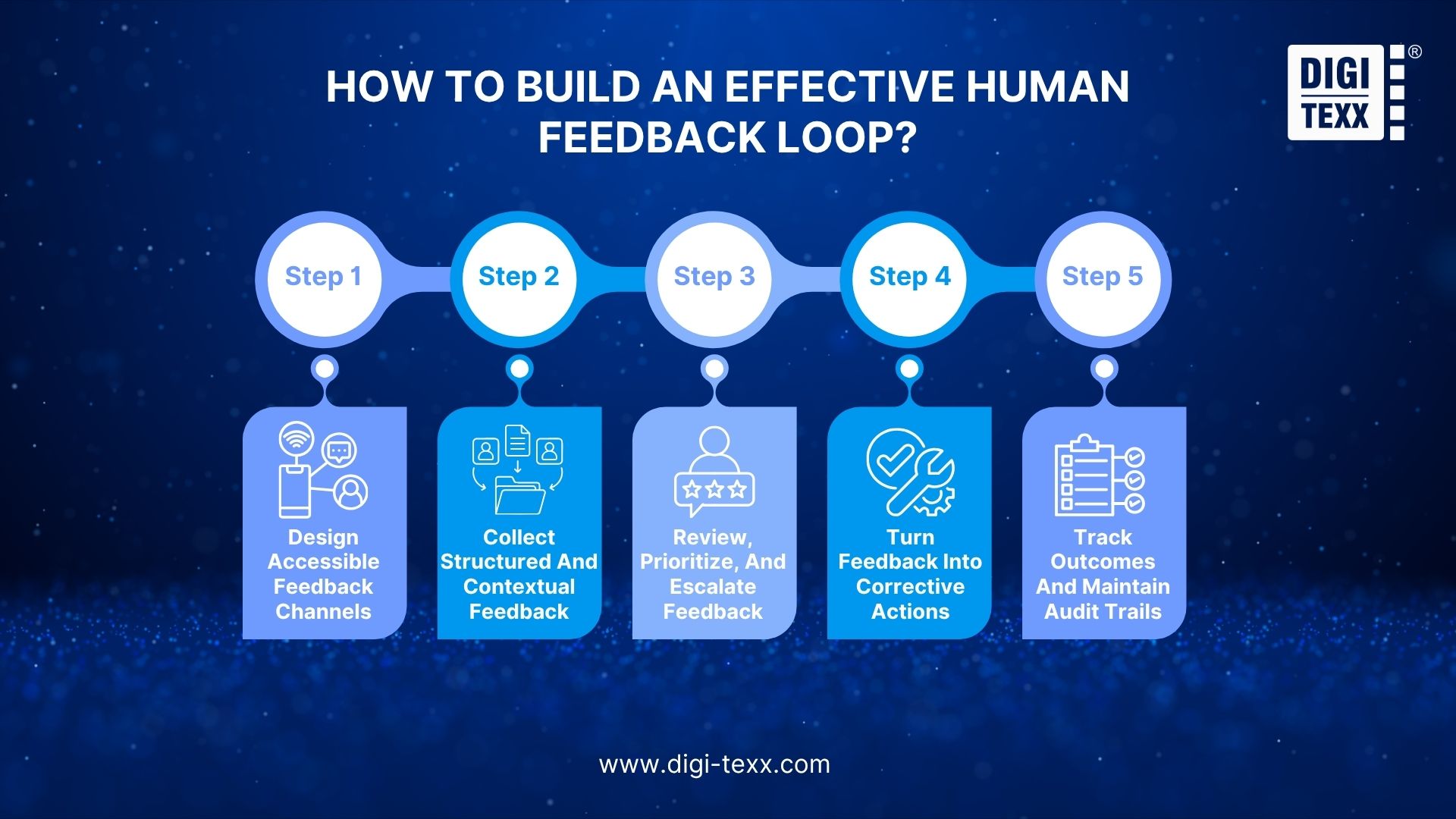
An effective human feedback loop should do more than collect comments or ratings. It needs a clear purpose, accessible feedback channels, consistent evaluation, defined ownership, timely action, and a process for verifying whether the response actually improves the AI system.
1. Design Accessible Feedback Channels
Start by defining what the feedback should achieve. Depending on the AI use case, feedback may be used to identify inaccurate outputs, detect bias, report safety issues, evaluate user experience, or trigger incident response.
Feedback channels should be easy to access, simple to use, and appropriate to the user’s workflow. Common methods include rating controls, structured forms, comment fields, correction options, and dedicated incident-reporting channels. High-risk issues should have a clear escalation path rather than relying on a basic feedback form.
The channel should also match the needs of different users. End users may need quick, low-effort reporting, while subject-matter experts may require detailed annotation fields or explanations. Where appropriate, organizations should also make clear how submitted feedback will be reviewed and used.
2. Collect Structured And Contextual Feedback
A strong feedback loop needs both structured signals and sufficient context. Ratings, categorical labels, and thumbs-up/thumbs-down responses make feedback easier to aggregate, compare, and monitor over time.
However, a rating alone rarely explains why an output was problematic. For important cases, capture relevant context such as the input, AI output, error type, task, user explanation, and impact. This allows reviewers to distinguish isolated mistakes from recurring or systemic problems.
Organizations should also consider who provides the feedback. Broad user feedback can reveal large-scale patterns, while qualified experts can provide deeper assessments for specialized or high-risk AI applications. Organizations that lack in-house reviewers at scale often rely on specialized annotation and review teams to maintain consistent evaluation criteria. Combining different feedback sources produces a more complete view of system behavior.
>>> See more:
- Top 17 Data Labeling Service Providers For AI Projects In 2026
- Data Annotation Reviews: Top Companies & Tools Compared
3. Review, Prioritize, And Escalate Feedback
Feedback becomes useful only when someone evaluates it. Assign clear responsibility for collecting, reviewing, classifying, and acting on feedback, with appropriate involvement from technical, business, risk, compliance, or subject-matter experts.
Feedback can be prioritized according to severity, frequency, potential impact, and regulatory or business relevance. Minor usability issues may enter a normal improvement queue, while harmful outputs, privacy incidents, security concerns, or high-impact decision errors may require immediate escalation.
Timeliness also matters. A feedback mechanism is ineffective as a governance control if serious issues remain unresolved for too long. Define faster review and escalation procedures for feedback that could create significant safety, legal, financial, or reputational risk.
4. Turn Feedback Into Corrective Actions
The purpose of feedback is not simply to document problems. Validated feedback should lead to an appropriate corrective action, such as updating prompts, guardrails, business rules, retrieval data, evaluation criteria, workflows, or model configurations.
Not every problem requires model retraining. First determine whether the root cause comes from the model, data, prompt, retrieval process, user interface, workflow, or governance control. When the issue traces back to the data layer, a structured data quality framework is usually more effective than retraining the model. Addressing the correct layer can often resolve an issue faster and reduce unnecessary changes to the model.
Each significant corrective action should have a clear owner, expected outcome, and follow-up review. This creates accountability and ensures that feedback becomes part of an improvement process rather than remaining in an unresolved backlog.
5. Track Outcomes And Maintain Audit Trails
A feedback loop is incomplete until the organization can determine what happened after feedback was submitted. Track the feedback, severity, review decision, responsible owner, corrective action, implementation status, and outcome where appropriate.
Maintain audit trails that connect AI outputs, human evaluations, overrides, escalation decisions, and corrective actions. These records support accountability, incident investigation, governance reviews, and evidence that human judgment was actually incorporated into system management.
Finally, close the loop by evaluating whether the corrective action reduced the original problem. Monitor relevant performance or risk indicators after the change and reopen the issue when the problem persists. This turns human feedback into a continuous governance mechanism rather than a one-time reporting process.
>>> See more:
- Data Integrity Definition: Meaning, Types, Examples & Best Practices 2026
- What Is Data Quality Control? Key Components, Tools & Examples
How To Measure Human Feedback Effectiveness?
Collecting human feedback does not demonstrate that a feedback system is effective. Organizations also need to measure whether feedback is being reviewed, acted upon, and translated into measurable improvements in AI system performance or risk management.
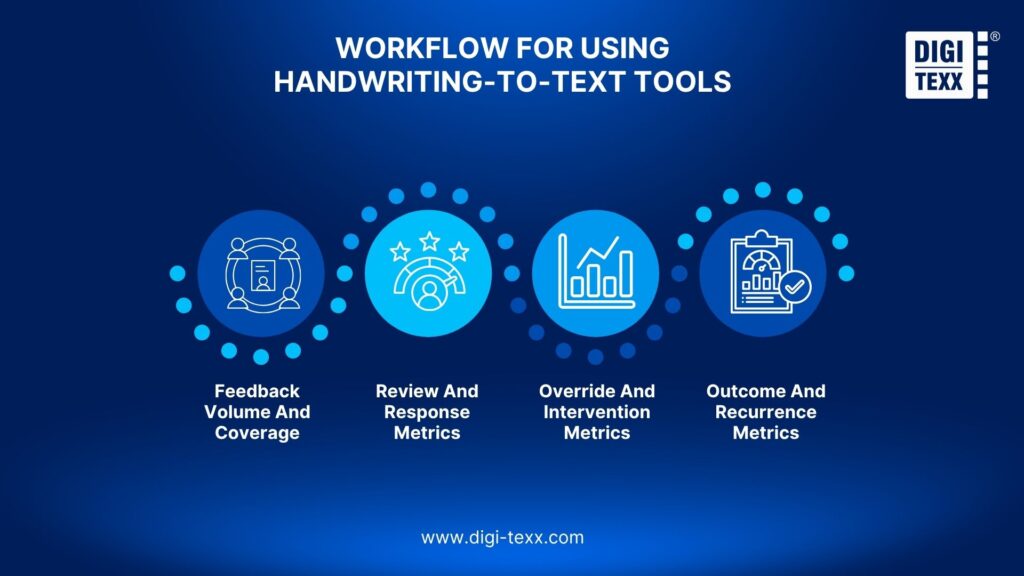
Feedback Volume And Coverage
Track how much feedback the system receives and which parts of the AI lifecycle or user population it represents. Useful measures include feedback volume, percentage of active users providing feedback, coverage across important use cases, and distribution across risk categories.
High feedback volume is not necessarily positive. A system with very little feedback may indicate that users cannot easily report problems or do not trust the feedback mechanism.
Review And Response Metrics
Organizations can measure how quickly and consistently feedback moves through the review process. Relevant indicators include:
- Time to review: how long it takes to assess submitted feedback.
- Escalation rate: the percentage of feedback requiring additional review or incident handling.
- Resolution rate: the percentage of validated issues that receive a documented corrective action.
- Time to remediation: how long it takes to implement and verify the response.
- Reviewer agreement: the degree to which reviewers reach consistent conclusions on similar cases.
These metrics help determine whether feedback is functioning as an operational governance control rather than simply accumulating in a reporting system.
Override And Intervention Metrics
For systems involving human oversight, organizations can monitor the frequency and rationale of human overrides, rejected recommendations, and escalations. NIST specifically recommends tracking downstream actions such as system overrides, reported errors or complaints, response times, response types, and adjudication activities.
A sudden increase in overrides may indicate declining model performance, a change in the operating environment, or a mismatch between system behavior and user expectations. However, a very low override rate is not automatically evidence of high quality because it can also result from automation bias or ineffective human review.
Outcome And Recurrence Metrics
The most important measurement is whether validated feedback leads to better outcomes. After corrective action, organizations can compare relevant indicators such as error rates, complaint rates, safety incidents, override frequency, or other risk measures before and after the intervention.
Track issue recurrence as well. If the same problem repeatedly appears after remediation, the organization may be treating symptoms rather than addressing the underlying cause.
Ultimately, a mature human feedback process should connect feedback metrics to broader AI governance measures. NIST describes feedback as an input into evaluation and risk management, with measurement results used to determine whether AI systems continue to perform as intended in their deployment context.
Key Risks Of Human Feedback In AI Governance
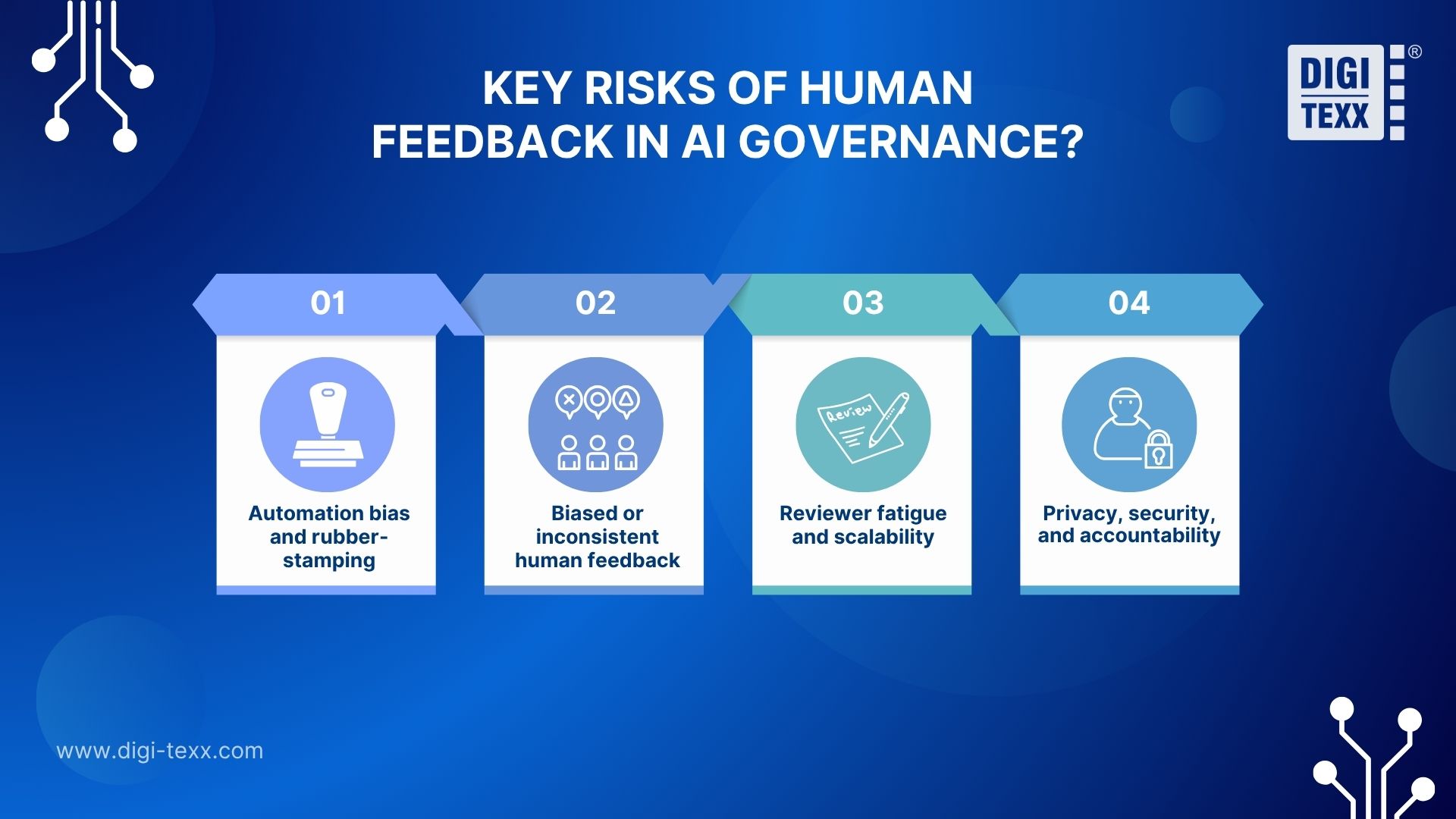
Human feedback strengthens AI governance, but it can also introduce new risks when feedback is poorly designed, inconsistently evaluated, or disconnected from decision-making. Effective governance therefore needs to address both the quality of human judgment and the conditions under which that judgment is applied.
- Automation bias and rubber-stamping: Reviewers may place excessive trust in AI recommendations and approve outputs without meaningful scrutiny. This risk increases when reviewers lack sufficient context, expertise, time, or authority to challenge the system. Human oversight should therefore include clear review criteria, training, and explicit override or escalation authority.
- Biased or inconsistent human feedback: Human judgments can vary across reviewers and may reflect individual or demographic biases. A narrow feedback group can also cause the system to optimize for limited perspectives. Use consistent evaluation criteria, multiple reviewers where appropriate, and sufficiently diverse feedback sources to reduce these risks.
- Reviewer fatigue and scalability: Manual review can become difficult to sustain as AI systems generate large volumes of outputs. Repetitive or high-pressure review tasks may reduce attention and consistency over time. Organizations should prioritize human review for higher-risk cases, automate routine evaluations where appropriate, and monitor reviewer workload and performance.
- Privacy, security, and accountability: Feedback may contain sensitive user information, proprietary data, or details about AI failures and incidents. Poor handling can create additional privacy or security risks. Feedback repositories should therefore be covered by the same data security controls applied to production data, including access restrictions, encryption, and retention rules. Organizations should control access to feedback data, document who is responsible for reviewing and acting on it, and maintain appropriate records of decisions, overrides, and corrective actions to support accountability.
Adding humans to an AI workflow does not automatically create effective governance. Human reviewers need the right information, authority, diversity, and operating conditions to provide meaningful oversight rather than simply validate AI decisions.
>>> See more:
- What Is Data Quality Management? Importance, Tools, and Best Practices
- Data Cleaning Methods: 6 Core Techniques For Clean Data
Best Practices For AI Governance And Human Feedback
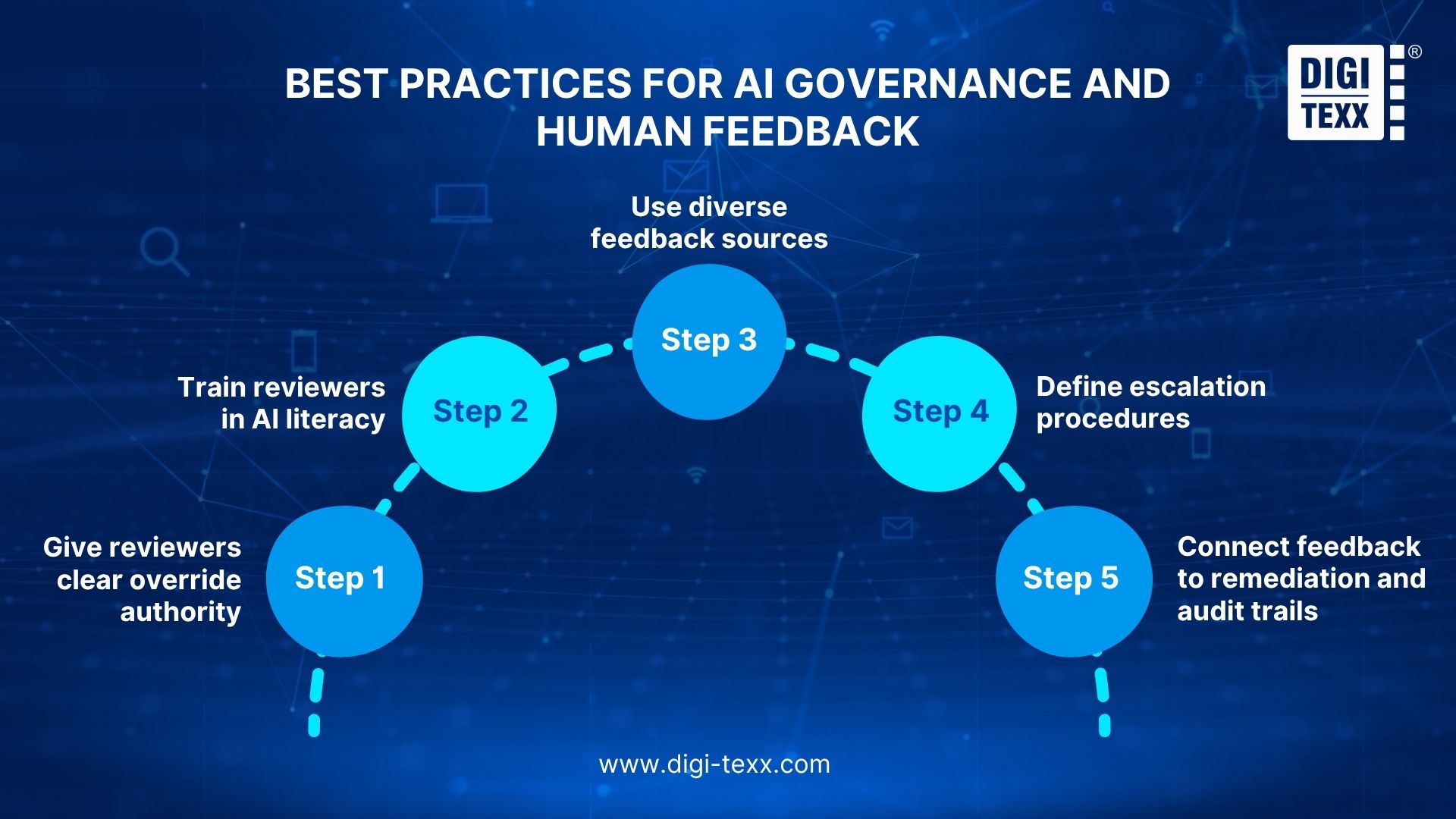
Effective human feedback requires clear authority, consistent evaluation, and a defined path from feedback to governance action.
- Give reviewers clear override authority: Reviewers should be able to reject, modify, or escalate AI outputs when predefined risk conditions are met. This prevents human oversight from becoming a rubber-stamping exercise.
- Train reviewers in AI literacy: Reviewers should understand the system’s capabilities, limitations, uncertainty, and common failure modes. Training should also address automation bias so reviewers can critically assess AI recommendations.
- Use diverse feedback sources: Combine feedback from users, operators, domain experts, and affected stakeholders where appropriate. Multiple perspectives can reveal contextual risks and unintended impacts that a single reviewer group may miss.
- Define escalation procedures: Establish clear thresholds for when feedback requires additional review, incident response, human intervention, or suspension of an AI function. Escalation criteria should reflect the severity and potential impact of the risk.
- Connect feedback to remediation and audit trails: Validated feedback should inform monitoring, risk assessment, and corrective actions rather than remain in a reporting queue. Record significant feedback, decisions, overrides, and remediation outcomes to support accountability and continuous improvement.
AI Governance Frameworks For Human Feedback
Different frameworks approach AI governance from different angles. The table below highlights how each one relates to human feedback, oversight, and risk management.
| Framework | Main role | Relevance to human feedback |
| NIST AI RMF | AI risk management | Uses feedback to identify, measure, and manage AI risks and improve system performance. |
| ISO/IEC 42001 | AI management system | Helps organizations establish processes for governing, monitoring, and continually improving AI systems. |
| EU AI Act | AI regulation | Requires effective human oversight for applicable high-risk AI systems, including the ability to monitor, intervene, and override AI outputs. |
These frameworks are not interchangeable. NIST AI RMF provides risk-management guidance, ISO/IEC 42001 provides requirements for an AI management system, while the EU AI Act establishes legally binding requirements within its applicable scope.
Despite their differences, they share a common principle: human input should lead to meaningful governance action. Feedback should be reviewed, documented, and connected to risk management, corrective actions, and continuous improvement rather than simply collected and stored.
FAQs About AI Governance And Human Feedback
What Is Human Feedback In AI Governance?
Human feedback is the evaluation, correction, judgment, or observations people provide about AI systems. It helps organizations identify risks, evaluate real-world performance, and improve AI behavior, controls, and governance processes.
What Is A Human Feedback Loop?
A human feedback loop is a process of collecting, reviewing, acting on, and evaluating human input about an AI system. It turns feedback into corrective actions, monitoring, and continuous system improvement rather than simply storing user comments or ratings.
What Is The Difference Between Human Feedback And Human Oversight?
Human feedback provides information about an AI system’s behavior, while human oversight gives people the authority and responsibility to monitor, assess, and control that system. Feedback can support oversight, but collecting feedback alone does not guarantee meaningful human control.
What Is The Difference Between HITL, HOTL, And HIC?
HITL involves humans directly reviewing or approving AI decisions. HOTL allows AI to operate while humans monitor and intervene when needed. HIC gives humans strategic authority over where, when, and why AI is deployed. The three represent different levels of human control.
Is RLHF Part Of AI Governance?
RLHF can support AI governance by using human judgments to improve model behavior during development. However, RLHF is a model-training technique, not a complete governance framework. AI governance also covers oversight, monitoring, risk management, accountability, and post-deployment controls.
Human feedback in AI governance is not simply about adding people to an AI workflow. It requires meaningful oversight, structured feedback, clear accountability, and corrective action throughout the AI lifecycle. By connecting human judgment with governance processes, organizations can build AI systems that are safer, more transparent, and accountable.
DIGI-TEXX Contact Information:
🌐 Website: https://digi-texx.com/
📞 Hotline: +84 28 3715 5325
✉️ Email: [email protected]
🏢 Address:
- Headquarters: Anna Building, QTSC, Trung My Tay Ward
- Office 1: German House, 33 Le Duan, Saigon Ward
- Office 2: DIGI-TEXX Building, 477-479 An Duong Vuong, Binh Phu Ward
- Office 3: Innovation Solution Center, ISC Hau Giang, 198 19 Thang 8 street, Vi Tan Ward
References
- European Commission. (2024). AI Act enters into force. European Commission. European Commission – AI Act
- National Institute of Standards and Technology. (2023). Artificial Intelligence Risk Management Framework (AI RMF 1.0). U.S. Department of Commerce. NIST AI Risk Management Framework
- National Institute of Standards and Technology. (2023). AI RMF Core. NIST AI RMF
- OECD. (2024). OECD AI Principles. Organisation for Economic Co-operation and Development. OECD AI Principles
- McKinsey & Company. (2025). The state of AI: How organizations are rewiring to capture value. McKinsey & Company