
Business verification services help companies confirm whether another business exists, is properly registered, and matches the information it provides. These services can check business registration, ownership, UBOs, tax information, sanctions, and other risk signals, often as part of broader data validation & verification processes.
This guide from DIGI-TEXX explains what business verification services are, how they differ from KYB, who needs them, what information they check, and why they matter. You will also learn how six providers compare and how enterprise data management can support reliable business data and verification workflows.
What Are Business Verification Services?
This section explains what business verification services are, how they differ from KYB, and which businesses can benefit from using them. You will learn what business verification involves, why it matters when working with other companies, and which industries commonly use these services.
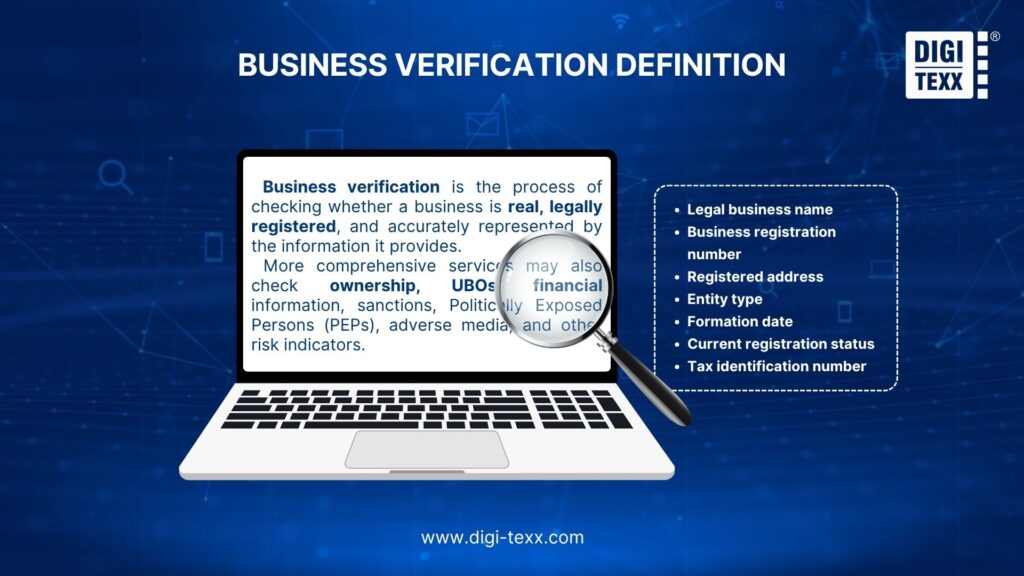
Business Verification Definition
Business verification is the process of checking whether a business is real, legally registered, and accurately represented by the information it provides.
A basic verification may check:
- Legal business name
- Business registration number
- Registered address
- Entity type
- Formation date
- Current registration status
- Tax identification number
More comprehensive services may also check ownership, UBOs, financial information, sanctions, Politically Exposed Persons (PEPs), adverse media, and other risk indicators.
For example, a payment platform may receive a merchant’s company name and registration number. A business verification service can compare those details with official records and flag mismatches for further review.
Important: verifying that a business exists does not automatically mean that the business is trustworthy or low-risk. Additional KYB, AML, sanctions, or financial checks may be required.
Business Verification Vs. KYB
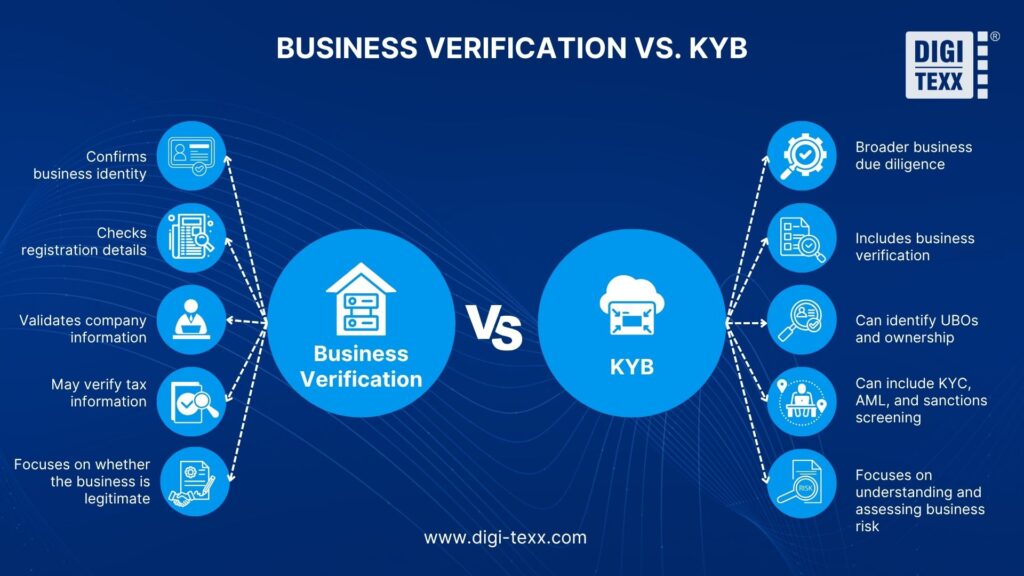
Business verification and Know Your Business (KYB) are closely connected but have different scopes.
| Business Verification | KYB |
| Confirms business identity | Broader business due diligence |
| Checks registration details | Includes business verification |
| Validates company information | Can identify UBOs and ownership |
| May verify tax information | Can include KYC, AML, and sanctions screening |
| Focuses on whether the business is legitimate | Focuses on understanding and assessing business risk |
A simple way to understand the relationship is:
-> Business verification = “Is this business real, registered, and accurately represented?”
-> KYB = “Who is this business, who controls it, and what risks does it present?”
Business verification is often one part of a broader KYB process.
Who Needs Business Verification?
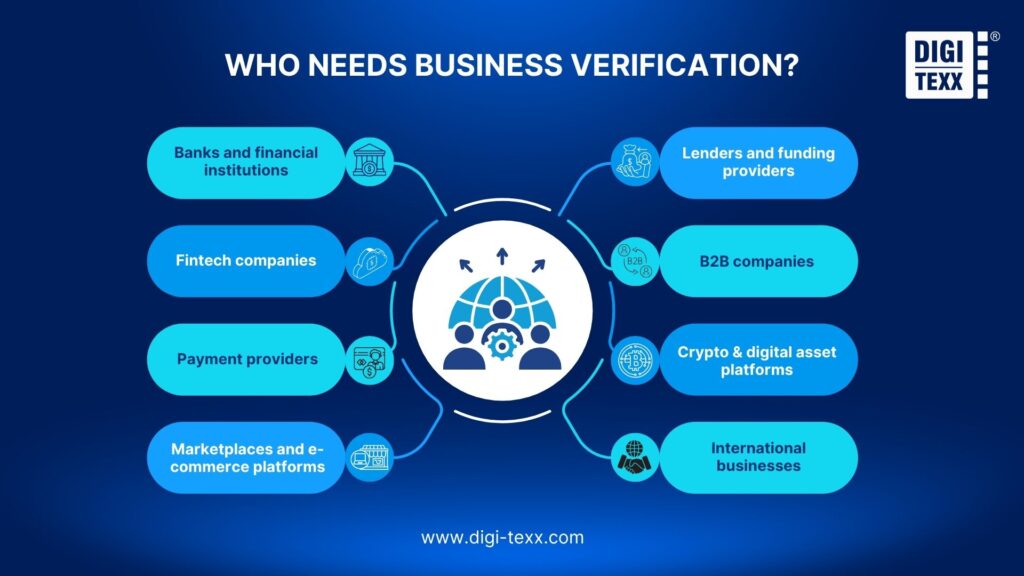
Business verification is useful for organizations that need to establish relationships with other companies while managing fraud, financial, or compliance risks.
Common users include:
- Banks and financial institutions: Verify commercial customers before providing financial services; support KYB and regulatory compliance processes.
- Fintech companies: Verify businesses during digital onboarding; combine KYB with KYC, AML, and fraud screening.
- Payment providers: Check merchants before processing payments or payouts; reduce exposure to fraudulent businesses.
- Marketplaces and e-commerce platforms: Verify sellers and partners; prevent fake or high-risk businesses from joining the platform.
- Lenders and funding providers: Verify borrowers before making funding decisions; assess business and financial information.
- B2B companies: Screen customers, suppliers, vendors, and partners; reduce third-party and supply chain risks.
- Crypto & digital asset platforms: Verify businesses and beneficial owners; support AML controls and financial crime prevention.
- International businesses: Verify companies across different countries; reduce the need for manual searches across multiple business registries.
Ultimately, these organizations share the same need: know who they are dealing with before allowing a business to enter or continue a commercial relationship.
>>> See more:
- What Is Automated Data Extraction? Guide, Benefits & Tools
- Business Process Automation Solutions: Top Tools, Benefits & Use Cases
- Data Cleaning: Definition, Benefits & Steps To Cleaning Data
Best Business Verification Services
The best business verification service depends on your business model, target markets, verification needs, and compliance requirements. Some providers focus on U.S. business data, while others are designed for global KYB, UBO verification, or broader KYC and AML workflows.
The comparison below highlights six providers based on their business verification capabilities, geographic coverage, ownership checks, compliance features, and integration options.
| Provider | Best For | Where It Stands Out | Main Verification Scope | Geographic Strength | Potential Limitation |
| Middesk | U.S. business verification | Deep focus on U.S. business identity and government data | Business identity, TIN, registration, ownership, sanctions, adverse media | 🇺🇸 U.S. | Less suitable when broad international coverage is the priority |
| Trulioo | Global KYB | Strong cross-border business and UBO verification | Business identity, registries, UBO, KYC/KYB, risk signals, monitoring | 🌎 Global | May be more than needed for businesses operating only in one market |
| Persona | Flexible KYB/KYC workflows | Highly configurable onboarding and verification flows | Registry, tax ID, documents, UBO, watchlists, adverse media | 🌎 150+ countries* | Better suited to configurable workflows than narrowly focused business-data use cases |
| Sumsub | End-to-end compliance | Combines KYB with KYC, AML and manual review | Registry, documents, ownership, UBO, KYC, AML | 🌎 Global | May be broader than necessary for basic business verification |
| Alloy | Fintech risk orchestration | Connects KYB with fraud, identity and risk decisioning | KYB, UBO, KYC, AML, fraud, ongoing monitoring | 🌎 Multi-market | More relevant to complex financial-services workflows than simple KYB |
| iDenfy | API-driven KYB | Combines business verification with financial and credit data | Registration, UBO, ownership, financial, credit, AML | 🌎 Global | May be less specialized for U.S.-only business verification |
1. Middesk
Company Information
| Founded | 2019 |
| Headquarters | United States |
| Primary Market | United States |
| Core Offering | Business verification & KYB |
| Verification Model | API-based business verification |
| Key Data | Business identity, TIN, ownership & risk data |
| Pricing | Custom quotation |
| Website | middesk.com |
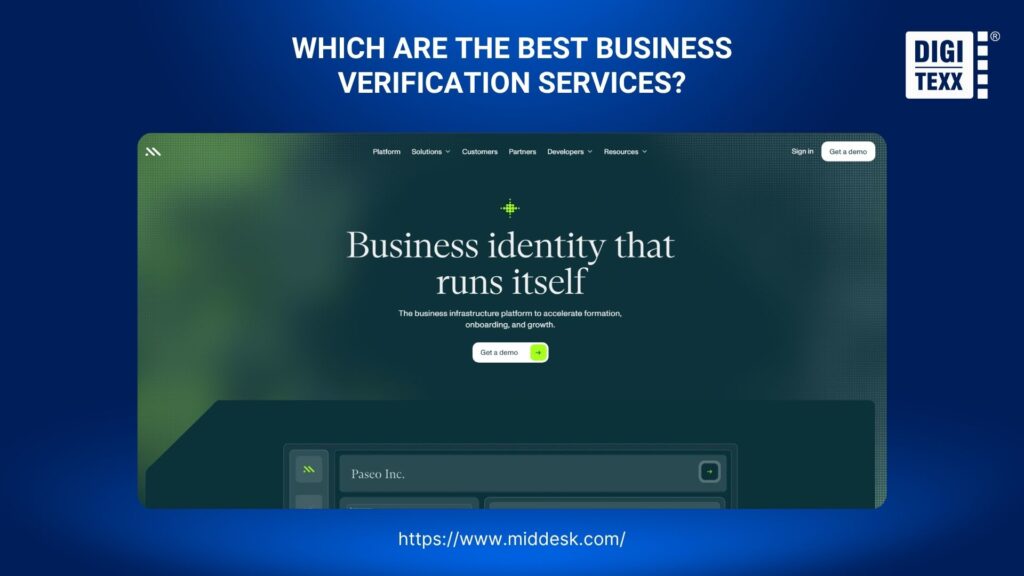
Middesk is a U.S.-focused business verification and Know Your Business (KYB) provider that helps organizations verify commercial entities before onboarding, lending, account approval, or marketplace participation. Its platform is designed around the needs of businesses that need reliable information about U.S. companies, including business identity, registration details, tax identification information, ownership, and risk indicators.
Unlike global KYB platforms that prioritize broad international coverage, Middesk focuses heavily on U.S. business data and verification workflows. Its platform can combine business identity verification with TIN verification, business name and address checks, ownership verification, sanctions screening, adverse media searches, and KYC checks for people associated with a business. This makes it useful for organizations that need to move from initial application to a verification or risk decision within an automated workflow.
Middesk also emphasizes the use of primary business data sources, including government records, supplemented by additional data and network signals when primary information is unavailable. This approach can help organizations verify whether a business exists, confirm key company information, and identify potential risk before completing onboarding.
Why We Picked It: Middesk stands out for its deep focus on U.S. business verification. While many KYB providers compete on global coverage, Middesk is particularly relevant for companies whose customer base is concentrated in the United States. Its combination of business identity, tax, ownership, and risk checks also makes it more than a basic business registry lookup. The API-based approach allows companies to integrate verification into automated onboarding, underwriting, lending, and marketplace workflows.
Services Offered:
- Business Identity Verification
- Business Registration Verification
- TIN Verification
- Business Name & Address Verification
- Ownership Verification
- Associated-Person KYC
- Sanctions Screening
- Adverse Media Screening
- Enhanced Business Screening
- Business Risk Assessment
- Automated KYB Workflows
- API-Based Verification
- Application-to-Decision Workflows
Key Use Cases:
- Business Onboarding
- Commercial Lending
- Fintech Account Opening
- Marketplace Seller Verification
- B2B Customer Verification
- Merchant Onboarding
- Business Risk Assessment
- Automated KYB Compliance
Best For: U.S.-focused fintechs, lenders, marketplaces, B2B platforms, and financial services companies that need automated business verification with detailed U.S. commercial entity data.
2. Trulioo
Company Information
| Founded | 2011 |
| Headquarters | Canada |
| Primary Market | Global |
| Core Offering | Global identity & business verification |
| Verification Model | API-based digital verification |
| Key Data | Business identity, registration, ownership, UBO & risk data |
| Pricing | Custom quotation |
| Website | trulioo.com |
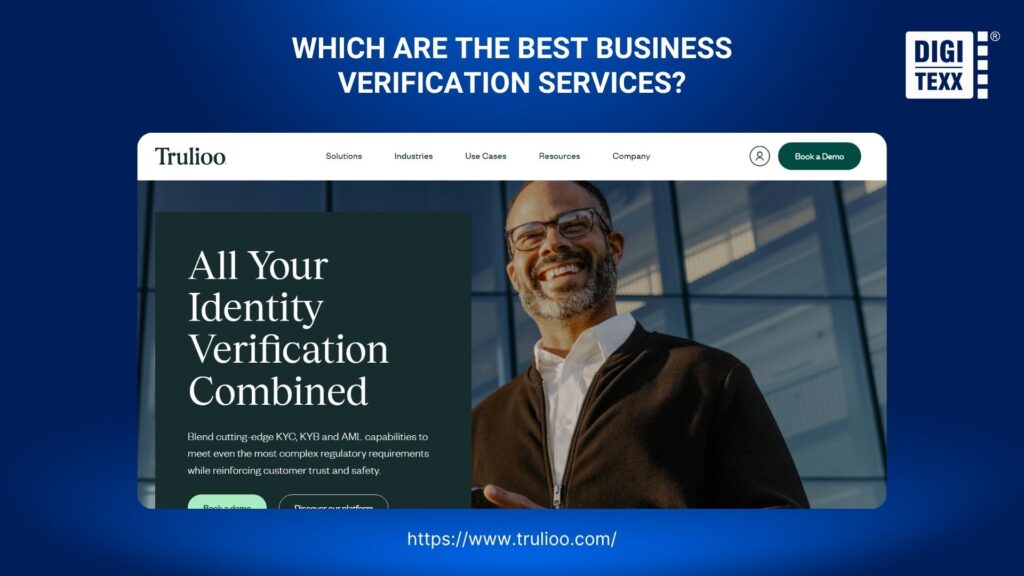
Trulioo is a global business verification and Know Your Business (KYB) provider that helps organizations verify companies, business owners, and ultimate beneficial owners (UBOs) across multiple jurisdictions. Its platform is designed for businesses that need to validate commercial entities during onboarding, compliance, risk assessment, and other workflows where accurate business and ownership information is required.
Unlike providers focused primarily on a single market, Trulioo emphasizes global business verification and cross-border coverage. Its KYB capabilities combine business registry information with ownership data, UBO identification, KYC, risk signals, and compliance workflows. This allows organizations to move beyond basic company verification and assess both the business entity and the individuals behind it within a connected verification process.
Trulioo also supports business verification across a broad range of jurisdictions and business registration formats. Its platform can connect organizations with government registries and other data sources to verify business identity, investigate ownership structures, and generate documentation that can support compliance and audit requirements. Ongoing monitoring capabilities can also help businesses identify relevant changes or risks after the initial onboarding process.
Why We Picked It: Trulioo stands out for its strong international business verification capabilities. Its ability to combine business verification with individual identity checks, UBO discovery, ownership structure analysis, and risk signals makes it particularly valuable for organizations operating across multiple jurisdictions. The API-based model also enables companies to integrate KYB and KYC checks into automated onboarding and compliance workflows rather than relying entirely on manual verification.
Services Offered:
- Business Identity Verification
- Business Registration Verification
- Business Registry Searches
- UBO Identification & Verification
- Ownership Structure Mapping
- Business & Individual KYC
- KYB Workflows
- Risk & Fraud Screening
- Compliance Verification
- Audit-Ready Reports
- Ongoing Business Monitoring
- API-Based Verification
- Automated Verification Workflows
Key Use Cases:
- Global Business Onboarding
- Cross-Border Customer Verification
- Fintech Compliance
- Marketplace Seller Verification
- Payment Provider Onboarding
- B2B Customer Verification
- UBO Verification
- Ownership Structure Analysis
- Business Risk Assessment
- Automated KYB & KYC Compliance
Best For: Global fintechs, payment companies, marketplaces, financial institutions, and enterprises that need to verify businesses and their owners across multiple countries and jurisdictions. Trulioo is particularly suitable for organizations that require international coverage and want business, UBO, KYC, and risk verification within a connected compliance workflow.
3. Persona
Company Information
| Founded | 2018 |
| Headquarters | United States |
| Primary Market | Global |
| Core Offering | Business & identity verification |
| Verification Model | API-based configurable verification workflows |
| Key Data | Business identity, tax data, documents, UBO & risk data |
| Pricing | Custom quotation |
| Website | withpersona.com |
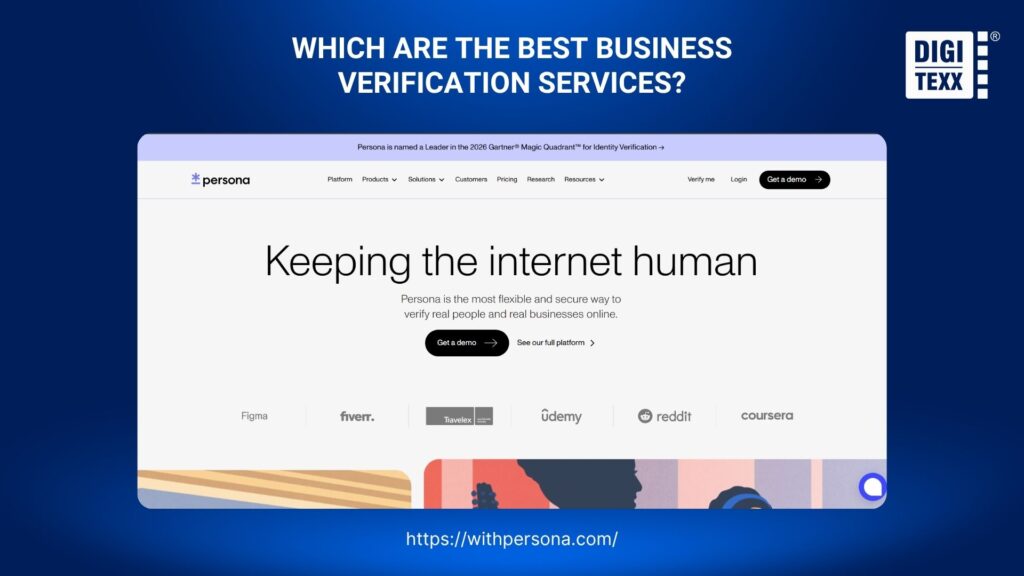
Persona is a global Know Your Business (KYB) and Know Your Customer (KYC) provider that helps organizations verify businesses and the individuals associated with them through a unified identity and compliance platform. Its approach is particularly relevant for organizations that need to evaluate both a commercial entity and its owners, directors, or other associated individuals during onboarding and risk assessment.
Unlike providers that focus primarily on business registry verification, Persona combines business verification with identity verification and configurable compliance workflows. Its KYB capabilities can include business registry checks, tax number verification, business document verification, UBO identification, watchlist screening, adverse media screening, and online credibility checks. This enables organizations to build verification processes around their specific onboarding and compliance requirements rather than relying on a single standardized check.
Persona also emphasizes flexible, configurable workflows that allow businesses to determine which verification steps are required for different customer types, risk levels, or markets. Its platform supports international business verification across more than 150 countries and provides multiple business and UBO data points for supported checks. This flexibility can be particularly useful for organizations operating different onboarding flows across markets or customer segments.
Why We Picked It: Persona stands out for its configurable combination of KYB and KYC capabilities. Rather than treating business verification and individual identity verification as separate processes, its platform enables organizations to connect company verification with UBO and person-level checks within a single workflow. Its international coverage and customizable verification logic also make it suitable for businesses that need different compliance processes depending on jurisdiction, business type, or risk profile.
Services Offered:
- Business Identity Verification
- Business Registry Verification
- Tax Number Verification
- Business Document Verification
- UBO Identification & Verification
- Ownership Verification
- Individual Identity Verification
- KYC & KYB Workflows
- Watchlist Screening
- Sanctions Screening
- Adverse Media Screening
- Online Credibility Checks
- Business Risk Assessment
- Configurable Verification Workflows
- API-Based Verification
Key Use Cases:
- Global Business Onboarding
- KYB & KYC Compliance
- UBO Verification
- B2B Customer Verification
- Marketplace Seller Onboarding
- Fintech Customer Onboarding
- Financial Services Compliance
- Cross-Border Business Verification
- Risk-Based Customer Screening
- Automated Compliance Workflows
Best For: Global fintechs, marketplaces, financial institutions, and enterprises that need configurable KYB and KYC workflows for verifying both businesses and the people behind them. Persona is particularly well suited to organizations that require flexible verification logic across different markets, customer segments, and risk profiles.
>>> See more:
- Best Data Cleansing Outsourcing Companies for 2026
- Best Data Conversion Services in 2026 | DIGI-TEXX
- Top 10 Data Enrichment Tools To Improve Data Quality In 2026
4. Sumsub
Company Information
| Founded | 2015 |
| Headquarters | United Kingdom |
| Primary Market | Global |
| Core Offering | KYB, KYC & compliance verification |
| Verification Model | Automated and expert-assisted verification |
| Key Data | Corporate registry, company documents, ownership, UBO & AML data |
| Pricing | Custom quotation |
| Website | sumsub.com |
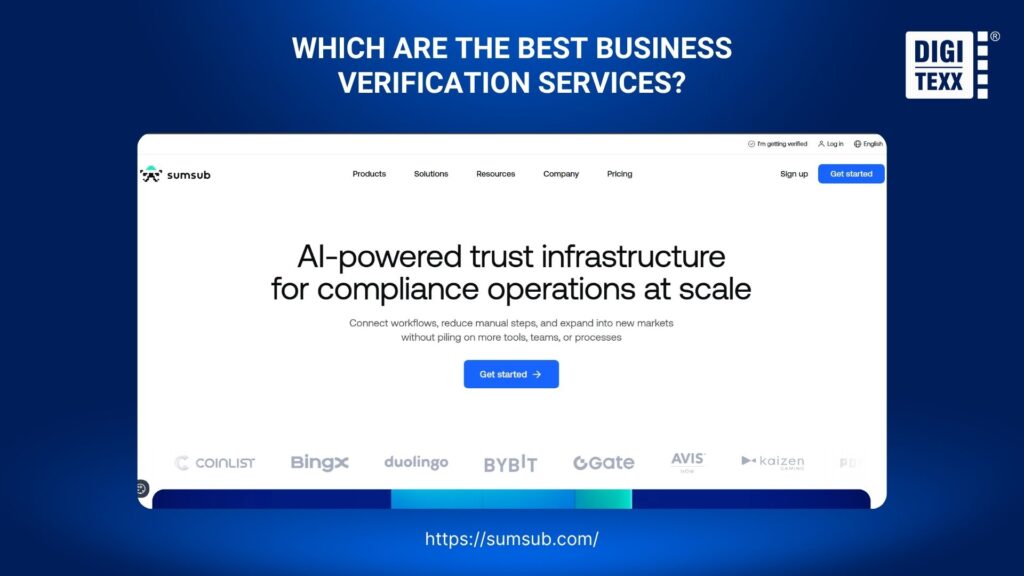
Sumsub is a global Know Your Business (KYB), Know Your Customer (KYC), and compliance provider that helps organizations verify companies, ownership structures, and associated individuals as part of broader onboarding and risk management workflows. Its platform is designed for businesses that need to combine corporate verification with AML screening and identity checks rather than relying on a basic business registry lookup.
Unlike providers that primarily focus on retrieving company registration information, Sumsub approaches KYB as a multi-stage compliance workflow. Its capabilities can include automated corporate registry checks, company document verification, ownership and management structure checks, UBO identification and verification, AML screening, and KYC for individuals associated with a business. This allows organizations to evaluate both the legal entity and the people behind it within a connected verification process.
Sumsub also supports a combination of automated and expert-assisted verification. Depending on the complexity of a case or the organization’s risk requirements, businesses can use automated checks alongside manual review. Its integration options include APIs, WebSDK, a dashboard, and verification links, giving organizations flexibility in how KYB and compliance processes are incorporated into existing onboarding systems.
Why We Picked It: Sumsub stands out for its end-to-end approach to KYB and compliance. Its ability to connect corporate registry verification, document review, ownership analysis, UBO verification, AML screening, and individual KYC makes it particularly relevant for organizations with complex or regulated onboarding requirements. The combination of automated checks and expert-assisted review also provides flexibility when standard automated verification is insufficient.
Services Offered:
- Corporate Registry Verification
- Business Identity Verification
- Company Document Verification
- Ownership Structure Verification
- Management Structure Checks
- UBO Identification & Verification
- Beneficiary Identification
- Associated-Person KYC
- AML Screening
- Sanctions & Watchlist Screening
- Automated KYB Verification
- Manual & Expert-Assisted Review
- API-Based Integration
- WebSDK Integration
- Verification Dashboard
- Verification Links
Key Use Cases:
- Business Onboarding
- Fintech KYB & KYC
- Marketplace Seller Verification
- Crypto Business Verification
- Financial Services Compliance
- UBO Verification
- Complex Ownership Structure Analysis
- AML Compliance
- Regulated Business Onboarding
- High-Risk Customer Verification
- Automated Compliance Workflows
Best For: Fintechs, marketplaces, crypto businesses, financial institutions, and other regulated or compliance-heavy organizations that need end-to-end KYB workflows combining business verification, ownership checks, UBO verification, AML screening, and associated-person KYC. Sumsub is particularly suitable when organizations need both automated verification and expert-assisted review within the same compliance workflow.
5. Alloy
Company Information
| Founded | 2019 |
| Headquarters | United States |
| Primary Market | Global |
| Core Offering | Identity, KYB & risk decisioning |
| Verification Model | API-based identity and risk orchestration |
| Key Data | Business identity, UBO, KYC, AML, fraud & risk data |
| Pricing | Custom quotation |
| Website | alloy.com |
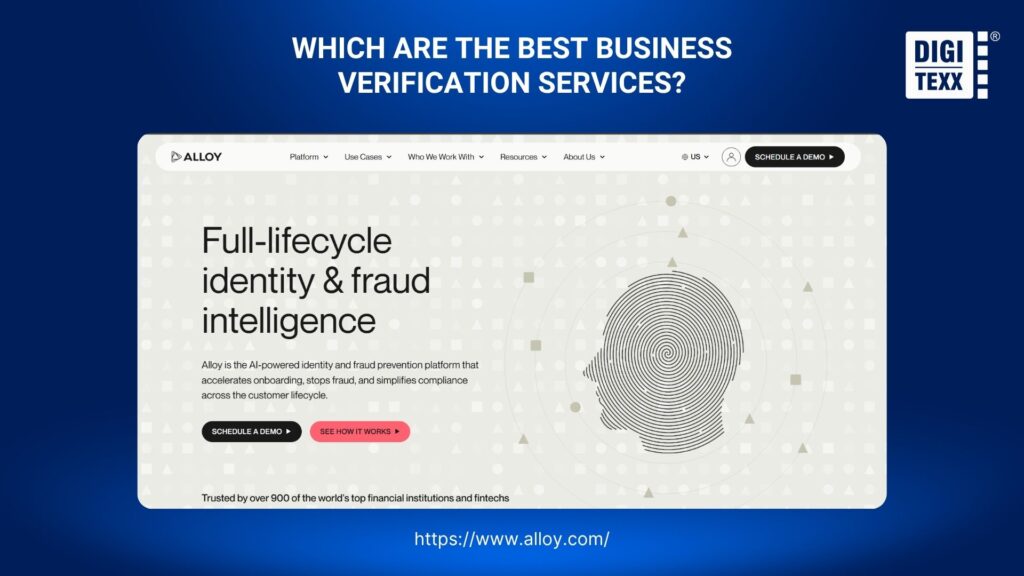
Alloy is an identity and risk management platform that helps fintechs, banks, lenders, and financial institutions integrate business verification into broader onboarding, fraud prevention, and risk decisioning workflows. Rather than positioning KYB as an isolated company lookup, Alloy connects business and identity verification with the controls organizations need to assess applicants and make automated risk decisions.
Its KYB capabilities can combine business entity verification, UBO verification, KYC, AML screening, fraud checks, and risk decisioning within a unified workflow. This enables financial institutions to assess a business alongside its owners and associated individuals while applying additional fraud and compliance controls before approving an account, application, or financial product.
Alloy also emphasizes ongoing identity and risk monitoring through perpetual KYC and KYB capabilities. Instead of relying solely on a one-time verification performed during onboarding or periodic reviews, organizations can continuously update customer profiles and respond to changes in identity or risk information. This approach can be valuable for financial institutions managing large customer bases where risk conditions can change after initial approval.
Why We Picked It: Alloy stands out for its combination of KYB, identity verification, fraud prevention, and automated risk decisioning. Its value extends beyond verifying whether a business exists by connecting business and UBO checks with broader financial crime and risk controls. The addition of ongoing KYC/KYB monitoring makes it particularly relevant for financial institutions that need to maintain accurate risk profiles throughout the customer lifecycle rather than only at onboarding.
Services Offered:
- Business Entity Verification
- Business Identity Verification
- UBO Verification
- KYC Verification
- AML Screening
- Fraud Detection & Prevention
- Risk Decisioning
- Identity Verification
- Customer Risk Assessment
- Ongoing KYC Monitoring
- Ongoing KYB Monitoring
- Perpetual KYC & KYB
- Automated Verification Workflows
- Risk Orchestration
- API-Based Integration
Key Use Cases:
- Financial Institution Onboarding
- Fintech Business Onboarding
- Commercial Lending
- Business Account Opening
- KYB & KYC Compliance
- UBO Verification
- AML Compliance
- Fraud Prevention
- Automated Risk Decisioning
- Continuous Customer Monitoring
- Business Risk Assessment
- Financial Crime Risk Management
Best For: Banks, fintechs, lenders, and financial institutions that need to integrate KYB with KYC, AML, fraud prevention, and automated risk decisioning. Alloy is particularly suitable for organizations that require a broader risk orchestration platform and ongoing monitoring rather than standalone business verification.
6. iDenfy
Company Information
| Founded | 2017 |
| Headquarters | Lithuania |
| Primary Market | Global |
| Core Offering | Business verification, KYC & AML compliance |
| Verification Model | API-based automated verification |
| Key Data | Business registration, ownership, UBO, credit & financial data |
| Pricing | Custom quotation |
| Website | idenfy.com |
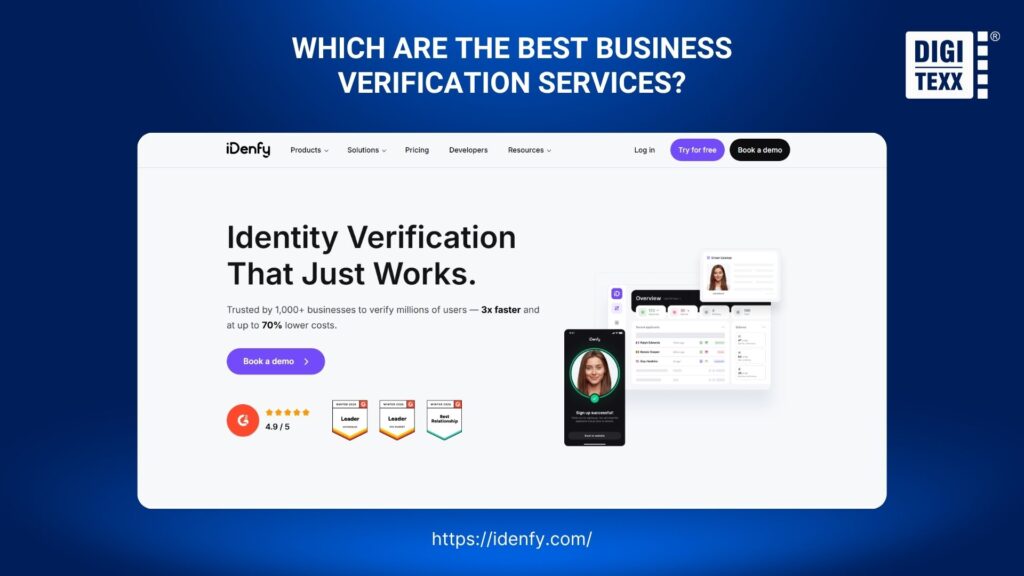
iDenfy is a global business verification, Know Your Business (KYB), KYC, and AML compliance provider that helps organizations verify companies, ownership structures, financial information, and associated individuals through automated workflows. Its platform is designed for businesses that need to combine corporate verification with financial and compliance data as part of onboarding and ongoing risk management.
Unlike providers that focus primarily on company registration data, iDenfy combines business identity and registration checks with ownership, UBO, credit, financial, and compliance information. Its platform provides access to more than 200 million companies, 180 business registries, and four major credit bureaus, enabling organizations to evaluate not only whether a business is legitimate but also relevant financial and risk characteristics.
iDenfy also supports customizable KYB workflows and continuous monitoring. Its perpetual KYB capabilities can monitor businesses for changes while incorporating AML screening, PEP and sanctions checks, adverse media screening, and custom risk profiles. Organizations can access these capabilities through APIs and a centralized dashboard, allowing verification and monitoring processes to be integrated into existing compliance operations.
Why We Picked It: iDenfy stands out for its broad combination of business, ownership, credit, financial, and compliance data. Its API-first approach makes it suitable for organizations that want to automate KYB checks while retaining control over verification rules and risk profiles. The combination of UBO verification, credit information, AML screening, and ongoing monitoring also makes iDenfy more comprehensive than a basic business registry verification service.
Services Offered:
- Business Registration Verification
- Business Identity Verification
- Ownership Verification
- UBO Identification & Verification
- Business Credit Information
- Credit Rating Checks
- Financial Information Verification
- Business Data Verification
- Identity Verification
- AML Screening
- PEP Screening
- Sanctions Screening
- Adverse Media Screening
- Custom Risk Profiles
- Custom KYB Verification Rules
- Perpetual KYB Monitoring
- Automated Verification Workflows
- Audit Logs
- API-Based Integration
- Verification Dashboard
Key Use Cases:
- Business Onboarding
- KYB Compliance
- B2B Customer Verification
- Marketplace Seller Verification
- Fintech Onboarding
- Financial Risk Assessment
- UBO Verification
- Business Credit Assessment
- AML Compliance
- PEP & Sanctions Screening
- Ongoing Business Monitoring
- Automated KYB Workflows
- Business Financial Due Diligence
Best For: Fintechs, marketplaces, B2B platforms, financial services companies, and enterprises that need business verification combined with ownership, credit, financial, AML, and identity data. iDenfy is particularly suitable for organizations looking for an API-driven KYB platform with customizable verification rules and ongoing monitoring capabilities.
>>> See more:
- Top 10 Data Entry Outsourcing Companies to Hire in 2026
- 14 Data Entry Skills Hiring Managers Look For In 2026
- Top 10 Data Extraction Tools to Automate Your Workflow
What Do Business Verification Services Check?
Business verification services check different types of business data to confirm that a company is legitimate and assess potential risks. This section covers the main information providers may verify, from registration and ownership details to tax, financial, compliance, and ongoing business changes.
Business Registration And Legal Information
Business verification services first check whether a company is legally registered and whether its basic information matches reliable business records.
Common information includes:
- Legal business name
- Business registration number
- Business address
- Entity type
- Incorporation or formation date
- Registration status
- State or country of registration
- Registered agent or representative, where available
These checks help identify issues such as incorrect company details, inactive businesses, or registration information that does not match what the company submitted.

Ownership And UBO Information
Business verification can also examine who owns and controls a company. This is important because the registered business name may not show the individuals who ultimately control the organization.
Providers may verify:
- Direct shareholders
- Indirect owners
- Ownership percentages
- Directors and officers
- Parent companies
- Ultimate Beneficial Owners (UBOs)
- Ownership and control structures
UBO refers to the individual who ultimately owns or controls a business, directly or indirectly. Identifying UBOs can help organizations understand who is behind a company and support broader KYB and compliance checks.

Tax And Financial Information
Some business verification services check tax and financial information to provide a more complete view of a company’s identity and financial profile. Some providers can also verify tax identifiers and provide access to financial or credit data.
Depending on the provider and country, checks may include:
- Tax Identification Number (TIN)
- Employer Identification Number (EIN)
- VAT number
- Credit information
- Financial reports
- Bankruptcy or insolvency records
- Liens or judgments
- Other commercial or financial data
Tax verification can help identify inconsistencies between the information provided by a business and external records. Financial data can also support lending, underwriting, supplier screening, and other business decisions.

AML, Sanctions, And Risk Screening
A company can be legally registered and still present financial or compliance risks. Business verification services may therefore combine company checks with AML, sanctions, and risk screening.
Depending on the provider, screening may cover:
- Sanctions lists
- Politically Exposed Persons (PEPs)
- Adverse media
- AML risk indicators
- Regulatory enforcement records
- Fraud indicators
- Other business or individual risk signals
These checks can help organizations identify businesses or associated individuals that require additional investigation before onboarding or continuing a relationship.

Ongoing Business Changes
Business information can change after the initial verification. A company may change its ownership, address, directors, registration status, or risk profile.
Ongoing monitoring can help organizations detect changes such as:
- New owners or UBOs
- Changes in directors or officers
- Address changes
- Changes in registration status
- Corporate structure changes
- New sanctions or risk indicators
- Relevant adverse media
This allows companies to move beyond one-time verification and monitor important changes throughout the business relationship.
For organizations working with large numbers of businesses, ongoing monitoring can help keep KYB information current and trigger additional review when a company’s risk profile changes.

>>> See more:
- Accounts Payable Outsourcing: How It Works, Benefits & Top Providers
- Best Administrative Support Outsourcing Services In 2026
- AI In Investing: What Every Investor Needs To Know
Why Are Business Verification Services Important?
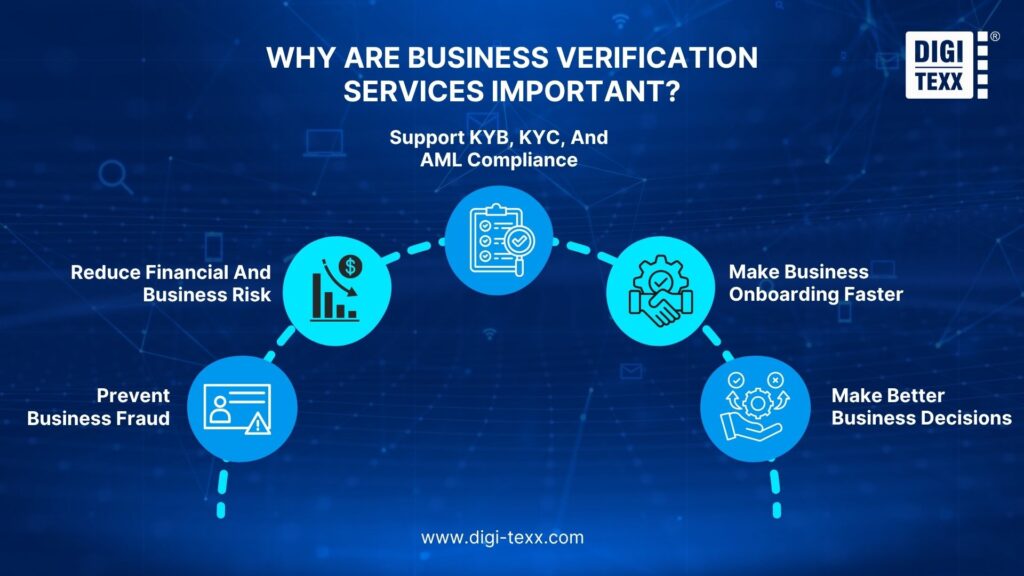
Business verification services help organizations confirm who they are working with before establishing or continuing a business relationship. By combining business data, ownership information, compliance checks, and automation, these services can help reduce fraud, manage risk, support compliance, and make business onboarding more efficient.
Prevent Business Fraud
Business fraud can involve fake companies, stolen business identities, fraudulent merchants, or misleading company information. Verification helps organizations identify inconsistencies before they result in financial or operational losses.
Business verification can help detect:
- Businesses that cannot be found in official records
- Incorrect registration numbers or company names
- Inactive or dissolved companies
- Suspicious ownership information
- Inconsistent business addresses
- Risk signals linked to owners or representatives
These checks do not eliminate fraud, but they can help organizations identify suspicious businesses earlier and determine when additional review is necessary.
Reduce Financial And Business Risk
Every business relationship can create some level of financial or operational risk. This is particularly important for organizations that provide credit, process payments, onboard merchants, or work with suppliers.
Business verification can support risk management by helping organizations:
- Validate business identity before onboarding
- Understand ownership and control structures
- Review financial or credit information
- Identify sanctions and other risk signals
- Assess potential customers, suppliers, or partners
- Apply additional checks to higher-risk businesses
Better business data allows teams to make more informed decisions about who they work with and what level of due diligence is appropriate.
Support KYB, KYC, And AML Compliance
Business verification can support broader KYB, KYC, and Anti-Money Laundering (AML) processes.
Business verification focuses primarily on the company, while KYC generally focuses on individuals such as owners, directors, or authorized representatives.
These checks can help organizations identify potential compliance issues and maintain appropriate records for regulatory and internal risk-management processes.
However, using a business verification service does not automatically make an organization compliant. Businesses still need to establish appropriate policies, controls, review procedures, and regulatory processes based on their industry and jurisdiction.
Make Business Onboarding Faster
Traditional business verification often requires employees to manually search registries, review documents, check ownership structures, and perform compliance screening.
This can become difficult when a company needs to onboard hundreds or thousands of businesses.
Automated verification services can help by:
- Collecting business information digitally
- Checking external databases automatically
- Matching submitted information with business records
- Identifying ownership and UBO information
- Running compliance screening
- Flagging potential issues for manual review
- Storing verification results and audit trails
This allows businesses to reduce repetitive manual work while keeping human review available for complex or high-risk cases.
Make Better Business Decisions
The ultimate purpose of business verification is not simply to collect information. It is to give organizations better information for making decisions.
Verification results can help teams decide whether to:
- Approve: The business passes the required checks.
- Reject: The business fails a defined requirement.
- Review: Potential risks require manual investigation.
- Request more information: Additional documents or data are needed.
For example, a marketplace may approve a seller after successful verification, while a financial institution may request enhanced due diligence when an ownership or sanctions check raises a concern.
By turning business data into actionable risk information, business verification services help organizations make more consistent decisions while reducing unnecessary manual work.
>>> See more:
- Construction Invoice Reconciliation: Process, Best Practices & Software 2026
- Top 10 Data Cleansing Companies for Businesses in 2026
- 10 Essential Data Cleaning Techniques for Better Data Quality
How To Choose The Right Business Verification Service?
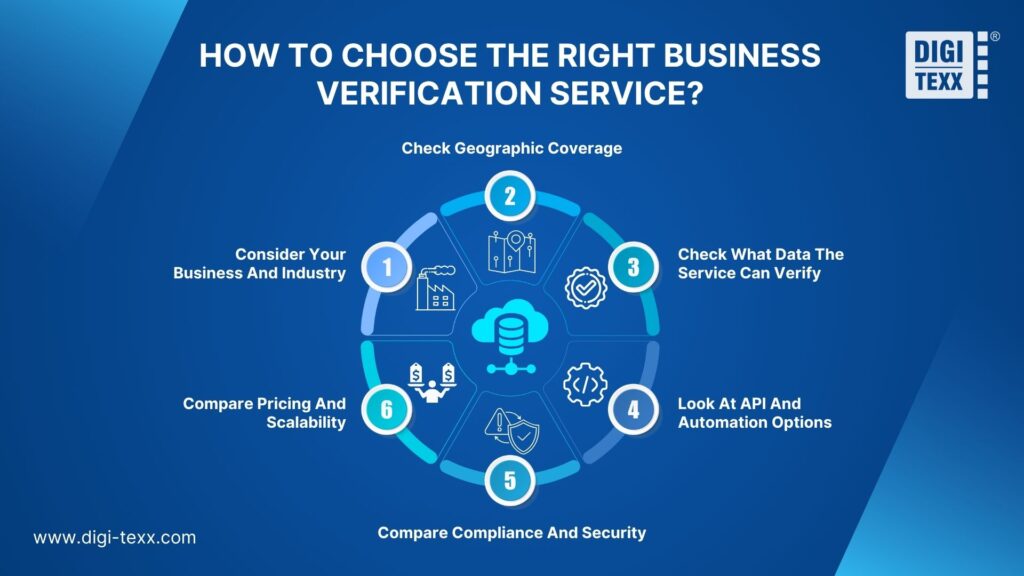
The right business verification service depends on your business model, target markets, verification requirements, and expected onboarding volume. Before choosing a provider, compare its data coverage, compliance capabilities, integration options, pricing, and ability to scale with your business.
Consider Your Business And Industry
Start by identifying why you need business verification and what types of businesses you need to verify. Different industries can have different risk levels, regulatory requirements, and verification workflows.
Consider:
- Fintech and banking: KYB, KYC, UBO, AML, sanctions, and ongoing monitoring
- Payment providers: Merchant verification, fraud prevention, and risk screening
- Marketplaces: Seller verification and business identity checks
- Lenders: Business identity, ownership, financial, and credit information
- B2B companies: Customer, supplier, and partner verification
- Crypto businesses: KYB, KYC, AML, sanctions, and transaction-related risk controls
Choose a provider whose capabilities match your actual compliance and operational requirements rather than paying for features you do not need.
Check Geographic Coverage
Business registration and compliance data vary significantly between countries. A provider that performs well in one market may not provide the same depth of data elsewhere.
Check whether the provider supports:
- Your target countries
- Relevant business registries
- Local registration numbers
- Tax identification systems
- Ownership and UBO data
- Local sanctions and compliance sources
- Multiple languages and document types, where necessary
If you operate internationally, prioritize providers with broad coverage and reliable data sources in the specific countries where you onboard businesses.
Check What Data The Service Can Verify
Do not evaluate providers based only on the number of countries they cover. Data depth and verification quality are equally important.
Check whether the service can verify:
- Business name and registration number
- Business status and address
- Incorporation details
- Tax identification numbers
- Ownership and UBO information
- Directors and officers
- Business documents
- Credit and financial information
- Sanctions and PEP data
- Adverse media
- Fraud and red flags
Also determine whether the provider obtains information from official registries, commercial databases, or other third-party sources. The right data sources depend on your risk level and verification requirements.
>>> See more:
- 20 Best Data Integration Tools: Definition, Benefits & Features
- What Is Data Integrity? Why It Matters, Types & Best Practices
- Data Quality Dimensions: 6 Core Metrics And Automation Guide
Look At API And Automation Options
If you verify a large number of businesses, manual checks can become slow and difficult to scale. API and automation capabilities allow verification to become part of your existing onboarding or compliance workflow.
Look for:
- REST API or other integration options
- Webhooks
- SDKs
- Automated verification workflows
- No-code or low-code options
- Custom verification rules
- Automated risk decisions
- Manual review for exceptions
- Audit logs and verification results
For example, a fintech could automatically trigger KYB when a new business submits an application, then route only failed or high-risk cases to a compliance team.
Compare Compliance And Security
Business verification involves sensitive corporate, ownership, tax, and identity information. Security and compliance should therefore be evaluated alongside verification capabilities.
Consider:
- Data encryption
- Access controls
- Data retention policies
- Audit trails
- Privacy requirements
- Relevant security certifications
- Regulatory support
- Data residency requirements
- Vendor security and risk assessments
You should also determine whether the provider supports the regulations relevant to your business and jurisdiction. A verification platform can support compliance processes, but it does not replace your organization’s own compliance policies and controls.
Compare Pricing And Scalability
Pricing models can vary considerably between providers. Some may charge based on verification volume, while others may use custom pricing based on features, markets, or business size.
Before making a decision, compare:
- Cost per verification
- Monthly or annual platform fees
- API usage costs
- Minimum usage commitments
- Additional charges for AML or UBO checks
- Manual review fees
- International verification costs
- Implementation costs
- Enterprise support
Also consider how pricing changes as your verification volume increases.
A provider that is affordable at 500 verifications per month may become expensive at 50,000. Look beyond the initial price and evaluate the total cost of ownership, verification quality, automation, and scalability over the long term.
>>> See more:
- Data Quality Framework in Practice: Templates, Tools, and Real Use Cases
- Top 8 Data Quality Issues and Solutions
- Top 10 Data Security Software Solutions for Enterprises
FAQs About Business Verification Services
What Is The Best Way To Verify A Business?
The best way to verify a business is to check its registration details against official business registries, then review ownership, UBO, tax, sanctions, and other risk information. For higher-risk businesses, automated business verification services can combine multiple data sources and streamline the process.
How Can I Get My Business Verified?
To get your business verified, provide accurate company information such as your legal name, registration number, registered address, and tax identification number. Depending on the provider, you may also need to submit incorporation documents, ownership details, or information about directors and UBOs.
How Can I Verify If A Business Is Legitimate?
To verify whether a business is legitimate, check its registration status through an official government registry and confirm that its name, address, registration number, and ownership details match. You can also check tax information, sanctions lists, UBOs, and adverse media for additional risk signals.
Is Google Business Verification Free?
Yes. Google Business Profile verification is free through Google. However, it is different from business verification or KYB services, which are used to verify companies for compliance, fraud prevention, and business risk management. Be cautious of third parties claiming to be Google and charging for Google Business Profile verification.
How Much Do Business Verification Services Cost?
The cost varies by provider, verification volume, geographic coverage, data sources, and features. Some providers charge per verification, while others offer custom pricing or subscription-based plans. Additional checks such as UBO verification, AML screening, sanctions screening, or ongoing monitoring may also affect the total cost.
Choosing the right business verification services depends on your industry, target markets, data requirements, compliance needs, and business scale. While dedicated KYB providers can automate complex verification and risk checks, some organizations may also need operational support for validating and managing business data at scale.
DIGI-TEXX provides data verification services and business support services to help businesses handle verification-related data and processes more efficiently. Explore DIGI-TEXX’s services to find the right support for your business needs.
DIGI-TEXX Contact Information:
🌐 Website: https://digi-texx.com/
📞 Hotline: +84 28 3715 5325
✉️ Email: [email protected]
🏢 Address:
- Headquarters: Anna Building, QTSC, Trung My Tay Ward
- Office 1: German House, 33 Le Duan, Saigon Ward
- Office 2: DIGI-TEXX Building, 477-479 An Duong Vuong, Binh Phu Ward
- Office 3: Innovation Solution Center, ISC Hau Giang, 198 19 Thang 8 street, Vi Tan Ward
References
- Google. (n.d.). Verify your business on Google. Google Business Profile Help. https://support.google.com/business/
- SEON. (n.d.). Business Verification Services. SEON. https://seon.io/resources/dictionary/business-verification-services/