
Choosing the right content moderation companies is essential for businesses managing user-generated content across social media moderation, e-commerce content moderation, gaming, and online communities. The best providers combine AI-powered detection, human moderation, quality assurance, multilingual support, and scalable operations to maintain safe digital environments.
This guide compares 10 leading content moderation companies in 2026, covering their services, key capabilities, use cases, pros, cons, and best-fit scenarios, including outsourcing solutions from DIGI-TEXX.

Comparison Table Of Content Moderation Companies
Choosing the right content moderation company is critical for platforms that rely on user-generated content (UGC), social communities, marketplaces, gaming platforms, and digital businesses. The best providers combine human moderation expertise, artificial intelligence (AI), quality assurance processes, multilingual support, and scalable operations to help businesses maintain safe online environments.
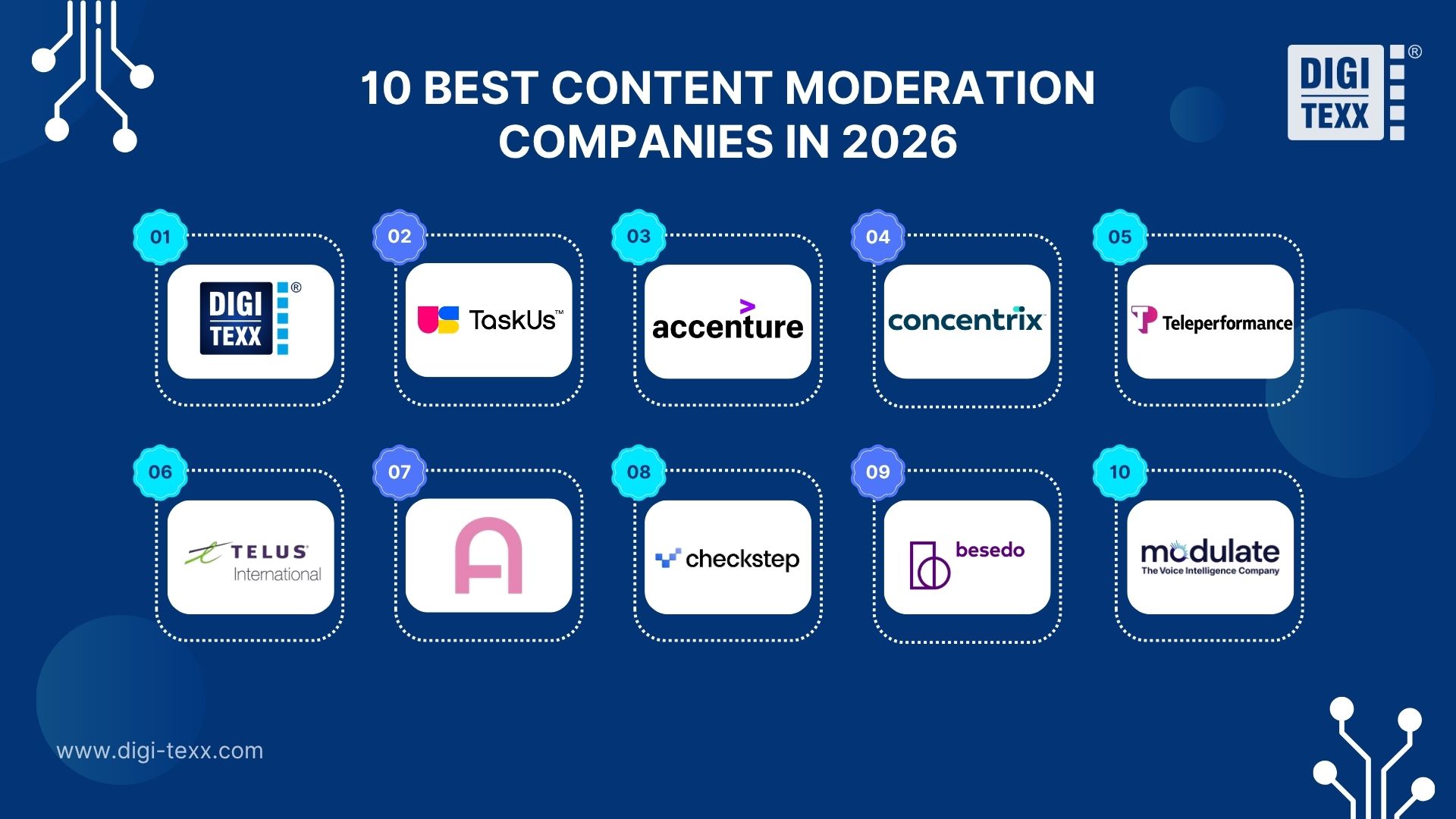
The following are the top content moderation companies in 2026 based on service capabilities, scalability, technology adoption, industry experience, and ability to support global operations.
| Company | Category | Best For | AI / Human Approach | Reference Pricing |
| TaskUs | Enterprise BPO & Trust and Safety Services | Social platforms, marketplaces, gaming companies | AI-assisted human moderation | Custom pricing / Contact sales |
| Accenture | Global Business Services & AI Operations | Enterprise-scale digital platforms | AI + human expertise | Custom enterprise pricing |
| Concentrix | Customer Experience & Trust Services | Global brands requiring multilingual moderation | Hybrid AI and human review | Custom pricing / Contact sales |
| TP | Global BPO & Digital Services | Large-volume content operations | Human moderation supported by AI | Custom pricing / Contact sales |
| TELUS Digital | Digital Customer Experience & AI Data Services | Technology companies and online platforms | AI training + human moderation | Custom pricing / Contact sales |
| DIGI-TEXX | Data Processing & Content Moderation Services | Businesses needing scalable outsourcing solutions | AI-enabled human moderation | Custom pricing / Contact sales |
| Alice | AI Trust & Safety Platform | Threat detection and online safety | AI-powered moderation | Custom enterprise pricing |
| Checkstep | AI Content Moderation Platform | Startups and digital communities | Automated AI moderation | Custom pricing / Contact sales |
| Besedo | Marketplace Moderation Provider | Classifieds and online marketplaces | AI tools + expert moderators | Custom pricing / Contact sales |
| Modulate | AI Trust & Safety Platform (Voice) | Gaming platforms, large online communities | AI-driven voice & behavioral intelligence | From ~$2,500/month |
>>> See more:
- Outsourced Content Moderation Services: Top Providers & How to Choose 2026
- Top 10 Order Processing Outsourcing Companies To Consider In 2026
- Outsourced Live Chat Services For Customer Support
10 Best Content Moderation Companies In 2026
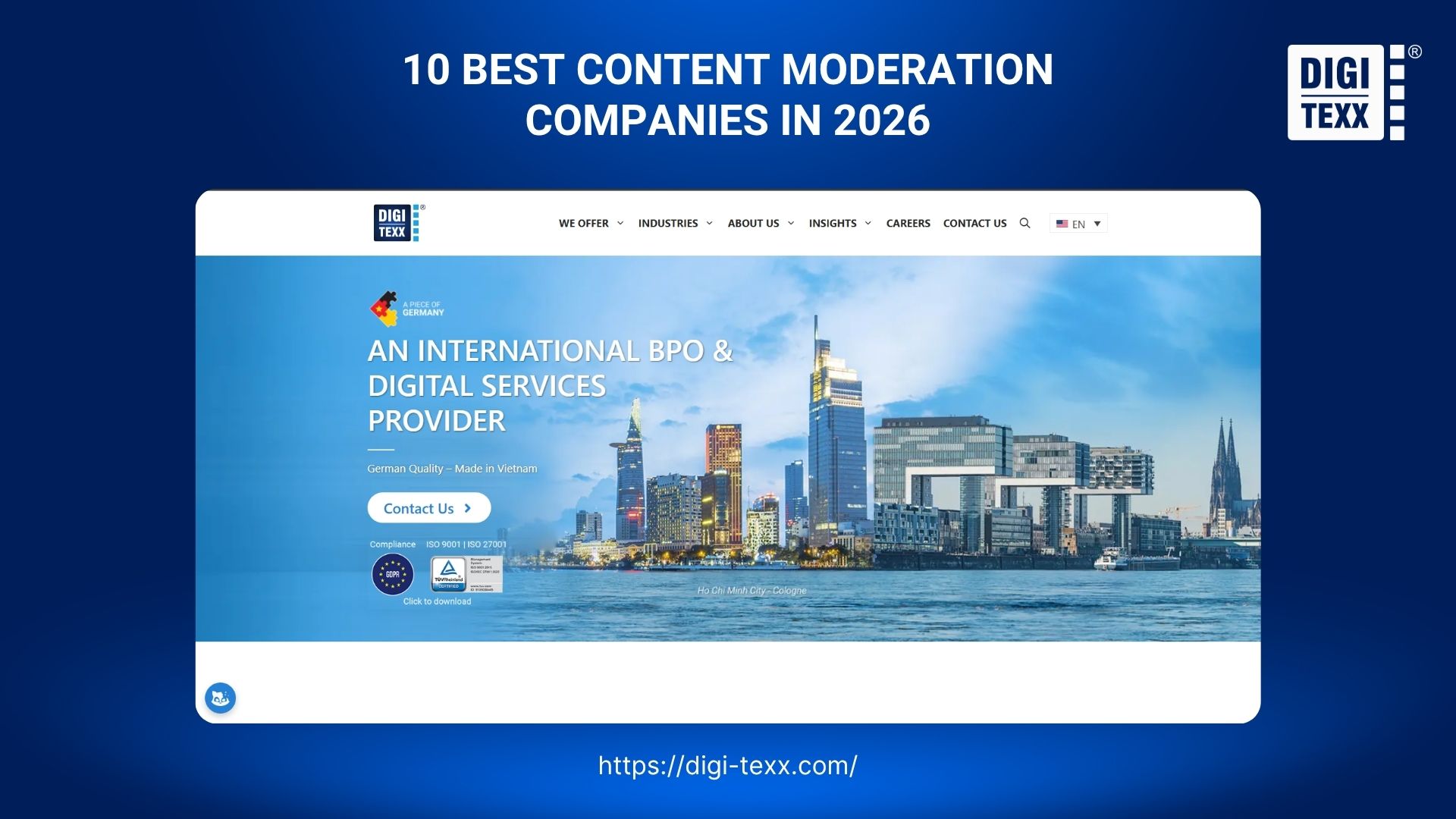
1. DIGI-TEXX
DIGI-TEXX has built its content moderation capability on more than 22 years of business process outsourcing experience, backed by dual ISO 9001:2015 (quality) and ISO 27001:2013 (information security) certification. This positions the company as a mid-sized alternative to large consulting-led providers, focused specifically on structured, quality-controlled data operations rather than broad enterprise consulting.
A key differentiator is DIGI-TEXX’s cross-trained annotation workforce, which applies the same data processing discipline used in its document and AI training data services to content moderation, covering use cases from vehicle and traffic annotation for AI security systems to refining AI-generated visuals for e-commerce. This gives clients a single provider for both content review and the broader data labeling work that trains the AI models behind moderation systems.
Content Moderation Services
DIGI-TEXX supports content moderation and related data operations, including:
- Social media moderation: Reviews posts, comments, profiles, and other user-generated content against predefined policies.
- Image and video moderation: Screens visual content for inappropriate, harmful, or policy-violating material.
- AI data labeling: Annotates and categorizes data used to train and improve AI and machine learning models.
- Text classification: Categorizes text-based content according to topics, attributes, risk levels, or client-specific rules.
- Digital content processing: Processes and organizes large volumes of digital information as part of broader data operations.
- Quality assurance: Uses structured QA procedures to monitor accuracy, consistency, and adherence to client requirements.
Its moderation workflows combine human review with technology-assisted processing, allowing businesses to maintain human judgment for nuanced content while improving the efficiency of repetitive, high-volume tasks.
Key Features
- Cost-efficient outsourcing model: Suitable for businesses looking to reduce the operational cost of large-scale data and moderation workflows.
- Data processing expertise: Brings established experience in structured data operations, annotation, and digital processing.
- AI-assisted workflows: Uses technology to support classification, annotation, and moderation processes where appropriate.
- Quality control: Applies QA procedures and performance monitoring to maintain consistent output across large teams.
- Scalable delivery: Can adjust operational capacity according to content volumes and project requirements.
- Offshore delivery capabilities: Provides an outsourcing model suited to companies seeking cost-effective support outside their primary operating markets.
Key Use Cases
DIGI-TEXX is particularly suitable for:
- Technology companies that need scalable content moderation or AI data operations.
- E-commerce platforms managing product content, reviews, user submissions, and other digital information.
- Social networks and online communities requiring human review of user-generated content.
- AI companies that need data labeling, classification, and human-verified training data.
- Businesses seeking offshore outsourcing to reduce operational costs while maintaining structured QA processes.
Pros
- Competitive cost structure for outsourced operations
- Strong background in data processing and AI data services
- Supports both content moderation and related data workflows
- Flexible capacity for high-volume projects
- Structured quality assurance processes
Cons
- Lower global brand recognition than major BPO and consulting firms
- May have less extensive enterprise consulting and Trust & Safety capabilities than larger providers
- Best suited to organizations comfortable with an outsourcing model rather than businesses seeking a full strategic consulting partner
Best For
DIGI-TEXX is best for technology companies, e-commerce platforms, social networks, and AI-driven businesses that need cost-effective content moderation combined with data processing, annotation, and quality assurance.
Pricing
Custom pricing. DIGI-TEXX does not present a fixed public price for content moderation services. Costs can vary based on content volume, service scope, languages, QA requirements, and outsourcing needs.
It is particularly suitable for organizations seeking a scalable offshore BPO partner rather than a large consulting-led Trust & Safety transformation provider.
2. TaskUs
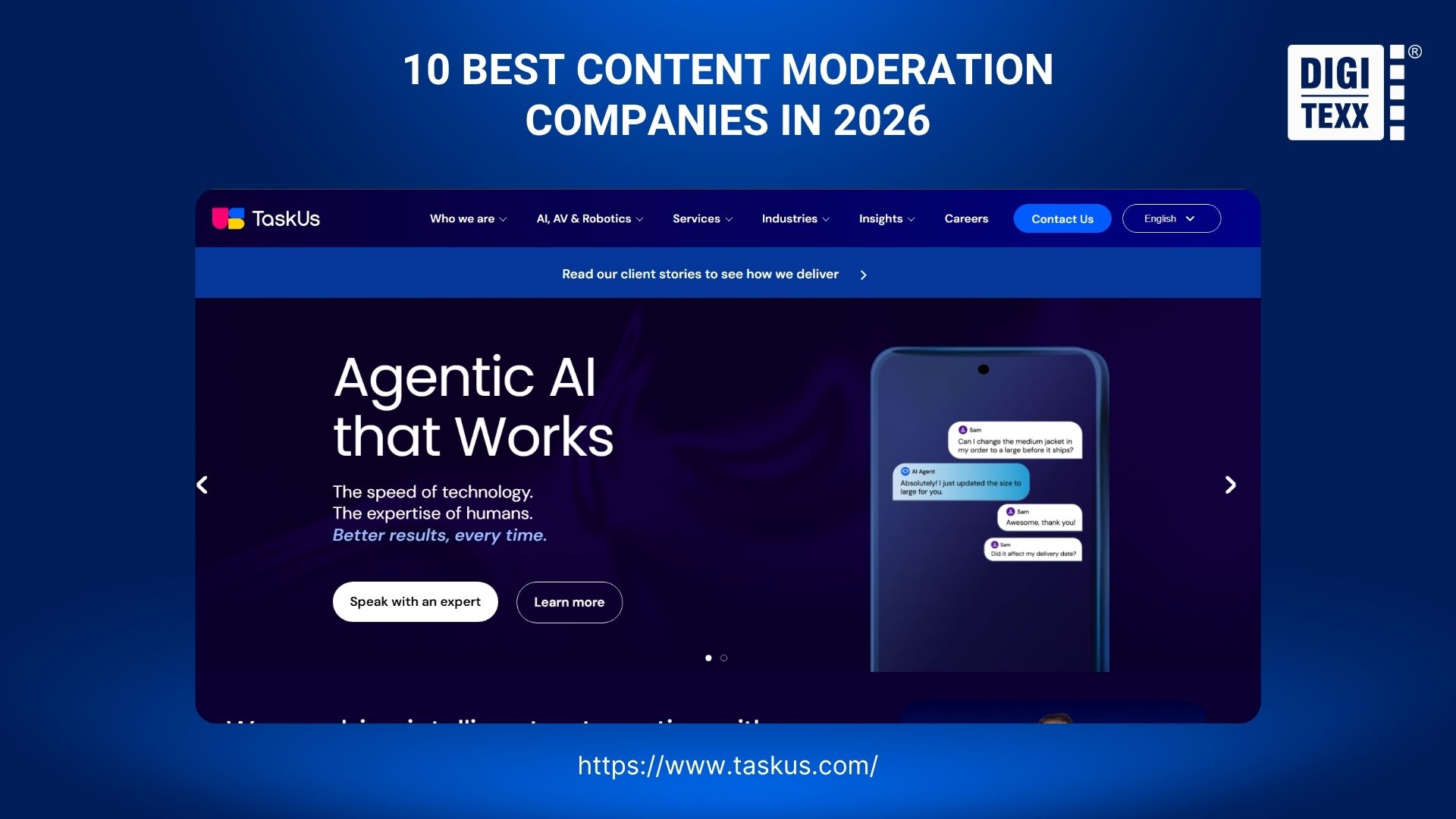
TaskUs is one of the largest content moderation workforces in the industry, with over 45,000 employees supporting social media, gaming, e-commerce, and streaming platforms. It has been named a “Leader” in Everest Group’s Trust and Safety Services PEAK Matrix Assessment for three consecutive years.
A key differentiator is its psychological care program, led by licensed mental health professionals, built specifically to support moderators exposed to graphic or harmful content. TaskUs also applies human-in-the-loop review to train and correct AI moderation systems, helping catch content that automated filters alone would miss.
Content Moderation Services
TaskUs supports different stages of the content moderation lifecycle, including:
- Social media moderation: Reviews posts, comments, profiles, and other user interactions for policy violations.
- Image and video moderation: Identifies graphic violence, sexual or exploitative material, dangerous acts, and other restricted visual content.
- Marketplace moderation: Reviews product listings, seller content, reviews, and user activity to detect fraud, prohibited products, and policy violations.
- Community moderation: Helps online communities enforce rules and address harassment, hate speech, spam, and abusive behavior.
- Trust & Safety operations: Supports policy enforcement, escalation management, and workflows for high-risk or sensitive content.
- AI data services: Provides data annotation and human-in-the-loop processes that can support the development and improvement of AI moderation systems.
Moderators can work against client-specific policies and escalation protocols, allowing TaskUs to adapt its operations to the platform’s content standards rather than applying a one-size-fits-all moderation framework.
Key Features
- Human + AI-assisted moderation: Combines human review with technology-enabled workflows to improve moderation efficiency and consistency.
- Multilingual operations: Supports moderation across different languages and geographic markets.
- Policy-specific workflows: Moderation processes can be aligned with a platform’s rules, risk categories, and escalation requirements.
- Quality assurance: Uses QA processes and performance monitoring to evaluate moderation accuracy and operational consistency.
- Scalable delivery: Suitable for platforms handling large and fluctuating volumes of user-generated content.
- Trust & Safety expertise: Extends beyond simple content review to areas such as policy enforcement, risk management, and user safety.
Key Use Cases
TaskUs is particularly relevant for:
- Social platforms managing large volumes of posts, comments, images, and videos.
- Gaming companies moderating player interactions, chats, and community-generated content.
- Online marketplaces reviewing listings, seller activity, reviews, and potentially fraudulent content.
- Digital communities addressing harassment, spam, hate speech, and other violations.
- Technology companies that need scalable moderation operations across multiple markets or around-the-clock coverage.
Pros
- Strong focus on Trust & Safety and large-scale content operations
- Supports multiple content formats and moderation workflows
- Combines human expertise with technology-assisted processes
- Global and multilingual delivery capabilities
- Can scale operations for high-volume digital platforms
Cons
- Primarily geared toward mid-market and enterprise organizations
- Outsourcing costs can be higher than building a small in-house moderation team
- Complex moderation programs may require significant policy training and operational setup
Best For
TaskUs is best for large digital platforms, marketplaces, gaming companies, and social networks that need scalable, multilingual content moderation combined with broader Trust & Safety operations.
Pricing
Custom pricing. TaskUs does not publish a fixed public price for content moderation services. Costs can vary based on content volume, moderation scope, languages, coverage, and operational requirements.
It is particularly suitable when moderation requirements extend beyond simple content review to policy enforcement, quality control, escalation handling, and AI data support.
3. Accenture
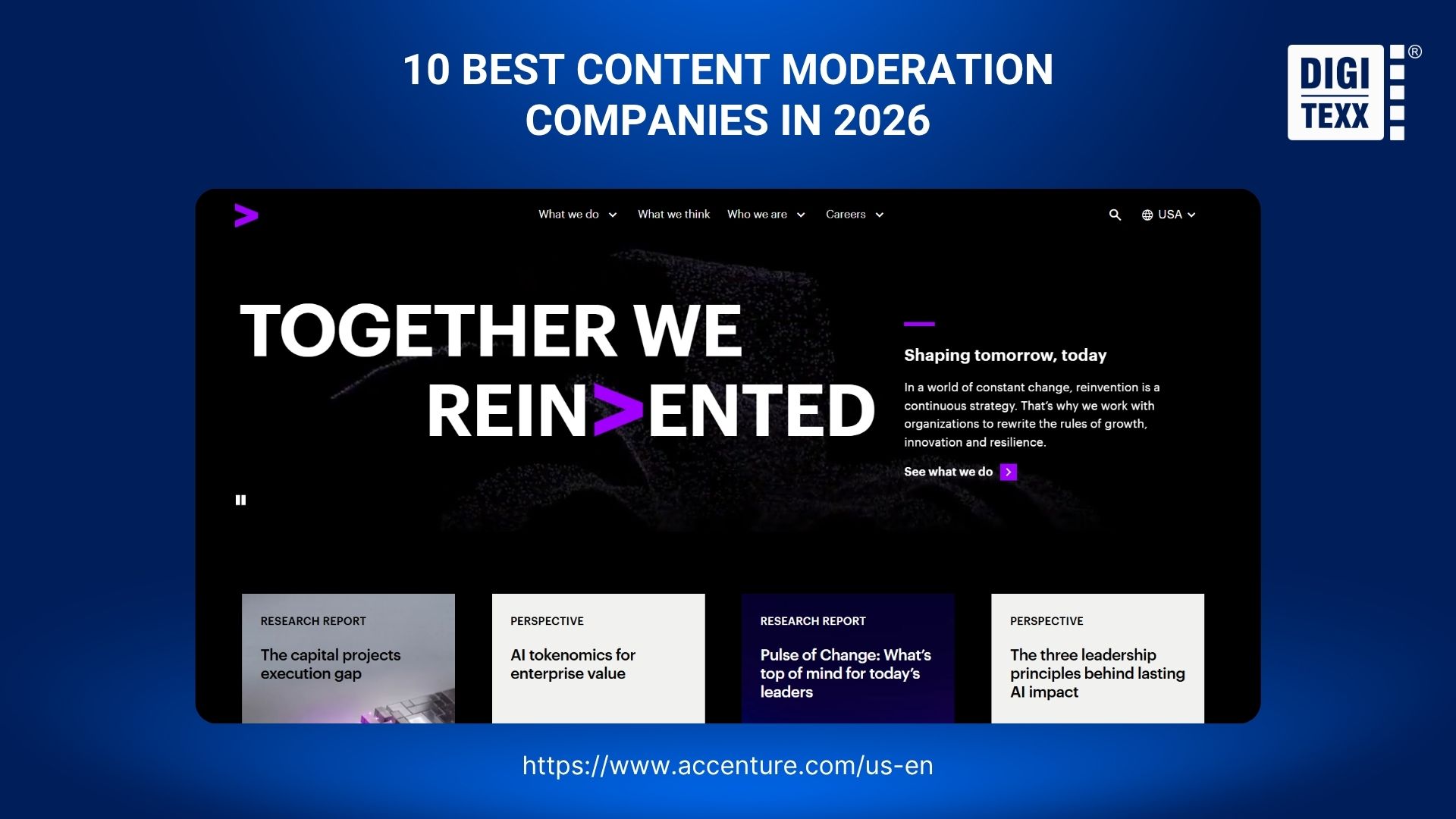
Accenture is one of the highest-ranked providers in this space, positioned as the highest-designated Leader on both the Market Impact and Vision and Capability axes in Everest Group’s Trust and Safety Services PEAK Matrix Assessment 2025, which evaluated 28 global providers. Its content moderation work sits inside a broader online safety and responsible AI practice rather than standing alone as a single service line.
A key differentiator is that Accenture’s safety teams also test and evaluate generative AI systems for accuracy, safety, and policy compliance, not just review user-generated content. This puts the company in a smaller group of providers equipped to support both traditional content moderation and the newer demand for AI model safety testing under one contract.
Content Moderation Services
Accenture supports content moderation and Trust & Safety operations through:
- Content review and moderation: Reviews user-generated content against platform-specific policies and risk categories.
- AI-powered moderation: Applies AI and automation to help detect potentially harmful, inappropriate, or policy-violating content at scale.
- Data labeling and annotation: Provides training data and human feedback to improve machine learning and AI moderation models.
- Risk and threat monitoring: Helps organizations identify emerging risks, abusive behavior, and potentially harmful activity across digital platforms.
- Policy enforcement: Supports workflows for reviewing violations, escalating high-risk cases, and applying platform rules consistently.
- Digital platform governance: Helps organizations establish governance processes around content policies, AI systems, compliance, and responsible platform operations.
Key Features
- AI and automation capabilities: Uses AI, analytics, and automation to improve moderation speed and reduce reliance on manual review for suitable content categories.
- Human-in-the-loop operations: Combines automated detection with human review for complex, ambiguous, or high-risk cases.
- Global delivery network: Supports large-scale operations across multiple regions and markets.
- Advanced analytics: Uses operational and content data to identify trends, measure moderation performance, and improve workflows.
- Enterprise compliance expertise: Relevant for organizations operating under complex regulatory, privacy, and industry-specific requirements.
- Integrated digital transformation: Content moderation can be incorporated into broader AI, data, customer experience, and business process transformation initiatives.
Key Use Cases
Accenture is particularly relevant for:
- Global enterprises managing large and complex digital ecosystems.
- Technology and platform companies dealing with high volumes of user-generated content.
- Financial services platforms requiring high-risk, governance, and compliance controls around digital interactions.
- Organizations adopting AI moderation that need data annotation, model support, automation, and human oversight.
- Enterprises undergoing digital transformation that want to integrate Trust & Safety with broader AI and managed operations.
Pros
- Strong combination of AI, automation, data, and human operations
- Extensive global delivery and enterprise resources
- Can integrate content moderation with broader digital transformation programs
- Strong capabilities in analytics, governance, and regulatory compliance
- Suitable for complex, high-volume enterprise environments
Cons
- Enterprise-scale implementation may involve greater complexity and longer deployment timelines
- Broader consulting and technology capabilities can make Accenture less specialized than dedicated content moderation providers
- May be less suitable for smaller businesses seeking a straightforward outsourced moderation service
Best For
Accenture is best for large enterprises and technology-driven organizations that need content moderation integrated with AI, automation, data, governance, and broader Trust & Safety operations.
Pricing
Custom enterprise pricing. Accenture does not provide a standardized public price for content moderation services. Costs depend on the scope of AI, moderation, data, and managed services required.
It is a strong fit when moderation is part of a larger digital transformation strategy rather than a standalone content review requirement.
>>> See more:
- Top 10 BPO Companies In SEA 2026: Next Generation Leaders In Digital Transformation
- Common Challenges In Building Strong Customer Engagement: How to Overcome With Business Support Services
- Data Entry Outsourcing for Healthcare: Ensuring Accuracy & Compliance
4. Concentrix
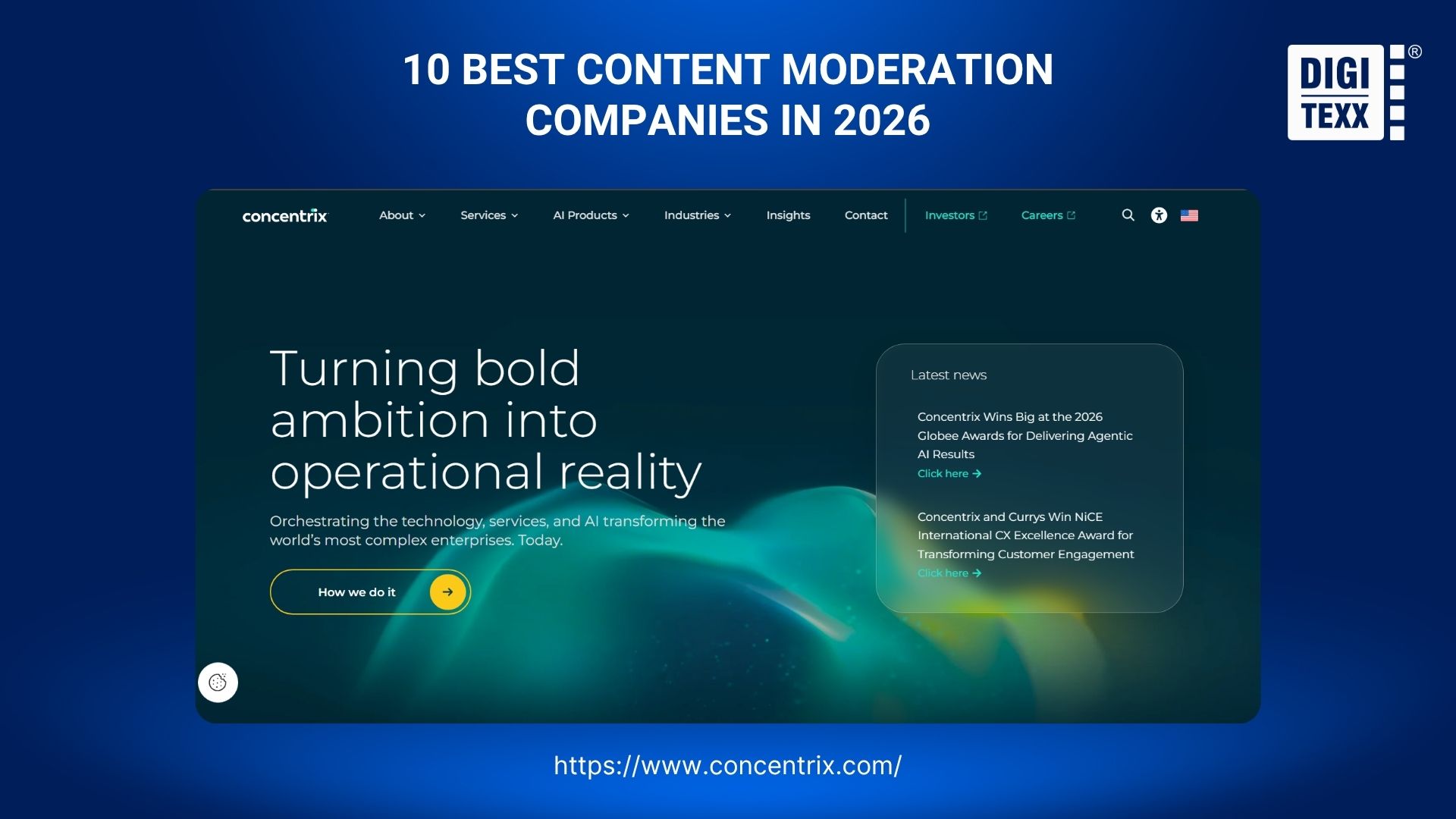
Concentrix has been named a Leader in Everest Group’s Trust and Safety Services PEAK Matrix Assessment for five consecutive years, ranking third for Market Impact and fourth for Vision and Capability among 28 global providers evaluated in the 2025 report. The company serves clients across social media, marketplaces, gaming, and other user-generated content platforms, with multilingual delivery spanning over 120 countries.
A key differentiator is Concentrix’s weCare wellness model, which pairs human-centered support with dedicated tools like its weCare Coaching platform and Wellbeing Analytics dashboard to monitor and manage moderator mental health at scale. Concentrix has also invested in generative AI for real-time video transcription and translation, helping teams catch policy violations in multilingual content faster than manual review alone.
Content Moderation Services
Concentrix supports a range of content moderation and Trust & Safety workflows, including:
- Social media moderation: Reviews posts, comments, profiles, and interactions for policy violations.
- User-generated content review: Assesses text, images, videos, and other user submissions against platform guidelines.
- Community moderation: Helps enforce community standards and address harassment, hate speech, spam, and abusive behavior.
- Fraud and abuse detection: Identifies suspicious activity, fraudulent behavior, scams, and other forms of platform abuse.
- Trust & Safety operations: Supports policy enforcement, case escalation, and workflows for managing online risks.
- AI data services: Provides data annotation and human feedback that can support AI and machine learning systems.
Key Features
- Multilingual moderation capabilities: Supports content review across different languages, regions, and cultural contexts.
- Global operational scale: Suitable for platforms that need moderation coverage across multiple markets or time zones.
- Human + technology-enabled workflows: Combines human judgment with automation and AI-supported processes where appropriate.
- Quality management: Uses quality assurance and performance monitoring to maintain moderation consistency.
- Customer experience integration: Can connect Trust & Safety operations with broader customer support and digital experience workflows.
- Cross-industry expertise: Supports use cases across technology, social platforms, marketplaces, gaming, and other consumer-facing digital services.
Key Use Cases
Concentrix is particularly suitable for:
- Social networks managing large volumes of posts, comments, and user interactions.
- Digital marketplaces that need to moderate listings, reviews, seller activity, and fraudulent behavior.
- Consumer platforms requiring multilingual content review and user safety operations.
- Online communities and gaming platforms dealing with harassment, abusive behavior, spam, and community violations.
- Global digital businesses that want content moderation and customer experience operations from a single outsourcing partner.
Pros
- Strong global delivery and multilingual capabilities
- Combines Trust & Safety with customer experience operations
- Supports both content moderation and fraud/abuse workflows
- Flexible workforce capacity for high-volume operations
- Experience serving multiple industries and digital business models
Cons
- Service consistency can depend on delivery location, staffing model, and project-specific implementation
- Broader BPO and CX focus may make it less specialized than dedicated Trust & Safety providers
- Large-scale outsourcing programs may require substantial onboarding and policy training
Best For
Concentrix is best for global consumer platforms, social networks, marketplaces, gaming companies, and digital businesses that need multilingual content moderation alongside broader Trust & Safety or customer experience operations.
Pricing
Custom pricing. Concentrix does not publish fixed rates for content moderation services. Pricing can vary based on moderation volume, languages, coverage, technology requirements, and service scope.
It is especially useful when content review, fraud prevention, community management, and customer support need to operate within a connected service model.
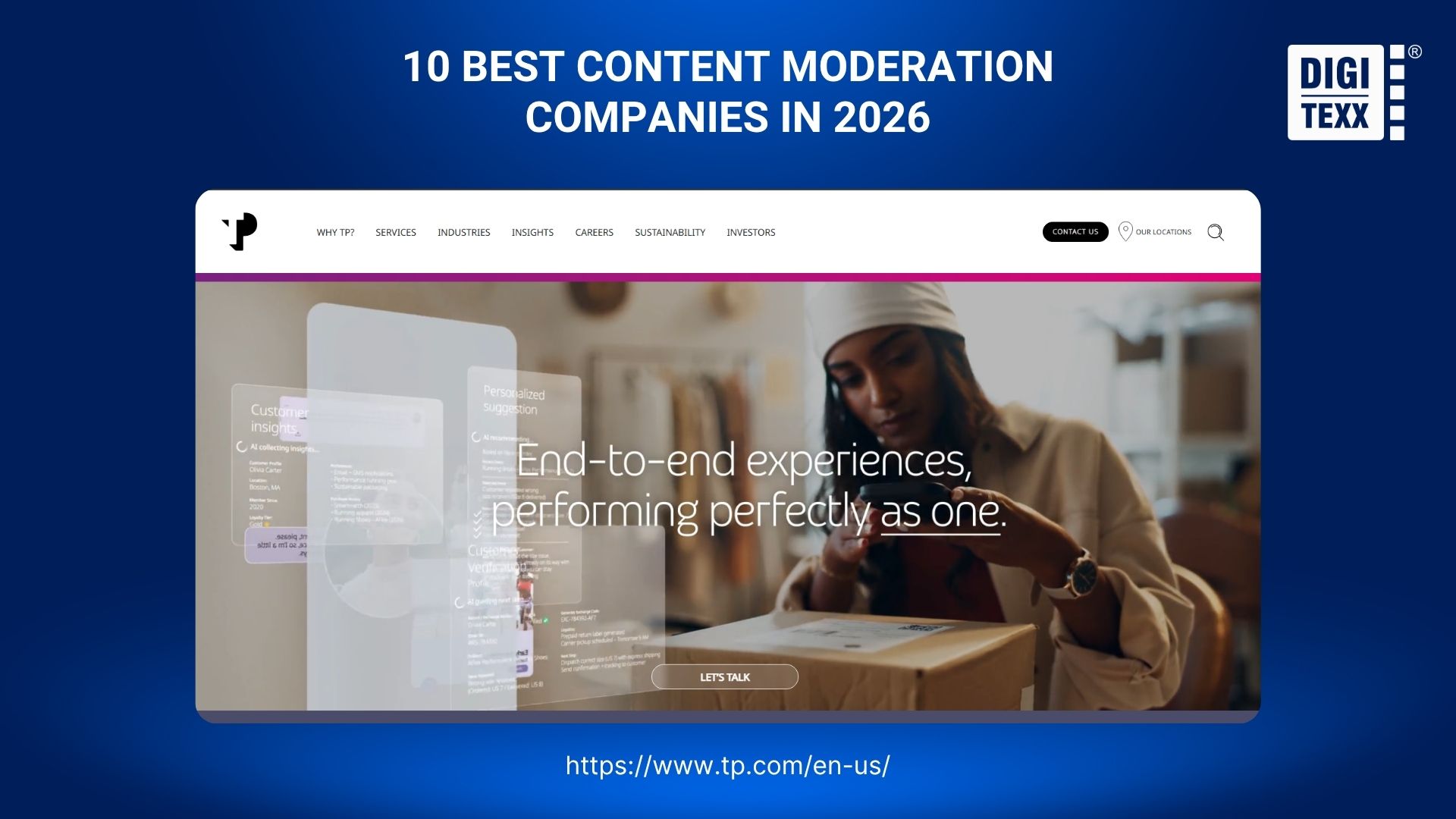
5. TP
Teleperformance, now operating under the brand TP, has been named a Leader in Everest Group’s Trust and Safety Services PEAK Matrix Assessment for multiple consecutive years, most recently earning Star Performer recognition for growth in market impact and capability. Its scale expanded further after acquiring Majorel, giving it one of the largest multilingual delivery networks in the industry across close to 100 countries.
A key differentiator is TP’s in-house Trust and Safety Academy, a dedicated training and coaching program built to prepare moderators for the realities of reviewing harmful content and to standardize policy enforcement across its global workforce. The company has also built proprietary analytics tools to identify patterns in policy violations, helping improve enforcement accuracy at scale.
Content Moderation Services
TP supports a range of content review and Trust & Safety operations, including:
- Text moderation: Reviews posts, comments, messages, and other text-based content for policy violations.
- Image and video moderation: Screens visual content for violence, sexual or exploitative material, graphic content, and other restricted categories.
- Social media moderation: Monitors user interactions and content across social platforms and online communities.
- User safety operations: Helps identify harassment, abuse, threats, and other behaviors that may put users or communities at risk.
- Policy enforcement: Applies platform-specific content rules and escalates complex or high-risk cases for further review.
- Trust & Safety support: Helps platforms manage content-related risks, moderation workflows, and user protection processes.
Key Features
- Large global moderation workforce: Provides the operational capacity needed for high-volume content review programs.
- 24/7 coverage: Supports continuous moderation for platforms operating across different time zones.
- Multilingual capabilities: Enables content review across languages and regional markets.
- AI-assisted workflows: Uses automation and technology-supported processes to help prioritize and process content at scale.
- Scalable operations: Can adjust moderation capacity to accommodate changing content volumes and business requirements.
- Quality management: Uses monitoring and quality assurance processes to improve consistency across large distributed teams.
Key Use Cases
TP is particularly suitable for:
- Social networks handling millions of user interactions and content submissions.
- Streaming platforms moderating comments, uploads, live interactions, and community activity.
- Global marketplaces reviewing listings, reviews, seller activity, and user-generated content.
- Gaming and online communities managing abusive behavior, harassment, spam, and other user safety issues.
- High-volume digital platforms requiring continuous moderation across multiple languages and regions.
Pros
- Very large operational capacity for high-volume moderation
- Broad geographic and multilingual coverage
- Suitable for 24/7 global content operations
- Experience supporting complex enterprise outsourcing programs
- Can scale workforce capacity as moderation demand changes
Cons
- Large-scale programs may require more management, coordination, and onboarding
- Operational consistency can require strong client-side policy documentation and quality controls
- May be less attractive for smaller companies with limited or straightforward moderation requirements
Best For
TP is best for large social networks, streaming platforms, marketplaces, gaming companies, and other digital businesses that need high-volume, multilingual, and 24/7 content moderation.
Pricing
Custom pricing. TP does not provide a standard public rate for content moderation. Costs depend on content volume, languages, coverage hours, workforce requirements, and operational scale.
Its strongest fit is for organizations where moderation scale and global operational coverage are more important than highly specialized, niche moderation capabilities.
>>> See more:
- Why Digital Onboarding and eKYC are Key to the Financial Sector’s Success?
- What Is Data Integrity? Why It Matters, Types & Best Practices
- Data Quality Dimensions: 6 Core Metrics And Automation Guide
6. TELUS Digital
TELUS Digital, formerly TELUS International, has been named a Leader in Everest Group’s Data Annotation and Labeling Solutions PEAK Matrix Assessment 2024, recognized for its platform-first approach to preparing training data across text, image, video, audio, and geospatial formats. The company has also expanded its multilingual delivery footprint across Asia-Pacific and Latin America to support both content moderation and AI data demand.
A key differentiator is TELUS Digital’s proprietary AI Data Platform and Experts Engine, a tech-enabled sourcing system that matches human specialists to data annotation, labeling, and validation tasks for training large language models and foundation models. This positions the company less as a pure content review provider and more as an infrastructure partner for teams building and refining their own AI systems.
Content Moderation Services
TELUS Digital supports a range of content and digital safety workflows, including:
- Social media moderation: Reviews posts, comments, profiles, and interactions against platform policies.
- Content classification: Categorizes user-generated content based on predefined topics, risk levels, or policy requirements.
- AI training data services: Provides data annotation and human-generated feedback to train and improve AI and machine learning models.
- Search relevance evaluation: Assesses search results and user queries to help improve the relevance and quality of search systems.
- Online safety operations: Helps identify harmful content, abusive behavior, and other risks affecting users and digital communities.
- Trust & Safety operations: Supports policy enforcement, escalation workflows, and quality assurance for digital platforms.
Key Features
- AI data expertise: Combines moderation with data annotation, labeling, and evaluation capabilities for AI systems.
- Multilingual workforce: Supports content review and data operations across multiple languages and markets.
- Human + AI workflows: Uses human expertise alongside technology-enabled processes to improve moderation efficiency and data quality.
- Quality control: Applies quality assurance and performance monitoring to maintain consistency across distributed operations.
- Technology-platform experience: Suitable for digital businesses that require moderation, AI data, and digital operations within the same service ecosystem.
- Scalable operations: Can support high-volume content and data workflows as platform requirements grow.
Key Use Cases
TELUS Digital is particularly suitable for:
- AI and machine learning companies requiring annotated data and human feedback alongside content operations.
- Technology platforms that need content moderation, classification, and online safety support.
- Search and discovery platforms requiring search relevance evaluation and content classification.
- Social and digital platforms managing large volumes of multilingual user-generated content.
- AI-driven businesses looking to combine Trust & Safety operations with data collection, annotation, and model evaluation.
Pros
- Strong combination of content moderation and AI data services
- Broad multilingual and global delivery capabilities
- Expertise in data annotation and machine learning support
- Suitable for technology-focused and AI-driven businesses
- Can connect moderation workflows with broader digital experience operations
Cons
- Broader digital experience and AI data focus may make it less specialized than dedicated content moderation providers
- Organizations seeking only straightforward human content review may not need its wider AI and data capabilities
- Complex AI data and moderation programs may require detailed workflows and quality specifications
Best For
TELUS Digital is best for AI companies, technology platforms, search businesses, and digital platforms that need content moderation alongside AI data annotation, content classification, or machine learning support.
Pricing
Custom pricing. TELUS Digital does not publish a fixed price for its content moderation and AI data services. Pricing can vary based on content volume, languages, data requirements, and project scope.
It is particularly strong when moderation is part of a broader AI data and Trust & Safety workflow, rather than a standalone content review requirement.

>>> See more:
- Data Quality Management: Importance, Tools, and Best Practices
- What Is Document Control Process? Steps, Benefits & Requirements
- The Role of OCR in Healthcare: Digitizing Patient Records
7. Alice
Alice, formerly known as ActiveFence, rebranded in January 2026 as it expanded from platform content safety into AI model security. The company currently protects more than 3 billion users across social platforms and works with 7 of the world’s 10 largest foundation AI model labs, including partners such as Amazon, TikTok, Nvidia, and Cohere.
A key differentiator is Alice’s adversarial intelligence engine, Rabbit Hole, built on nearly a decade of real-world abuse data and used to power both its legacy platform safety detection and its newer WonderSuite product line, which tests, guards, and monitors AI models and agents for exploitation, prompt injection, and unintended harmful behavior. This dual focus sets Alice apart from providers in this list that moderate user content but do not extend into securing the AI systems behind it.
Content Moderation Services
Alice provides technology-driven moderation and Trust & Safety capabilities, including:
- Automated content detection: Uses AI and machine learning to identify potentially harmful or policy-violating content across digital platforms.
- Threat intelligence: Monitors emerging online threats and harmful trends to help platforms understand evolving safety risks.
- Extremism detection: Identifies extremist content, narratives, and related activity that may pose risks to users or communities.
- Cyber abuse monitoring: Helps detect malicious online behavior, coordinated abuse, and other digital threats.
- Risk analysis: Evaluates content and behavioral signals to help Trust & Safety teams prioritize potentially high-risk cases.
- Real-time safety monitoring: Supports faster detection and response to emerging threats across high-volume platforms.
Key Features
- AI-based threat detection: Applies machine learning and automated analysis to identify harmful content and behavioral patterns.
- Real-time monitoring: Helps platforms detect emerging risks quickly rather than relying solely on retrospective manual review.
- Automated risk scoring: Can help prioritize content, accounts, or behaviors based on their potential level of risk.
- Threat intelligence capabilities: Provide contextual intelligence that can help Trust & Safety teams understand emerging threats and abuse patterns.
- Large-scale detection: Designed to support platforms processing substantial volumes of content and safety signals.
- Technology-led moderation: Reduces dependence on manual review for detection and triage while allowing human teams to handle complex cases.
Key Use Cases
Alice is particularly suitable for:
- Large social networks dealing with coordinated abuse, harmful content, and rapidly changing safety threats.
- Gaming and online communities facing harassment, extremism, toxic behavior, and other user safety risks.
- Large digital platforms that need automated detection across high volumes of user-generated content.
- Platforms facing sophisticated threats where basic keyword filtering or manual moderation is insufficient.
- Trust & Safety teams that need additional threat intelligence and automated risk signals to prioritize investigations.
Pros
- Strong AI-driven detection and automation capabilities
- Focused expertise in Trust & Safety technology and threat intelligence
- Supports real-time identification of emerging risks
- Useful for complex and high-volume safety environments
- Can complement human moderation teams by automating detection and risk prioritization
Cons
- More focused on technology-enabled Trust & Safety than outsourced human moderation
- May be excessive for businesses with simple content review requirements
- Complex safety programs may require integration with existing moderation, policy, and escalation workflows
Best For
Alice is best for large social networks, gaming platforms, online communities, and other digital businesses facing complex Trust & Safety risks that require AI-powered detection, threat intelligence, and automated risk analysis.
Pricing
Custom enterprise pricing. Alice does not publish a standardized public price for its Trust & Safety platform. Pricing can depend on content volume, threat detection capabilities, risk intelligence, and enterprise requirements.
It is particularly valuable when a platform needs to supplement human moderation with real-time, technology-driven risk detection rather than simply outsourcing content review.

8. Checkstep
Checkstep is a London-based Trust and Safety startup founded in 2020 by Guillaume Bouchard, former CEO of Bloomsbury AI, which was acquired by Facebook. The company processes more than 60 million pieces of content every month for customers including Trustpilot, JustGiving, and the Daily Mail, and closed a £3 million funding round in May 2026 to expand across the EU and US.
A key differentiator is Checkstep’s automation rate: its platform automates more than 98 percent of moderation decisions, far higher than the hybrid AI-plus-large-workforce model used by most BPO providers on this list. This makes Checkstep a better fit for platforms that want AI to handle the bulk of moderation directly inside their product, with human review reserved only for the small share of ambiguous or high-risk cases.
Content Moderation Services
Checkstep supports automated detection across multiple content types and risk categories, including:
- Text moderation: Analyzes user-generated text for harmful, abusive, or policy-violating content.
- Image moderation: Detects potentially inappropriate or unsafe visual content.
- Video moderation: Supports automated analysis of user-uploaded video content.
- Hate speech detection: Identifies potentially hateful or discriminatory language and content.
- Harassment detection: Flags abusive, threatening, or targeted behavior.
- Policy-based moderation: Helps platforms apply their own content rules and moderation thresholds to automated decisions.
Key Features
- API-based integration: Allows developers to embed moderation capabilities directly into websites, applications, and platform workflows.
- AI moderation models: Uses automated content analysis to screen large volumes of user-generated content.
- Customizable policies: Enables businesses to configure moderation rules and thresholds based on their specific community standards.
- Real-time analysis: Supports rapid content screening before or shortly after content is published.
- Automated decision workflows: Can help platforms classify, flag, or route content based on detected risks.
- Human review compatibility: Automated moderation can be combined with human review for ambiguous or higher-risk cases.
Key Use Cases
Checkstep is particularly suitable for:
- Startups that need moderation capabilities without building an internal moderation system from scratch.
- SaaS platforms where user-generated content is part of the product experience.
- Online communities that need automated detection of harassment, hate speech, and other policy violations.
- Marketplaces managing user-generated listings, reviews, images, and other content.
- Digital platforms looking to integrate moderation directly into their existing technical stack.
Pros
- API-first architecture suitable for developer-led integration
- Faster deployment than building a moderation system internally
- Supports multiple content types and safety categories
- Customizable moderation policies and thresholds
- Helps automate high-volume, repetitive content screening
Cons
- AI-based detection still requires human review for ambiguous, nuanced, or high-risk cases
- Businesses may need technical resources to integrate and configure the API effectively
- Less suitable for companies looking for a fully outsourced human moderation workforce
Best For
Checkstep is best for startups, SaaS companies, online communities, and digital marketplaces that want to integrate AI-powered content moderation directly into their products through APIs.
Pricing
Custom pricing. Checkstep does not provide a universal public price for its AI moderation platform. Costs can vary based on content volume, moderation models, API usage, policy requirements, and human review needs.
It is particularly suitable for businesses seeking automated, customizable, and developer-friendly moderation rather than a traditional outsourced moderation team.

>>> See more:
- What Is Document Management? A Complete Overview
- Accounts Payable Outsourcing:How It Works, Benefits & Top Providers
- Best Administrative Support Outsourcing Services In 2026
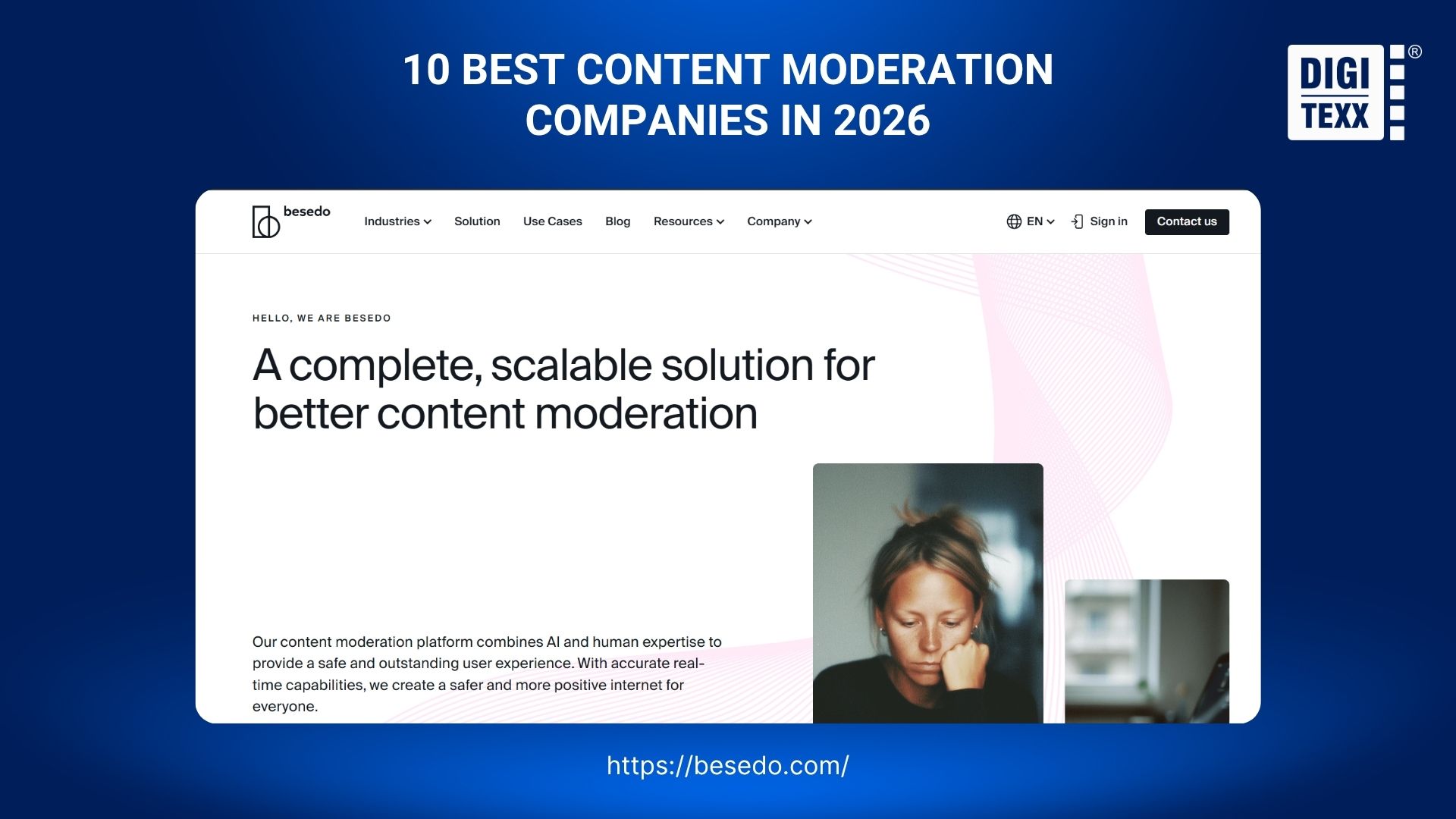
9. Besedo
Besedo has specialized in marketplace fraud and content moderation since 2002, making it one of the longest-running providers in this list. The company moderates billions of pieces of content per year across more than 100 languages, with offices spanning Sweden, France, Malta, Colombia, and Romania.
A key differentiator is Implio, Besedo’s proprietary moderation platform, which processes real-time chat content in under 80 milliseconds and images in under 1 second. Implio combines automated decisioning with a manual review interface in one tool, allowing marketplaces, dating apps, and classifieds platforms to catch scams and fake listings without switching between separate detection and moderation systems.
Content Moderation Services
Besedo provides moderation and platform safety services including:
- Marketplace moderation: Reviews product listings, advertisements, profiles, and user submissions against platform policies.
- Classifieds moderation: Screens classified ads for prohibited, misleading, fraudulent, or inappropriate content.
- Text and image moderation: Reviews written and visual content for policy violations and potentially harmful material.
- Fraud detection: Helps identify suspicious listings, scams, fraudulent behavior, and other marketplace abuse.
- Spam detection: Detects repetitive, deceptive, or unwanted content that can reduce platform quality.
- Human content review: Uses trained moderators to assess cases that require contextual judgment or escalation.
- AI-assisted moderation: Uses automated tools to identify and prioritize potentially problematic content for review.
Key Features
- Marketplace-focused expertise: Designed around the specific safety and trust challenges of classifieds and user-generated marketplaces.
- AI + human moderation: Combines automated detection with expert human review for more complex cases.
- Fraud and abuse prevention: Goes beyond content quality to help identify scams, fraudulent listings, and suspicious activity.
- Scalable moderation operations: Supports platforms managing large volumes of listings and user-generated submissions.
- Policy-based workflows: Moderation processes can be aligned with individual platform rules and enforcement requirements.
- Quality assurance: Uses review and monitoring processes to improve consistency and moderation accuracy.
Key Use Cases
Besedo is particularly suitable for:
- Classifieds platforms that need to review large volumes of user-submitted advertisements.
- Online marketplaces managing product listings, seller content, images, and user reviews.
- Automotive and real estate platforms where fraudulent or misleading listings can create significant user risk.
- Dating and social platforms requiring profile, image, and interaction moderation.
- User-generated content platforms that need a combination of automated detection and human review.
Pros
- Strong specialization in marketplace and classifieds moderation
- Combines AI-assisted detection with human expertise
- Supports fraud, spam, and abusive-content detection
- Suitable for high-volume user-generated marketplaces
- Moderation workflows can be adapted to platform-specific policies
Cons
- More specialized toward marketplaces and classifieds than general-purpose moderation across every digital platform
- Human moderation components can increase operational costs at scale
- Businesses seeking a purely automated API-based solution may prefer a technology-first provider
Best For
Besedo is best for online marketplaces, classifieds platforms, and other user-generated-content businesses where content moderation needs to work alongside fraud prevention and marketplace trust.
Pricing
Custom pricing. Besedo does not publish a standard public price for its content moderation services. Pricing can vary based on moderation volume, content types, marketplace requirements, automation, and human review.
It is particularly suitable for platforms that need AI-assisted detection combined with expert human moderation to manage large volumes of listings and user activity.
10. Modulate
Modulate is a Boston-based voice AI company best known for ToxMod, the gaming industry’s first voice-native, proactive moderation system, used by Activision (Call of Duty), Rockstar Games (GTA Online), Riot Games, and Rec Room. The platform has moderated more than 160 million hours of voice data to date and, according to Activision’s own published data, reduced disruptive voice chat behavior in Call of Duty by 43 percent.
A key differentiator is Velma, Modulate’s underlying Ensemble Listening Model, which analyzes tone, escalation patterns, and interaction dynamics in live voice chat rather than relying on transcripts or keyword matching the way most text-first moderation tools do. This makes Modulate the strongest option on this list for platforms where harm happens primarily through spoken conversation rather than text or images.
Content Moderation Services
Modulate supports real-time voice and behavioral safety workflows through its ToxMod platform, including:
- Live voice moderation: Monitors real-time voice chat to detect harassment, hate speech, threats, and grooming as they happen, without relying on player reports.
- Behavioral and tonal analysis: Evaluates how something was said, including tone, intensity, and escalation, not just the words used.
- Prosocial behavior detection: Identifies and rewards positive community behavior alongside flagging harmful conduct.
- Text moderation: Extends detection beyond voice into in-platform text chat.
- Phone number and PII anonymization: Protects user privacy during voice data processing.
- Case routing for human moderators: Flags high-severity incidents with supporting context for faster human review.
Key Features
- Voice-native detection: Built from the ground up for voice, rather than adapting a text-first system to handle audio.
- Low-latency, high-volume processing: Runs on AWS infrastructure to ingest and analyze millions of audio snippets per minute.
- High detection accuracy: Client deployments have reported accuracy rates around 99% after iterative tuning with a client’s code of conduct.
- Usage-based pricing model: Costs scale with volume of voice data processed rather than a flat licensing fee.
- Cross-industry expansion: Originally built for gaming, now extending into social platforms, ride-share, delivery, and gig work.
- Human-in-the-loop compatibility: AI detection surfaces context so human moderators can act quickly on flagged incidents.
Key Use Cases
Modulate is particularly suitable for:
- Multiplayer games and battle arenas (FPS, MOBA, MMO) where open voice communication is standard.
- Game studios building user-generated content or player-hosted rooms that include live voice.
- Social and virtual-world platforms where voice, not just text, is the primary mode of interaction.
- Platforms that have struggled to moderate voice chat because most moderation tools were built for text.
- Studios wanting to reduce player churn linked to toxic voice behavior, since ToxMod has been shown to reduce severe toxicity exposure by 50% or more in some deployments.
Pros
- Purpose-built for voice, not a text tool with voice added on
- Backed by real, third-party-verified results (Activision’s own 43% reduction data)
- Proven at large scale across major multiplayer titles
- Prioritizes user privacy through anonymization features
- Expanding beyond gaming into adjacent real-time voice industries
Cons
- Narrower scope than general-purpose text/image moderation providers on this list
- Best suited to platforms where voice interaction is central; less relevant for text- or image-only platforms
- Integration still requires a tuning period with a client’s own code of conduct to reach top accuracy
Best For
Modulate is best for gaming platforms, virtual worlds, and other real-time platforms where harmful behavior occurs primarily through live voice conversation rather than text or static content.
Pricing
Custom, usage-based pricing tied to the volume of voice data processed. Modulate does not publish a fixed public rate card; costs depend on platform scale, integration scope, and moderation categories required. It is particularly valuable for platforms where behavioral tone and real-time voice context matter as much as, or more than, the literal content of a message.

>>> See more:
- AI In Investing: What Every Investor Needs To Know
- What Is Automated Data Extraction? Guide, Benefits & Tools
- Business Process Automation Solutions: Top Tools, Benefits & Use Cases
How To Choose A Content Moderation Company?
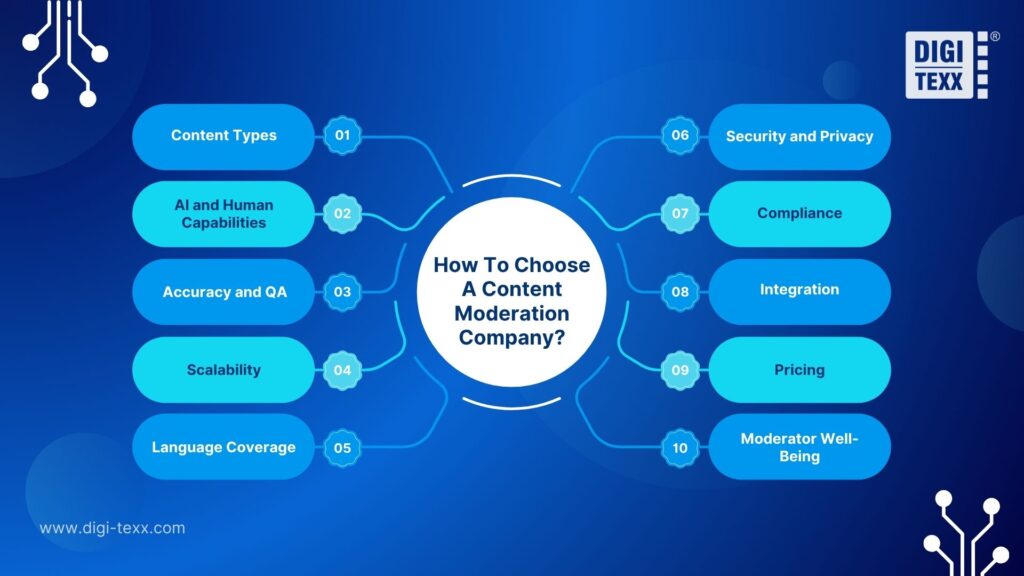
Choosing a content moderation company requires evaluating more than price. Businesses should consider the provider’s technology, human review capabilities, quality, security, scalability, and operational fit.
- Content Types: Check whether the provider supports the formats your platform needs, including text, images, video, audio, live streams, UGC, and marketplace content.
- AI and Human Capabilities: Evaluate AI detection, risk scoring, NLP, computer vision, multimodal moderation, and the provider’s human-in-the-loop escalation process.
- Accuracy and QA: Review how the provider manages false positives, false negatives, reviewer consistency, policy adherence, audits, calibration, and ongoing quality assurance.
- Scalability: Assess content-processing capacity, peak-volume handling, workforce flexibility, geographic redundancy, 24/7 coverage, and SLAs to ensure the provider can support future growth.
- Language Coverage: Check supported languages, regional dialects, native-language moderators, cultural expertise, multilingual AI, and language-specific QA.
- Security and Privacy: Evaluate encryption, access controls, secure moderation environments, data retention, data residency, confidentiality, and incident response practices.
- Compliance: Consider the provider’s experience with privacy, platform safety, child safety, content governance, industry-specific requirements, and audit reporting.
- Integration: Look for APIs, SDKs, webhooks, moderation dashboards, case management, automated escalation, and analytics that fit your existing workflow.
- Pricing: Compare pricing models such as per-item, hourly, volume-based, monthly, or custom enterprise pricing. Evaluate total cost of ownership (TCO) rather than headline price alone.
- Moderator Well-Being: Ask how the provider manages exposure to disturbing content through workload monitoring, content rotation, recovery policies, psychological support, training, and safe working environments.
>>> See more:
- Top 10 Data Extraction Tools to Automate Your Workflow
- 20 Best Data Integration Tools: Definition, Benefits & Features
- Data Quality Framework in Practice: Templates, Tools, and Real Use Cases
What Are Content Moderation Solutions?
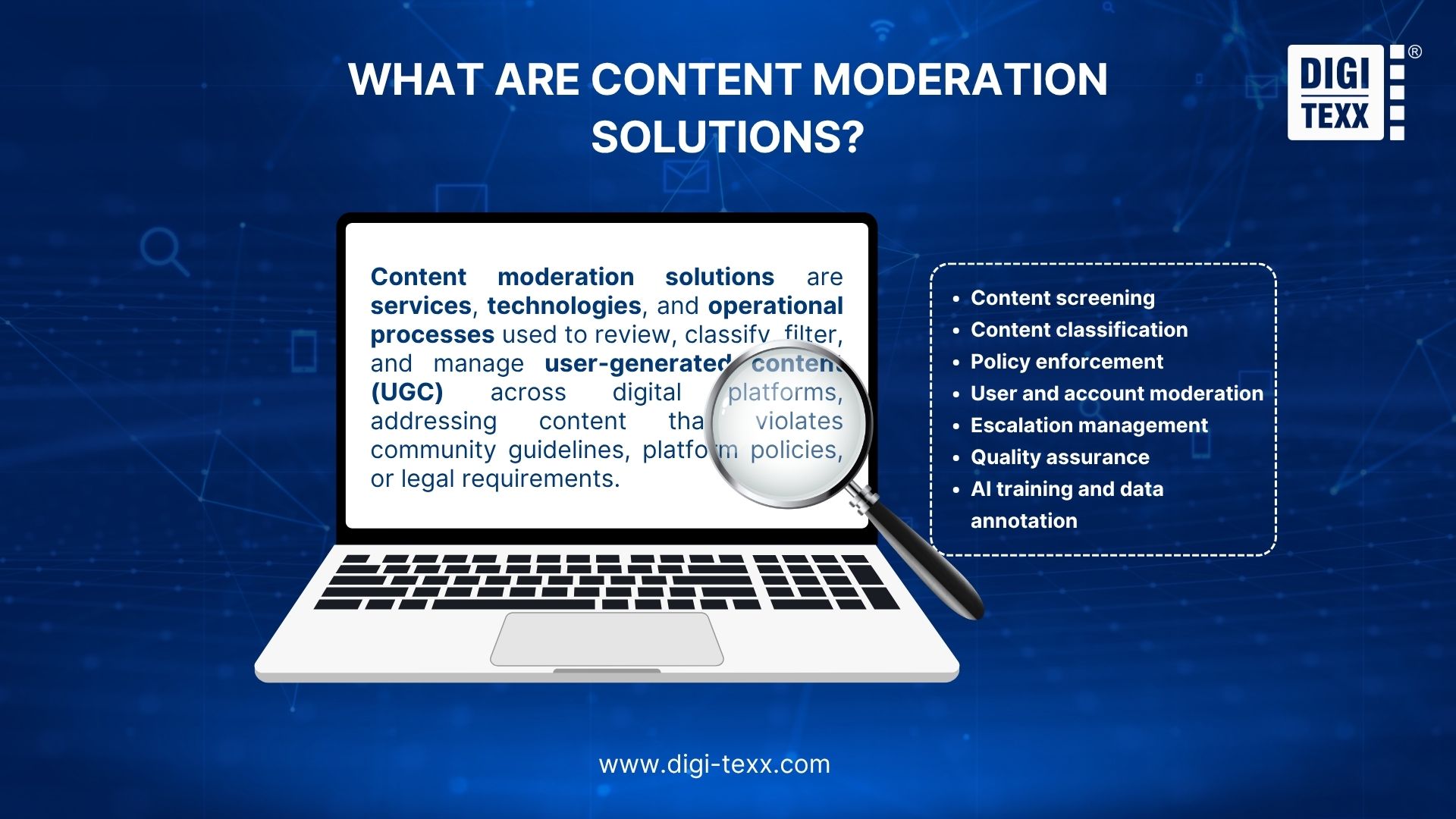
Content moderation solutions are services, technologies, and operational processes used to review, classify, filter, and manage user-generated content (UGC) across digital platforms, addressing content that violates community guidelines, platform policies, or legal requirements. Depending on the platform and risk profile, this can involve human moderators, automated AI systems, or a hybrid model.
A content moderation company’s role extends beyond removing inappropriate posts. Core activities typically include:
- Content screening and classification: Reviewing user-generated content and categorizing it by policy risk level
- Policy enforcement: Approving, removing, restricting, or escalating content based on platform rules
- User and account moderation: Catching abusive behavior, suspicious accounts, or coordinated abuse
- Escalation management: Routing ambiguous or high-severity cases to specialized reviewers
- Quality assurance: Auditing moderation decisions for accuracy and consistency
- AI training and data annotation: Creating labeled datasets to improve automated moderation models
Depending on the service model, this can also include 24/7 operations, multilingual review, and performance reporting.
Content formats and risks covered typically include:
- Text: posts, comments, reviews, messages
- Images and video: photos, memes, uploaded clips, livestreams
- Audio: voice messages, recorded calls
- Marketplace content: listings, seller profiles, transaction communications
Common policy targets: hate speech, harassment, graphic violence, sexual content, child safety risks, misinformation, spam, and fraud.
>>> See more:
- Data Cleaning: Definition, Benefits & Steps To Cleaning Data
- Construction Invoice Reconciliation: Process, Best Practices & Software 2026
- Top 10 Data Cleansing Companies for Businesses in 2026
FAQs About Content Moderation Companies
How Much Do Content Moderation Services Cost?
Content moderation costs vary based on content volume, content type, language coverage, moderation complexity, and AI versus human review. Providers may charge per item, per hour, by volume, or through custom enterprise contracts. High-risk or multilingual moderation generally costs more.
What Is The Difference Between AI And Human Content Moderation?
AI moderation uses machine learning, NLP, computer vision, and other technologies to review large volumes of content quickly. Human moderation provides contextual judgment for complex or ambiguous cases. Many platforms use a hybrid model that combines AI detection with human review.
How Do Content Moderation Companies Protect User Privacy?
Providers protect user data through measures such as encryption, access controls, secure moderation environments, data retention policies, and confidentiality procedures. Businesses should also verify a provider’s data protection practices, compliance requirements, and data residency policies before outsourcing moderation.
What Industries Need Content Moderation The Most?
Content moderation is especially important for social media, online communities, gaming, marketplaces, dating platforms, live-streaming, media and entertainment, and user-generated content platforms. Any business that allows users to publish or exchange content may require moderation.
How Do Companies Moderate User-Generated Content?
Companies typically use a hybrid moderation workflow. AI systems first screen and classify content, while human moderators review ambiguous, high-risk, or context-dependent cases. Content is then approved, removed, restricted, or escalated according to the platform’s community guidelines and enforcement policies
The right content moderation companies can help businesses balance moderation accuracy, scalability, operational cost, and user safety. When choosing a provider, consider content types, AI and human capabilities, QA, language coverage, security, compliance, integration, pricing, and moderator well-being. For businesses seeking a scalable outsourcing model, DIGI-TEXX offers content moderation alongside data processing, AI data services, and quality assurance to support high-volume digital operations.
DIGI-TEXX Contact Information:
🌐 Website: https://digi-texx.com/
📞 Hotline: +84 28 3715 5325
✉️ Email: [email protected]
🏢 Address:
- Headquarters: Anna Building, QTSC, Trung My Tay Ward
- Office 1: German House, 33 Le Duan, Saigon Ward
- Office 2: DIGI-TEXX Building, 477-479 An Duong Vuong, Binh Phu Ward
- Office 3: Innovation Solution Center, ISC Hau Giang, 198 19 Thang 8 street, Vi Tan Ward
References
- National Institute of Standards and Technology. (2024). Artificial Intelligence Risk Management Framework: Generative Artificial Intelligence Profile. U.S. Department of Commerce. https://www.nist.gov/publications/artificial-intelligence-risk-management-framework-generative-artificial-intelligence
- National Institute of Standards and Technology. (n.d.). AI Risk Management Framework Playbook. U.S. Department of Commerce. https://www.nist.gov/itl/ai-risk-management-framework/nist-ai-rmf-playbook
- Schaffner, B., et al. (2024). “Community Guidelines Make this the Best Party on the Internet”: An In-Depth Study of Online Platforms’ Content Moderation Policies. arXiv. https://arxiv.org/abs/2405.05225