

AI in investing is transforming the financial sector, moving well beyond buzzword status to become a foundational force reshaping capital management. Investors and financial institutions now use artificial intelligence to evaluate complex datasets, forecast market trends, and optimize portfolios with greater precision than traditional methods allow. In this article, DIGI-TEXX examines how AI in investing is redefining conventional investment approaches and what that means for the future of finance.
>>> Explore more:
- What are the 6 steps of the data analysis process?
- Top 10 Data Entry Outsourcing Companies to Hire in 2026
- Top 10 Best big data processing tool for Business 2026
What Is AI In Investing?
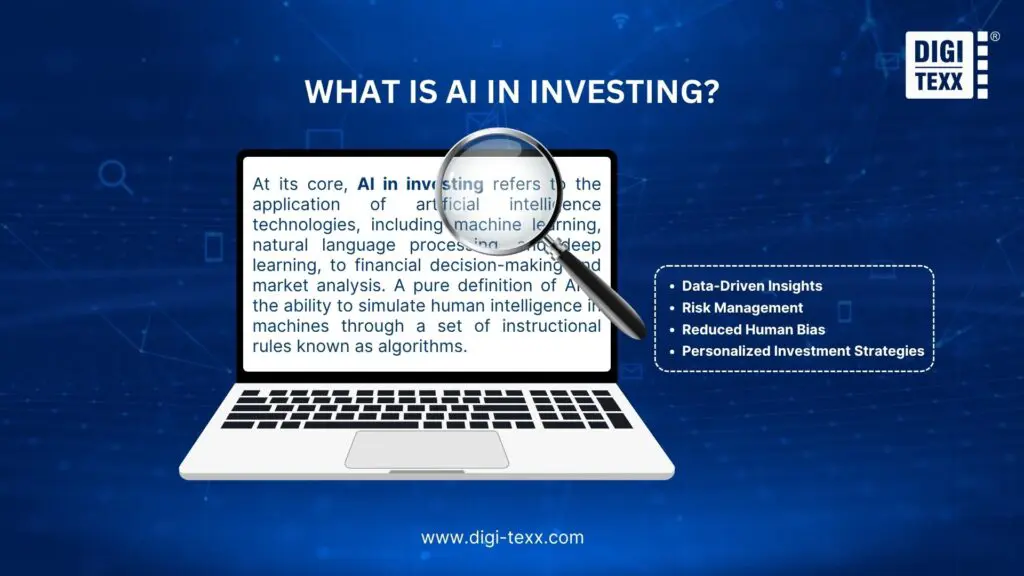
At its core, AI in investing refers to the application of artificial intelligence technologies, including machine learning, natural language processing, and deep learning, to financial decision-making and market analysis. A pure definition of AI is the ability to simulate human intelligence in machines through a set of instructional rules known as algorithms.
In the investing context, this means automating complex analytical tasks that would otherwise require significant human time and expertise. AI-powered investing systems can ingest vast quantities of structured and unstructured data, from earnings reports and macroeconomic indicators to news feeds and satellite imagery, and extract actionable signals far faster than any human analyst could.
Rather than replacing investor judgment, AI amplifies it, giving investors access to deeper analysis, broader data coverage, and faster execution than was previously imaginable.
>>> Explore more:
- Professional Fashion Photo Editing Services for Stunning Visuals
- Top 10 Data Cleansing Companies for Businesses in 2026
- Why Businesses Outsource Data Management in 2026?
The Rise Of AI In The Investment Industry
The application of AI in finance has been revolutionary. Investors now have more options thanks to its capacity to analyze enormous volumes of data and spot trends. Important uses consist of:
Natural Language Processing (NLP)
News articles, earnings reports, and even social media chatter can all be interpreted and analyzed by AI systems thanks to natural language processing (NLP). NLP assists investors in forecasting market sentiment and making data-driven choices by gleaning pertinent insights.

Sentiment Analysis
Sentiment analysis powered by AI measures the general attitude or public opinion about particular stocks, businesses, or markets. Investors have a distinct edge in spotting opportunities or possible hazards thanks to this real-time analysis.
High-Frequency Trading
AI algorithms are used in high-frequency trading (HFT) to execute trades quickly. These systems give investors an advantage in extremely volatile markets by analyzing market data, spotting lucrative opportunities, and completing transactions in milliseconds.
>>> See more:
- Financial Data Quality Management: Benefits & How To Improve It
- Best Insurance Claims Processing Outsourcing BPO in the US 2026
- Best Data Cleansing Outsourcing Companies for 2026
Key Benefits of AI For Investors And Financial Institutions
AI offers a plethora of benefits to individual investors and financial institutions alike, helping them make smarter, faster, and more reliable decisions. Here are the core ways AI creates value:
Data-Driven Insights
Traditional investment strategies rely heavily on human expertise and intuition. Data analytics in investing enhances this process by analyzing massive datasets to uncover hidden patterns and trends, offering actionable insights that were previously inaccessible.
Risk Management
Risk is an inherent part of investing. AI helps mitigate this by analyzing historical and real-time data to predict potential risks. This enables investors to diversify their portfolios and prepare for market fluctuations more effectively.
>>> See more:
- An Overview of Document Processing Company: What You Need to Know
- Invoice Processing Outsourcing Services For US Businesses
- How to Automate Documentation in 2026: Step By Step Guide
Reduced Human Bias
Human investors are often influenced by cognitive biases such as anchoring, recency bias, overconfidence, and loss aversion. AI systems apply consistent rules to every decision, reducing emotional influence and enabling more disciplined and consistent investment execution.
Practical Applications Of AI In The Investment Process
AI delivers the most value when applied to specific tasks inside a structured investment process. The seven applications below show where AI creates the clearest advantages for investors today. Each one works best as a tool that sharpens human judgment rather than one that operates independently of it.
1. Stock Screening And Multi-Factor Analysis
AI evaluates companies across fundamental metrics, technical signals, market trends, and news sentiment simultaneously. A human analyst works through these dimensions sequentially. An AI system processes them together and adjusts each signal’s weight based on current market conditions.
During turbulent markets, the system leans on technical and sentiment data. During stable periods, it shifts focus toward growth fundamentals and alternative data. This dynamic prioritization is what separates AI stock analysis from traditional screening tools.
2. Summarize Investor Sentiment
Sentiment tools today do far more than label a headline as positive or negative. They apply contextual language understanding to interpret tone, subtext, and shifts in communication style across a body of text.
On an earnings call, the system reads beyond the scripted remarks. It tracks how an executive’s word choice changes when addressing specific topics, how their responses to analyst questions differ from prepared statements, and whether their tone on a business segment has shifted since the previous quarter.
>>> See more:
- Outsourced Order Processing Services – Fast & Accurate
- Best Photo Retouching Services – Enhance Your Photos Today
- Intelligent Document Processing Services: How It Works & Business Benefits
3. Portfolio Construction And Automated Rebalancing
AI portfolio tools match asset allocation to an investor’s goals, risk tolerance, and live market conditions. They draw on historical data to identify compositions that optimize returns while managing volatility, accounting for how assets correlate across different market environments.
Once a portfolio is live, the system monitors it continuously and rebalances automatically when allocations drift beyond defined limits. This removes the execution delays that come with manual oversight.

4. Offer Individualized Investment Advice
Personalization through AI extends well beyond a standard risk questionnaire. The system generates recommendations based on a complete financial profile: income patterns, spending behavior, employment sector, career stage, and geographic concentration.
A software engineer working in a technology hub already carries significant implicit exposure to the tech sector through their career and human capital. An AI system recognizes this and adjusts portfolio recommendations accordingly, reducing risk duplication that a generic model would overlook.
5. Assess Predictive Models And Risk
AI risk tools assess volatility, cross-asset correlations, and company-specific threats simultaneously from financial filings, news sources, and market data. Standard risk models apply fixed historical relationships. AI models update those relationships dynamically as conditions shift.
During market crises, asset class correlations behave unpredictably. An AI system can trace how stress in one sector, like commercial real estate, spreads through regional bank balance sheets, small-business credit, and consumer spending. Understanding this transmission allows investors to create targeted hedges and prepare for scenarios that correlation matrices alone can’t predict.
>>> See more:
- Secure Data Annotation Services: Top Companies & How to Choose
- 15 Best Data Labeling Service Providers In 2026
- Healthcare Back-Office Support Services For Efficient Operations
6. Regime-Aware Backtesting
Standard backtesting applies a strategy to historical data and measures results. AI-powered backtesting goes further by assessing the relevance of each historical period to current conditions before assigning it weight in the analysis.
Testing a strategy designed for electric-vehicle stocks, for example, the system determines that legacy automotive data from the 1990s is of limited relevance. Business models, competitive dynamics, and investor behavior in that era were structurally different from today. The system weights recent, structurally comparable periods more heavily.

7. Synthetic Scenario Generation
Synthetic data is AI-generated data engineered to replicate the statistical properties of real financial markets. Its core purpose is to address a persistent limitation in financial modeling: genuine historical examples of rare, high-impact market events are scarce.
By creating thousands of synthetic crisis scenarios that maintain real market stress traits while adding plausible variations, AI systems can stress-test strategies against conditions that haven’t occurred but are theoretically possible. Models relying solely on synthetic scenarios are fragile, so the most robust AI systems use synthetic data as a complement, ensuring conclusions are grounded in actual market evidence.
The Importance Of Data Cleansing In AI Investment Strategies
The effectiveness of AI in investing hinges on the quality of data it processes. Poor-quality data can lead to inaccurate predictions and misguided decisions. This makes data cleansing in AI investment a critical step in any AI-driven investment strategy.
Why does data cleansing matter?
- Accuracy: Removes errors and inconsistencies, ensuring reliable outputs.
- Efficiency: Eliminates duplicate data, optimizing processing time.
- Relevance: Filters out irrelevant information, allowing AI to focus on actionable insights.

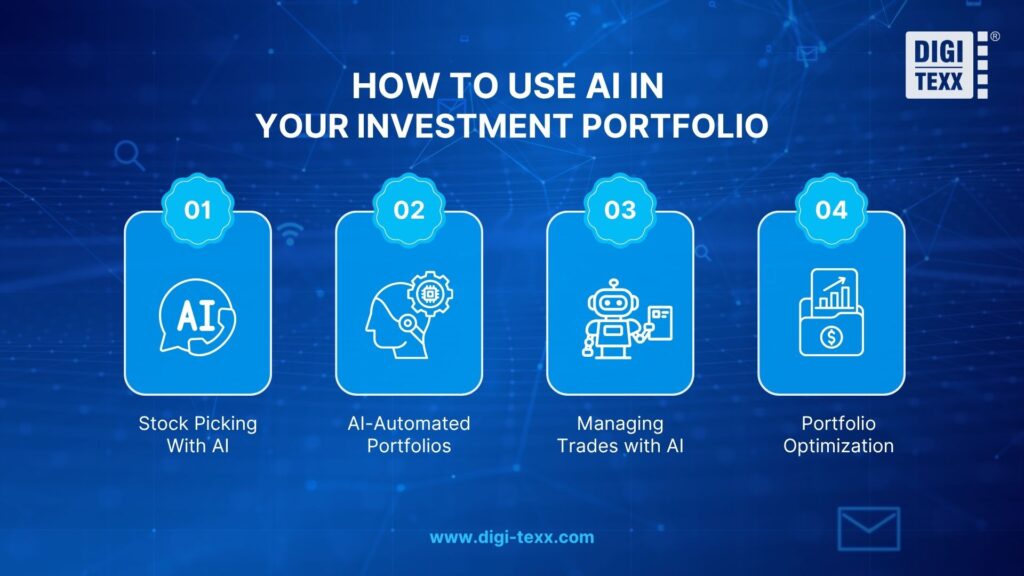
How To Use AI In Your Investment Portfolio?
AI offers practical tools across every stage of the investment process. Whether you are a retail investor looking to sharpen your stock selection or an institutional manager seeking to optimize a complex multi-asset portfolio, there is an AI application relevant to your needs.
Stock Picking With AI
AI-powered tools analyze vast amounts of data, including market trends, company performance, and economic indicators, to identify stocks with high growth potential. These systems uncover patterns and opportunities that are often overlooked by traditional methods. By providing real-time insights, AI enables investors to make more informed and confident stock-picking decisions.
>>> Explore more:
- Best Offshore Data Annotation Service Providers in 2026
- Product Photo Editing Services For eCommerce In The US
- Administrative Support Outsourcing: 2026 Complete Guide
AI-Automated Portfolios
AI-driven robo-advisors design and manage portfolios tailored to an investor’s risk tolerance, goals, and market conditions. These platforms automatically rebalance portfolios in real time to adapt to market changes, optimize returns, and minimize risks. This hands-off approach is ideal for both novice and experienced investors seeking efficient portfolio management.
Managing Trades With AI
AI enhances trading by executing orders at the best possible times and prices, ensuring precision and speed. It minimizes human errors, eliminates emotional decision-making, and takes advantage of fleeting market opportunities. By streamlining the trading process, AI increases efficiency and profitability for investors.
Portfolio Optimization
AI continuously evaluates and adjusts portfolios to maintain the ideal balance between risk and reward. It analyzes asset performance, market trends, and diversification to ensure alignment with financial objectives. By using predictive analytics, AI helps investors stay ahead of market shifts and maximize returns.
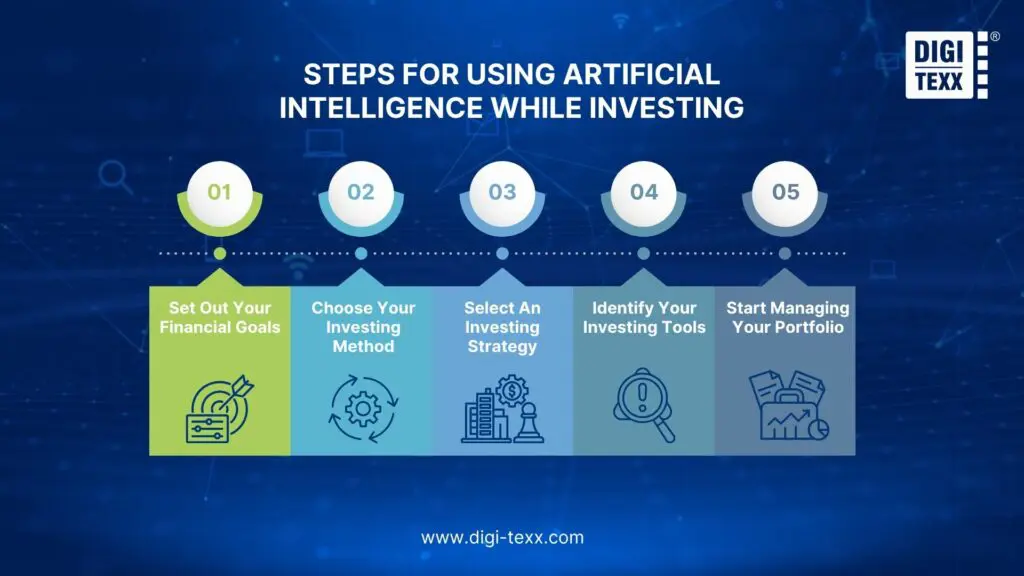
Steps For Using Artificial Intelligence While Investing
Step 1: Set Out Your Financial Goals
Define your investment objectives clearly before selecting any tool. Goals shape every downstream decision: the time horizon, acceptable risk level, return target, and liquidity needs. Specific, measurable goals also give you a baseline for evaluating whether AI tools are adding value. Without clear goals, you cannot assess whether the signals you receive are helping or hurting performance.
>>> See more:
- Architectural Photo Editing Service in the US | Top 5 Providers
- Medical Claims Processing Outsourcing For Healthcare Providers
- Top 7 Free AI Business Document Analysis Tools 2026
Step 2: Choose Your Investing Method
Decide whether to manage your investments independently using AI tools or rely on a platform that offers fully automated services like robo-advisors.
Step 3: Select An Investing Strategy
Match your strategy to your goals and method. Long-term passive investors benefit most from robo-advisors and automated rebalancing. Factor-based investors can use AI screeners to identify stocks with specific quality, value, or momentum characteristics. Active traders can apply sentiment and predictive analytics to refine timing and position management.
Your strategy should be defined and documented before you introduce AI tools. The tools should serve the strategy, not determine it.
Step 4: Identify Your Investing Tools
Select platforms that match your strategy and technical comfort level. Evaluate each tool on transparency, cost, regulatory status, and the quality of its underlying data. Start with one or two tools rather than attempting to integrate many systems at once.
Step 5: Start Managing Your Portfolio
Once your tools are in place, monitor your portfolio regularly. Use AI insights to rebalance and optimize your investments as market conditions evolve.
>>> See more:
- B2B Data Cleansing in 2026: The Guide to Maintaining Data Quality
- Top Document Scanning Software for 2026: Features, Pros & Cons
- 10+ Best Data Entry Software You should know
Top AI Investment Platforms For Investors
The AI investing platform landscape has grown significantly, with options catering to everyone from beginners to institutional professionals. Here is an overview of some of the leading platforms available in 2026.
Agent Factory
Developed by monday.com, Agent Factory takes a modular approach to AI investing by allowing users to build a custom team of AI agents rather than relying on a single all-purpose tool. Each agent can be assigned a specific role, monitoring market news, analyzing portfolio performance, tracking risk exposure, and agents can collaborate to surface coordinated insights.
The platform is designed for investors who want full control over how AI supports their strategy, with pricing ranging from a free tier to enterprise plans.
Magnifi
A conversational AI investing platform that allows users to ask complex investment questions in plain English. It aggregates portfolios from over 200 brokerages and provides personalized guidance while keeping the investor in control of all decisions. Magnifi is particularly well-suited for DIY investors who want professional-grade insights without the technical complexity.
>>> Explore more:
- Offshore BPO: Meaning, Example & Best Offshore BPO Company 2026
- Digitization Of Historical Documents: Importance & Process
- Top 13 Enterprise Document Solutions for Your Business Processes
TrendSpider
Designed for active traders, TrendSpider offers AI-powered technical analysis automation with automated chart pattern recognition and machine learning-driven strategy creation across over 150 candlestick patterns and multiple timeframes. Its no-code AI Strategy Lab allows traders to deploy custom machine learning models without programming knowledge.
WarrenAI
An AI research assistant built around Warren Buffett’s value investing philosophy. It combines a large financial database with AI trained on fundamental analysis to help investors find quality companies at fair prices. It includes tools for SWOT analysis, investment case generation, and access to Buffett’s annual letters and curated educational resources.
Composer
A no-code algorithmic trading platform that allows users to describe investment strategies in plain English and have the AI generate executable trading algorithms. With a community marketplace of over 3,000 pre-built strategies and zero trading commissions, Composer has become a popular choice for retail investors seeking institutional-grade automation.
Danelfin
An AI-powered stock scoring system that rates US and European stocks on a simple 1-to-10 scale and provides explainable AI transparency, showing exactly which fundamental, technical, and sentiment factors drove each rating. It is designed for data-driven investors who want accountability and clarity in their AI-generated signals.
>>> See more:
- What Is Data Processing? Key Types And Benefits
- Data Quality Management: Importance, Tools, and Best Practices
- What Is Business Process Management (BPM)? Definition & Benefits
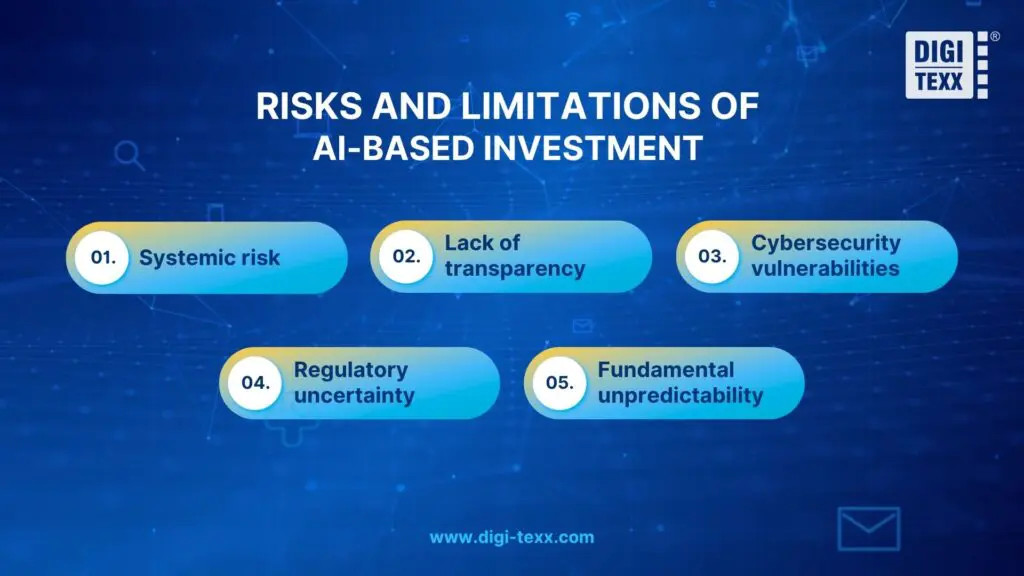
Risks And Limitations Of AI-Based Investment
AI in investing offers substantial benefits, but it also carries meaningful risks that every investor must understand before incorporating AI tools into their strategy:
- Systemic risk: Widespread adoption of similar AI models means many institutions may respond identically to the same market signals, creating synchronized movements that amplify volatility rather than reduce it, a concern the SEC has explicitly raised.
- Lack of transparency: Deep learning models are “black boxes”: they generate predictions without intelligible explanations. This complicates compliance, makes audits difficult, and erodes investor trust.
- Cybersecurity vulnerabilities: AI systems that ingest large datasets continuously are high-value targets. A compromised system could expose sensitive data, generate manipulated trade signals, or enable market manipulation. Security infrastructure must scale with AI deployment.
- Regulatory uncertainty: AI-specific rules on disclosures, explainability, and liability are still being written. Firms deploying AI aggressively in client-facing applications risk navigating regulatory changes retroactively.
- Fundamental unpredictability: No AI can predict markets with certainty. Markets are driven by human behavior, geopolitics, and regulation, not pure pattern repetition. A model optimized for one market regime may fail in another it has never encountered. No AI tool guarantees returns.
FAQs About AI In Investing
Can You Use AI For Investing?
Yes, absolutely. AI tools for investing are widely available and accessible to investors at every level of experience and capital. Retail investors can use AI-powered apps for stock analysis, portfolio tracking, and automated rebalancing. Active traders can use AI to automate technical analysis and build algorithmic strategies.
Institutional investors use AI for everything from deal sourcing and due diligence to portfolio optimization and investor communications. The key is matching the right AI tools to your specific investment goals, strategy, and workflow.
What Are The Opportunities Of AI In Investing?
The opportunities of AI in investing are extensive and span both the act of investing in AI companies and the use of AI as an investment tool. As an investment target, AI presents opportunities in semiconductor infrastructure, the chips required to power complex algorithms, and in large cloud service providers that give businesses access to advanced AI computing capabilities. Both represent high-growth segments of the technology sector.
As an investment tool, AI creates opportunities to gain superior market insights, manage risk more precisely, reduce behavioral biases, execute trades more efficiently, and build more resilient portfolios, advantages that were once exclusive to the world’s largest financial institutions.
Is AI Investment A Suitable For Beginner Investors?
Yes, AI investing can be suitable for beginner investors if it is used as a support tool rather than a substitute for understanding. Many AI investing platforms are designed for beginners, with simple interfaces, plain-language explanations, and guided features such as portfolio recommendations and automatic rebalancing. These tools can make investing more accessible and less intimidating.
AI in investing is reshaping the investment landscape, offering unparalleled opportunities for both individual investors and financial institutions. From analyzing data to managing risks and optimizing portfolios, AI-driven strategies are more efficient, accurate, and reliable than ever before.
By leveraging AI as DIGI-TEXX guided above in your investment portfolio, you can gain a competitive edge and make informed decisions that align with your financial goals. The future of investing is here-start exploring the possibilities of AI today!
If you have any questions or would like expert advice on data analytics services, please feel free to contact us using the information below.
DIGI-TEXX Contact Information:
🌐 Website: https://digi-texx.com/
📞 Hotline: +84 28 3715 5325
✉️ Email: [email protected]
🏢 Address:
- Headquarters: Anna Building, QTSC, Trung My Tay Ward
- Office 1: German House, 33 Le Duan, Saigon Ward
- Office 2: DIGI-TEXX Building, 477-479 An Duong Vuong, Binh Phu Ward
- Office 3: Innovation Solution Center, ISC Hau Giang, 198 19 Thang 8 street, Vi Tan Ward
Reference:
- World Economic Forum. (n.d.). How the power of AI can revolutionize the financial markets. https://www.weforum.org/stories/2026/01/how-the-power-of-ai-can-revolutionize-the-financial-markets/
- Financial services’ deliberate approach to AI. (n.d.). MIT Sloan School of Management. https://mitsloan.mit.edu/ideas-made-to-matter/financial-services-deliberate-approach-to-ai