Big Data companies help businesses collect, store, process, and analyze large volumes of data to support better decision-making and digital transformation. However, these companies differ in their areas of expertise, from cloud data infrastructure and analytics platforms to data management and processing services. In this article, DIGI-TEXX explores 20 leading data companies in 2026, highlighting their scale, core solutions, and industry focus.
>>> See more:
- Top 20 Data Cleaning Companies Popular In The USA 2026
- Top 20 Data Entry Outsourcing Companies to Hire in 2026 [List]
- Best 20 BPO Companies in Vietnam 2026: Compare Providers
What Is Big Data?
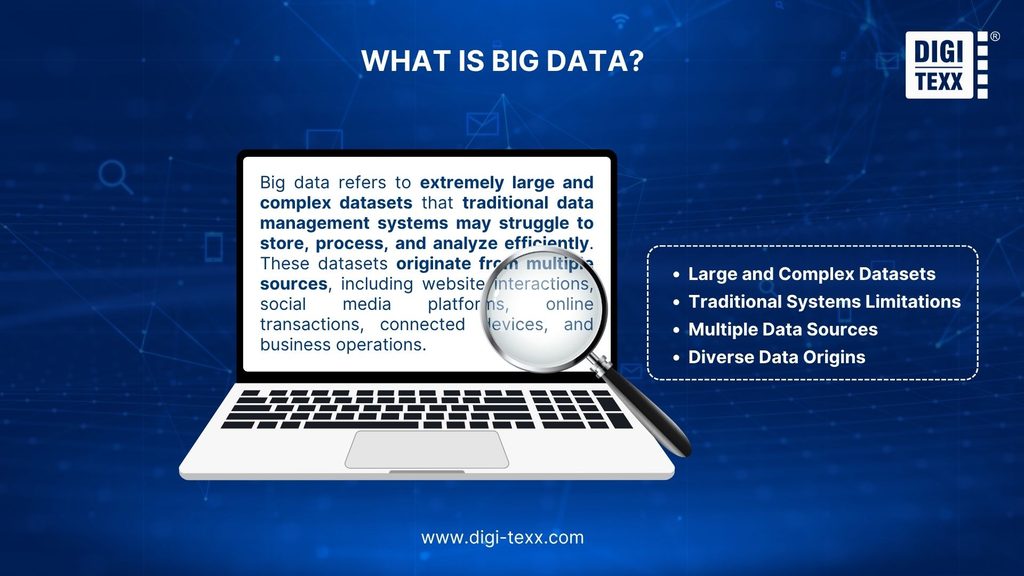
Big data refers to extremely large and complex datasets that traditional data management systems may struggle to store, process, and analyze efficiently. These datasets originate from multiple sources, including website interactions, social media platforms, online transactions, connected devices, and business operations. According to the National Institute of Standards and Technology (NIST), big data requires scalable architectures to support efficient storage, processing, and analysis.
Big data is commonly described through five key characteristics, known as the Five Vs:
- Volume: The vast amounts of data generated from digital platforms, transactions, and connected devices.
- Velocity: The speed at which data is generated and processed, often requiring real-time or near-real-time analysis.
- Variety: Different data formats, including structured, semi-structured, and unstructured data.
- Veracity: The accuracy, consistency, and reliability of data.
- Value: The actionable insights and business benefits that organizations can gain from data.
These characteristics highlight both the opportunities and challenges for identifying patterns, understanding customer behavior, improving operational efficiency, and supporting better business decisions. However, extracting meaningful insights requires specialized technologies for data storage, integration, processing, management, and analytics.
Big data companies provide the platforms, tools, and expertise that help organizations manage complex datasets and extract actionable insights, and support data-driven decision-making.
>>> See more:
- Back Office Support Services: What Businesses Need To Know
- Document Indexing Services To Improve Search Accuracy & Data Retrieval
Key Criteria For Evaluating Leading Data Companies
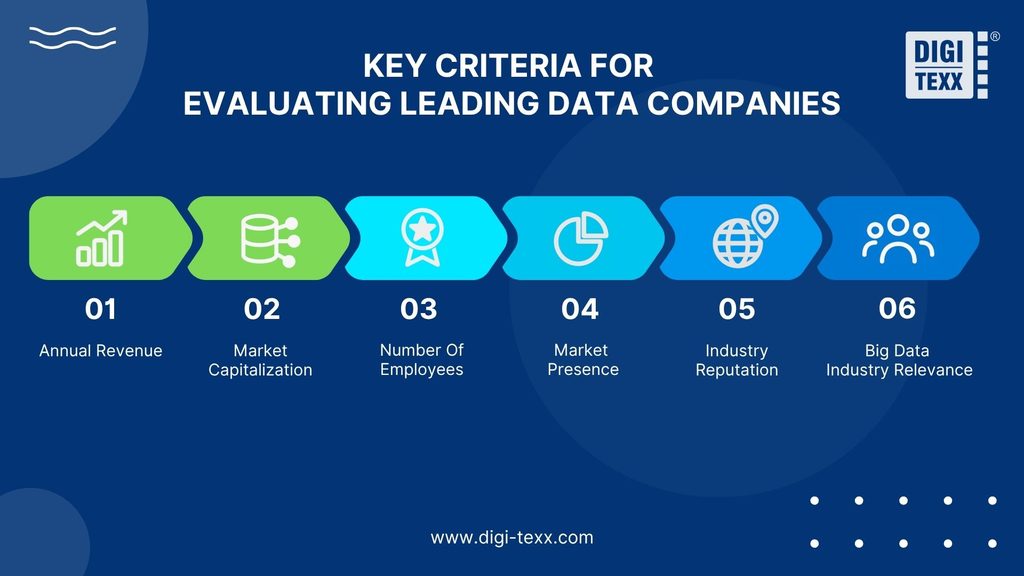
Identifying large and reputable data companies requires more than looking at their revenue or brand recognition. Businesses should consider several factors, including financial performance, operational scale, market influence, and expertise in the Big Data industry. The following criteria provide a basis for evaluating and comparing leading companies:
- Annual Revenue: Indicates a company’s overall financial scale. Publicly reported revenue provides a useful reference for comparing company size, although consolidated revenue may include business activities unrelated to big data.
- Market Capitalization: Reflects the market value of a publicly traded company’s outstanding shares. This metric provides insight into its valuation but does not directly measure its capabilities or performance in the big data industry.
- Number of Employees: Provides an indication of organizational scale and available human resources. However, workforce size alone does not determine technical expertise or service quality.
- Market Presence: A company’s geographic reach, customer base, strategic partnerships, and presence across global markets help demonstrate its market influence and ability to serve businesses at scale.
- Industry Reputation: Industry reputation can be assessed through customer relationships, strategic partnerships, industry recognition, certifications, and coverage in reputable industry reports. These indicators help establish a company’s credibility and standing in the market.
- Big Data Industry Relevance: Company size alone does not determine its importance in the Big Data sector. Its core products, platforms, and services should demonstrate clear involvement in areas such as data storage, cloud infrastructure, data integration, processing, management, and analytics.
These criteria provide a framework for evaluating leading data companies rather than establishing a definitive ranking. Financial and operational metrics indicate overall company scale, while industry reputation and big data expertise help assess each company’s relevance to enterprise data requirements.
>>> See more:
- Why Businesses Outsource Data Management in 2026?
- What are the 6 steps of the data analysis process?
Top 20 Biggest Data Companies In 2026
This list features 20 major companies in the Big Data industry, compiled with reference to The Business Research Company – Big Data Platform and Tools Market Size Report 2026-2030 and CRN’s 2026 Big Data 100. The selection considers company scale, market presence, industry reputation, and contributions to Big Data technologies and services.
| Company | Headquarters / Principal Office | Latest Annual Revenue | Primary Data Focus |
| Microsoft | Redmond, Washington, USA | $331.8 billion (FY2026) | Cloud computing, data management, and analytics |
| Amazon Web Services (AWS) | Seattle, Washington, USA (Amazon headquarters; AWS is a business segment) | $128.7 billion (FY2025, AWS segment) | Cloud infrastructure, data storage, and analytics |
| Alphabet (Google Cloud) | Mountain View, California, USA | $402.8 billion (FY2025, Alphabet consolidated; not Google Cloud revenue) | Cloud data platforms, data analytics, and AI |
| IBM | Armonk, New York, USA | $67.5 billion (FY2025) | Hybrid cloud, data management, and AI |
| Oracle | Austin, Texas, USA | $67.4 billion (FY2026) | Enterprise databases and cloud data infrastructure |
| SAP | Walldorf, Germany | €36.8 billion (FY2025) | Enterprise data management and business analytics |
| Dell Technologies | Round Rock, Texas, USA | $113.5 billion (FY2026) | Enterprise storage and IT infrastructure |
| Hewlett Packard Enterprise (HPE) | Spring, Texas, USA | $34.3 billion (FY2025) | Hybrid cloud and enterprise data infrastructure |
| Databricks | San Francisco, California, USA | Not publicly disclosed | Lakehouse platform, data engineering, and AI |
| Snowflake | Menlo Park, California, USA (principal executive office) | $4.68 billion (FY2026) | Cloud data platform, warehousing, and analytics |
| Palantir Technologies | Aventura, Florida, USA | $4.48 billion (FY2025) | Data integration, analytics, and operational AI |
| MongoDB | New York City, New York, USA | $2.46 billion (FY2026) | NoSQL databases and application development |
| Cloudera | San Jose, California, USA (listed office) | Not publicly disclosed | Hybrid data management and analytics |
| Teradata | San Diego, California, USA | $1.66 billion (FY2025) | Enterprise data warehousing and analytics |
| SAS Institute | Cary, North Carolina, USA | More than $3 billion in annual sales (company-reported) | Advanced analytics and AI |
| Elastic | Distributed company; no principal executive office | $1.74 billion (FY2026) | Search, observability, and security |
| Informatica* | Redwood City, California, USA (pre-acquisition) | $1.64 billion (FY2024, standalone) | Enterprise data integration, quality, and governance |
| Salesforce | San Francisco, California, USA | $41.5 billion (FY2026) | CRM, customer data, and analytics |
| Cisco Systems | San Jose, California, USA | $63.3 billion (FY2026) | Networking, observability, and security analytics |
| Qlik | King of Prussia, Pennsylvania, USA | Not publicly disclosed | Data integration and business intelligence |
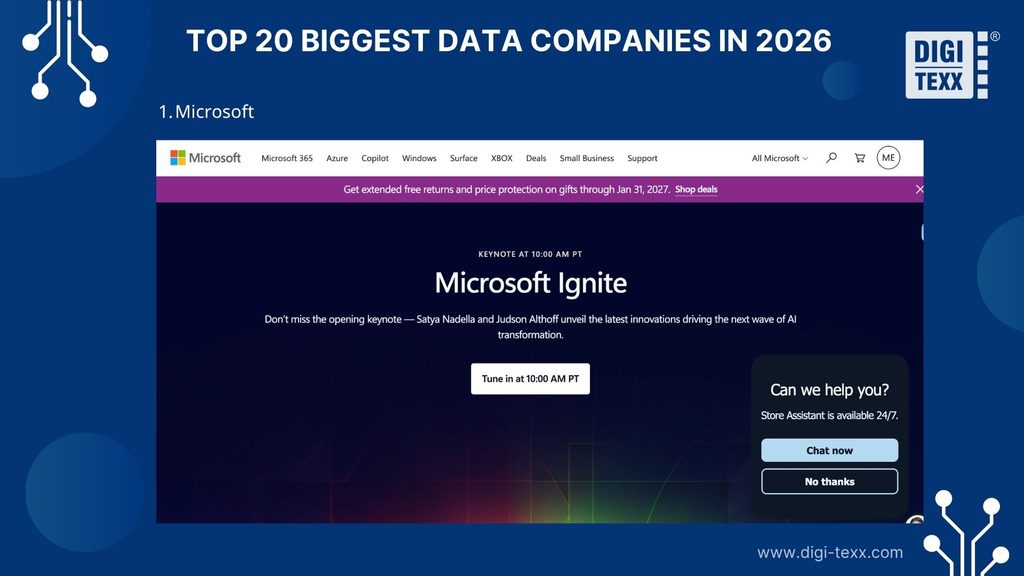
1. Microsoft
Microsoft is a global technology company known for its software, cloud computing, and enterprise solutions. Its data ecosystem helps businesses store, process, manage, and analyze information across cloud and on-premises environments.
Key Data Solutions:
- Microsoft Fabric: An integrated platform for data engineering, warehousing, real-time analytics, and business intelligence.
- Azure Data Lake Storage: Scalable cloud storage for large volumes of structured and unstructured data.
- Power BI: A business intelligence tool for creating interactive dashboards and turning data into actionable insights.
Best For: Businesses seeking an integrated cloud data and analytics ecosystem, particularly those already using Microsoft products.
Strengths: Broad enterprise ecosystem, seamless product integration, and flexible hybrid cloud capabilities.
Industries Served: Financial services, healthcare, retail, manufacturing, government, and technology.
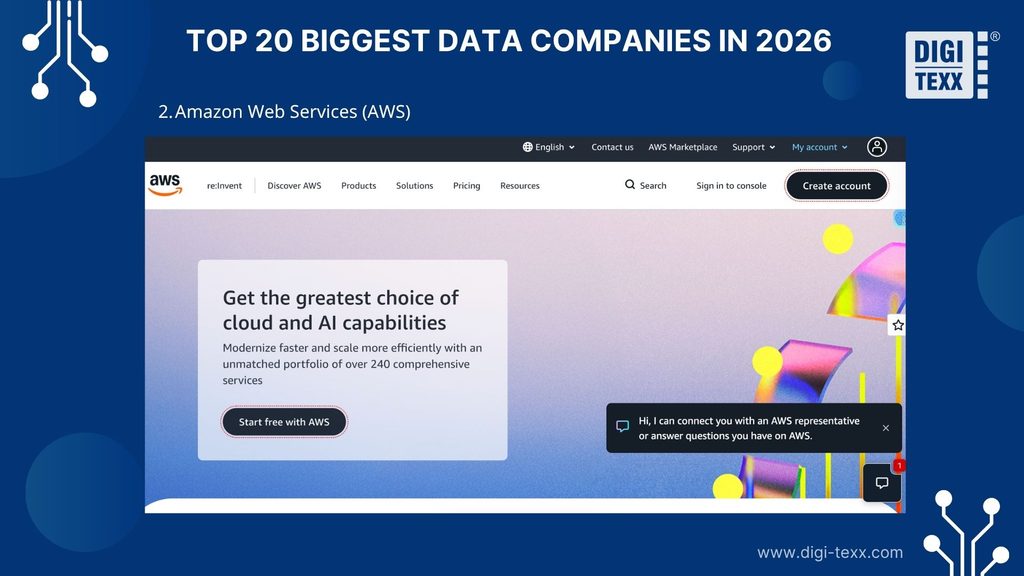
2. Amazon Web Services (AWS)
Amazon Web Services (AWS) is a leading cloud computing provider offering infrastructure and managed services for storing, processing, and analyzing large datasets.
Key Data Solutions:
- Amazon S3: Scalable object storage for managing large volumes of structured and unstructured data.
- Amazon Redshift: A cloud data warehouse for querying and analyzing large datasets.
- AWS Glue: A data integration service for discovering, preparing, and transforming data across systems.
Best For: Businesses building scalable cloud data infrastructure, data lakes, and analytics pipelines.
Strengths: Extensive cloud infrastructure, flexible scalability, and integration with a broad range of data services.
Industries Served: Financial services, healthcare, retail, manufacturing, media, and technology.
3. Alphabet (Google Cloud)
Alphabet is a global technology company whose Google Cloud division provides cloud infrastructure, data analytics, and AI solutions to help businesses manage and extract insights from large datasets.
Key Data Solutions:
- BigQuery: A serverless data warehouse for analyzing large datasets using SQL.
- Google Cloud Dataflow: A managed service for building batch and real-time data processing pipelines.
- Looker: A business intelligence platform for data exploration, reporting, and interactive dashboards.
Best For: Businesses seeking cloud-native analytics, real-time data processing, and integrated AI capabilities.
Strengths: Scalable serverless infrastructure, strong AI integration, and advanced data analytics capabilities.
Industries Served: Financial services, healthcare, retail, manufacturing, telecommunications, and technology.
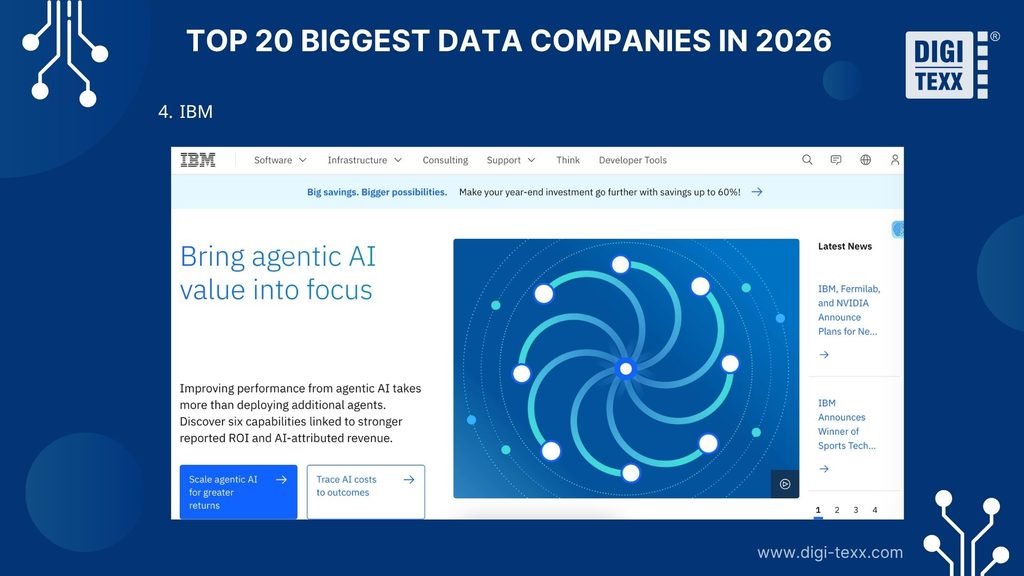
4. IBM
IBM is a global technology and consulting company specializing in enterprise IT infrastructure, hybrid cloud, data management, and AI. Its solutions help organizations manage complex data environments and prepare information for analytics.
Key Data Solutions:
- IBM watsonx.data: A hybrid data lakehouse for accessing and analyzing data across different environments.
- IBM Db2: An enterprise database management system for storing and querying business data.
- IBM StreamSets: A data integration platform for building and managing data pipelines across cloud and on-premises systems.
Best For: Large enterprises requiring hybrid data management, enterprise databases, and AI-ready data infrastructure.
Strengths: Extensive enterprise technology expertise, hybrid cloud support, and strong data governance capabilities.
Industries Served: Banking, financial services, healthcare, government, manufacturing, and telecommunications.
5. Oracle
Oracle is an enterprise technology company known for its database software, cloud infrastructure, and business applications. Its solutions support transactional processing, enterprise data management, and advanced analytics.
Key Data Solutions:
- Oracle Autonomous Database: A managed database service that automates routine administration and database optimization.
- Oracle Autonomous Data Warehouse: A cloud data warehouse designed for large-scale reporting and analytical workloads.
- Oracle Analytics Cloud: A platform for data preparation, visualization, reporting, and business insights.
Best For: Enterprises using Oracle databases and business applications that need integrated data management and analytics.
Strengths: Mature database technology, automated management, and integration with enterprise applications.
Industries Served: Financial services, healthcare, retail, manufacturing, telecommunications, and government.
>>> See more:
- 17 Data Labeling Service Providers To Consider In 2026
- Leading Intelligent Document Processing Companies Reviews 2026
6. SAP
SAP is an enterprise software company specializing in ERP systems and business applications. Its data solutions help organizations connect information across finance, supply chains, procurement, and other business functions.
Key Data Solutions:
- SAP Business Data Cloud: A managed data platform that connects SAP and third-party data for analytics and AI.
- SAP Datasphere: A data management solution for integrating and harmonizing information while preserving business context.
- SAP Analytics Cloud: A platform for business intelligence, data visualization, and enterprise planning.
Best For: Organizations using SAP applications that need unified business data and analytics across enterprise operations.
Strengths: Deep integration with ERP systems, strong business process expertise, and consistent enterprise data management.
Industries Served: Manufacturing, retail, consumer products, financial services, healthcare, and utilities.
7. Dell Technologies
Dell Technologies is an IT infrastructure company providing enterprise storage, servers, and networking solutions. Its data infrastructure helps organizations store, protect, and access large datasets for business and analytics workloads.
Key Data Solutions:
- PowerScale: Scale-out storage for managing large volumes of unstructured data.
- PowerStore: Enterprise storage for databases, applications, and virtualized workloads.
- ObjectScale: Object storage designed for cloud-native applications and data-intensive workloads.
Best For: Enterprises requiring scalable storage infrastructure for large datasets, analytics, and mission-critical applications.
Strengths: Broad storage portfolio, enterprise-grade performance, and flexible infrastructure for different data workloads.
Industries Served: Financial services, healthcare, manufacturing, government, telecommunications, and media.
8. Hewlett Packard Enterprise (HPE)
Hewlett Packard Enterprise (HPE) provides enterprise IT infrastructure, hybrid cloud, and storage solutions. Its portfolio helps organizations manage data across on-premises, edge, and cloud environments.
Key Data Solutions:
- HPE GreenLake: A cloud-based platform for managing infrastructure and data services across hybrid environments.
- HPE Alletra: An enterprise storage portfolio designed for applications and data-intensive workloads.
- HPE Data Fabric Software: A data management platform for connecting and accessing distributed data across different environments.
Best For: Large organizations managing distributed data environments that require hybrid cloud infrastructure and enterprise storage.
Strengths: Enterprise infrastructure expertise, hybrid cloud flexibility, and scalable storage capabilities.
Industries Served: Financial services, healthcare, manufacturing, government, telecommunications, and technology.
9. Databricks
Databricks is a data and AI company known for its lakehouse architecture, which combines data lake flexibility with data warehouse capabilities. Its platform supports data engineering, analytics, and AI development.
Key Data Solutions:
- Databricks Lakehouse: A unified environment for data engineering, data warehousing, analytics, and AI workloads.
- Delta Lake: An open-source storage framework that improves data reliability through features such as ACID transactions.
- Unity Catalog: A governance solution for managing data access, permissions, and lineage.
Best For: Organizations building large-scale data pipelines, analytics environments, and AI applications.
Strengths: Unified data and AI workflows, open lakehouse architecture, and centralized data governance.
Industries Served: Financial services, healthcare, retail, manufacturing, media, and technology.
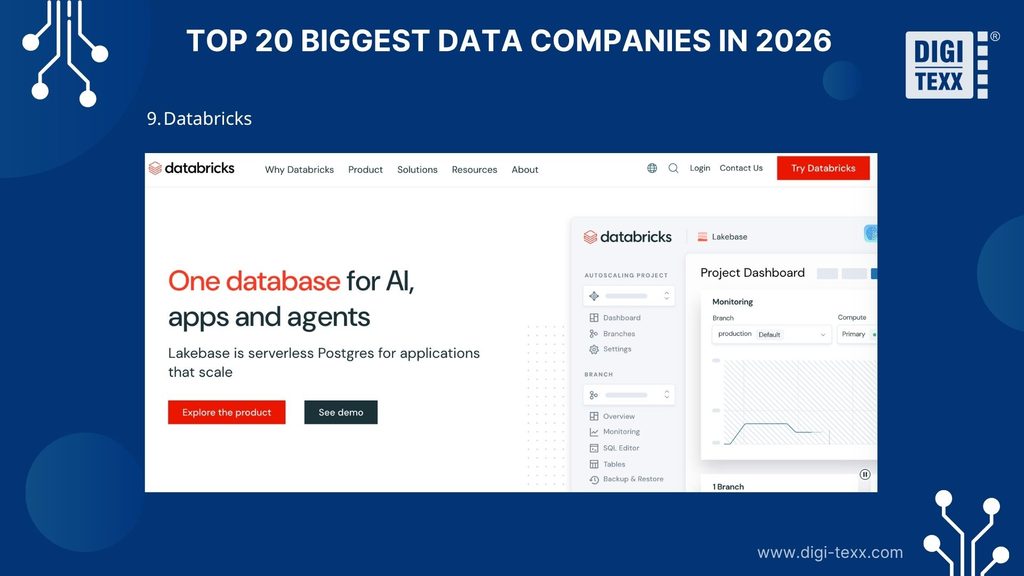
10. Snowflake
Snowflake is a cloud-based data platform that helps organizations store, integrate, process, and analyze information across cloud environments.
Key Data Solutions:
- Snowflake Data Warehouse: A cloud data warehousing solution for storing and querying structured and semi-structured data.
- Snowpark: A developer framework for processing data and building applications using languages such as Python, Java, and Scala.
- Snowflake Cortex AI: AI capabilities that help businesses build applications and analyze enterprise data using large language models.
Best For: Businesses seeking cloud-native data warehousing, analytics, data sharing, and AI capabilities.
Strengths: Flexible scalability, managed cloud infrastructure, and secure data collaboration.
Industries Served: Financial services, healthcare, retail, advertising, manufacturing, and technology.
>>> See more:
- Data Validation & Verification: Differences With Clear Examples
- Healthcare Back-Office Support Services For Efficient Operations
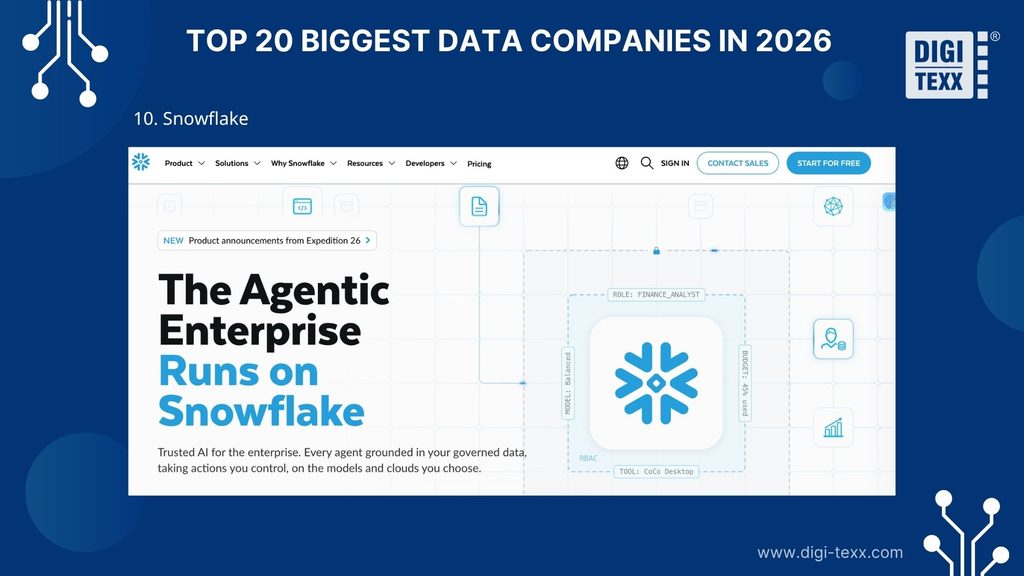
11. Palantir Technologies
Palantir Technologies develops software platforms that help organizations integrate complex data, analyze information, and connect insights with operational decisions.
Key Data Solutions:
- Palantir Foundry: A data operations platform for integrating information from multiple sources and supporting enterprise analytics.
- Palantir Gotham: A platform for government and intelligence organizations to analyze complex datasets and investigate relationships.
- Palantir AIP: An AI platform that connects large language models with enterprise data and operational workflows.
Best For: Government agencies and large enterprises managing complex data environments and mission-critical operations.
Strengths: Advanced data integration, operational analytics, and AI capabilities designed for controlled environments.
Industries Served: Government, defense, healthcare, manufacturing, energy, and financial services
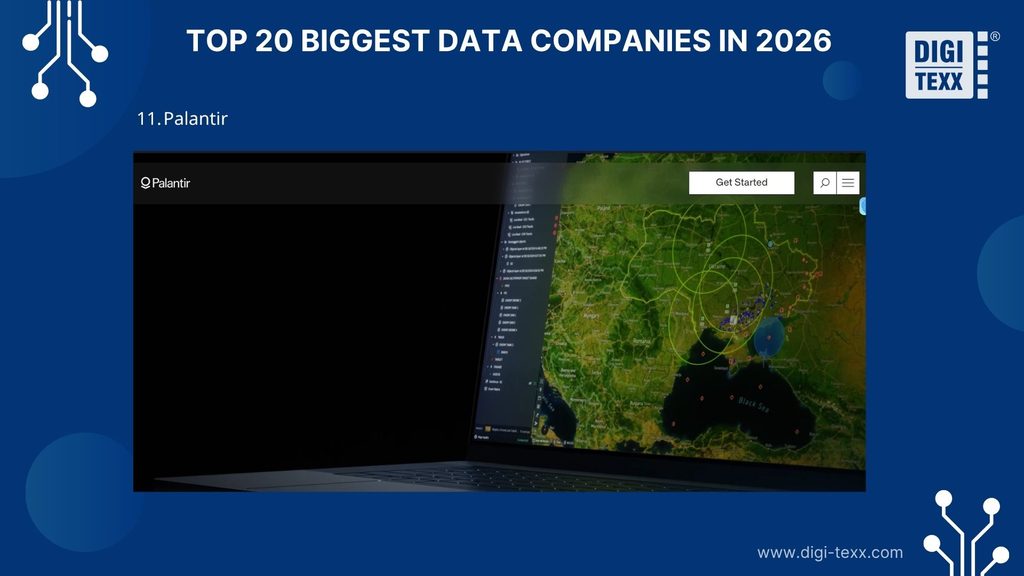
12. MongoDB
MongoDB is a database technology company known for its document-oriented NoSQL database. Its platform helps developers manage flexible data structures and build scalable, data-intensive applications.
Key Data Solutions:
- MongoDB Atlas: A managed multicloud database service for deploying and scaling MongoDB applications.
- MongoDB Atlas Search: A search capability that enables full-text search across application data.
- MongoDB Vector Search: A solution for semantic search and AI applications, including retrieval-augmented generation (RAG).
Best For: Developers and businesses building modern applications that require flexible data storage, scalable access, and AI-powered search.
Strengths: Flexible document data model, multicloud deployment, and integrated search capabilities.
Industries Served: Financial services, healthcare, retail, media, telecommunications, gaming, and technology.
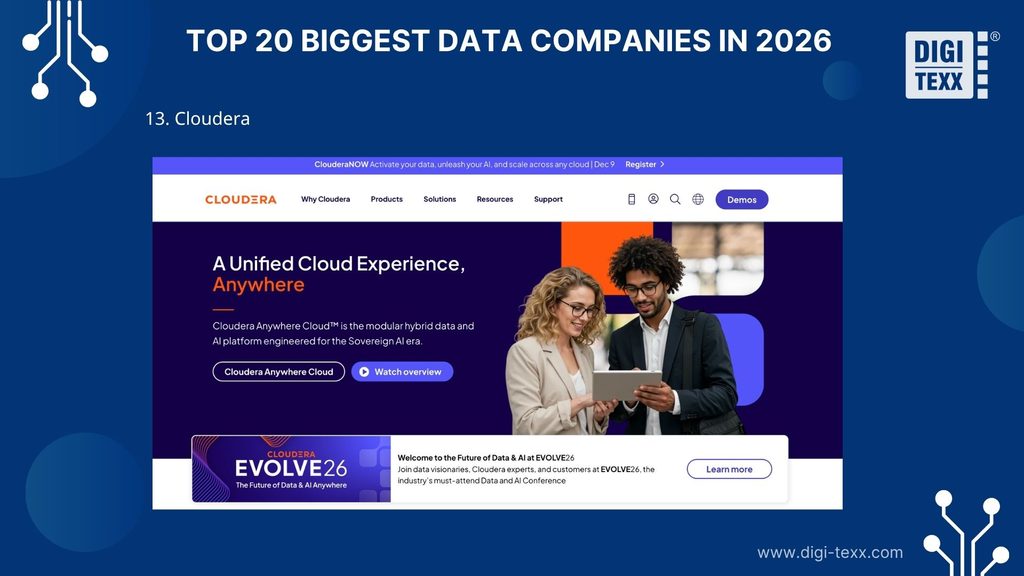
13. Cloudera
Cloudera is an enterprise data and AI company providing a hybrid data platform for managing and analyzing information across public clouds, private clouds, and on-premises environments.
Key Data Solutions:
- Cloudera Data Platform (CDP): A hybrid platform for managing enterprise data and analytics workloads across different environments.
- Cloudera Data Engineering: Tools for building and managing large-scale data pipelines using technologies such as Apache Spark.
- Cloudera Data Flow: A data ingestion and streaming solution for moving information between different systems.
Best For: Large enterprises with hybrid or multicloud environments that need centralized data management and large-scale processing.
Strengths: Hybrid cloud flexibility, open-source technology integration, and unified data governance.
Industries Served: Financial services, telecommunications, healthcare, government, manufacturing, and energy.
14. Teradata
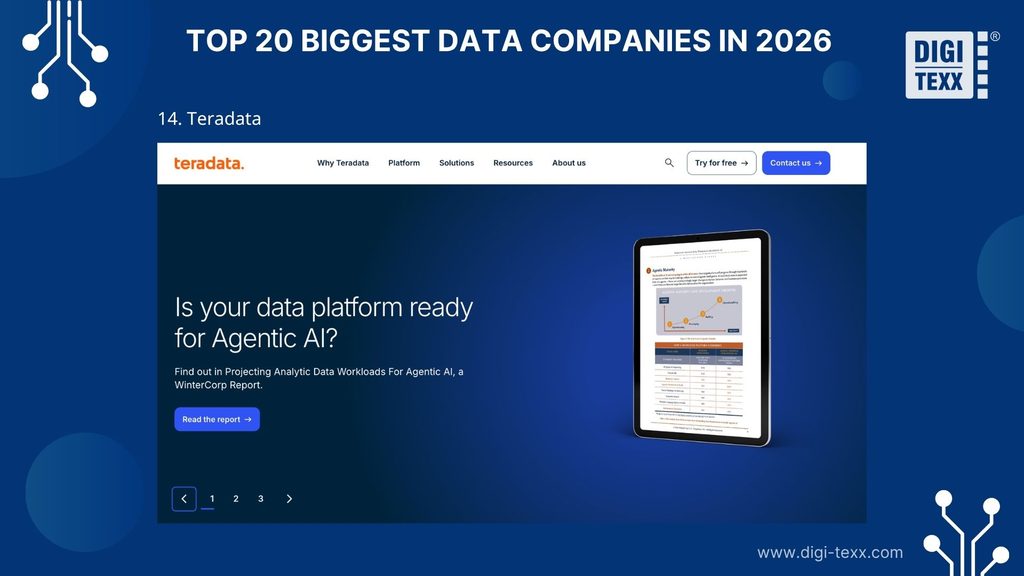
Teradata is an enterprise data and analytics company specializing in large-scale data management, cloud analytics, and AI-driven decision support.
Key Data Solutions:
- Teradata VantageCloud: A cloud analytics platform for managing and analyzing large enterprise datasets.
- Teradata AI Studio: Capabilities for developing and operationalizing AI and machine learning workflows.
- Teradata Fabric: Data connectivity capabilities that help organizations access information across distributed systems.
Best For: Large enterprises managing complex data environments and requiring scalable analytics across cloud and on-premises systems.
Strengths: Enterprise-scale analytics expertise, support for complex workloads, and hybrid data connectivity.
Industries Served: Financial services, telecommunications, healthcare, retail, manufacturing, and government.
15. SAS Institute
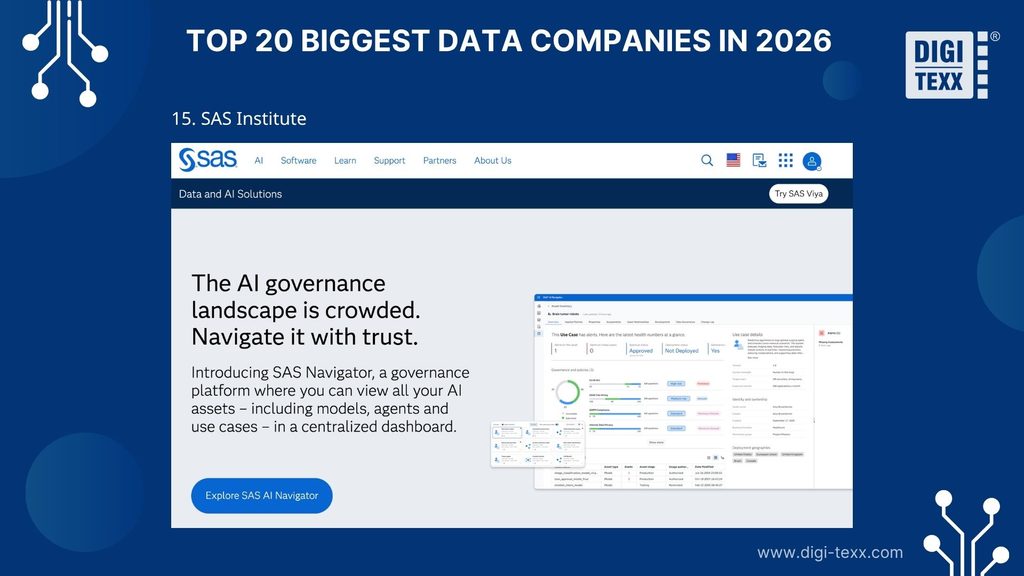
SAS Institute is an analytics and AI software company specializing in data management, statistical analysis, predictive modeling, and business intelligence.
Key Data Solutions:
- SAS Viya: A cloud-native platform for data preparation, statistical analysis, machine learning, and model deployment.
- SAS Visual Analytics: A business intelligence solution for exploring data and creating interactive dashboards.
- SAS Model Manager: Tools for managing, deploying, and monitoring analytical models throughout their lifecycle.
Best For: Organizations relying on advanced analytics, statistical modeling, and predictive insights to support complex business decisions.
Strengths: Deep statistical expertise, mature analytics technology, and integrated model management capabilities.
Industries Served: Banking, insurance, healthcare, government, retail, manufacturing, and life sciences.
>>> See more:
- Insurance Back Office Support Services for Insurers & Agencies
- Outsource Order Processing: Reduce Costs & Scale Faster With BPO Experts
- What is Optical Character Recognition (OCR) and How Does It Work?
16. Elastic
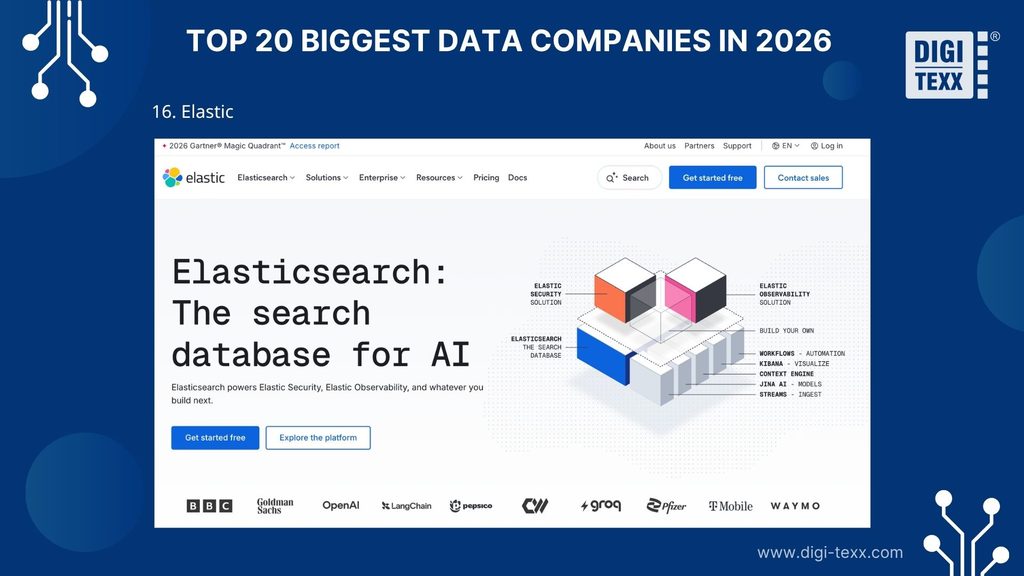
Elastic is a search-powered technology company that helps organizations search, analyze, and monitor large volumes of structured and unstructured data. Its platform supports enterprise search, observability, and security analytics.
Key Data Solutions:
- Elasticsearch: A distributed search and analytics engine for indexing, querying, and analyzing large datasets.
- Elastic Observability: A solution for monitoring applications and infrastructure through logs, metrics, and traces.
- Elastic Security: A security analytics platform for detecting threats and investigating incidents across IT environments.
Best For: Organizations requiring powerful search, real-time application monitoring, and security analytics.
Strengths: Fast data search, flexible deployment options, and integrated search, observability, and security capabilities.
Industries Served: Financial services, technology, telecommunications, retail, healthcare, government, and media.
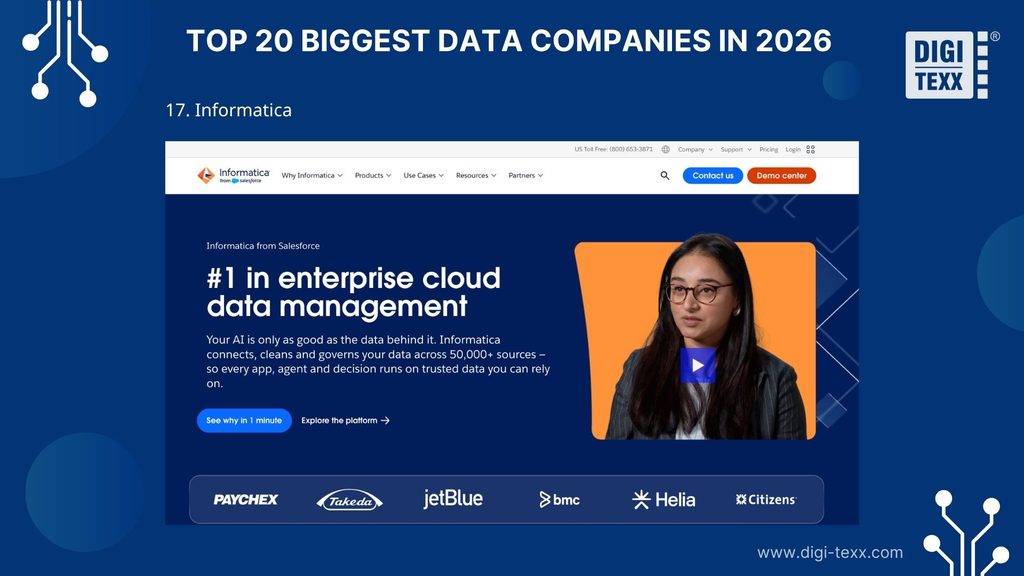
17. Informatica
Informatica is a data management software provider specializing in data integration, quality, governance, and master data management. It became part of Salesforce following the completion of its acquisition in November 2025.
Key Data Solutions:
- Intelligent Data Management Cloud (IDMC): A cloud platform combining data integration, quality, governance, and management capabilities.
- Cloud Data Integration: Tools for connecting data sources and building pipelines across applications and cloud environments.
- Master Data Management (MDM): Solutions for maintaining consistent business records, such as customer, product, and supplier data.
Best For: Enterprises that need to integrate fragmented data sources, improve data quality, and establish consistent data governance.
Strengths: Broad data management capabilities, AI-assisted data management, and support for hybrid and multicloud environments.
Industries Served: Financial services, healthcare, life sciences, retail, manufacturing, telecommunications, and the public sector.
18. Salesforce
Salesforce is a global enterprise software company best known for its customer relationship management (CRM) platform. Its data ecosystem helps businesses unify customer information, connect applications, and improve customer-facing operations.
Key Data Solutions:
- Salesforce Data Cloud: A platform for unifying customer data from different sources and creating comprehensive customer profiles.
- Tableau: A business intelligence platform for exploring data and building interactive dashboards.
- MuleSoft Anypoint Platform: An integration platform that connects applications, data sources, and systems through APIs.
Best For: Businesses seeking to unify customer data, connect CRM applications, and improve sales, marketing, and service analytics.
Strengths: Strong CRM integration, extensive business application ecosystem, and combined data integration and analytics capabilities.
Industries Served: Financial services, retail, healthcare, manufacturing, telecommunications, education, and professional services.
19. Cisco Systems
Cisco Systems is a global technology company specializing in networking, cybersecurity, and IT infrastructure. Through its Splunk portfolio, Cisco also helps organizations collect and analyze machine data to improve security and operational visibility.
Key Data Solutions:
- Splunk Enterprise: A platform for collecting, searching, and analyzing machine-generated data, including logs and events.
- Splunk Enterprise Security: A security analytics solution for detecting threats and investigating incidents.
- Splunk Observability Cloud: A platform for monitoring application and infrastructure performance using metrics and traces.
Best For: Organizations that need to analyze machine data, monitor complex IT environments, and improve cybersecurity operations.
Strengths: Strong networking and security expertise, extensive machine-data analytics, and integrated observability capabilities.
Industries Served: Financial services, telecommunications, government, healthcare, manufacturing, retail, and technology.
20. Qlik
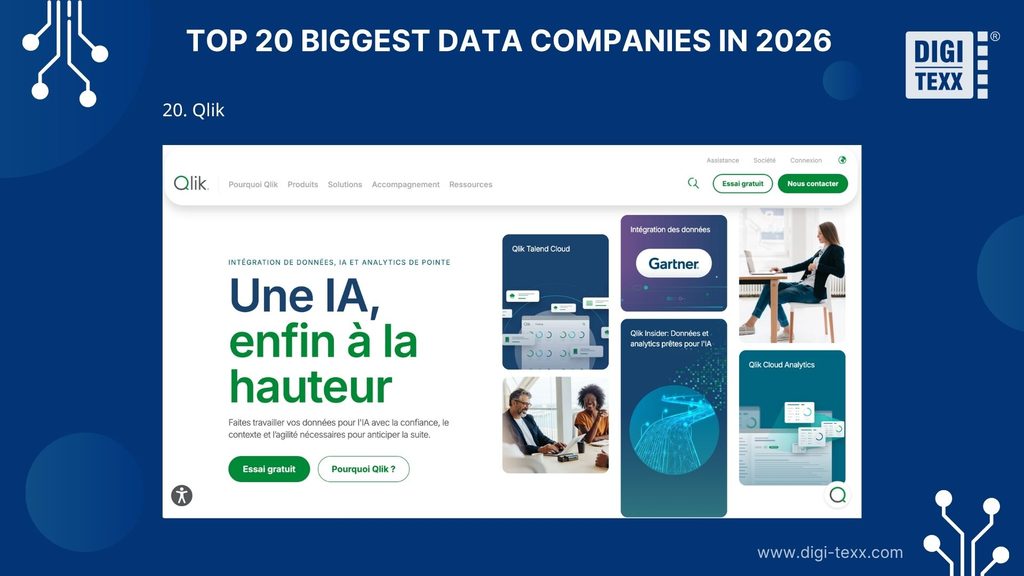
Qlik is a data integration and analytics company that helps organizations collect, transform, govern, and analyze information from different sources.
Key Data Solutions:
- Qlik Cloud Analytics: A cloud-based platform for data exploration, interactive dashboards, and self-service analytics.
- Qlik Talend Cloud: A data integration and quality platform for connecting data sources and building reliable data pipelines.
- Qlik Replicate: A data replication solution for moving information from databases into cloud platforms and data warehouses.
Best For: Businesses that need to combine data integration and business intelligence across multiple databases, cloud platforms, and enterprise applications.
Strengths: Integrated data integration and analytics capabilities, real-time data replication, and flexible data exploration.
Industries Served: Financial services, healthcare, retail, manufacturing, telecommunications, energy, and the public sector.
While the companies above provide the platforms and infrastructure for managing and analyzing Big Data, businesses also need reliable data processing services to make their information accurate, structured, and ready for use. DIGI-TEXX, a Data Processing and Digital Services Provider, helps organizations meet this need through data annotation services, document processing services, and intelligent document processing (IDP).
By combining specialized expertise with technology-driven workflows, DIGI-TEXX helps businesses process large volumes of data, reduce manual workloads, improve data quality, and prepare information for AI applications. These services enable organizations to build a more reliable data foundation while optimizing their day-to-day operations.
>>> See more:
- Ecommerce Back Office Support Services By DIGI-TEXX
- Professional E-commerce Data Entry Services by DIGI-TEXX
- Outsource Data Processing Services: Providers & QA
How To Choose The Right Big Data Company For Your Business
Choosing the right Big Data company requires businesses to evaluate their goals, data requirements, technical infrastructure, and budget. The following factors can help identify a provider that delivers long-term value.
- Business Needs: Businesses should identify their primary objectives, whether they involve data storage, processing, analytics, or AI development. The provider’s core solutions and industry expertise should align with these requirements.
- Data Volume and Scalability: Evaluate whether the provider can handle current data volumes and scale its infrastructure as business needs grow. This helps maintain performance as data requirements become more complex.
- Technology and Integration: Consider compatibility with existing databases, cloud platforms, enterprise applications, and analytics tools. Seamless integration helps avoid data silos and unnecessary system changes.
- Security and Compliance: Review the provider’s data protection measures, including encryption, access controls, and security certifications. Compliance with relevant regulations is also essential when handling sensitive information.
- Pricing and Support: Compare the total cost of ownership, including storage, processing, implementation, and maintenance. Businesses should also assess technical support, response times, and ongoing assistance.
>>> See more:
- What Is Document Control Process? Steps, Benefits & Requirements
- How To Prepare A Classified Balance Sheet: Steps & Example
Frequently Asked Questions
Who Are The Big 5 Data Center Companies?
The Big 5 hyperscale data center providers are Amazon Web Services (AWS), Microsoft Azure, Google Cloud, Meta, and Oracle Cloud Infrastructure (OCI). They operate large-scale global data center networks to support cloud computing and AI workloads.
What Are The Top 10 Data Analytics Companies In The US?
The 10 leading data analytics companies in the US include Microsoft, Google, IBM, Oracle, SAS Institute, Databricks, Snowflake, Palantir Technologies, Teradata, and Qlik. They provide solutions for data management, business intelligence, advanced analytics, and AI-powered insights.
We hope this overview from DIGI-TEXX has helped businesses better understand the biggest data companies, explore the solutions they offer, and identify the technologies and partners that best fit their data needs. With a clearer understanding of the available options, businesses can find suitable solutions to support their data strategies and business goals.
>>> See more:
- Data Cleansing Outsourcing: Top Companies to Hire in 2026
- Data Labeling Service: What It Is, Types & Benefits For AI
- Invoice Reconciliation Process: 6 Steps & How It Works
For businesses seeking additional guidance or expert support with document processing and data extraction, please feel free to contact DIGI-TEXX using the information below.
DIGI-TEXX Contact Information:
🌐 Website: https://digi-texx.com/
📞 Hotline: +84 28 3715 5325
✉️ Email: [email protected]
🏢 Address:
Headquarters: Anna Building, QTSC, Trung My Tay Ward
- Office 1: German House, 33 Le Duan, Saigon Ward
- Office 2: DIGI-TEXX Building, 477-479 An Duong Vuong, Binh Phu Ward
- Office 3: Innovation Solution Center, ISC Hau Giang, 198 19 Thang 8 street, Vi Tan Ward
Reference:
- NIST Big Data glossary – Background definition and architecture context.
- Microsoft FY2026 Annual Report – FY2026 consolidated revenue.
- Teradata official platform page – May 2026 product renaming.
- CRN 2026 Big Data 100 – Editorial industry context, not evidence for this article’s ordering.
- The Business Research Company – Market background; a specific report URL and its coverage should be confirmed.