
Business process documentation tools have become essential for organizations facing increasingly complex workflows and rising demands for operational efficiency. Manually creating and maintaining process documentation is not only time-consuming but also highly susceptible to errors, placing a significant administrative burden on teams. In this article, DIGI-TEXX explores 18 of the best business process documentation tools to help you identify the solution that best fits your organization’s needs.
>>> See more:
- What is Automated Document Processing and How Does It Work?
- Top 10 Data Processing Software For Business 2026 – Best Tool Reviewed
- Outsourced data annotation services: List of best companies to work for
Top 18 Best Business Process Documentation Tools
Here are the top 18 best process documentation tools, which are highly recommended by experts:
1. Tango
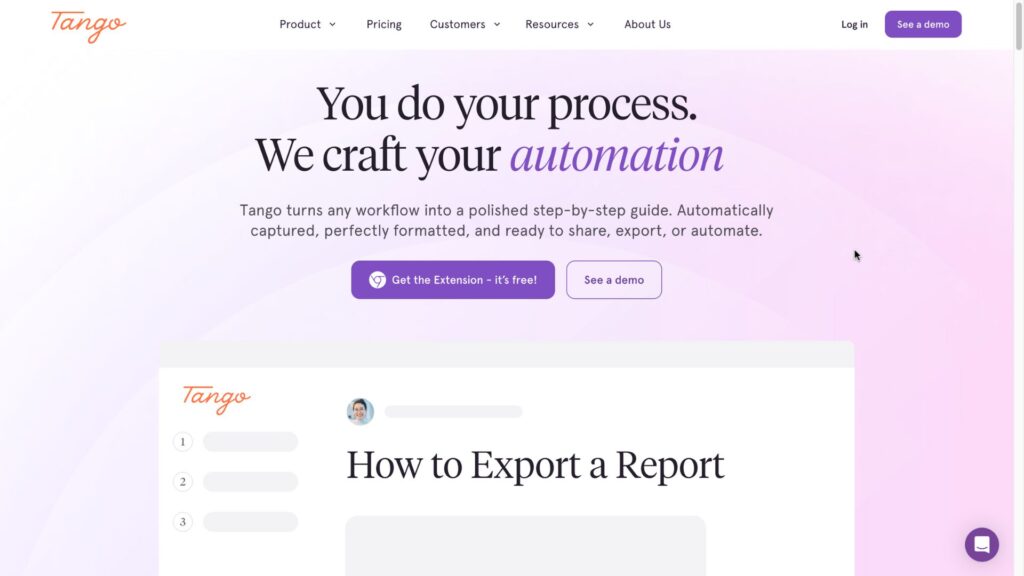
Tango is an innovative browser-based process documentation tool that revolutionizes how organizations create workflow guides through intelligent automation. Designed for customer support teams, training departments, and operations managers, Tango automatically captures every step of your workflows in real-time, eliminating tedious manual documentation work.
What sets Tango apart is its AI-driven workflow intelligence that automatically generates comprehensive step-by-step guides with annotated screenshots and written instructions as you work. The built-in analytics engine identifies bottlenecks and improvement opportunities, enabling teams to optimize processes while organizing documents efficiently in shared workspaces.
Pros
- Enhances training and onboarding.
- Automates process documentation, saving time and effort.
- AI-driven workflow insights.
- Real-time process recording and screenshot capture.
- Organizes documents efficiently in shared workspaces.
Cons
- Does not support exporting files to Microsoft PowerPoint.
- Limited to browser-based usage.
>>> See more:
- Automate Document Workflow: A Complete Guide for Businesses
- Top 12 Data Entry Outsourcing Companies In United States
2. Lucidchart
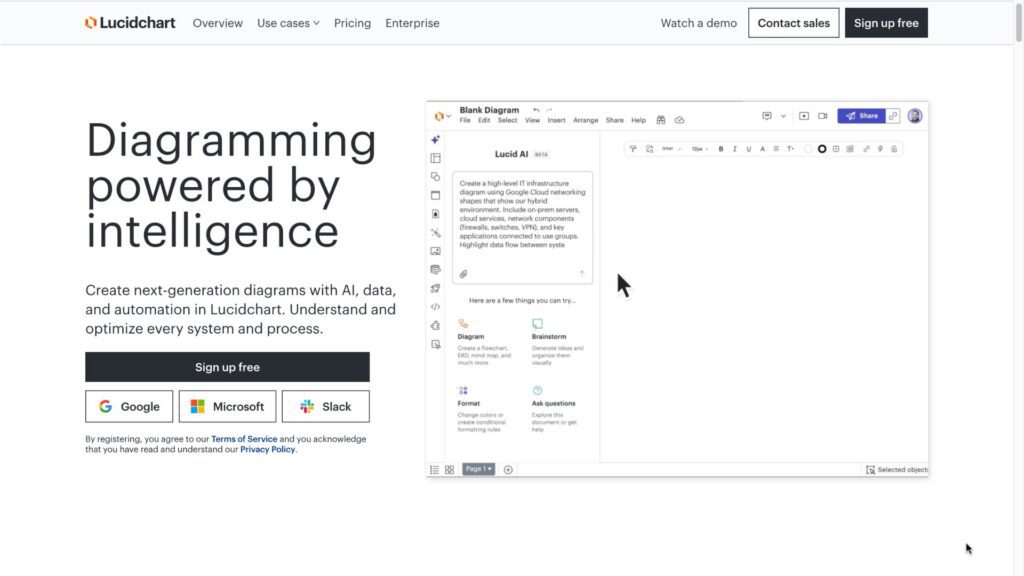
Lucidchart is a cloud-based visual documentation tool that simplifies business process mapping through an intuitive drag-and-drop interface. Designed for cross-functional teams, project managers, and business analysts, Lucidchart enables organizations to create professional flowcharts, technical diagrams, and process maps without requiring design expertise or extensive training.
Lucidchart’s key differentiator is its powerful real-time collaboration capability that allows multiple team members to work simultaneously on diagrams, regardless of technical skill level. The platform offers flexible sharing options and role-based permissions ideal for cross-functional teams, with a free plan available to explore core features before upgrading.
Pros
- Intuitive drag-and-drop interface requires minimal learning curve.
- Real-time collaboration enables teams to work together seamlessly.
- Free plan available to explore core features.
- Flexible sharing options for different user roles.
- Versatile tool for both simple flowcharts and complex technical diagrams.
Cons
- Advanced features require a paid subscription.
- The free plan has limitations on the number of documents.
- Can become expensive for larger teams needing premium features.
- Some users report occasional lag with very complex diagrams.
- Limited offline capabilities.
3. Process Street
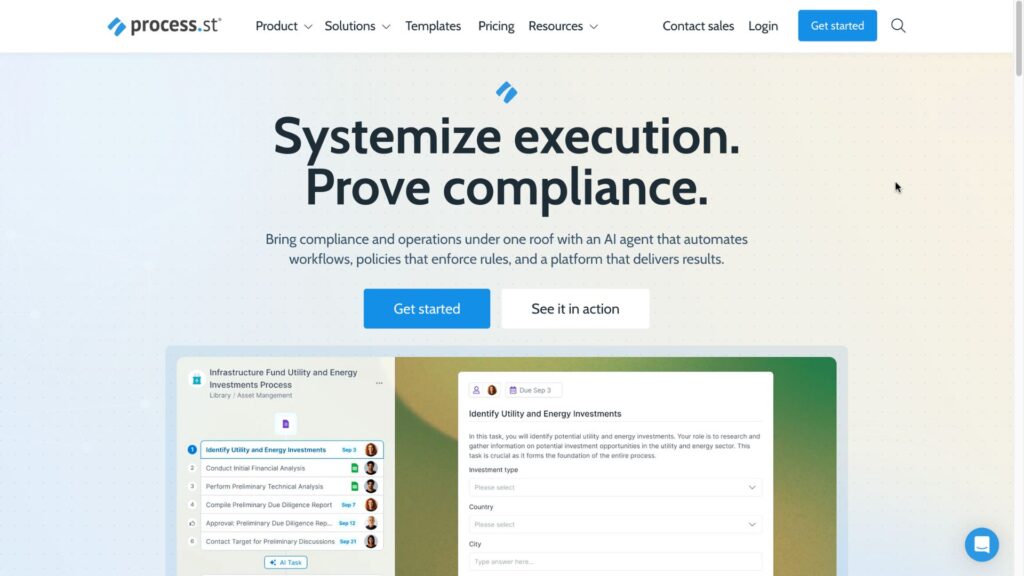
Process Street is a workflow automation tool that helps organizations manage and execute recurring processes with consistency and efficiency. Designed for teams in compliance, finance, HR, and operations across industries like fintech, healthcare, and technology, Process Street transforms repetitive tasks into automated, trackable workflows that eliminate manual oversight and reduce errors.
What distinguishes Process Street is its Process AI technology that enhances workflow automation while providing performance analytics to identify bottlenecks and optimization opportunities. Pre-built templates for onboarding, project management, and compliance workflows enable teams to deploy standardized processes immediately without building from scratch.
Pros
- Provides Process AI for enhanced automation.
- Supports complex workflows and diagrams.
- Easy and intuitive process creation with drag-and-drop functionality.
Cons
- Lacks advanced security options for restricting task access.
- Team leaders cannot limit access to specific tasks.
- Limited customization for access permissions.
- Limited offline functionality.
>>> See more:
- Top 10 Automated Document Processing Software
- What is Optical Character Recognition (OCR) and How Does It Work?
4. Document360
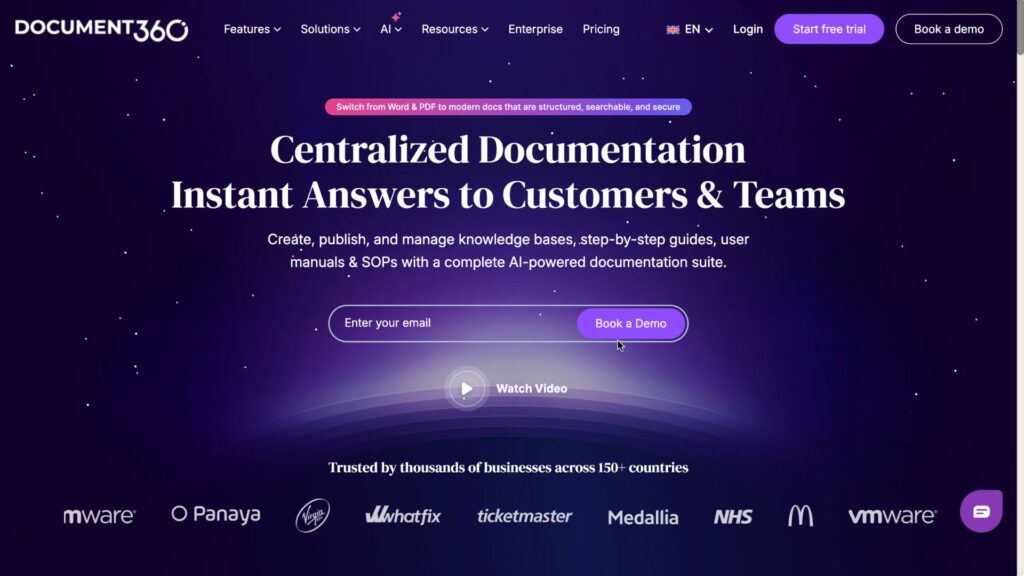
Document360 is a tool that leverages AI-driven content analysis to create, manage, and optimize business process documentation. Designed for businesses of all sizes, this tool helps teams maintain user-friendly, up-to-date documentation through automated content improvement suggestions and comprehensive version control that tracks every change in dynamic work environments.
Document360’s primary strength is its AI assistant (Eddy) that ensures tone consistency while automatically suggesting titles, tags, and SEO meta descriptions to enhance documentation discoverability. The platform supports both Markdown and an advanced editor, giving teams flexibility in content creation while maintaining professional standards.
Pros
- AI assistant (Eddy) ensures tone consistency.
- Supports both Markdown and an advanced editor.
- Seamless integration with Slack, Microsoft Teams, and Zendesk.
- Tailored for businesses of all sizes.
- Automatically suggests titles, tags, and SEO meta descriptions.
Cons
- The free version has limited features.
- Advanced features require a premium subscription.
- May have a learning curve for maximizing AI features.
- Limited functionality without a paid upgrade.
5. Confluence
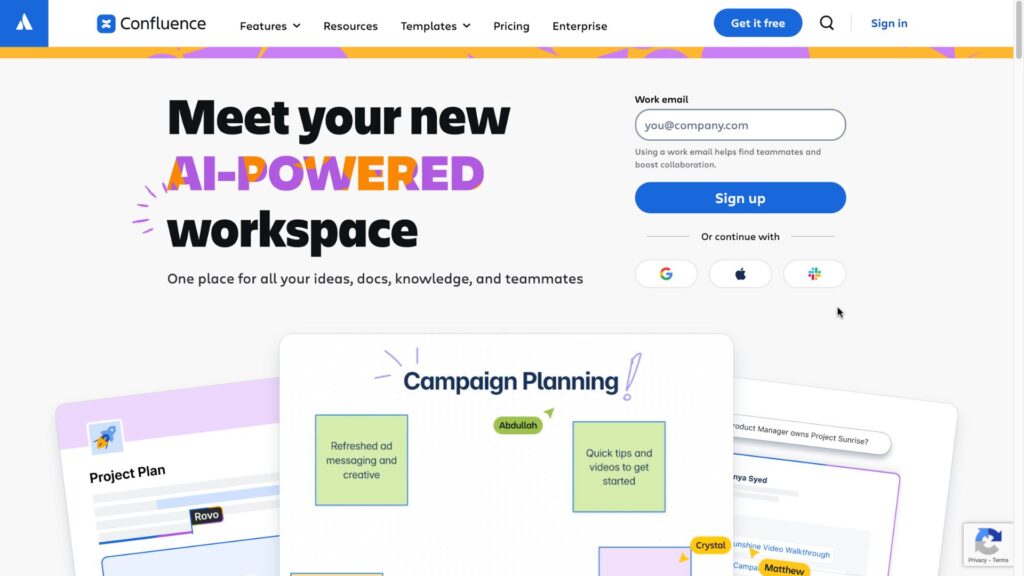
Confluence is an enterprise-grade collaborative workspace that enables teams to create, share, and manage content in a unified platform. Widely adopted across tech, marketing, and product development teams, Confluence provides a centralized hub where documentation, project knowledge, and team collaboration converge in real-time, eliminating information silos and scattered documentation.
Confluence’s standout capability is its seamless real-time collaborative editing that allows multiple users to work simultaneously while tracking all changes through comprehensive page versioning. The platform organizes content using spaces and pages, integrates deeply with Atlassian tools and popular apps, and offers pre-built templates that accelerate content creation.
Pros
- Integrates with popular apps like Slack, Dropbox, and Trello.
- Real-time collaborative editing with multiple users.
- Page versioning tracks and reviews all changes.
- Intuitive drag-and-drop interface accessible to non-technical users.
- Cross-platform compatibility.
Cons
- Higher-tier subscriptions are needed for advanced features.
- Performance can lag with large or complex diagrams.
- Limited functionality in offline mode.
- Advanced features may have a steep learning curve.
>>> See more:
- What Is Business Process Outsourcing (BPO)? Definition & Benefits
- Ecommerce Photo Retouching Services | Boost Image Quality
6. Scribe
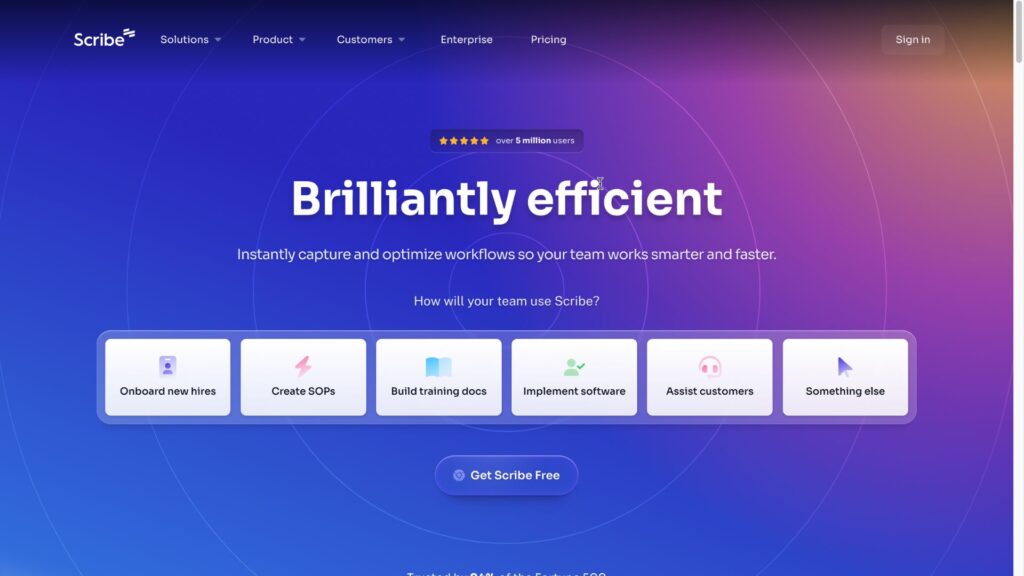
Scribe is an AI-powered documentation tool that automatically creates step-by-step visual guides as you work. Designed for teams in operations, sales, HR, and IT, Scribe streamlines documentation processes by capturing workflows and transforming them into comprehensive instructions without manual writing, saving significant time and effort.
What makes Scribe stand out is its intelligent automation that records your actions and instantly generates detailed guides with screenshots and annotations. The platform allows customization with branding options and automatically redacts sensitive information to maintain privacy, ensuring documentation is both professional and secure.
Pros
- Automatically generates visual guides while you work.
- Intuitive drag-and-drop interface.
- Robust editing and customization options.
- Page templates and annotations available.
- Simplifies process documentation through automation.
Cons
- Custom branding is only available in the premium plan.
- The premium plan may be expensive for some users.
- Free version offers limited features.
- Advanced customization requires a paid subscription.
- Limited offline access.
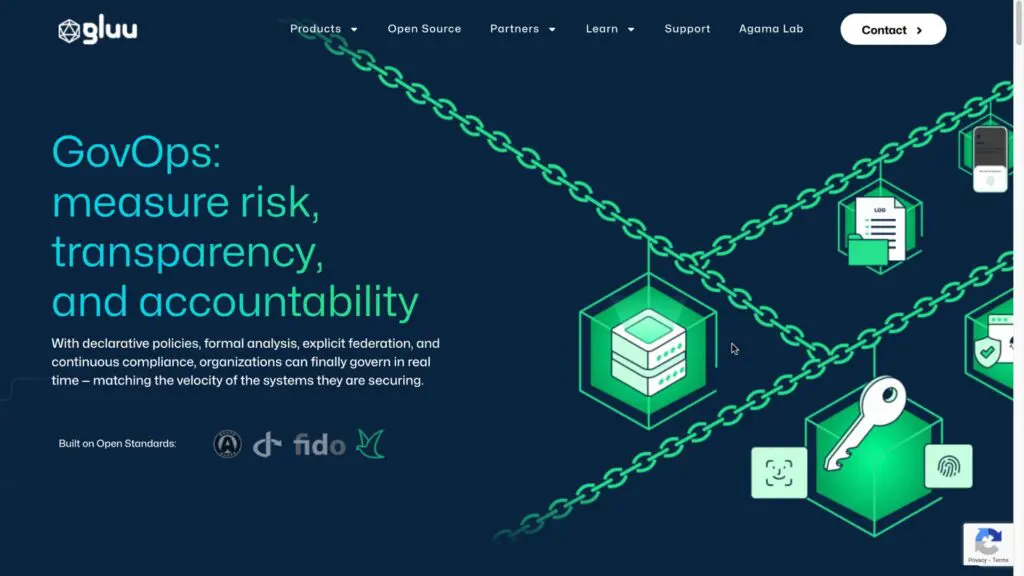
7. Gluu
Gluu is an interactive process documentation tool that enables organizations to create engaging guides and knowledge bases for internal workflow management. Designed for teams focused on internal operations and knowledge sharing, Gluu simplifies process mapping, task assignment, and schedule creation through a built-in process designer that eliminates complex interfaces and technical barriers.
What separates Gluu from competitors is its focus on internal collaboration with interactive guides that enhance knowledge sharing across teams. The platform features regular notification systems that keep team members updated on process changes and offers various permission settings for effective task delegation, ensuring clear accountability and streamlined workflow execution.
Pros
- Built-in process designer for easy task and schedule creation.
- Interactive guides enhance knowledge sharing.
- Regular notifications keep team members updated.
- Various permission settings for effective delegation.
- Streamlines workflows without complex interfaces.
Cons
- Best suited for internal use only.
- Lacks features for sharing knowledge bases externally.
- Limited external collaboration capabilities.
- Not ideal for client-facing documentation.
8. Bit.ai
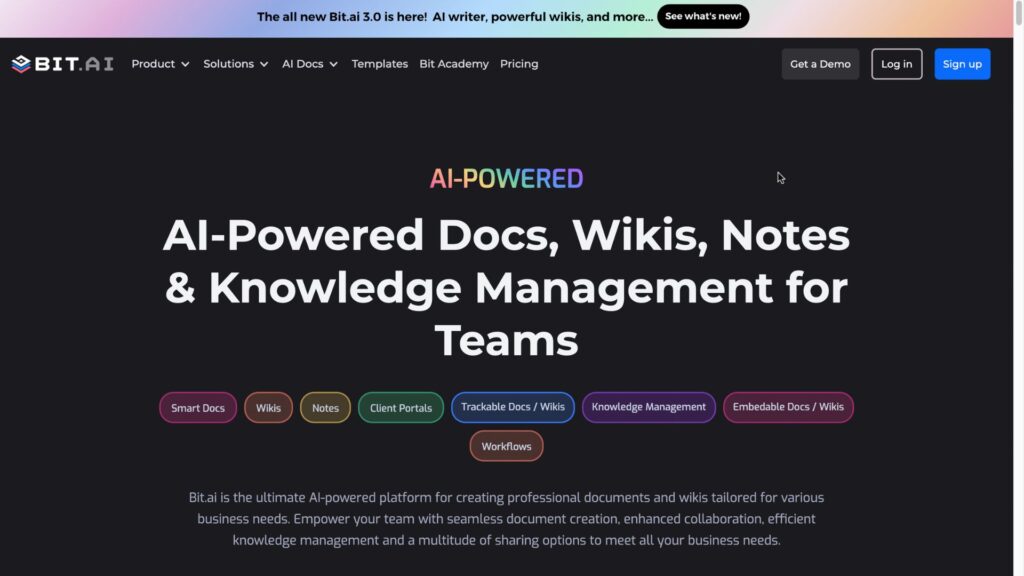
Bit.ai is an interactive documentation tool designed to make team collaboration seamless through rich media integration and real-time engagement. Built for project teams, training departments, and client-facing organizations, Bit.ai combines multiple media types-videos, documents, images, and interactive tutorials—into unified knowledge bases that teams can access and update simultaneously.
Bit.ai’s defining characteristic is its interactivity that allows multiple users to engage with various media formats in real-time within a distraction-free editor. The platform includes client portals for external sharing, interactive wikis for knowledge management, and collaboration features that keep distributed teams aligned on documentation and training materials.
Pros
- Seamless team collaboration features
- Supports multiple media types (videos, documents, etc.).
- Interactive tutorials and wikis.
- Distraction-free editor for focused work.
- Client portals for external sharing.
Cons
- Formatting and design options may not fully meet all needs.
- No free plan for files larger than 5 MB.
- Limited customization compared to some competitors.
- File size restrictions can be restrictive.
>>> See more:
- What Is A Back Office Service? Examples, Benefits, And Cost In 2026
- How to Automate Document Process: A Step-by-Step Guide
9. Heflo
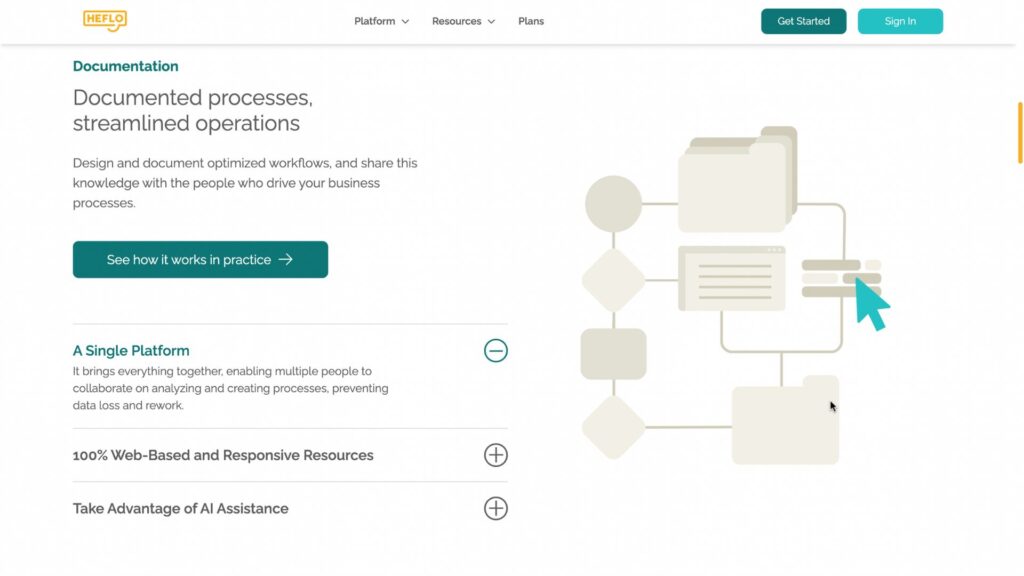
Heflo is a cloud-based process documentation tool that consolidates documentation, publication, approval, and feedback workflows into a single unified system. Designed for organizations seeking streamlined process management, Heflo enables teams to define automated workflows, set tasks with deadlines, and establish team roles while tracking progress through scheduled reporting.
Heflo’s unique advantage is its all-in-one approach, combining process documentation with workflow automation and approval management. The self-service document template editor allows teams to create standardized documentation quickly, while automated workflows with deadline management ensure consistent task progression and clear accountability.
Pros
- All-in-one platform for documentation, approval, and feedback.
- Self-service document template editor.
- Automated workflows with deadline management.
- Team role establishment and progress reporting.
- Cloud-based for easy access.
Cons
- Some users find reporting features restrictive.
- Considered overpriced compared to similar tools.
- Limited third-party app integrations.
- Dynamic flowcharts cannot be updated in real-time.
10. Pell.io
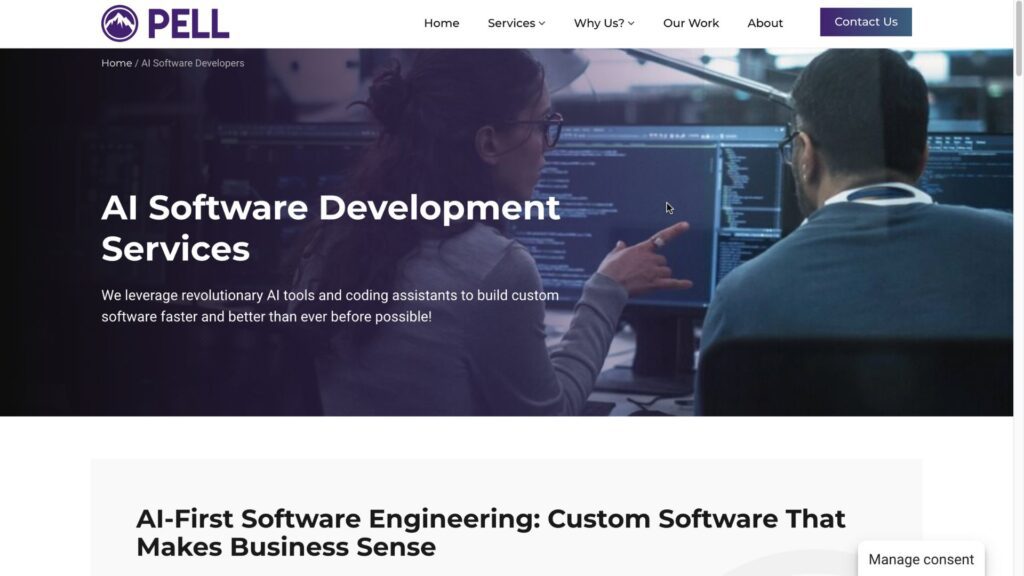
Pellio is a business process management tool designed to document, share, execute, and track processes that enhance organizational productivity. Built for teams requiring rich multimedia documentation, Pellio allows users to enrich process steps with images, videos, files, and HTML objects, creating comprehensive guides that improve understanding and execution.
What differentiates Pellio is its combination of multimedia-rich documentation with personalized dashboards that provide tailored progress monitoring and preset task management. The platform simplifies organizational structure through easy department formation, user management, and permission granting, while offering process reporting that identifies improvement opportunities.
Pros
- Enriches documentation with images, videos, files, and HTML.
- Personalized dashboards for progress monitoring.
- Simple department formation and user management.
- Process reporting to identify improvement opportunities.
- Easy permission granting and access control.
Cons
- Support is only available via email.
- Limited customer support channels.
- May lack real-time support for urgent issues.
- Response times can vary.
11. Whatfix
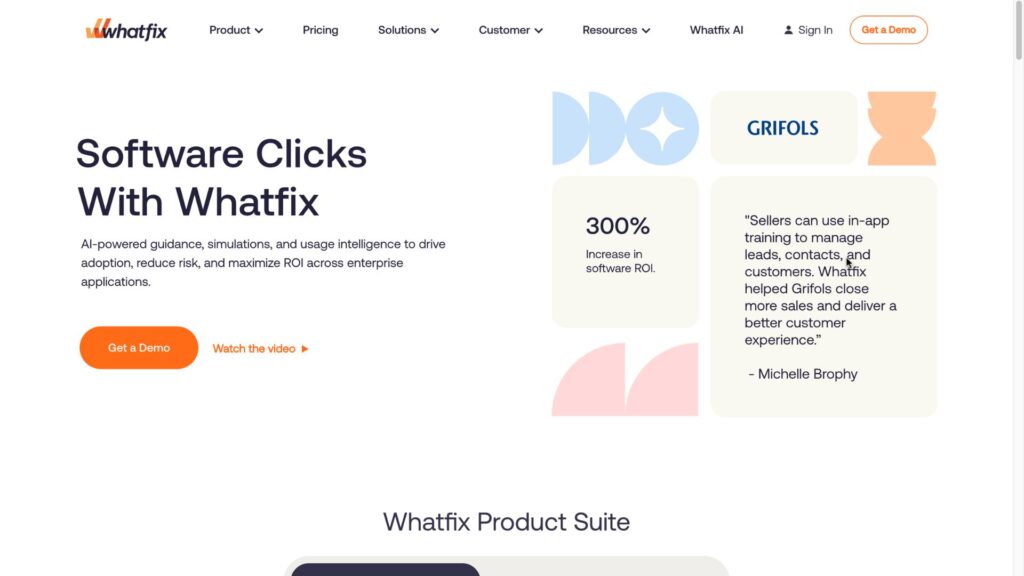
Whatfix is a digital adoption tool that enhances user onboarding and software engagement by embedding documentation directly into applications. Designed for enterprises seeking improved software adoption, Whatfix provides in-app guidance, personalized learning paths, and real-time support that appears exactly when users need it.
Whatfix’s breakthrough innovation is its seamless integration of documentation into software applications through self-help widgets, in-app notifications, and interactive walkthroughs. The platform delivers contextual, step-by-step guidance within workflows while user analytics track progress and measure effectiveness, enabling teams to refine training strategies.
Pros
- Integrates documentation directly into software applications.
- Creates self-help widgets and in-app notifications.
- Step-by-step walkthroughs for better guidance.
- User analytics measure documentation effectiveness.
- Enhances employee participation and engagement.
Cons
- Requires full training to use the tool effectively.
- Editing features and layouts are not straightforward.
- Complex setup process.
>>> See more:
- Outsourcing Data Cleansing: What You Need to Know
- Fashion Photo Retouching: Key Techniques, Benefits, and Tips
12. SmartDraw
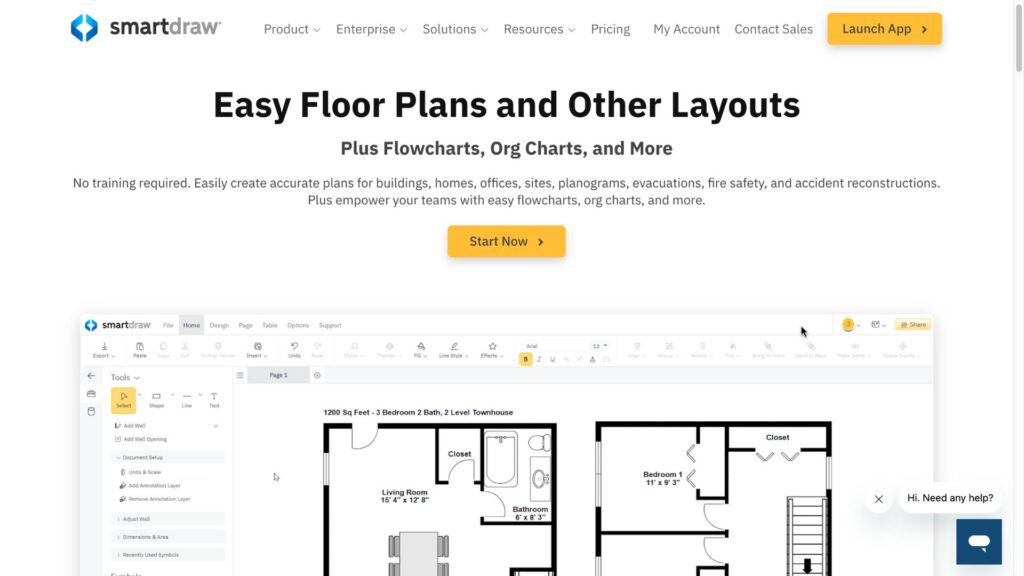
SmartDraw is a specialized diagramming platform built specifically for flowcharting and process visualization. Designed for business analysts, project managers, and teams requiring professional visual documentation, SmartDraw enables users to create flowcharts, organizational charts, mind maps, and complex diagrams with automated formatting that ensures consistent, polished results.
SmartDraw’s core specialization is its powerful automated formatting engine combined with over 70 professional templates for various diagram types, allowing teams to create charts, mind maps, and organizational trees efficiently. The platform integrates seamlessly with Microsoft Office and Google Workspace, making diagram exporting and sharing effortless within existing workflows.
Pros
- Specialized for flowcharting and process visualization.
- Automated formatting saves time.
- 70+ templates for various diagram types.
- Integrates with Microsoft Office and Google Workspace.
- Creates charts, mind maps, and organizational trees easily.
Cons
- Steep learning curve for new users.
- Unwelcoming interface, according to some users.
- Lacks real-time collaboration features.
- Poor customizability compared to competitors.
13. Creately
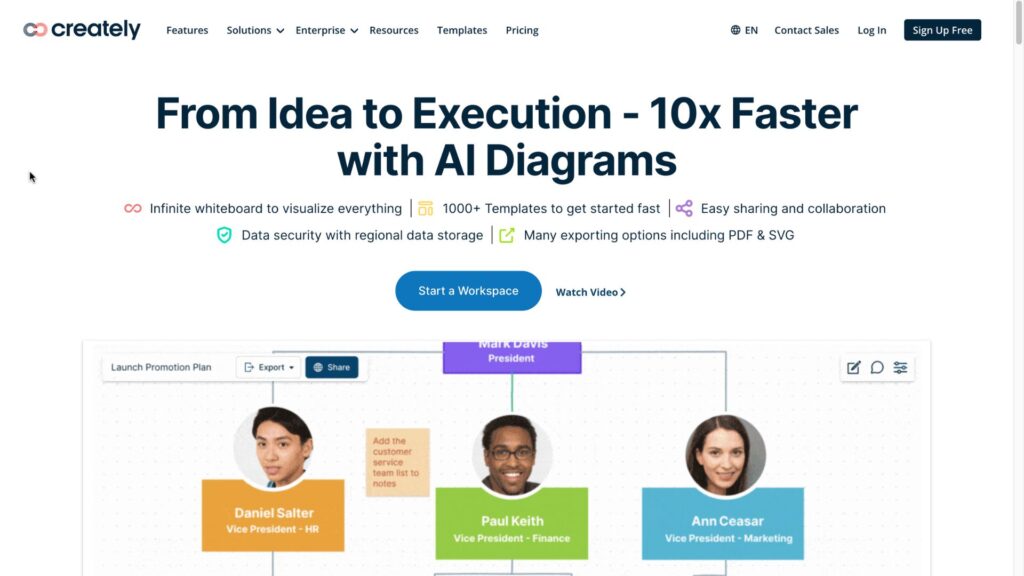
Creately is a visual collaboration platform that enables teams to create professional diagrams, flowcharts, and process maps through an intuitive interface. Designed for project managers, business analysts, and cross-functional teams, Creately combines powerful diagramming capabilities with real-time collaboration features that make complex process visualization accessible to both technical and non-technical users.
What distinguishes Creately is its infinite canvas workspace that supports unlimited collaboration with real-time cursors showing where team members are working. The platform offers 1,000+ professionally designed templates, intelligent formatting that automatically aligns and organizes elements, and a comprehensive shape library that covers everything from basic flowcharts to advanced technical diagrams.
Pros
- 1,000+ professional templates for various diagram types.
- Infinite canvas for large, complex process maps.
- Real-time collaboration with live cursors.
- Intelligent formatting automatically aligns elements.
- Comprehensive shape library for all diagramming needs.
Cons
- Can be overwhelming for simple documentation tasks.
- Premium features require a paid subscription.
- Steep learning curve for advanced features.
- Limited offline functionality.
- Export options may be restricted in free plan.
14. Tettra
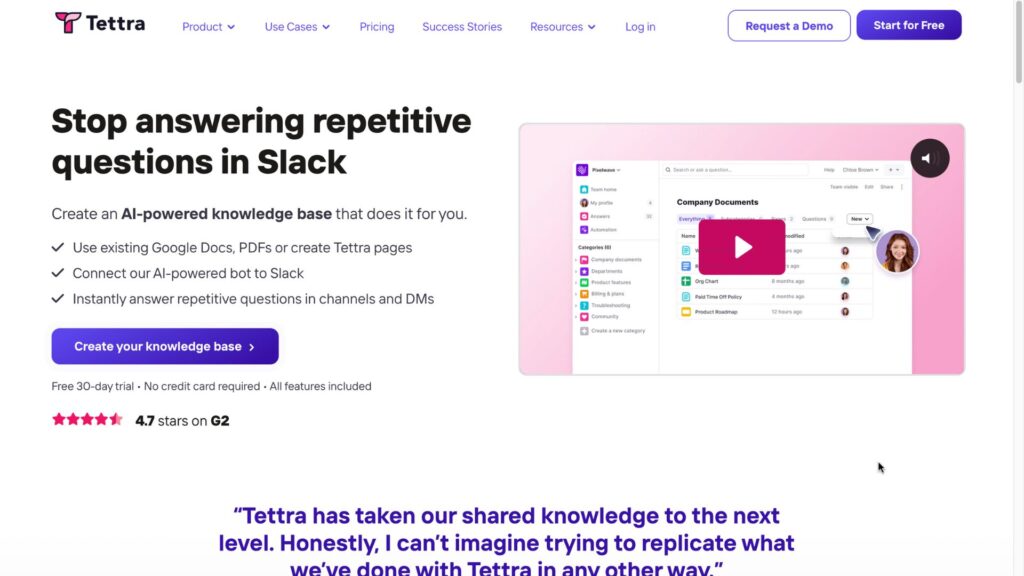
Tettra is a knowledge management platform specifically designed to organize company information and reduce repetitive questions. Built for customer support teams, HR departments, and growing organizations, Tettra creates a centralized knowledge base where teams can document processes, policies, and answers to frequently asked questions, ensuring information is always accessible and up-to-date.
Tettra’s standout feature is its Slack and Microsoft Teams integration that brings knowledge directly into team conversations. The platform includes AI-powered content suggestions that recommend relevant documentation based on questions, request management to identify knowledge gaps, and verification workflows that ensure documentation remains accurate over time.
Pros
- Seamless integration with Slack and Microsoft Teams.
- AI-powered content suggestions for relevant documentation.
- Request management identifies knowledge gaps.
- Verification workflows ensure accuracy.
- Simple, intuitive interface for quick adoption.
Cons
- Limited customization options for branding.
- Advanced features require higher-tier plans.
- Not ideal for complex process mapping.
- Focuses primarily on text-based documentation.
- Limited visual diagramming capabilities.
15. Floik
Floik is an interactive product demo and process documentation tool that transforms workflows into engaging, step-by-step guides. Designed for product teams, customer success departments, and training professionals, Floik enables organizations to create interactive product walkthroughs, video tutorials, and comprehensive documentation that showcases products and processes in action.
What makes Floik unique is its ability to capture product workflows and automatically generate multiple content formats- interactive demos, video tutorials, and step-by-step guides- from a single recording. The platform includes customizable branding, lead capture forms for demos, and analytics that track viewer engagement and identify where users drop off or need additional support.
Pros
- Creates multiple content formats from one recording.
- Interactive demos showcase products effectively.
- Customizable branding for professional presentation.
- Lead capture forms for marketing purposes.
- Analytics track viewer engagement and behavior.
Cons
- Primarily focused on product demos rather than general process documentation.
- Requires learning to maximize all features.
- Premium features are locked behind paid plans.
- May be overkill for simple internal documentation.
- Limited offline access to created content.

>> See more:
- What Is a Document Management System (DMS)?
- What Is Digital Document Transformation? A Practical Overview
16. Nintex
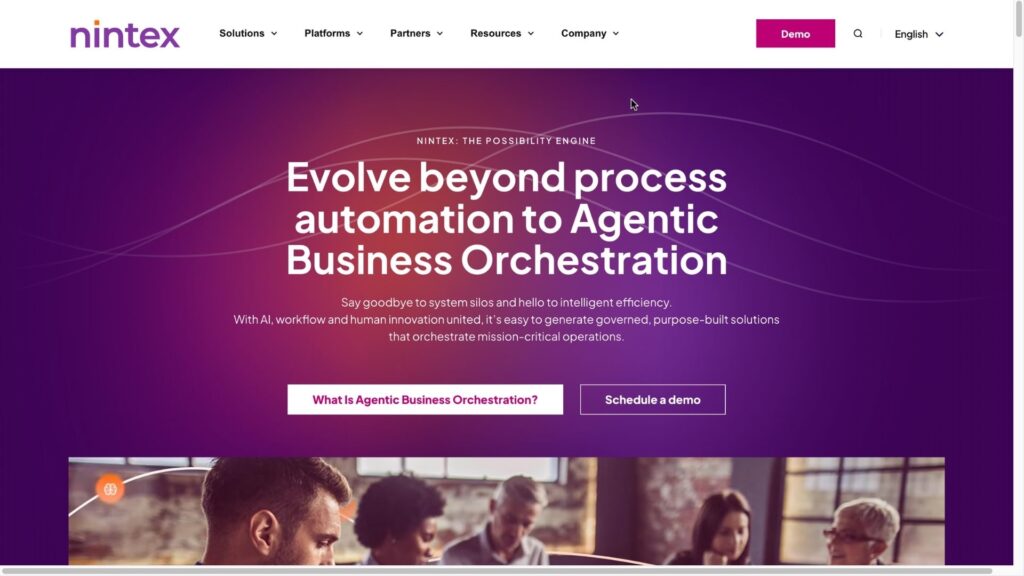
Nintex is an enterprise-grade process management platform that combines process mapping, workflow automation, and document generation into a unified system. Designed for large organizations across healthcare, finance, and government sectors, Nintex enables teams to visualize complex processes, automate repetitive workflows, and maintain compliance through comprehensive process documentation and monitoring.
Nintex’s enterprise strength lies in its powerful workflow automation engine that connects process documentation directly to executable workflows. The platform features drag-and-drop process mapping, integration with major enterprise systems (SharePoint, Salesforce, SAP), advanced analytics for process optimization, and robust compliance tracking that meets regulatory requirements across industries.
Pros
- Powerful workflow automation engine.
- Integrates with major enterprise systems.
- Advanced analytics for process optimization.
- Robust compliance tracking capabilities.
- Comprehensive process mapping and automation in one platform.
Cons
- Expensive for small businesses and startups.
- Steep learning curve for non-technical users.
- Requires significant implementation time.
- Complexity may be excessive for simple documentation needs.
- Limited flexibility in customization without technical expertise.
17. Tallyfy
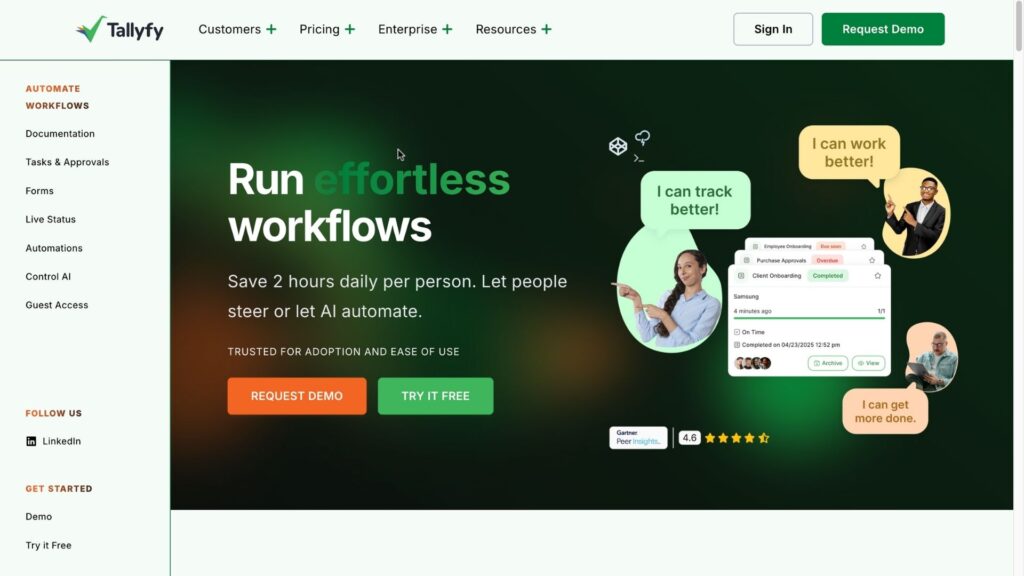
Tallyfy is a workflow automation and process documentation platform that transforms standard operating procedures into trackable, executable tasks. Built for operations teams, compliance departments, and service organizations, Tallyfy eliminates the gap between documentation and execution by converting written processes into automated workflows that team members can follow, complete, and track in real-time.
Tallyfy’s defining capability is its process-to-workflow conversion that turns documented procedures into actionable task sequences with automatic assignments, deadline tracking, and progress monitoring. The platform includes conditional logic for complex processes, client-facing forms for external collaboration, and comprehensive audit trails that document every process execution for compliance purposes.
Pros
- Converts documentation into executable workflows.
- Automatic task assignments and deadline tracking.
- Conditional logic for complex process flows.
- Client-facing forms enable external collaboration.
- Comprehensive audit trails for compliance.
Cons
- Pricing can be high for smaller teams.
- Learning curve for setting up complex workflows.
- Limited customization in lower-tier plans.
- May require time investment for initial setup.
- Advanced features require premium subscription.
18. SweetProcess
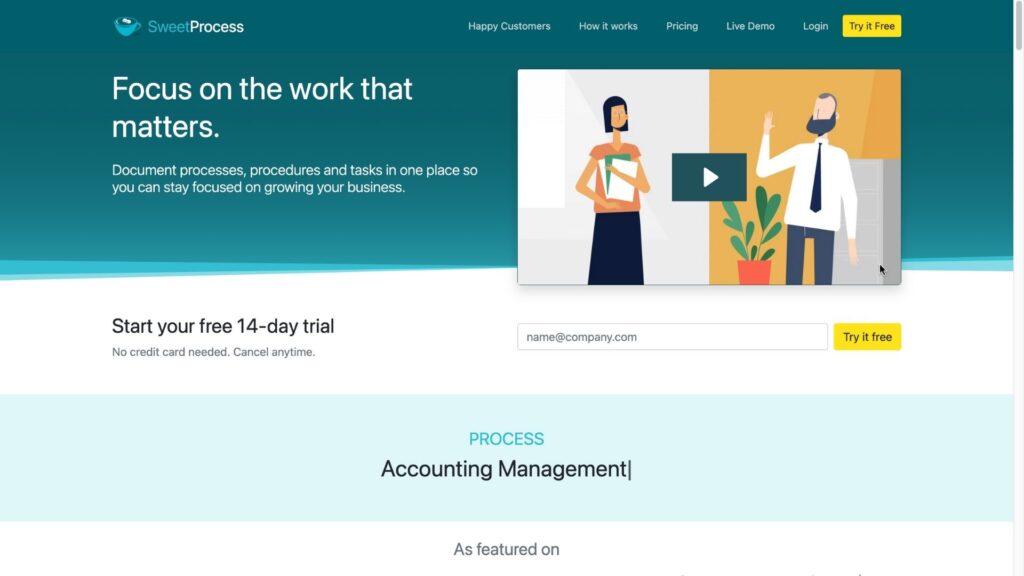
SweetProcess is a straightforward process documentation tool focused on creating, organizing, and sharing standard operating procedures, policies, and processes. Designed for small to medium-sized businesses seeking simplicity without sacrificing functionality, SweetProcess provides teams with an intuitive platform to document institutional knowledge and ensure consistent task execution across the organization.
SweetProcess’s primary advantage is its simplicity and ease of use, allowing teams to quickly document processes without extensive training or technical expertise. The platform features task assignments with automated reminders, team acknowledgments to confirm policy understanding, process templates for common workflows, and approval workflows that maintain quality control while enabling rapid documentation deployment.
Pros
- Simple, intuitive interface requires minimal training.
- Task assignments with automated reminders.
- Team acknowledgments confirm policy understanding.
- Process templates for quick deployment.
- Approval workflows maintain quality control.
Cons
- Limited advanced features compared to enterprise tools.
- Basic visual diagramming capabilities.
- Lacks robust integration with enterprise systems.
- May not scale well for very large organizations.
- Limited customization options for branding.
What Is Business Process Documentation Software?
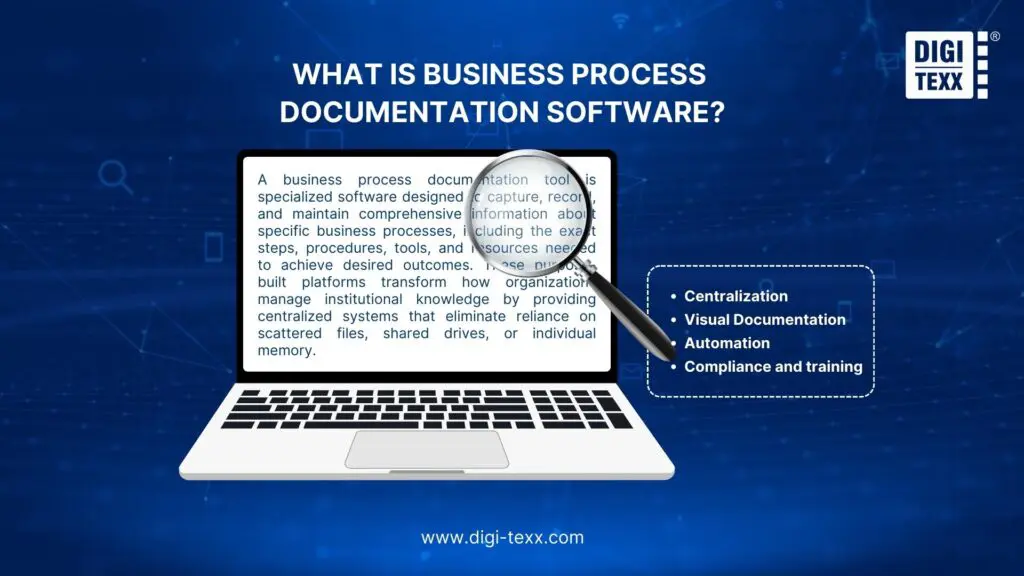
A business process documentation tool is specialized software designed to capture, record, and maintain comprehensive information about specific business processes, including the exact steps, procedures, tools, and resources needed to achieve desired outcomes. These purpose-built platforms transform how organizations manage institutional knowledge by providing centralized systems that eliminate reliance on scattered files, shared drives, or individual memory.
4 Key capabilities and features of these tools include:
- Centralization: Serves as a single source of truth for storing standard operating procedures (SOPs), policies, contracts, and critical business documents – eliminating reliance on scattered files, shared drives, or individual memory.
- Visual documentation: Enables process mapping through flowcharts, diagrams, BPMN models, and step-by-step visual guides that make complex workflows easy to understand and follow.
- Automation: Advanced tools automatically capture and document workflows by recording user actions in real-time, generating step-by-step guides with screenshots, instructions, and annotations – significantly reducing manual documentation time.
- Compliance and training: Ensures consistent task execution through structured review cycles, version control, and approval workflows – supporting quality control, regulatory compliance, and accelerating employee onboarding with clear, accessible documentation.
In essence, business process documentation tools bring structure, visibility, and control to organizational knowledge, helping teams avoid costly mistakes, maintain operational consistency, preserve institutional expertise, speed up training cycles, and ensure compliance across all operations while transforming complex workflows into actionable instructions that enhance overall business performance.
>>> See more:
- Top 7 Document Scanning Software for Businesses
- What Is Automated Data Extraction? Guide, Benefits & Tools
Benefits Of Business Process Documentation Software
Business process documentation tools play a crucial role in improving organizational efficiency by offering a centralized platform for managing workflows, policies, and procedures. Here are some of the key advantages:
- Improved operational efficiency: By providing clear, step-by-step instructions, these tools reduce errors and save valuable time, enabling smoother task execution.
- Centralized knowledge & retention: Critical information is stored in one place, safeguarding against knowledge loss when employees leave and making it easier to update processes.
- Consistency and quality control: Ensures that tasks are consistently performed the same way every time, enhancing the quality and uniformity of output across the organization.
- Faster onboarding and training: Simplifies the training process for new employees, allowing them to quickly grasp workflows and procedures, thus reducing training time.
- Enhanced compliance and risk management: Facilitates tracking and maintaining compliance with industry regulations, helping businesses meet standards and minimize operational risks.
- Increased transparency & collaboration: Improves visibility into workflows, enabling teams to collaborate more effectively and make informed decisions.
- Facilitates scaling and optimization: Identifies bottlenecks and inefficiencies within processes, helping businesses improve and scale their operations as they grow.
>>> See more:
- Construction Invoice Reconciliation: Best Practices, Software & Outsourcing
- Healthcare BPO Services – Cost Optimization & Improve Care 2026
Types Of Process Documentation Tools
Your requirements may vary by team or sector; for example, some may need specialized tools to help meet their goals. Here are 4 common types of process documentation tools for capturing business processes:
- Standard Operating Procedure (SOP) Software: Process documentation examples in healthcare or finance, SOPs (standard operating procedures) are vital. SOP software provides checklists with template compliance, versioning, and template control, containing all necessary documents.
- Documentation Generators and Screen Capture Tools: Capture tools compile workflows, processes, generating documents, images, and even films. With Scribe, for example, you can create walls with steps automatically. Enable the application, carry out the procedure, and voila, it outputs everything that is required for performance: text, links, screenshots, and sign explanations within minutes.
- Process Mapping Tools: The work that involves process mapping or flowchart software diagrams, workflow procedures in a visual form. When dealing with activities that involve multiple steps, options, or branches, they are useful. Very often, a software of this kind comes with a collaborative component, automation, and aids in optimizing the process planning and enhancement.
- Knowledge Management Systems: These software solutions are lacking when it comes to archiving, as they do have the means to capture such information, distribute it to everyone in the organization, as well as classify with any aids to process related contents.

>>> See more:
- An Overview of Document Processing Company: What You Need to Know
- How Automated Invoice Processing Saves Time and Reduces Errors?
Choosing The Right Business Process Documentation Tools
Selecting the right business process documentation tool is crucial for enhancing team productivity and ensuring accurate documentation of workflows. 5 Factors to consider when choosing a business process documentation tool include:
- Ease of use & adoption: Intuitive, user-friendly tools encourage consistent adoption. Look for simple interfaces and clear instructions that enable quick team onboarding.
- Collaboration & access: Choose tools offering real-time editing, role-based permissions, and mobile access so teams can collaborate seamlessly across locations and devices.
- Integration capabilities: Select tools that integrate with your existing systems (Slack, Jira, Google Workspace, CRM platforms) to enhance workflow efficiency without disruption.
- Version control: A robust version control system tracks changes over time, maintains update history, ensures accuracy, and streamlines the approval process for revisions.
- Searchability: Powerful search capabilities enable quick access to specific processes and documents, saving time and improving efficiency when retrieving critical information.
>>> See more: Understanding Intelligent Document Processing with DIGI-TEXX
Top Process Documentation Software Trends for 2026
Based on a comprehensive analysis of vendor announcements, feature releases, and platform updates from major process documentation software providers, these are the key trends emerging in 2026:
- AI-Powered insights: Many vendors are now incorporating artificial intelligence to provide deeper insights into workflow performance and user behavior. This helps teams pinpoint inefficiencies and streamline their processes.
- Real-Time collaboration: More tools are supporting real-time collaboration, allowing multiple users to simultaneously edit and comment on documents. This feature has become essential for remote teams, ensuring ongoing productivity and alignment across members.
- Interactive guides: There’s a rise in the development of interactive, step-by-step guides designed to improve user training and onboarding. These guides help users grasp complex processes more intuitively, minimizing the need for lengthy training programs.
- Enhanced security features: As data security becomes increasingly critical, vendors are focusing on offering stronger protections such as encryption and role-based access controls. These features help secure sensitive data, ensuring compliance with industry regulations.
- Customizable workflows: A growing demand for customizable workflows is driving vendors to offer more flexibility in process management. This enables businesses to adapt the software to their specific needs, ensuring the tool is aligned with their unique business requirements.
>> See more:
- Top Cloud Document Processing Solutions to Streamline Your Business in 2025
- Common Errors in Handwriting Recognition & How to Fix Them
Frequently Asked Questions About Business Process Documentation Tools
What Are The Risks Of A Lack Of Process Documentation?
The absence of process documentation can lead to inconsistent performance, challenges in onboarding new employees, and potential compliance issues. It can also create inefficiencies, negatively impacting overall productivity. Properly documenting processes helps minimize these risks and ensures more streamlined and effective operations.
What Is The Best Process Documentation Tool?
Top business process documentation tools you should consider: Tango, Lucidchart, Process Street, Document360, Confluence, Scribe, Gluu, Bit.ai, Heflo…
How Do You Document Your Business Processes?
Documenting business processes involves a clear, step-by-step approach to ensure accuracy and usability. Here are the key steps in effective process documentation:
- Step 1 – Define the scope: Clearly identify which process you are documenting and its boundaries.
- Step 2 – Understand your audience: Know who will use the documentation so you can tailor the content to their needs and level of expertise.
- Step 3 – Identify key stakeholders: Determine the people involved in or responsible for the process.
- Step 4 – Gather accurate information: Collect details through interviews, observations, and existing materials.
- Step 5 – Organize the content: Structure the process logically from start to finish.
- Step 6 – Write clear instructions: Use simple, concise language to describe each step.
- Step 7 – Add visuals: Include flowcharts, diagrams, or screenshots to improve clarity.
- Step 8 – Review and get feedback: Validate the documentation with stakeholders and refine it based on their input.
Can Process Documentation Tools Integrate With Other Business Software?
Yes, most process documentation tools offer integration with popular business software like Slack, Google Workspace, Trello, and Jira. These integrations help streamline workflows, improve collaboration, and boost overall productivity by allowing seamless communication and data sharing between platforms.
Process documentation software is essential for modern organizations seeking to streamline operations, enhance productivity, and maintain consistency across workflows. By automating documentation creation, centralizing knowledge, and facilitating collaboration, these tools transform how teams capture and share institutional knowledge.
However, while business process documentation tools help capture workflows, many companies still struggle with time constraints, limited resources, and maintaining consistency across their documentation efforts. The challenge often lies not just in having the right tools but in implementing comprehensive documentation strategies that align with organizational goals.
DIGI-TEXX provides professional back-office support services that help organizations standardize processes, minimize operational risks, and scale efficiently. Our experienced team works alongside your internal staff to ensure documentation processes are not only created but properly maintained, updated, and integrated into daily operations. Whether you need assistance with process documentation, workflow optimization, or comprehensive back-office management, DIGI-TEXX delivers the expertise and resources to transform your operational efficiency.
If you have any questions or would like expert advice on data analytics services, please feel free to contact us using the information below.
DIGI-TEXX Contact Information:
🌐 Website: https://digi-texx.com/
📞 Hotline: +84 28 3715 5325
✉️ Email: [email protected]
🏢 Address:
- Headquarters: Anna Building, QTSC, Trung My Tay Ward
- Office 1: German House, 33 Le Duan, Saigon Ward
- Office 2: DIGI-TEXX Building, 477-479 An Duong Vuong, Binh Phu Ward
- Office 3: Innovation Solution Center, ISC Hau Giang, 198 19 Thang 8 street, Vi Tan Ward